Compassionate Action

The Legacy of My Grandmothers: Bringing Their Voices to Light

There are long held secrets on both sides of my family. One I’ve known about for a long time but hadn’t readily understood the whole story in context. The other I learned of in October 2023. It’s taken me several months to piece elements together and come to a horrifying conclusion.

I do want to alert you that what I’m about to share may be too graphic for some in painting these terrible narratives. They derive of a time, rising up through poverty and lack of choice. But it could just as well be told in present times and for what else could come if we allow it.

I’m going to disclose these family secrets here. Why now? Why publicly? It’s a time sensitive matter of life and death. I feel a responsibility. These tragic stories need be told and the women involved—my grandmothers—and others like them honored. My 92-year-old mother is urging me to do so. One of the stories is about her mother.

I never knew either of my grandmothers. They were names to me with no attachment. But they’ve come alive as I’ve researched their lives and deaths. I want to say their names and grieve for them, what they went through and the generational trauma living in the family line.


Jewel Nadine Whitley, née Smithart

Sisters BB (left) and Blackie (right), circa 1930.

My maternal grandmother went by her nickname Blackie. She was born in Leesburg, Mississippi in 1912, one of six children. The family had been there for generations doing well for those times. But in 1913 they picked up and fled due to serious encounters and death threats from the Ku Klux Klan because they employed Black people at their businesses, perhaps a story for another time. They landed in east Texas where eventually Blackie met her husband, Carl. They made their life in the still tiny towns of Jacksonville and then Palestine. My mother Sue was born in 1932, an only child. Times were exceedingly hard in those rural communities, more so than elsewhere. There was little to no work. If there was, pay was a pittance. Blackie worked at a laundry. Carl’s work in those early days is unknown. My mother remembers going to bed hungry much of the time. They lived below the poverty line. My mother told me she thought it was normal—everyone living a hand-to-mouth existence. No future.

Imagine worrying through the day, kept up at night with how to make ends meet, what to scrape together to make a meal, which meal(s) to skip that day, how to keep your growing child in clothes. What if something happened and there’s no money to make it right and nonexistent resources? Maybe you know those who are in those kinds of situations or have been there yourself.

As if that wasn’t bad enough, it’s this next part that so twists me up inside. My mother doesn’t know when what I’m going to tell you next occurred. She only found out at all because her favorite aunt BB told her sometime after Blackie passed.

Have you heard those old stories of women aborting their pregnancy with a coat hanger and didn’t think they were real? I know in my heart Blackie only undertook that unspeakable action because she felt family circumstances held no other choice. Step into her life discovering another child was on the way: the desperation, sadness, hopelessness, absolute despair, guilt. This was not an act taken lightly. I can only imagine the courage it took. Where did it happen? How? I have a sense she was alone in the bathroom, no help then or in the aftermath…a secret she long kept to herself until she disclosed it to her sister BB. I stand in her shoes in that time and it tears me up.

Whether her uterus managed to heal or it was permanently destroyed, we don’t know. But at some point, Blackie began to feel unwell, which probably developed over time. However, by age 36 it was clear it was something serious. We don’t know if she went to a doctor at the outset. There was probably no money. Or did she wait until her pain and bleeding was unbearable? At age 38 Blackie was finally diagnosed with uterine cancer.

Did the way the abortion occurred cause the cancer? It is very rare for uterine cancer to appear in one so young. If the disease were to present, most experienced it after age 50. I tend to believe there was a link…the physical and emotional wounding, and stress likely took its toll. My mother told me Blackie was emotionally absent.

When I think about the treatment and its side effects Blackie endured, I shudder. Radium capsules were placed in her uterine cavity. My mother remembers seeing them, a string tail at one end to pull them out. In my mind I saw a teenaged girl-sized tampon-like apparatus. They were unsuccessful. I’m sure it added to her pain by burning her up inside. Blackie suffered another four years, passing at age 42.


Emma Mae Woody, née Heard

Emma, date unknown.

My father Glenn was a motherless child born into the Dustbowl in the Texas panhandle on January 11, 1932 in Dalhart, the youngest of seven children. The only thing we knew about Emma was her death from undisclosed complications of childbirth. Nothing else. My father never even saw his mother’s face. The only photograph that exists—faded sepia—is of Emma walking down a barren dirt road to nowhere. She’s unrecognizable, the image taken from such a distance. It’s undated. In genealogy charts researched for us by a friend, we learned she was born in October in 1887 in Arkansas, no town or county given…and nothing whatsoever available about her family line. We don’t even know who her people were.

My knowledge base changed when my cousin David and his wife came to visit my mother and me in October 2023. David had been extensively researching the Woody family genealogy and brought with him a large laminated family tree. He also said he’d come across Emma’s death certificate and gave me a copy. He noted it was exceptional due to the notes regarding death and attendance were handwritten by the doctor whose signature was indecipherable. The document, now close to 100 years old, is washed out and hard to read. Thankfully, the handwriting is much larger than the type. The first thing that popped out to me in contributing causes was “retained placenta.” What is that? None of us present had heard of this. For the time, I set the family tree and death certificate aside as we returned to visiting.

When I pulled it out again a few weeks later, I first researched “retained placenta”.  

Delivery of the placenta is vital in preventing severe complications from developing. In normal circumstances, the placenta naturally detaches on its own and is delivered from the uterus. However, when the placenta fails to detach and be delivered within 30 minutes after the delivery of the baby, it is referred to as a retained placenta. Sometimes, an entire placenta is retained while other times, only part of a placenta is retained. Both can pose serious risks to the mother. The entire placenta must be delivered.

If it’s not removed in a timely manner, the risks are: serious infection, hemorrhage, internal bleeding, damage to the uterus, sepsis leading to septic shock.

I began to feel queasy. I returned to the death certificate. Under cause the doctor had written “septicemia”—the medical term for blood poisoning. Then I read the doctor’s full statement on contributing causes: Retained placenta. Delivery unattended on account of bad roads.

I understand it was common to have home births at that time, many without physicians or even a midwife. Of course, home births happen today but most have a back-up plan if things go awry with the birth. There was a gap of seven years between my dad and the twins closest in birth. He had four brothers and two sisters. But this tells me my grandfather and all siblings still lived at home then.

Did no one seek help? I looked at the death certificate again. The doctor noted he attended Emma from January 25 until February 18. That’s the day she died at age 45. My father was born January 11! She received NO treatment until 2 weeks after the birth and hung on 37 days before passing. There can be no doubt Emma suffered horribly. I don’t care what the roads were like! I would have gone for help. Wouldn’t you? Two weeks?

I was enraged. Underneath is a deep sadness. I cannot relay this story without crying or getting a catch in my voice and feel my anger arising. I cannot think about this much before I begin to spiral.

All my father’s immediate family have been long gone. I started sending emails out to cousins asking if they’d ever heard any stories from their parents about Emma growing up or if anyone had any photos of her. Nothing. It’s as though she’s a ghost, any trace of her swept away with the exception of that telling death certificate.

I feel like Emma is reaching up from the grave, wanting someone to know that she mattered.

In my mind, what happened was criminal negligence committed by my grandfather James Woody. There’s a small chance I wouldn’t have hopped on this accusation and left it to ignorance. But there’s more. When my dad was a toddler my grandfather farmed him out to a childless couple down the road only too happy to take him in. When my father was age four, the couple asked my grandfather if they could adopt him. It’s quite likely his first family didn’t come see him. My father had no memory of that happening.

When my grandfather showed up at the couple’s house he was loaded for bear. The husband sent my father to hide under the bed. I can imagine the yelling going on outside giving warning. My grandfather killed the husband, beating him about the head. His fists held brass knuckles. Then he took my father back to his birth home. He was never charged. The claim was made that when the husband opened the door, he had a rifle.

My father suffered from the trauma of witnessing that incident his entire life, being motherless, and ongoing abuse by his father. It affected his life and those of us close to him. All of this could possibly have been avoided had Emma received timely adequate care for the retained placenta. Most survive when it’s addressed as required.

My grandfather was 60 when my dad was born. There was a first family also with seven children. Their mother Luiza died at age 40. My cousin and I had a consultation about the dates Luiza gave birth to their last child Margarett, and the perplexing length of time from the birth and then the deaths of mother and child. David said, “From the birth/death date proximity of Margarett, I’m led to assume complications from childbirth led to death of mother and child.  However, I have no factual support on that, only supposition.  It appears possible that both JM Woody’s wives may have died in relation to childbirth.” He could find no death certificates. I’m glad I never knew this grandfather. He died alone in his cabin by his own hand at age 80—two weeks before I was born.

My father passed in April 2022. I would not have told this story prior to his passing, even if I’d known it. He would not have been able to endure it.


One might say that was so long ago, a frequent occurrence. Such things happen. I’m saying, it didn’t have to be that way—ever. It boils down to women’s status. Have times changed? I was aghast with the results I uncovered about maternal mortality rates. Not all those years ago…today.

We’ve been in a maternal healthcare crisis all along—and it’s getting worse by the year. How can we be thought of as one of the richest countries when the US is 55th in the world in maternal mortality—as designated by a 2020 WHO report—way up there with developing countries, the worst of any developed nation? And the CDC documents Women of Color are nearly three times likelier than White women to die during childbirth. We don’t take care of our own.

Women have the right to live safe, empowered lives making decisions that are right for them and their families…and have the support to do so. This is not a political statement. This is reality. We cannot return to the Dark Ages. We must go toward The Light.


Please feel free to share widely. It matters.
Categories: Compassionate Action, Global Consciousness, Women's Rights | Tags: , , , , | 11 Comments

Q’ero Relief: Food Delivery for Ccochamocco

I’m going to provide some background before launching into my update for anyone reading of this undertaking for the first time. Kenosis Spirit Keepers, the nonprofit I founded in 2007,  began to fundraise back in early April to provide emergency COVID-19 relief for the Hatun Q’ero village of Ccochamocco, where my close relationships have developed since the mid-90s. I love these people. The village is quite isolated at 14,500’ high in the Peruvian Andes, and Indigenous lands in the Cusco Region had been closed by the Peruvian government.

Who thought the pandemic would last for so long and intensify? The timeline kept slipping again and again as to when quarantines would end in the Cusco Region and Indigenous lands would reopen. We’d been ready since June to make the food delivery. But it was not to be. All I could think of was how their food supplies must be dwindling away.

Some have been cavalier about the Q’eros’ predicament saying they’ve survived for a thousand-plus years that way. Sorry. I can’t accept the image that kept playing in my mind of my godson, his and other families, children and elders being hungry, only having potatoes to eat and then those diminishing. That’s exactly what happened. By October when lands finally opened and it became possible to travel into the high mountain villages, potatoes had been their sole dietary choice for quite a while. I’m thankful they at least had that.

See the full report of our effort for Ccochamocco, plus the Hopi villages of Moenkopi and Shungopavi in northern Arizona. Scroll down to the portion on Q’eros after Hopi.

Now on to happy news…

First, I want to express great gratitude for all the donors over these months. Because of you, we had $7000 to pay for food and expenses to get the goods up to the waiting villagers. This kind of money goes a very long way in Peru, as you’ll discover in a moment.

Second, I really want to recognize my Q’ero liaison Santos Machacca Apaza. A lot of times, those people who quietly operate in the background but who do all the legwork to get things done—make things actually happen—are taken for granted. I don’t. As soon as lands reopened, Santos made the long trip from Cusco to Ccochamocco to consult with the community on what they needed, then went to a number of merchants in Cusco to secure supplies and got the best price. Very time consuming, along with hiring a large truck, helpers and everything else, including keeping me apprised. Clearly, if he wasn’t so willing and trustworthy, we couldn’t have gotten this done.

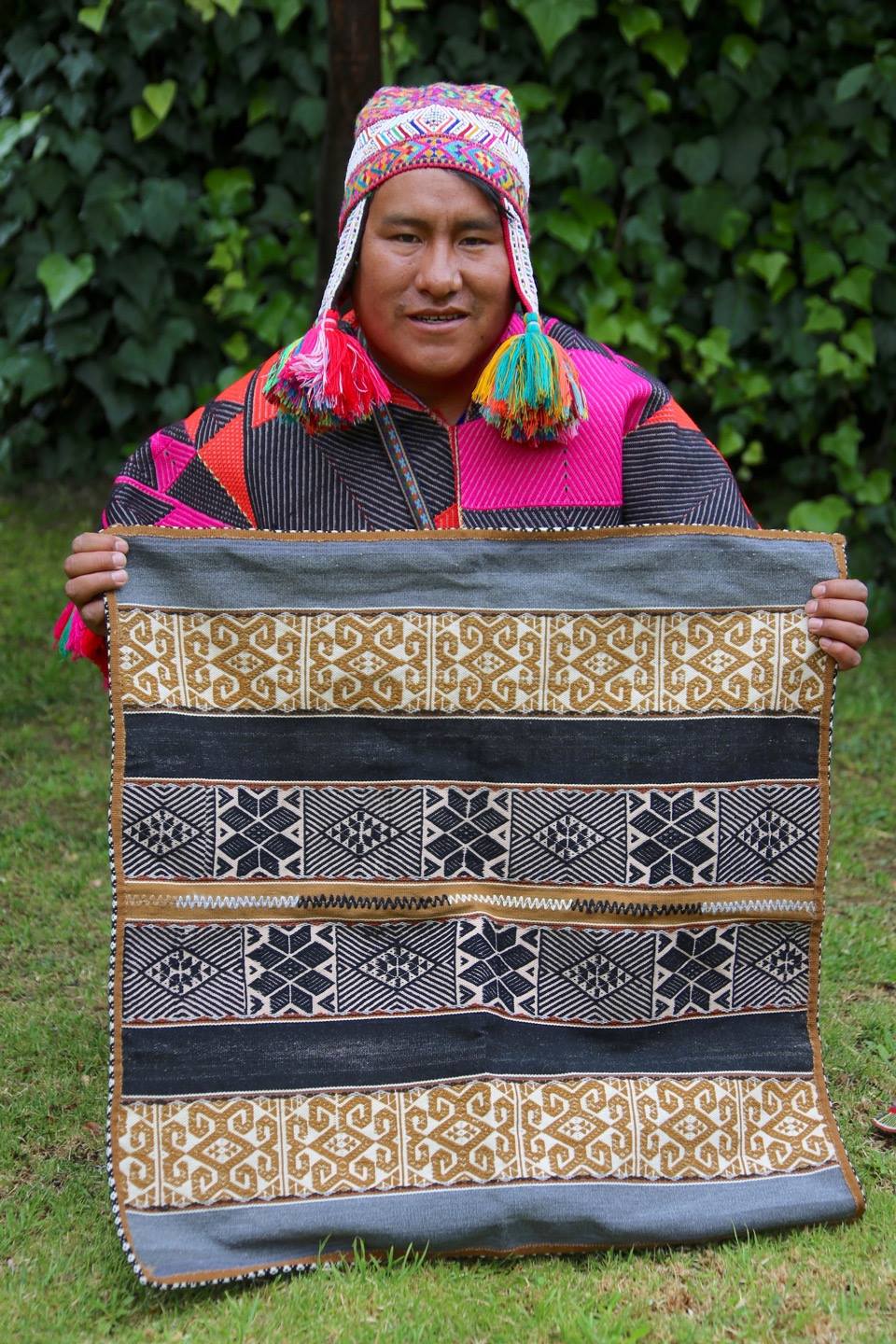
Santos Machacca Apaza, my Q’ero liaison, showing one of his wife Remigia’s weavings.

It was a 3-day operation from first load to delivery into the hands of the families—not counting all the prep beforehand. Santos documented it all with photos and videos. Here are some.

This first video is the only one with English. The rest are in the Q’ero dialect with a few words of Spanish sprinkled in periodically. Santos narrates, expressing the gratitude of our Q’ero friends, telling us 54 families will be fed now for months as a result of what they’ve received, visible in this wide circle before each family and more to the far side of the video pan. He thanks all donors and, if you listen closely, at the last pass through the circle you can hear some of them calling out in thanks to Pachamama (Mother Earth) and Apu Wamanlipa, the sacred mountain that watches over Ccochamocco.

This next video is a little wonky but I wanted to share it. This is Juan Machacca Paucar, the current president of Ccochamocco, a responsibility that rotates every year or so. He wants to show us all the food each family received: rice, flour, sugar, cooking oil, quinoa, tuna, soups, pasta, lentils, oatmeal, condensed milk, salt, soap and a few other things I can’t identify.

Just as when we come together for despacho ceremony, Q’ero friends place importance on standing, speaking sincere words of welcome and letting us know how they hold us in their hearts. First, you see Modesto Machacca Apaza, father to Miguel Angel, my godson. Next is Carmina Zamata Machacca, Miguel Angel’s maternal grandmother, who you can glimpse hovering behind the stacked food. (So big now at 14!)

Finally, you see some Q’ero friends holding a banner. When Santos asked me to send a photo file of the Kenosis Spirit Keepers business card, I had no idea he had this purpose in mind. Plus, it appears he located an old image of me, probably lifted from Facebook. Frankly, I was a bit embarrassed when I saw this. I tend to operate beneath the radar. But I know how much receiving these goods means to them, and this is their way of making a visual representation of their appreciation.

If anything, I wish we’d been able to show a gallery of donors who made all of this possible, for both Q’ero and Hopi. It would be crammed full front and back. Kenosis Spirit Keepers is merely the vehicle through which love flows from like-hearted people who assist us in fulfilling our mission to help sustain these Indigenous peoples who hold intent to keep their traditions alive.

Despacho ceremony
Despacho ceremony. Modesto Machacca Apaza breathing prayers into a coca kintu (prayer offering). Photo credit: Cécile Sother.
Categories: Compassionate Action, Emergency Relief Fund, Gratitude, Q'ero | Tags: , , | Leave a comment

Book Review: It’s What I Do

One of my keen interests is about risk-taking—the people that take them and what underlying pull nags at them to take the leap consistently. Is it the adrenaline rush? That’s certainly there depending on how great the risk. Or is it something else that’s driving them?

It'sWhatIDoBookLynsey Addario is one of those people. Her memoir It’s What I do: A Photographer’s Life of Love and War tells her story. She didn’t start out to be a conflict photographer, one who goes into war-torn areas and refugee camps, right in the middle of it. This eventuality wasn’t even on her radar when she took a job as a professional photographer at the Buenos Aires Herald at the age of 23, never having trained as a photographer. Yet, as willingness lays out a path, at 26 she traveled to Afghanistan to interview women living under the Taliban. How did she even do that? I’m guessing troubling thoughts at least flitted through her mind. She was moving into a field almost solely dominated by males and all it came with…that the course was filled with threat of all sorts around nearly every corner…that she was sacrificing any ‘normal’ love or family life. All this in addition to witnessing graphic horror, so much on a daily basis, the kind that typically gives nightmares for years to come.
Clearly, she set these concerns aside. Lynsey Addario wanted to tell the truth, what was happening in such places and times. Not the media spin or political propaganda. She had something most men in the field wouldn’t think to entertain. She had the women, and men who let themselves, willing to tell their stories, which she captured in images. She knew how to hear them and wanted the world to know. That was her calling—humanitarian issues and human rights.

Over the years, she’s twice been kidnapped and periodically in areas where troops had been ordered to kill journalists, which happened. Her photographs relayed people’s stories and the realities of war in Afghanistan, Iraq, Syria, Libya, South Sudan and the Congo. Sometimes her images weren’t published—too politically sensitive—she was told. And the truth remained veiled.

Sometimes she was called out by critics for the photographs she took. Too intrusive, disrespectful. Lynsey Addario’s images for Maternal Mortality in Sierra Leone: The Story of Mamma Sessay (!) is the graphic accounting of a teenaged mother traveling by canoe from her village seeking medical intervention to birth the second of twins, still in her belly.  She did not get the help she needed and died a terrible death. “In Sierra Leone, 1033 women die for every 100,00 live births…This  statistic is made more tragic by the fact that the deaths are almost always preventable.” Unnecessary maternal deaths are high across much of the world, including the US. It’s because of such publicity, keeping nothing under wraps, that it can’t be ignored and prevention is more likely. As brought to its attention, the UN created Every Woman Every Child, “a long-term effort with global health partners to create a world where no woman has to die from complications of pregnancy and childbirth.”

I imagine this is the effect she hoped for when she took those photographs of Mamma Sessay.

Recognizing Lynsey Addario and other female photo journalists like her working for good in the midst of war, poverty and suffering. They’re a rare breed. Sunday, March 8 is International Women’s Day.

It’s What I do: A Photographer’s Life of Love and War is available in print, ebook and audio book. I listened to the audio book and highly recommend.

*******

! A warning the images—shot by Lynsey Addario and published by Time Magazine—contained in the link are a graphic series of suffering and maternal death in childbirth. The child survived.


Categories: Book Review, Compassionate Action, Global Consciousness | Tags: , , , | Leave a comment

The Churning, the Empowerment

Sometime in the fall an idea began to form that I would participate in the retreat taking place at Garchen Buddhist Institute over the turning of the new year. It was called their Winter Event—with Garchen Rinpoche and Lamas—for the Long Life Ceremony, Mahakala Empowerment and Bodhisattva Practices. I was actually surprised when the thought arose. I hadn’t been drawn before and knew absolutely nothing of Tibetan Buddhism. But somehow it seemed clear to me I was supposed to be there, so signed on for three days of the seven.

As the raven flies, Garchen Institute is about ten minutes away from my home. But because of the dirt roads between my place and theirs, it takes me about four times that to get there. As my first attendance day approached, I decided I’d better do a dry run to see if I could find it. I’d been out there about seventeen years ago, a few years after it was established, curious to see what was there. It’s fortunate I went with a friend then who had a vague idea where it was because it felt like we were lost for sure. But finally, all those years ago, there was a tiny sign indicating where to turn.

This time, on my dry run, I was alone and took my GPS which turned out to be no help, trying to take me down a cow path and then in the opposite direction, which I knew wasn’t right. It occurred to me that such places need to be hidden in a certain sense. When I did find my way, prayer flags were flying and it was clearly marked. But no signage along the way.

Garchen 2

I arrived that first day knowing nothing, which for me has usually worked out best. Little to entangle my mind, and the staff was kind in advising me of basic protocol—no shoes in the temple—and showed me to my place on the floor for the next few days.  I also did not know…

His Eminence Garchen Rinpoche is one of the foremost Buddhist masters and accomplished Tibetan Lamas alive in this world today.” Instead, I began to know so by his overwhelmingly compassionate presence when he first entered the room, something maintained throughout my experience there.

I had a rough time the first day. For years I’ve been able to sit cross-legged, straight-backed without support for hours without discomfort. One time in the middle of another retreat a long time ago, it just suddenly happened, like I was planted, and had continued ever since until this time. Every muscle in my body ached, and my right leg was restless. My mind wandered from the Lama’s teachings, and I kept fidgeting. I wasn’t able to follow what was presented. Frankly, I couldn’t wait for the day to be over.  But overnight something happened. I can only believe I’d been experiencing unconscious resistance in the face of something profound. In order to shift, there’s always conflict between what was and what is coming into being.

Over the next two days, the gentle smiling presence of Garchen Rinpoche, the chants and ceremony took me, culminating with the Mahakala Empowerment. Again, I had no idea what was coming. For me, the teachings were complex. Better to overwhelm my mind with. One of the nuns passed out a card to everyone with an image of a very scary looking deity. It was from the two-armed Mahakala, through Garchen Rinpoche, we were to receive blessings and the empowerment. I only understood this Mahakala to be one of the protector bodhisattvas.

People began to get up from their places and line up. They all had white silk scarves draped over their outstretched arms, seeming to appear out of nowhere. I touched the woman in front of me and told her I was unsure what to do as I didn’t have the length of silk. She smiled widely at me and said, “Yes, you do! I’ll pass mine on to you.” People were so kind. Then suddenly I was standing in front of Garchen Rinpoche. He took my face in his hands and touched my bowed head. One of the Lamas threw the silk scarf around my neck. I felt something. I was passed from one Lama to the next accepting sacraments from them in the form of a seed to swallow, dribbles of juice and a packet of seeds to keep. Somehow, I made it back to my place, closed my eyes, engulfed in energy. A few times I opened my eyes slightly to gaze at the Mahakala image on the card and close them again, as we’d been told to do. Then something completely unexpected happened…and I sat with it for days before I even attempted to express it to a couple of trusted friends. I’ve found that sharing such things, once I’m able to articulate them somewhat, helps to ground them.

Garchen 1

The retreat went on for a few days but it was the last for me. I emerged from that sacred space to hear that Trump ordered the murder of Iranian General Suleimani, that we were on the precipice of war. And it broke me apart. My great sadness and horror that yet another thoughtless act could be perpetuated by this president. The contrast was just too great.

Today I listened to Justine Toms of New Dimensions Radio interview mythologist-storyteller Michael Meade discussing Recreating the World. It was timely and reminded me of what I already know. Meade says we’re in a place the Irish call the Betwixt and Between. I call that place the Edge of Limitation. The end has already happened. We’re in the middle of it. He calls this state the Great Churning, when things come up from the bottom, those things we’ve sensed all along but now clearly laid out in front of us. We’re faced with the cynicism of politics where so many of our elected officials don’t stand for the wellbeing of Mother Earth and all beings. But acting for the 1% and their own self-interest, bought by large conglomerates and the extremely wealthy with an agenda. We’ve lost our Innocence. We experience loss and tragedy.

At the same time, Innovation is also revealed in a multitude of ways, speaking to the possibility of unity, the potential of coming together. We must enter the Imaginal Realm, identified so by Henry Corbin, where we must dive deeply and attune to our true inner nature. Now is a phase heading toward Initiation, unveiling all that’s light and dark.

In the last minutes before I arose from the cushion where I sat eyes closed in meditation— removed from the world in the temple at Garchen—I had a vision. One so real and powerful that…even now as I write this…I feel chills.  There was a great pile of rubble and earth. It began to shake, to come apart. A terrible, strange being climbed out of the gaping hole…and came to stand squarely…in front of me. It was the two-armed Mahakala, protector, remover of suffering for sentient beings. He then vanished and, in his place, was a control panel of the kind in the cockpit of an airplane.

Mahakala

Initially, I was overwhelmed by this vision and remained that way for some days. Now I know it was a clear message and the empowerment…and not only for me.

Now is the time for all of us to make the choice…to journey on…to be leaders in this transition.

I’m reminded of walking the Camino Francés. By the eighth day of my pilgrimage, I was in a great deal of pain, my right foot having sustained a mystery injury. I shuffled along slowly, pulling myself by my walking stick. I was alone. I was in the middle of nowhere…somewhere in northern Spain…

The trail was pretty much empty. I just toddled on. Another older gentleman, this one French, checked on me in passing, “Ca va?” In the middle of nowhere there’s nothing to do but go on. He must have taken a break somewhere because later he whispered as he passed again, “Courage!”

—Excerpt from The Essential Way


Categories: Compassionate Action, Contemplative Life, Global Consciousness, Spiritual Evolution | Tags: , , , , , , , | 4 Comments

To Be Human

There are two questions Krista Tippett of On Being consistently asks people she interviews. She starts out with what was your religious upbringing? The answer to that may or may not be relevant in the present, although the effect lingers in some way—great or small. Somewhere along the way she does the deep dive with what does it mean to be human? Even though people are usually expecting this question, given Krista’s long history of asking it, there’s a pause…because the answer is defining. There are two additional questions that aren’t usually spoken but are inferred: How do we want to live? Who will we be to each other? From these, the beliefs, interests and actions of the individual naturally unfold to state who they are in the world. It has to do with Identity. It’s important.

I’m not religious but do identify as spiritual. My beliefs are firmly grounded in human potential, the humanitarian and respect for the planet. With that, the questions mentioned previously—setting aside the one on religion—are engrained within my consciousness. Sometimes I think it would be easier if they weren’t, if I could turn my back. But I can’t, even as exhausting as it’s become in the last few years. The questions are swirling around all of us, coming from every direction, calling continually for us to define Who We Are.

Aside from the many environmental issues, immigration is at the forefront for me, having written of it before in regard to Francisco Cantú’s book The Line Becomes a River. I hold great respect for the many who are acting with decency, some with great sacrifice, to do what they can, seeing those in need as people—not chips in a political game.

In October, the Prescott United Methodist Church and others in the local interfaith community, League of Women Voters, Prescott Indivisible and Prescott Peacebuilders sponsored an immigration panel. I went because I really wanted to know how the question was being answered locally. Representation on the panel was wide-ranging, covering a lot of ground. Of the invitations extended, we learned that only the Prescott Police Department declined to send a representative as panel member.

These are the key points offered from those on the panel.

Saul Fein is a Holocaust survivor. Born in Romania, he emigrated to Argentina in early WWII, finally coming to the US to become a citizen after the mandatory five-year wait period. He made these important statements.

Emigration spells persecution. People don’t leave their homes unless they’re threatened significantly.

A member of the local immigrant community, who had come from Mexico 25 years ago, spoke of life as an immigrant seeking citizenship in the US. The tears she could not hold back, her shaking body, communicated more than words ever could.

Dan Streeter, Superintendent of the Humboldt Unified School District, the largest in Yavapai County, cited the 14th Amendment, Civil Rights, Family Rights and Privacy Acts related to protection, and that schools are prohibited from denying students access based on immigration status. He was reassuring in that he said, This is not a political issue for schools. This is a child issue for schools. That was a relief, but then he also stated concerns about children coming to school hungry, or not at all, as families avoid available assistance out of fear—a valid one [my comment].

73390628_2192914634351636_5916838640226402304_n

Photo credit: Doug Iverson.

Laura Rambikur is an adjunct professor at Boston University’s School of Theology teaching graduate level courses on immigration and theology. She also works as a clinical therapist, serving survivors of torture, for the International Rescue Committee in Phoenix. She spoke of history and what makes it important today.

Family separation links all the way back to the transatlantic slave trade. What we’re experiencing today is baked into how this country really came to be. Immigration in this country is always been linked along racial lines, as well as economic empowerment for very specific groups of people in positions of power.

 We can’t begin to have a conversation on immigration until we recognize the history we participate in. The theological concept of Manifest Destiny is taught in our schools: the right to take advantage of, to conquer and to expand.

 This led westward expansion and cultural development specifically in the Southwest. This is important when thinking of boundaries and borders, especially when considering tribal communities that have been here more than 3000 years. Until the 1930s, tribal membership numbers were kept in the Arizona Game and Wildlife [designation]. Until 1970s, Native Americans had to pass a literacy test to have the right to vote. Immigration has always been about who is counted and who is not, always along racial lines.

 Today politicians use theology [quoting scripture out of context] in a very public way that affirms children being ripped from the arms of their parents.

 How do we participate in these policies whether we are aware of them or not?

Ella Rawls, daughter of an immigrant, is an immigration attorney working with low income immigrants in southern Arizona. Ella went through the types of visas and application process. For some, it may take 12 years.

Now in San Diego and El Paso, when they present at the border, they are no longer allowed into the US. They get a court date and are forced to go back to Mexico to wait. Courts are secretive and do not allow legal observers to view what’s going on. The level of success is very low unless they have access to immigration lawyers, who are often hard to reach and, if not working for a nonprofit, very expensive.

Sue Lefebvre is the author of No More Deaths and representative of the humanitarian organization by the same name based in southern Arizona. Their mission is: to end death and suffering in the Mexico–US borderlands through civil initiative: people of conscience working openly and in community to uphold fundamental human rights. More information on their website. They have especially been in the news over the last few years for search and rescue efforts in the desert, and providing aid by leaving water, food and blankets on migrant trails. Volunteers have been arrested while carrying out their duties according to their charter. Dr. Scott Warren was put on trial in federal court for harboring undocumented migrants, a felony, which ended in a hung jury. Some of the charges were dropped. But, as I’m writing this, he has entered retrial in Tucson and faces 10 years in prison if convicted. You can follow a daily log of the trial here.

Sue spoke about the impact on those living along the border, and hardships and deaths of migrants.

In 1994 NAFTA between the US, Canada and Mexico came into being and destroyed the cotton market in Mexico. Farmers began to move north. In addition, in 1994, they tightened measures at border entry. Many more began attempting to cross through the desert. Before 1994, there were a few deaths in the desert. In 2000 there were 1,600,000 arrests and 260 people died in the Arizona desert [and it’s kept climbing].

gallonsoutsidecourt-1038x576

Photo credit: No More Deaths.

Elea Ziegelbaum is a graduate of Prescott College and community organizer from northern Arizona who has focused on migrant and climate justice since high school. She spent several months on a research project collecting data on immigration enforcement in Yavapai County. In her talk she especially focused on the 287(g) program, an agreement between ICE and the Yavapai Sheriff Department. Few in the audience knew what she was talking about.

That’s because it’s secretive. It authorizes local law enforcement to conduct immigration enforcement, the highest level of collaboration possible, with ICE.

This is a completely voluntary agreement.

The main emphasis is to elevate detentions and deportations in members of the immigrant and undocumented community in any given area by creating a tight web that increases people’s chances of being arrested and deported.

Yavapai County has had the 287(g) agreement since 2008. The impact is hard to determine because the records are kept under wraps. They are not open to sharing arrest and deportation data. So, this is a conservative number. Since 2008, 1812 arrests can be confirmed.  Again, a conservative number. Considering how small our communities are, even this is a sizeable impact that has torn families apart.

 Diane Iverson, children’s book author and illustrator, opened the panel with a prayer she’d written. By the time she’d said the last words, tears were slipping down my cheeks…because, as a collective, we’ve fallen so short of the ideals she mentioned, and so many have closed their hearts.

Prayer for the Immigrant

 Oh God, whose name is love, we have a statue on our shore. She lifts her flame heavenward in a way that makes us proud to be American. Please make us worthy of her lofty ideals. Give us hearts willing to share the blessings of this country.

 Welcome into your peace the father and his child, face down on the river’s edge, who longed for the life we sometimes take for granted. Give us the will to free the little ones from their cages and into the arms of their loved ones.

 Be present with all those who work to create and enforce laws, that our nation may be both just and compassionate. Open our hearts that we may remember our own immigration story. For we were strangers in the land of Egypt, and yet here we are, in the comfort and safety of this room and this country by your abundant grace. Amen.

So, we are left with the questions mentioned in the beginning whose answers provide a platform to live by…

What does it mean to be human? How do we want to live? Who will we be to each other?

Categories: Compassionate Action, Global Consciousness, Indigenous Rights | Tags: , , , , , | Leave a comment

Blog at WordPress.com.