Posts Tagged With: Indigenous traditions

What Legacy GMOs?

The Effect on Tradition, Health and Individual Rights

The pervasive nature of GMO (Genetically Modfied Organism) foods and the corporations who benefit is subject matter that affects us all. I became aware of just how pervasive this issue had become when I was at a conference several years ago. A Zuni man told of the danger to his Native corn crop; he feared cross-contamination from GMO-planted fields nearby or even seeds blowing over from trucks transporting them. Should it happen then his corn would no longer be that grown by his ancestors for centuries. Crop purity was his concern as his right to maintain tradition. The Zuni man isn’t alone as farmers all over are fighting to keep their heritage crops.

Native Corn

Native Corn
Photo: Carla Woody

Kenosis Spirit Keepers is collaborating with Grandmother Flordemayo of the International Council of 13 Indigenous Grandmothers to help fund her Native Seed Temple for just that reason—preservation of tradition. Elders are already bringing her seeds for safekeeping and propagation.

We Are What We Eat

Learn about GMOsBut beyond that the use of GMOs in our food boils down to real questions about our health and individual rights to actually know what we’re eating. There’s so much media coverage about the amount of fast food in the American diet. The proliferation of GMOs must be equally as concerning.

The following paragraphs were provided by GMO-Free Prescott, a 501(c)3 nonprofit organization, promoting grassroots efforts that encourage informed and nourishing food options and choices through education and public awareness.

Is the Genetic Engineering of Food Life-Affirming?

Let’s begin by asking: What does “life-affirming” mean? Life-affirming means that it gives you a new faith in life. It reminds you that life is good and that everything will be fine; something that promotes life or celebrates life rather than the destruction of it.

If these statements ring true, as they do for many of us, then a follow-up question to be asked about the genetic engineering of food is:  Is the patenting of life…life-affirming? Since the patenting of life forms goes hand-in-hand with genetic engineering this is an important query.

The patenting of life forms has become the subject of a growing worldwide campaign by citizen groups, environmentalists, scientists, farmers’ organisations and also religious leaders. They believe that animals, plants, humans, microorganisms and their parts such as genes and cells, should not be patentable as these life forms are creations of God and Nature.

—    From Third World Network

A further inquiry might be: Does our experience with genetic engineering and GMOs over the last twenty years align with the previous statements?

October is National Non GMO Month. The October 24 Lifepath Dialogues Gathering will be guest hosted by GMO-Free Prescott as an educational outreach to the community—and it happens on National Food Day. Held 6:30-8 PM at Creekside Center, 337 N. Rush Street in Prescott as usual.
Categories: Healthy Living, Indigenous Wisdom | Tags: , | 2 Comments

Sacred Reciprocity – Part II

Excerpted from Navigating Your Lifepath by Carla Woody.

THE NATURE OF TRUE COMMUNITY

In Part I, I wrote about ayni, which can be loosely translated from the Quechua as “sacred reciprocity.” In my estimation, it bears exploring over and over again, as we can dip more deeply into the meanings that rest beneath the surface. Ayni is not merely a concept, something nice to talk about, to the people of the Andes and other Native peoples. It is an actual day-to-day practice so embedded that they don’t even question it.

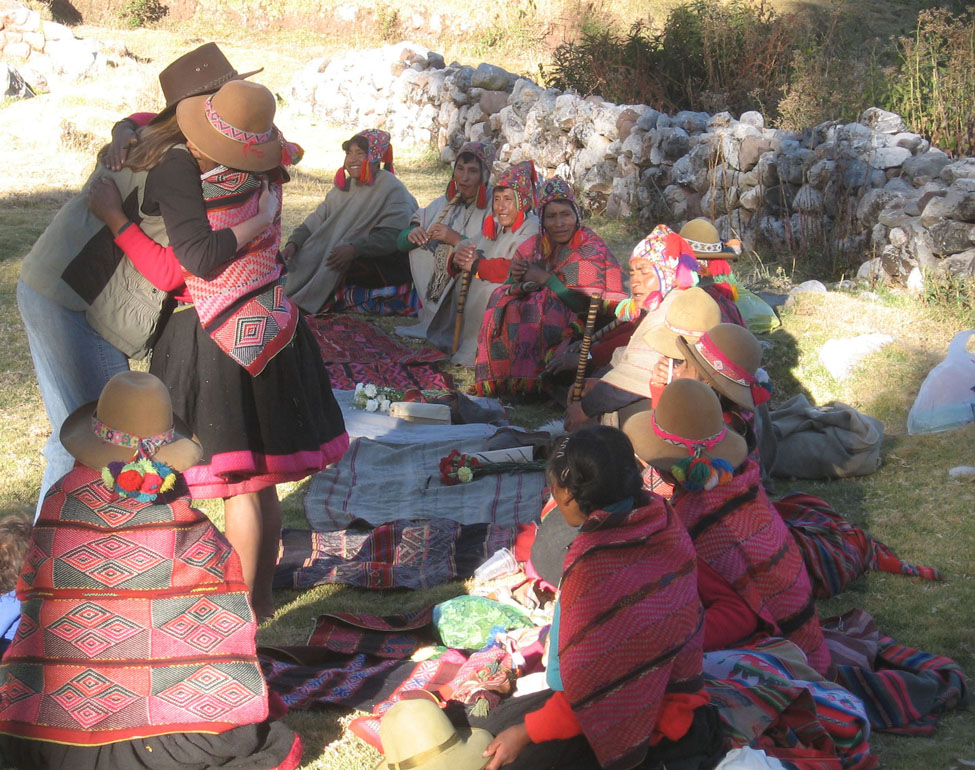
Carla and Q'ero Waikis

The author greeting Doña Carmina and other Q’ero waikis (friends) before a despacho (blessing) ceremony outside Cusco.
Photo credit: Oakley Gordon

In Western culture we think more in terms of giving and receiving. I give you something. You owe me something in return. In the Andean tradition there’s a much different flavor to giving and receiving. It has to do with the support of the entire community, not just one person.

If one person knows how to do something very well and the other person doesn’t, the one who has the skill automatically shares the teaching. The reciprocity comes to the first person in two ways. First, the teacher is validated for her knowledge base and may also learn more through the teaching. Maybe even more importantly, the entire community benefits because there are now two people with added value instead of just one.

COLLABORATION ONLY WELCOME

In 2004 I heard a radio program on global cultural change called “Andean Harvest” on Worlds of Difference that lent a further distinction to ayni and its influence. The interview took place in one of the mountain villages in Peru and had to do with the potato crop, of which there are a few hundred varieties. The challenge had to do with the farmers growing more of the different kinds of potatoes and getting them to market. To do so would give the opportunity to increase their livelihood. As a part of this undertaking, they were being advised by outside sources.

But the farmers rejected most of the sources’ advice. In the interview one of the elders said, “We will do nothing that would put one of us in competition with the other.” He went on to explain that introducing competitiveness would negatively impact the overall health of the community. What he said gave me pause and a great deal of consideration by contrasting it with my home culture.

THE WORTH OF WHO WE ARE

In Western culture, competition is considered healthy, naturally a part of our capitalistic society. Sports teams compete. Sportsmanship behavior is encouraged. But there are a few other strange, although familiar twists, which get in the way and preclude the practice of true ayni as yet.

The programming of our society says that success means we have to “be somebody.” That translates to a profession: doctor or lawyer but not “merely” a mother or father. If we define our worth and identity through career choice, or lack of thereof, there’s a huge convolution to the psyche; it sends the ego scrambling. The natural follow-on is one of competition, individual gratification, the need to “win” in order to be validated. The behaviors that come of this particular mindset produce not community, but a fractured society generating discordant energy.

Competition introduced into locales such as those in the Andes would create confusion, disrupting their underlying spiritual tradition. People there are known not so much by what they do, but by who they are. Many of the shamans and mystics that I have come across in Peru and elsewhere can determine who we are by seeing our energy field. That tells everything. A light energy field and the intent to evolve are what garner respect, not a livelihood.

Witnessing our own thoughts and actions is a slippery slope at best. The ego has all kinds of rationale to convince us that what we do is for our own good and that of those around us. Coming from the culture we do, unconsciously ingesting what we have, we perform a service to ourselves, and ultimately our communities, by being alert and wiser than the ego mind. The Core Self insists on it. Here are a couple of questions to consider.

– How do you find the level of competition around you?

– How can you make space for and “sponsor” others?

***

Go to Sacred Reciprocity, Part I.

Categories: Indigenous Wisdom, Personal Growth, Sacred Reciprocity, Spiritual Evolution, Spiritual Travel, Travel Experiences | Tags: , , , , , , , | 2 Comments

What Is Renewal? – Part II

In the Part I of What Is Renewal I relayed my experience at a conference back in 2007 put on by the Bali Institute of Global Renewal when a young man asked me…

Do you think it’s time for some traditions to die

so the next thing can come along?

And after my initial shock at his question I recovered enough to answer…

The thought of that happening hurts my very soul.

I don’t remember what else I said and it probably wasn’t as coherent as I’d have liked just because of the powerful emotions washing over me in that moment. But I do know that I thanked him for his question; I said it was personally quite significant to me. He looked perplexed.

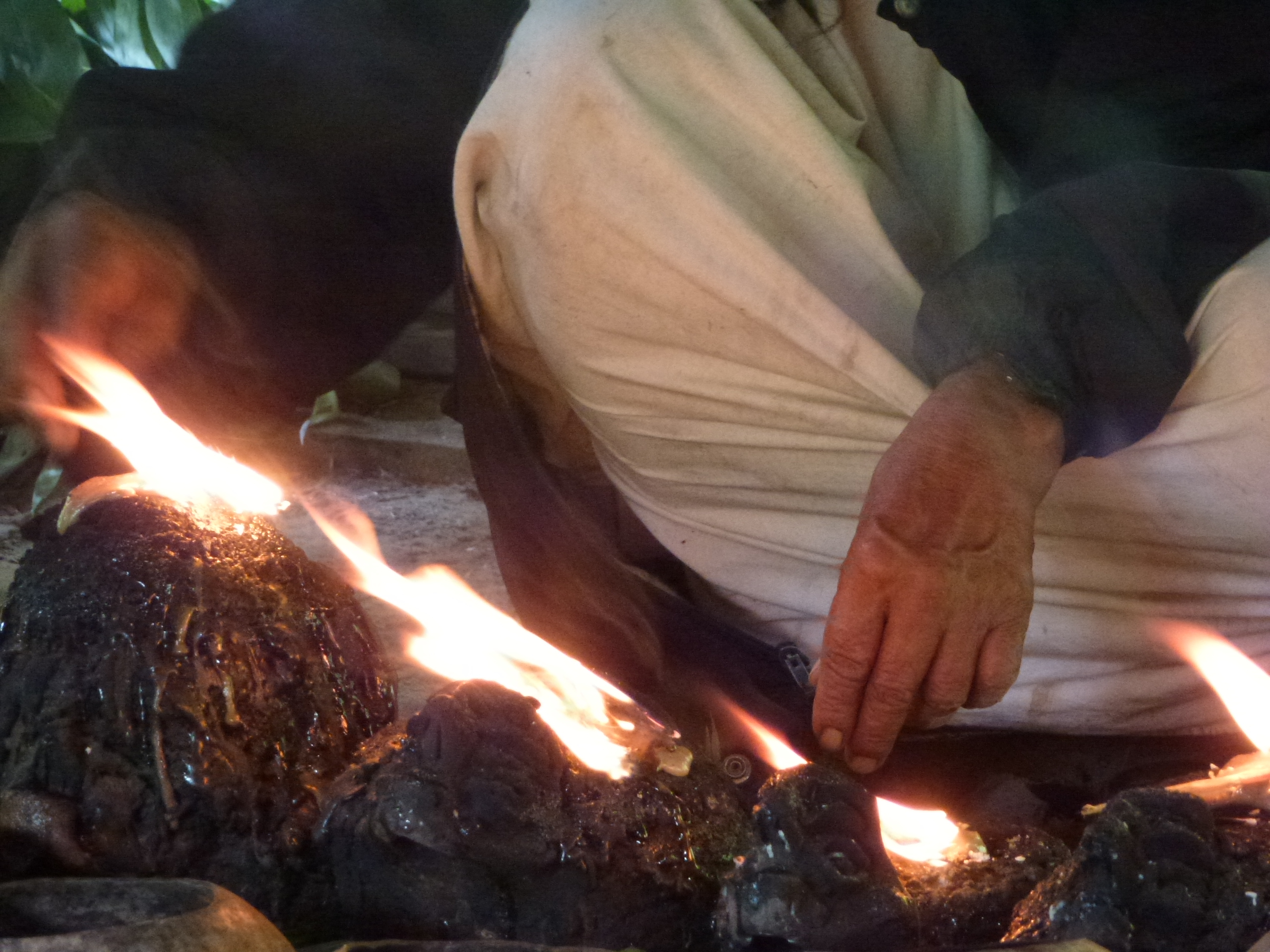
Don Antonio lighting the godpots

Don Antonio Martinez lighting the godpots during the sacred balché ceremony of the Lacandón Maya.
Photo: Carla Woody

WE HAVE A HUNGER

Do I understand about cycles, death and rebirth, seasons? Of course. Transition is the nature of the work I do every day. Is it time for these traditions to return to the ether? No! At least, certainly not yet.

Through my experiences with Native peoples over the years, I’ve learned these things: They are people who touch the earth, live close to it, who understand the nature of connection of all things…energy…sharing in community…a global consciousness. They hold these threads sacred in their now fragile traditions.

If you’re reading this article, then you probably belong to a culture that has largely forgotten these things. And we’re hungry for these aspects that are so rare or fleeting in our present-day societies—especially because the pendulum swing seems stuck toward destruction of these values.

Part of my involvement at the conference was to help facilitate a track called “Language of the Soul.” On the final day of that forum, and as a culmination to our activities and discussions, I guided a despacho ceremony—learned from Q’ero spiritual leaders— with those who had chosen that track, about forty people. To my knowledge only one other person there was familiar with the blessing ritual. But all actively participated: folks from such far-flung places like China, Malaysia, Indonesia, Zimbabwe, Australia, United States and others. Afterwards, they made comments about the effect it had on them, such as feeling moved and the sensation of energy for the first time.

BEARING WITNESS

Hopi Harold Joseph sharing traditions in Don Antonio's godhouse

Hopi elder Harold Joseph (left) sharing traditions in Don Antonio’s godhouse after the balché ceremony.
Photo: Darlene Dunning

I fully believe that if we honor Indigenous traditions such as those I discussed in Part I…if we’re willing to sit in circle…to take part in these deeply held spiritual rituals…then we touch what’s timeless. We’re injected. A transmission takes place that gets integrated into who we are in the world.

And when we hold sacred witness to those who have had the difficult and usually thankless role of holding these filaments—and honor them for the stake they’ve held—a sacred reciprocity occurs. There is a ripple that goes out. When there are enough of us engaged in this way, then perhaps it’s time for some traditions to relinquish themselves. That’s hardly yet though, is it?

Isn’t it ironic that this consideration came to me at a conference whose subject matter was global renewal? Maybe it’s easier to create a careful cocoon, to insulate ourselves, to stick our collective heads in the sand and ignore what’s happening around us. I can’t do it.

My soul won’t let me.

I offer spiritual travel journeys with the premise of supporting Indigenous traditions that are so in danger of decimation through influence from Western culture. Through Kenosis Spirit Keepers, the nonprofit extension of my organization, we sponsor Native Spirit Keepers living in the US so that they may sit in circle and reconnect with Maya, Q’ero and Quechua spiritual leaders and community. Through this intangible process I have witnessed the important effect it has—spiritual beauty and strength.

For Western travelers who accompany me, I view our participation and witnessing as a gift of respect, aside from the transformational aspects it has on us.

And the long-term effects are forever carried in our souls.

***

For those who are moved to support this work in preservation of Native wisdom traditions and well-being of the Maya people, please join us for Entering the Maya Mysteries, January 13-25, 2013. Your participation matters. Also see my post on the humanitarian work of Don Sergio Castro. Grandmother Flordemayo of the International Council of 13 Indigenous Grandmothers will be with us in January blessing our travels with prayers.

Categories: Healing, Indigenous Wisdom, Lacandón Maya, Spiritual Evolution, Spiritual Travel | Tags: , , , , , , | 3 Comments

What Is Renewal? – Part I

(Original article written in 2007 with additions here.)

Recently I had the good fortune to be invited to participate in a conference on global renewal sponsored by the Bali Institute. It was held in Ubud, considered to be the cultural and spiritual center of Bali. This was a significant gathering bringing together people from many countries with at least one thing in common — a vision for a better, kinder world and the strong desire to make it happen now. I’m still digesting all that happened for me. Part of it I will share with you here.

GLOBAL RENEWAL

Balinese temple figure

Balinese temple figure.
Photo: Carla Woody

It was the second day of the conference and I had arrived early to the Bali Classic Centre where it was held. It’s a site too beautiful for words with temples, lush foliage and meandering pathways throughout. I was standing in the open-air pavilion where people tended to gather during breaks, just enjoying my surroundings, when a young man approached me asking if he could speak to me. He indicated he had seen some literature on the programs I’m doing with the Maya in the Chiapas region of Mexico. In particular he was interested in Don Antonio Martinez, the last Spirit Keeper practicing the ancient sacred traditions of the Lacandón Maya. Then he said something I didn’t at all expect.

 Do you think it’s time for some traditions to die

so the next thing can come along?

 Whether his question came out of earnest interest or a flip attitude didn’t really matter. His words hit me like a shock wave that reverberated in hidden, interior places. This was a question I had come to Bali to hear.

FRAGILE TRADITIONS

Don Antonio and Balche Ceremony

Don Antonio Martinez of the Lacandón Maya during the balché ceremony.
Photo: Carla Woody

While I’m fairly sure the effect of the missile wasn’t apparent from the outside, my mind was immediately flooded with images. I replayed a time earlier that year with Don Antonio in the middle of the rainforest village of Najá, in his lone god house, burning copal in two of his god pots, chanting, invoking connection with Hachäkyum, the principal deity of the Lacandón, and another god in honor of our visit. He’d chuckled softly when the copal in one of the pots had at first refused to light saying that god was shy that day.

There was evidence of hundreds of such ceremonies in the burnt residue in his god pots, mounded to overflowing. He needed to retire these god pots and replace them with new ones. When asked why he hadn’t, he said that since the road had cut through the jungle to Najá it brought too much noise for the sacred renewal ritual. I remember remarking to myself how very little disturbance there was in contrast with what we visitors had at home. But still, it was an affront to the gods.*

Q'eros of Peru

Sitting in circle with Q’ero spiritual leaders.
Photo credit: Monty DeLozier

Another image came to me in the next split second, this time in the high mountains of the Andes in Peru, sitting in circle with Q’ero paq’os, or shamans, and other members of the Q’ero Nation, participating in a despacho, or blessing, ceremony. The absolute sense of collectively touching something beyond what is ordinarily presented, my eyes swept the circle of travelers who had come with me; I noted the ceremony’s subtle and sometimes dramatic effect on them.

These experiences are precious and will perhaps soon border on extinction just like in the Lacandón rainforest and the myriad other places where the footprint of modern society has been placed. A road is planned to Q’ero, which, until this time, has remained isolated at 17,000 feet in altitude with traditions pure and intact.

Hopi Spirit Keepers 2007

The author with Hopis Clarence Washington (lft) and David Washington (rt) at Salk’awasi, Mollamarka, Peru.
Photo: Darlene Dunning

Then my mind came to rest on the memory of the Hopi father and son that we sponsored to the Andes that past summer. I recalled the gratitude they expressed frequently, through tears, to be gifted with the opportunity to be in circle with their Quechua brothers and sisters and what it meant to them.

As I absorbed the ultimate meaning of the young man’s question coupled with these recollections, I was surprised to find tears welling up from my heart, through my throat, discovering moisture in my eyes. And in a cracking voice, this is what I said to him.

The thought of that happening hurts my very soul.

***

Go to Part II.

*In an area now thoroughly infiltrated by missionaries and decimated by logging companies, Najá was the last hold-out until Chan K’in Viejo, their powerful Spirit Holder, passed in 1997 at about 105 years old. Don Antonio, his son-in-law, is now the last Spirit Keeper maintaining the traditional beliefs and ceremonies.

If you are called to support preservation of these fragile traditions—and have a life-transforming experience yourself—I invite you to join us for Entering the Maya Mysteries, January 13-25. Among other opportunities to engage with authentic Maya spiritual leaders, Grandmother Flordemayo, a member of the International Council of 13 Indigenous Grandmothers, will travel with us…lending her prayers to our circles.

Categories: Healing, Indigenous Wisdom, Lacandón Maya, Spiritual Evolution, Spiritual Travel, Travel Experiences | Tags: , , , , , , , | 1 Comment

Review: The Spirit Hunters

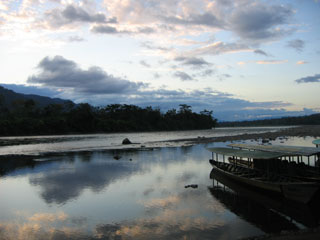
Alto Madre de Dios

Rio Alto Madre de Dios flowing through Manu.
Photo: Oscar Panizo

This 1994 film documents the beliefs, traditions and everyday life of the Matsigenka—The People—an isolated tribe of the Upper Amazon in the Manu region of Peru. The documentary opens with breath-taking scenes of the rainforest and moves into the story of a particular village. It relates the communal focus, hunting practices—and a matrilineal culture, unusual for most parts of the world.

We’re provided a look into exchanges between Glenn Shepard, an American anthropologist then living with the Matsigenka, and elder healer Mariano, who is also a gifted storyteller, an important role since their tradition is completely oral. In a walk through the rainforest, Mariano points out medicinal plants and shares their use. The film is packed full of interesting material on the ritual use of plant spirits: how shamans leave their bodies to gain knowledge and see the future. Even the dogs are given plant medicine to help in a hunt. And it relays warnings on how witches can steal people’s souls. One of my favorite jungle sounds is the primeval roar of the howler monkey. So I was particularly taken when I discovered here that the Matsigenka believe they carry a shaman’s soul.

Pasqualito

Don Pasqualito and his newly made flute.
Photo: Alonso Mendez

Another interesting note was contact the Matsigenka had with the Inca. For me, that piece of information brought back fond memories. I arranged for half my 2009 spiritual travel program in Peru with Don Américo Yábar to be spent in Manu. I invited three Q’ero spiritual leaders to accompany us; the Q’eros being the descendants of Inca priests and holders of that ancient tradition. Since my friends live at very high altitude, going to the jungle took them way out of their element. They were quite excited and it was a delight to watch them, particularly when they found bamboo. They spent much of the time making flutes and testing them out! We didn’t meet any Matsigenka but it was a return trip to the rainforest for these Inca descendants.

But back to “The Spirit Hunters.” Truly, this film is worth your time. It’s a glimpse into an Indigenous people who live a simple life, but it doesn’t romanticize the lifestyle or protect our Western eyes from the perils. More than anything it reveals a rich imprint, a complex belief system that guides their days.

Written and produced by Kim MacQuarrie. Narrated by James Earl Jones. The film is 50 minutes. Watch the complete film on Culture Unplugged. To learn more on the Matsigenka here’s an article by Glenn Shepard: “The People of Manu.”

Categories: Arts, Film Review, Healing, Indigenous Wisdom, Spiritual Travel | Tags: , , , , , , , , | Leave a comment

Blog at WordPress.com.