Arts

Book Review: The Painter from Shanghai

painter_from_shanghai

By Jennifer Cody Epstein

I’m always attracted by novels with a backdrop of art, controversial times and exotic locales and quickly became engrossed in The Painter from Shanghai. Only at the end did I realize the central character and many of the supporting ones actually lived. The times were dangerous and the daring commitment of those chronicled in the book’s pages is penetrating.

The author has written a fictional account of Pan Yuliang, a Chinese artist often known in her own country as the “Famous Western-Style Woman Painter”—a title she abhorred because it noted her gender. As a young girl in the early 1900s she was sold to a brothel by her uncle. This is the story of her origins and how she managed to leave that life to enter the world of art, something unheard of in those times, to become a well-known international artist and professor. The reader travels with her from China to Paris to Rome and back to China as she maneuvers between the strong pressures of Chinese tradition, dedication to her art and the political, sometimes deadly upheaval of the 1930s and 1940s. The book provides excellent entertainment as a novel. But it also educates about strict Chinese conventions, some of the heart-breaking practices Chinese women had to endure, and the intersection of Communism and Chiang Kai-shek’s Republicans. Above all it’s about the inner life of an artist and hard choices she makes to adhere to her dream.

Available at Amazon and elsewhere.

Categories: Book Review, Visual Arts | Tags: , , , , | Leave a comment

Spiritual Responsibility? Duty? Cargo?

I’ve been toying with terms to express what I mean and the process I’ve been evolving through in the last year. Responsibility or duty: both have a heavy connotation, not something done freely but something expected.

Within Maya communities there is the “cargo system” still in effect from colonial times. It has to do with civic and religious hierarchical positions, each held for one year. In the Andes, a similar system exists. “Cargo” may be translated as “burden.” Those “carrying cargo” incur expense, the higher the role in the hierarchy, the more monetary investment. In colonial times, the Spanish used the system as a means of control and exploitation. Today, it’s supposed to be a means of mediating wealth and sharing. But in reality, it creates separation. Those who have the most to expend are the ones who rise in community stature. Hence, they have more prestige. This aspect of the construct is quite distasteful to me, not much different than what often exists in western churches.

Going Home ShungopaviOil on canvas depicting Home Dance.©2011 Carla Woody

Going Home Shungopavi
Oil on canvas
depicting Home Dance.
©2011 Carla Woody

Over these last years, I’ve developed friendships with Hopi people who keep the old ways, and learned much about their traditions. Their clan system is complex, each clan and its members carrying separate spiritual responsibilities. Their religious and cultural ceremonies happen monthly according to the cycles of the Hopi calendar. Each ceremony takes up a good portion of each month due to preparation in the kivas and kitchens, aside from the actual dance and closure afterwards. I’ve witnessed the amount of work that goes into them, as well as listened to friends sharing what they can with an outsider. Truly, I marvel how they are able to get anything else done! For those who have chosen to maintain their traditions…it’s a huge investment of time and energy. Many have found it to be too much and put the sacred ways aside to a great degree. Tradition is going to the wayside.

That brings me to my own process. I founded Kenosis Spirit Keepers, as the volunteer-run nonprofit extension of Kenosis, back in 2007. I took that step because I fully believed that the Indigenous wisdom traditions must be valued and supported in a time when powerful influences across the globe sought to devalue and deplete what was life-affirming. Little did I know that my decision would take me on an unexpected, personal odyssey.

Initially, there was abundant support, both financial and sweat equity. We were able to contribute significantly and support community projects in the Peruvian Andes, sponsor intimate meetings between Native spiritual leaders, and eventually began to offer educational outreach in the local community. It was hard work but we could see the positive outcomes that resulted. Those were exciting times. It was exhilarating.

Then the recession hit. Funds dried up and people pulled back and holed up. I found that I was working harder and harder with few outside resources. My commitment to the mission never waivered. But such things eventually take a personal toll on the spirit and physical body.

Finally, a loud internal voice intervened when I was most tired and discouraged, “Why bother? No one out there cares. You’re wasting your time. It’s hopeless.” I’d set the questions aside but they’d return…until the voice became my nearly constant companion. First, you have to understand that it’s normally quite rare for me to have such messages play in my mind. I finally recognized that my internal struggle was a spiritual test.

Maya PrayersOil on canvas depicting the church in San Juan Chamula.©2011 Carla Woody

Maya Prayers
Oil on canvas
depicting the church in San Juan Chamula.
©2011 Carla Woody

Something happened last January during my spiritual travel program in Chiapas, Mexico that shifted my perspective. During “free time” I’d gone to the Maya church in the traditional village of San Juan Chamula, taking those with me who wanted to return. Every year I spend as much time as I can in this powerful place where the very air vibrates with energy. A few days prior we’d been there for the Festival of San Sebastián, during which the statues of the saints, wearing layers of robes, are taken out of their glass cases and carried on the shoulders of cargo holders in a processional in the main square.  When we returned, the saints had not yet been returned to the glass cases that lined the walls. Maya men were removing the outer layers of vestments on the saints and carefully putting them away in special wooden trunks that would later be stored and protected in individual homes.

I stood watching a few feet from a table where Saints Lucia and Martha were resting. Maya women sat on the floor alternately talking with each other and chanting in unison. Candles were everywhere; pine boughs covered the floor; copal smoke was thick in the air. It was magical in the sense that deep reverence can be. I looked at Saint Martha’s painted eyes—and they suddenly seemed to come alive and gaze deeply into mine. I felt penetrated as though some sort of transmission had taken place.

Then one of the men motioned to another who then approached the table. Very carefully, he lifted Saint Martha in his arms and slowly walked over to her case against the wall. But before he placed her inside, he paused.

And then he danced with her, a beatific expression on his face.

My breath caught and my eyes filled with tears. Such a display cannot be from a “burden” one carries, but directly from the heart. Since then I find that each time I share what I witnessed, tears come again. I continue to be moved and the memory has rooted itself within me for purpose, I believe.

A few weekends ago we were privileged to host Hopi Spirit Keepers Harold and Charlene Joseph for our Series here in Prescott. Some aspects they shared had to do with the involved process of Hopi weddings, their ceremonial cycles and community participation. People were touched, to the point that one participant later told me she had no words. Afterwards, a friend and I took Harold and Char to dinner.

We discussed the “Why bother?” questions that had been haunting me, although less frequently in the last months. Surprisingly, those questions were common to all of us sharing that meal. Yet, we all persevere because the core element of spiritual belief and service is implanted somehow in our DNA.

So after all the months of testing—mental angst, physical exhaustion and spiritual inquiry—I’ve returned again to one central theme that I learned years ago in the Andes: ayni, or sacred reciprocity. That’s the term I was looking for; it was under my nose all along. I even wrote about it again in recent blog posts! But I’m revisiting the meaning in a different way.

This is what I’ve re-learned so far:

—    Such ways of being are the invisible strands that hold the world together;

—    It’s possible to operate within a construct that is riddled with shortcomings and still hold pure intent;

—    Intangible things that you value spiritually are worth the hard work, sometimes requiring a lot of faith;

—    Strike a balance in all things;

—    Touch just one person and it touches others;

—    Ask for help; some things take a community.
Categories: Healthy Living, Hopi, Indigenous Wisdom, Maya, Personal Growth, Sacred Reciprocity, Spiritual Evolution, Spiritual Travel, Visual Arts | Tags: , , , , , , , , | 4 Comments

Sculpting a Life

I just completed a three-day workshop at the Mountain Artists Guild with artist Mary Schulte exploring papier mache and concrete sculpture. Sculpture isn’t something I’d done before; I’d never been attracted or even curious. But I met Mary and saw her exquisite papier mache giraffes in June at the “Arte Natura” artists’ reception at the Prescott Center for the Arts Gallery where my own artwork was also exhibited. And something pulled at me; I was intrigued.

Papier Mache Horse

My first attempt at papier mache: a whimsical horse with twigs for legs and straw for mane and tail.

Close-up of horse

Her gentle soul emerged.

That “something” had been running under my skin for a while urging me to move out of the status quo. I long ago learned that when I get a solid internal signal I follow it—even though all the “whys” are unclear. And if the usual excuses of “not enough” time…money…you name it…jump up especially strong then I acknowledge the excuse but set it aside; I’m then certain I’m on the right track. I just follow my initial intuition because…I also learned something else many years ago. The part of me that seeks to maintain the comfort zone gets quite vocal when familiarity is threatened.

In her introduction Mary talked about the types of sculpting. You can carve away like you would with marble or wood. Or you can hand build, adding layer by layer, as in the case of the media we would use. Over the next three days we students—none of us having done anything like it before—engaged in a joint journey of discovery with Mary as our skilled guide.

We students agreed on several things:

  • Undertaking the exploration was exhilarating and fun;
  • There’s focused attention to learning;
  • One medium was easier than the other;
  • Just because one took more learning didn’t mean we’d rule it out;
  • Having a guide who knows the territory saves a ton of angst and wasted time;
  • Even though we did similar things, we each had our own unique signature;
  • By deciding to undertake even this small journey it instilled options and a further sense of freedom.
Concrete Raven

This bird was as feisty as the concrete medium. He became more raven-like as he emerged, grew claws and perched on a wooden branch.

Ultimately, you can look at everything you do for cues as to your own growth. The important thing is to be active. Get out of your comfort zone. Stretch yourself. Otherwise, you relegate yourself to a ho-hum life.

By virtue of its definition, personal growth requires you to carve away what no longer fits or serves you; and to add what does and build upon it.

For me, I learned that my other art capabilities are transferable to an area I hadn’t even considered. And those three days were well spent. Aside from learning a new skill I could add into my body of resources, it did something even more important. It served to open a doorway and leverage evolution—giving a clear announcement to myself that I’m on the move. Permission granted.

***

If you’d like to know more about Mary Schulte’s artwork or when she’ll offer workshops, contact her at vam@cableone.net. I recommend it!

Categories: Arts, Creativity Strategies, Personal Growth, Spiritual Evolution, Visual Arts | Tags: , , , , , , , | Leave a comment

Review: The Spirit Hunters

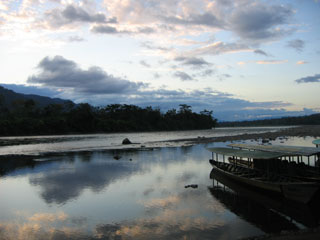
Alto Madre de Dios

Rio Alto Madre de Dios flowing through Manu.
Photo: Oscar Panizo

This 1994 film documents the beliefs, traditions and everyday life of the Matsigenka—The People—an isolated tribe of the Upper Amazon in the Manu region of Peru. The documentary opens with breath-taking scenes of the rainforest and moves into the story of a particular village. It relates the communal focus, hunting practices—and a matrilineal culture, unusual for most parts of the world.

We’re provided a look into exchanges between Glenn Shepard, an American anthropologist then living with the Matsigenka, and elder healer Mariano, who is also a gifted storyteller, an important role since their tradition is completely oral. In a walk through the rainforest, Mariano points out medicinal plants and shares their use. The film is packed full of interesting material on the ritual use of plant spirits: how shamans leave their bodies to gain knowledge and see the future. Even the dogs are given plant medicine to help in a hunt. And it relays warnings on how witches can steal people’s souls. One of my favorite jungle sounds is the primeval roar of the howler monkey. So I was particularly taken when I discovered here that the Matsigenka believe they carry a shaman’s soul.

Pasqualito

Don Pasqualito and his newly made flute.
Photo: Alonso Mendez

Another interesting note was contact the Matsigenka had with the Inca. For me, that piece of information brought back fond memories. I arranged for half my 2009 spiritual travel program in Peru with Don Américo Yábar to be spent in Manu. I invited three Q’ero spiritual leaders to accompany us; the Q’eros being the descendants of Inca priests and holders of that ancient tradition. Since my friends live at very high altitude, going to the jungle took them way out of their element. They were quite excited and it was a delight to watch them, particularly when they found bamboo. They spent much of the time making flutes and testing them out! We didn’t meet any Matsigenka but it was a return trip to the rainforest for these Inca descendants.

But back to “The Spirit Hunters.” Truly, this film is worth your time. It’s a glimpse into an Indigenous people who live a simple life, but it doesn’t romanticize the lifestyle or protect our Western eyes from the perils. More than anything it reveals a rich imprint, a complex belief system that guides their days.

Written and produced by Kim MacQuarrie. Narrated by James Earl Jones. The film is 50 minutes. Watch the complete film on Culture Unplugged. To learn more on the Matsigenka here’s an article by Glenn Shepard: “The People of Manu.”

Categories: Arts, Film Review, Healing, Indigenous Wisdom, Spiritual Travel | Tags: , , , , , , , , | Leave a comment

The Gift of Mother India

Last night I saw The Best Exotic Marigold Hotel with a circle of friends. It’s a film about travelers all seeking something—even if they didn’t know it—against the backdrop of very foreign land, in this case Jaipur, India. As we sat around a restaurant table afterwards, my friends and I had plenty of fodder for discussion—and for me, waves of beautifully intense memories flooded back.

In February of 1998 I was in Delhi and Jaipur studying raga, Indian classical vocal music, with Pir Shabda Kahn, who is now spiritual leader of the Sufi Ruhaniat International and Director of the Chisti Sabri School of Music. I was truly ripe for my experience in Mother India and what unfolded back then. Through the daily hours-long practice the veil became quite thin. I remember having a challenge staying grounded in “normal” reality at all. The drone of the tamboura going straight in through my crown set up the ensuing Initiation quite nicely. I relayed part of my experience in my first book: Calling Our Spirits Home.

❖❖❖

Temple photo

Burial temple in Delhi of Hazrat Inayat Khan, who brought Sufism to the west.

I was drawn to go to India.  I was inexplicably drawn from the depths of my soul.  I had no words of explanation for my friends and family.  I had no expectations toward the outcome.  Yet, I knew that India had something to teach me, and that I would learn.  I found myself in a state of not knowing, but trusting.

We landed in Delhi in the early morning hours.  As our taxi conveyed us to our hotel, I was immediately transported back to 1978.  Magically, my time travel took me to the six months I spent in Iran.  There was a palpable aura of dejá vu as I noted the walls at streets’ edges barring glimpses into homes beyond and battered shutters rolled down over crumbling shop fronts.  The same coating of dust blanketed everything.  I saw the faces of the Iranian people I knew back then in the dark skin and beautiful brown eyes of our taxi driver.  I said to myself: This is nothing new.

In the days that followed, I made entries into my mental databank:  beautiful architecture, beggars on the street, tent dwellings, exquisite handicrafts, waves of people, gracious smiles, noxious fumes and traffic without rules.  Each time effectively dissociated, I said: I’ve seen this before.  Then we left Delhi and went to Jaipur.

While still in Delhi, I wrote about my feelings that, as I looked back on them later, seemed prophetic to me.  From my journal: “I feel as though I am waiting to leave Delhi and go to Jaipur where something awaits me.  I have the sense of going into myself and knowing that Self in all its manifestations—past, present and future…”

Choutu Singh

Choutu Singh

I spent the first days in Jaipur in meditative practices sequestered in the compound of Diggi Palace where we were staying.  Diggi Palace was so named from its history as the hunting lodge of a long-gone maharaja.  Its modest rooms and grounds provided an oasis in the heart of Jaipur.  On the third day, my companion and I left the grounds and encountered Choutu Singh, the young Indian man who would become our constant guide.  He offered us the services of his rickshaw and there I began my Initiation.

It seemed that Choutu drove us through every aspect of Jaipur and suddenly I experienced all as new—and connected directly to me.  From my enduring meditations, or perhaps from just being in Mother India, I was in a heightened state of awareness.  As we drove through byways and alleyways, the material destitution of the people I saw entered me.  The filth I saw entered me.  The barrage of noise and toxic air entered me.  The open sides of the rickshaw found no barrier, physical or psychic, that divided any experience from me.  There were no boundaries.  All was seamless and I said out loud, “I’ve never seen anything like this.”

Jaipur photo

Street scene Jaipur.

Carla Woody photo

Author Carla Woody in a Jain Temple in Jaipur.

We had stopped in a gem shop when I experienced waves of illness—immediate, sudden.  Although quite healthy prior to our venture out that afternoon, by the time we returned to Diggi Palace less than an hour later, I was desperately ill.  Fever, chills, insomnia and acute body aches were my companion through the night.

Inexplicably, waves of intense sadness arose from unaccountable depths.  It was mine and it was not mine.   Tears streamed down my face off and on through the night and during meditation the next morning.  Then, I put hands on myself with the intent toward healing and began to feel better throughout the day.  That night I had a normal night’s sleep and awoke feeling energetic and light as though I had been through a deep cleanse.

❖❖❖

It took me two years to integrate this gift. Through that process I learned that dissociating from what brings fear only enlarges upon fear. Solely by fully associating, inviting the demon to tea as Shabda was fond of saying, allowing the aversion or angst to wash through consciousness may it be transformed. I remain indebted to Pir Shabda Kahn for creating the safe haven for this particular Initiation of mine.

Categories: Arts, Healing, Meditation, Personal Growth, Spiritual Evolution, Spiritual Travel | Tags: , , , , , , , | 2 Comments

Learning to Love Globally

In the spring of 2010 some local artists and students began a mural project at Miller Valley Elementary School depicting some of the actual students at work and play. This empowering slogan ran across the walls at the major intersection where the school is located: “Learning to Love, Loving to Learn.” It was part of a public mural project that was started around town years before to depict history, enhance beauty, relay affirming messages, and engage the public.

The portrait of a Hispanic boy featured prominently in the artwork. A City Council member objected and became quite vocal via his radio show, inciting racism. The artists and students endured drive-by insults and demonstrations, both pro and con. Giving into pressure, the principal told the artists to lighten the boy’s complexion, then retracted that direction. The town known as “Everybody’s Hometown” ended up on national news and talk shows showing that it was anything but that.

The wife of a Native person we’d sponsored for our Spirit Keepers Series contacted me from Washington saying, “Tell me it’s not so.” I was absolutely incensed and ashamed that such a thing would happen here—or anywhere for that matter.

Here’s what I note about the backlash: When the pendulum is ready to swing dramatically, resistance becomes even stronger to hold things back. This is true whether it happens within the psyche of an individual or globally. The important thing is: to acknowledge the resistance, the clashing factions, indeed document it; and move forward anyway. The intensity wouldn’t have happened unless progress was being made.

But integration and healing must take place. Such things can’t slip by or remain simmering beneath the surface. This certainly goes for us as individuals—and the wider world we inhabit.

Jacob Devaney of Culture Collective intends to produce a film of the mural controversy. Here’s what Jacob said to me: “One aspect that relates to work you’re doing is the idea of ‘listening is healing, or being heard is healing.’ When a community is able to feel heard and able to define itself through its own stories instead of having the outside world define them, it is healing. It is true in many indigenous cultures as well, we need to be able to listen to each other and feel heard. That’s how healing works. It’s not about being right or wrong. It’s about having your voice counted. That’s what public art does; and that’s what this film seeks to accomplish.”

This will be a film that helps heal a community—but also the larger world. Culture Collective is now raising the funds needed. I invite you to support inclusiveness. To learn more visit Up Against the Wall Film—Public Art Indicted.

Categories: Arts, Compassionate Communication, Healing, Personal Growth | Tags: , , , , , , | 1 Comment

Blog at WordPress.com.