cultural interests

A Hopi Spirit Keeper’s Travels in Mayalands

Note from Carla Woody: In December 2012, I offered a special Winter Solstice “Entering the Maya Mysteries” program. Kenosis Spirit Keepers sponsored Charlene Joseph, a Hopi Spirit Keeper from Moencopi, on this journey as a part of ongoing efforts to bring together Indigenous Wisdom Holders for mutual spiritual support. Char’s presence, and the heartfelt connections she made with her Maya relations, brought even greater depth to our shared experiences. Truly, it was a gift to have her with us. Below she has generously shared her journey and what it meant to her.

My Mexico/Guatemala  Spiritual Adventure

By Charlene Joseph

What an adventure!  I traveled to Peru in 2009 and had a very rich cultural and spiritual experience.  Knowing the Hopi ancient history and growing up in the traditional Hopi way, I was able to connect to the indigenous people and their way of life.  My travel to Mexico and Guatemala in December 2012 was just as spiritual and the connection to the people culturally and traditionally was immense, just as it was when I went to Peru.

Charlene Joseph and Carla Woody departing for Chiapas, Mexico.

Charlene Joseph and Carla Woody
departing for Chiapas, Mexico.

I spent one week in Tucson with my daughter’s and son’s families the week before my trip. The day before we were to fly out of Phoenix, I left Tucson for Phoenix to meet up with Carla Woody, the organizer of the trip, and spend the night.  Not only did I have trouble finding my way to the hotel, but the next morning as I was reorganizing my luggage, I discovered that I didn’t have my passport! I had left it in Tucson.

It was still early enough to drive back to Tucson and be back before our plane left at 3:00 p.m. so I called my daughter.  Even while studying for her final exams at University of Arizona, it was very thoughtful of her to bring my passport halfway to meet me at Casa Grande. So now, I’m set with my passport and ready to board the plane to Mexico, wondering what laid ahead for me.

San Cristóbal de las Casas


As we were driving to San Cristóbal from Tuxtla after spending the night, I thought about my family back home, the upcoming Hopi New Year and prayers that I will miss for the first time in years, my father who taught me about the Hopi migration from the South. At the same time, I was enjoying the beautiful scenery.

Arriving in the colonial town of San Cristóbal and checking into our hotel felt to me like we were in seclusion.  It was chilly in the hotel lobby and I was wondering why the heater was not on. Once we got checked in and made our way to the room, I found it was just as cold there.  Soon found out that there are no heaters.  We had to dress warm at night or even wear our jackets to bed.  During the day the weather got very warm so we soaked in as much sun and warmth to our liking.

Processional during Festival of Our Lady of Guadalupe.©2012 Carla Woody.

Processional during Festival of Our Lady of Guadalupe.
©2012 Carla Woody.

It was lively day and night in downtown San Cristóbal with fireworks, parades honoring the Lady of Guadalupe, locals selling their art and craft work, food, and even fresh boiled corn, which was my favorite! Also many tourists walked the streets looking, eating, buying from locals, and just enjoying their time.
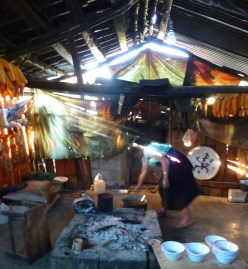
Family kitchen.©2012 Carla Woody.

Family kitchen.
©2012 Carla Woody.

One evening we drove about twenty minutes up to the indigenous village of Chamula to participate in ceremony with Don Xun Calixto.  As we were driving through the village, I saw ladies and young girls washing clothes at the water spring, just like we used to when I was growing up.  That scene took me way back to my childhood days. I felt at home seeing the people working in their gardens, fields, drying their harvest, carrying water from the water spring to their homes, and firewood for the evening loaded on the person’s back and everyone working in harmony, it seemed.

We stopped at the bottom of a hill and walked up the steps to Don Xun’s family home, a traditional brick home with an outside shed-like kitchen where they also kept their harvest of corn, beans, squash, variety of melon, and cauliflower stored. On the open fire-pit was a pot of boiling stew being prepared for our meal with the family.  In the yard chickens were being fed, and the group gathered talking and admiring the craft work the family had for sale.
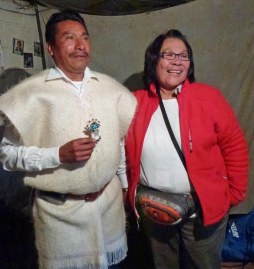
Don Xun Calixto, Spiritual leader of San Juan Chamula, and Charlene Joseph.©2012 Carla Woody.

Don Xun Calixto, Spiritual leader of San Juan Chamula, and Charlene Joseph.
©2012 Carla Woody.

Don Xun  started the ceremony in the main house in front of the altar as we sat around him on wooden benches or chairs.  We sat quietly and watched while one group member did the interpretation.  After ceremony was over, I gave a talk and encouraged Don Xun to continue his and his people’s way of life,  that it is good to find that they are still growing their own food and eating off of the land.  I shared with him that my people, the Hopi, live that way also but that we are slowly forgetting.  I told Don Xun that what I shared are my father’s words that he had wanted me to tell our people from the South and that we are connected.  We are brothers and sisters.  Don Xun was happy to hear this.

I presented him with a katsina rain spirit doll (Corn Boy) and asked him to remember my people on Hopi when he is doing his prayers because we need rain for our corn to grow. I asked him to send the rain clouds to Hopi with his prayers because we have been getting little moisture and we need it for our corn to grow.  Don Xun chuckled and said that they did not get enough rain this year either.

Southern Guatemala

Charlene Joseph and Don Nicholas, who attends San Maximón, in Santiago Atitlán.©2012 Carla Woody.

Charlene Joseph and Don Nicholas, who attends San Maximón, in Santiago Atitlán.
©2012 Carla Woody.

A few days later, we left for Guatemala and were on the road all day.  On the way down to Lake Atitlán, Guatemala, there were cornfields everywhere, all the way from San Cristóbal, Mexico to Guatemala.  I was happy because this made the connection for Hopi, and me personally, even more significant.  Corn is very important to Hopi just as it is to the Maya people in the South.

Lake Atitlán is very beautiful, especially at sunset and sunrise.  The weather was much warmer at night which made it very comfy to sleep.  In the morning, after a night’s rest, we got on the boat to take a 40-minute ride across the lake to Santiago Atitlán, below a volcanic mountain.  There we participated in ceremony with Don Nicholas honoring San Maximón.   After ceremony, we headed back to our hotel to board our private bus for Antigua.  It was a 3-hour ride and we got there around 8 p.m.

Ajq'ij Felipe Mejia (Maya Daykeeper) at Iximche.©2012 Carla Woody

Ajq’ij Felipe Mejia (Maya Daykeeper) at Iximche.
©2012 Carla Woody
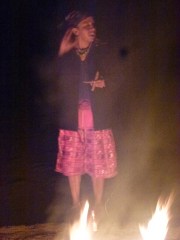
Ajq'ij Apab'yan Tew (Maya Daykeeper) at Iximche.©2012 Carla Woody

Ajq’ij Apab’yan Tew (Maya Daykeeper) at Iximche.
©2012 Carla Woody

This time we checked into our hotel for three nights.  On December 15, we drove to Iximche for a fire ceremony with Maya Daykeepers Felipe Mejia and Apab’yan Tew at a sacred place where there are pyramids.  It felt very welcoming to see school children playing games and having a cookout.  It was very lively!  The ceremony was interesting and was very colorful.  Again, I felt a strong connection to the Mayas when offerings were made to the fire with food.  I shared with them that Hopi does the same thing.  We also feed the fire and make food offering to the sun.  There were other similarities that I observed that reaffirmed the history of the Hopi to the Mayas of the South.

Palenque

Temple of the Sun at Palenque, Winter Solstice 2012.©2012 Carla Woody.

Temple of the Sun at Palenque,
Winter Solstice 2012.
©2012 Carla Woody.

Nearing the end of our travels and looking forward to Palenque in the jungle.  We left Antigua, went through border checkpoint, and got back into Mexico on December 17th.  Took the whole day to get back to San Cristóbal where we spent two more nights before heading to Palenque where the great pyramids are in the jungle.

It was amazing!  I can’t even begin to express how I felt when we went to the pyramids in Palenque.  Magazines, movies, and pictures are never the same as experiencing the real thing.  Driving to Palenque through the mountains was awesome, too.  All of a sudden a person or people will come out of the forest, people walking along the road with hoes, wood, carrying traditional pottery filled with water.  Wow!

We visited the pyramids on December 20th.  We did a great amount of walking and climbing at the pyramids.  I managed to climb up several with the help of my group members, and especially Ed from Prescott, Arizona who pulled me up and helped me down.  It was interesting to find that the temples are named for the sun, moon, snake, corn, and others I can’t quite remember.  Hopis honor those same things.  There was a ballcourt and a shrine representing the Twin Warriors and the Grandmother which Hopi includes in the Hopi Way of Life ceremonies today.

December 21st was the day of Winter Solstice in Mayaland.   On Hopi, Winter Solstice is also happening at this same time when the men are in the kiva praying and preparing for the New Year.  A time of sacrifice without sleep, praying and working hard so life can continue. They do this for, not only the Hopi, but for all life on earth including animals, plants, sun, moon, water, Mother Earth and all humankind.

On this Winter Solstice Day, the rain was coming down hard and it had started the night before.  Hoping that the rain would subside, we left at seven in the morning for the pyramids to observe Winter Solstice. Sitting on the steps of the Temple of the Sun waiting and getting drenched, after a couple of hours, some of us decided to go back to our cabanas to dry,   We didn’t get to observe the Solstice because the rain took over until five in the afternoon.  As I always say, things happen for a reason!

This journey to Mexico and Guatemala reaffirmed the Hopi migration and some history from the South for me and the Hopis.  My father talked about Palatqwapi , the Snake Serpent, the Twin Warriors and their Grandmother, and more that they brought with them when migrating from the South.  These are all still very much alive today in the Hopi Way of Life.

My father always emphasized that we need to keep faith and continue the Hopi Way to keep the world evolving. I feel very humbled to have participated in this journey and to be able to honor my father and his knowledge and wisdom in this way.

Categories: cultural interests, Hopi, Indigenous Wisdom, Maya, Spiritual Travel | Tags: , , , , , | Leave a comment

Book Review: The Woman at Otowi Crossing

otowicrossing

By Frank Waters

I discovered The Woman at Otowi Crossing in the late 1990s. It spoke to me in such a way that I wrote the executors of Frank Waters’ estate to get permission to use a paragraph in the flyleaf of my own book Calling Our Spirits Home—and they graciously complied. 

So all these scribbled pages, Jack, are to help you understand that an awakening or Emergence, as the Indians call it, is more than a single momentary experience. It requires a slow painful process of realization and orientation… How many thousands of obscure people like me all the world over are having the same experience right now? And for no apparent reason, like me. Keeping quiet about it, too.

                                                       —From Helen Chalmers’ journal in The Woman at Otowi Crossing

The book by Frank Waters is a fictional account of the real-life Edith Warner, there called Helen Chalmers, who ran a tearoom at Otowi Crossing, near both Los Alamos and San Ildefonso Pueblo, for more than twenty years until the Chile train line shut down. Set during the time of the research and development of the atomic bomb, it creates a juxtaposition between the ancient ways and beliefs of pueblo life, modern science and so-called progress. The secrets of those things kept hidden were in the air, the goings-on at Los Alamos as well as influences from her close relationship with the Pueblo people. They permeated Helen’s days in such a way that it created awakenings in her, what she called Emergences. The Woman at Otowi Crossing is replete with such rich aphorisms as the one below, reflecting, too, Waters’ own journey of consciousness.

 … Perhaps none of us really learn anything by degrees. We just keep absorbing things unconsciously without realizing what they mean. Till suddenly, for no apparent reason, it all comes into focus with a blinding flash… 

Historically, Waters’ book would be of interest, too, weaving in the likes of Neils Bohr, Robert Oppenheimer, local Pueblo people and others who frequented Helen’s tearoom. If you’re like me, then, after you read The Woman at Otowi Crossing, you’ll rush out to get The House at Otowi Bridge by Peggy Pond Church. It could almost be considered a companion, one not to be read without the other. Church’s book is a biography of the legendary Edith Warner, a complex woman who lived simply in an out-of-the-way place in a controversial time, and gained wide respect by those who knew her.

Categories: Book Review, cultural interests, Indigenous Wisdom | Tags: , , , , | Leave a comment

What 12-21-12 Meant to Me by Lori Clarke, Guest Blogger

Note from Carla Woody: Lori Clarke is a Canadian who traveled with us on the Winter Solstice 2012 program. She has generously offered impressions of her travels and a day she’d been anticipating for many years.

***

The anticipated climax of my trip was to be the day of the end of the Mayan calendar, December 21, 2012.  I have been following this day since my mid 20’s, copying the date into each new years calendar.   In my 20’s, the date seemed a life time away but now in my mid 50’s, the date is actually here… right now…

I decided several years ago that when this date arrived, I didn’t want to be home.  I wanted to be able to say where I was on that date, when whatever happened…or didn’t happen…on the Winter Solstice of 2012.  The end of the Mayan calendar and by some peoples’ interpretation, an accurate prediction of ‘the end of the world.’

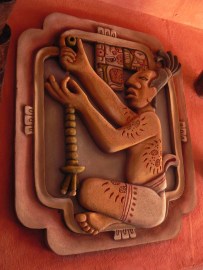
Maya Relief

Maya Relief
©2012 Lori Clarke

I left Canada on Dec 8. Our ambitious itinerary kept us busy traveling and participating in healing and fire ceremonies, dinners with traditional families, textile and art gallery tours with our guides, visiting churches, museums and sacred sites.  Meeting our guides, hearing their stories and feeling their passion was inspiring, lifting.  It is very encouraging to learn that there is quite a collective movement cultivating the Mayan culture–the archaeological and historical richness, and striving to find the balance between maintaining tradition and economic growth in an increasingly modern world.  Pride in their ancestral lineage, increased understanding between the many language dialects and unity are essential components for their future.  The Maya were not defeated but very much alive.  Coming together.

Our group of 12 arrive in Palenque on Dec 19.  We spent the day touring the ruins and hear about Maya cosmology.  Upon returning to our lodging after a long, hot and humid day, I laid down before having dinner.  I increasingly didn‘t feel well and ended up vomiting.  After all these years of anticipating this date, how could I be sick and miss Dec 21, 2012.  I didn’t eat dinner that night.    Then, as night fell upon us, it began to rain.  We have not seen any rain on our trip and now, on the eve of Dec 21, it is not only raining but we are having a torrential downpour.   I began to worry if we were even going to the site in the morning if this rain continues.

Temple of the Foliated Cross

Scene from the Temple of the Sun toward the Temple of the Foliated Cross.
©2012 Lori Clarke.

To my astonishment, I woke up in the morning feeling fine.  It was a one-time appellation, no diarrhea, no headache.  Very strange.  But it does continue to rain.  We gather, eat breakfast and catch a cab to the Palenque ruins.    Along the road we pass a large group of walkers.  Maybe a 100 people, all soaking wet, singing and dancing on their way to the site.  Mostly young people, long hair, oddly dressed and obviously free-spirited.  At the gate, we are the first people in line and wait to get our tickets.  While we are waiting, we notice that the rain has stopped.  How timely.  The large group of walkers then arrive and fill up the entrance area.  Moments later, our group was allowed in 15 minutes before the park was officially open.  We quickly walk to the selected area and climb the steps up to the temple (The Temple of the Sun).  To our amazement, we have the place to ourselves, only one security person and us.  The rain has stopped but the grounds are wet and slippery making the climb rather tricky.   We look out over the jungle canopy and observe the low level of clouds, hanging heavy and providing a misty, mysterious mood to the morning.   We had a beautiful period alone on top of the temple looking down at the altar and up over the treetops.  It was a sacred moment.  The rain began again and groups of people started to arrive on site.  How truly special it was to experience this quiet and private time alone in the heart of Palenque.  No distractions from completely being present and absorbing all of its splendour.

However breathtaking this moment was in space and time, it wasn’t what we were expecting.  It had been our plan to see the sun rise above the jungle canopy at 8:36am.  The anticipation of being there to see the first peak of the rising sun on Dec 21, 2012 was exhilarating.  As much as it was disappointing that it didn‘t happen that way, it had to be realized that, unseen to us, the sun certainly did rise that morning.  A very powerful acknowledgement.

It continued to pour.  We all were varying degrees of wet and a little annoyed with all this rain.  But then I had another realization.  Water is life.  The rain is cleansing and water inspires growth, like the planted seed.

My eyes were then attracted to the altar in the centre of this area.  It was great to see it this morning without people sitting on or hanging around it, as was the case yesterday.  The altar is stone in the shape of a cross.  The centre of the cross is also marked, marked with another raised stone.  To me, this represents the heart.  From the heart, energy flows out in all four directions.  Each direction having it’s own strength and character.  Standing at the top, I could see it clearly.

I decided to go down to the altar and stopped for a moment at each of the four directions.  I then noticed that the rain falling on the temple steps was pooling and then cascaded over and down the stairs creating the flow of a waterfall.  I had glad I decided to wear my sandals this morning so I didn’t have to worry about my shoes getting wet.  I chose to be childlike and walked through the puddles.  I intentionally walked up the steps of the highest temple, following the cascading waterfall.  I imagined, feeling like a spawning salmon climbing upwards against the flow.   Reaching the top, I noticed my heavy breath.  After a few moments, I made my decent following the same path down.

As I left this area, and walked between the two sets of major ruins, I felt a strong wind.  As I learned in Peru, I stopped, opened my arms and greeted the energy.  I stood still for a moment breathing in the breath.

Dec 21, 2012  is the beginning of a new era.  What was profound to me on this date is what I already know to be true.  Believe in the unseen.   I saw very clearly, that when we are aligned with a higher power, and are connected at the heart, we will be nurtured and guided so our energy will flow outward in love and be of service to the universe.   Through our own free will, each one of us as individuals will live our life and learn the lessons through our authentic souls.

©2012 Lori Clarke. All rights reserved. Reprinted with permission.

Rain at Palenque

Rain cascading over the steps leading to the ball court,
Dec. 21, 2012.
©2012 Carla Woody.

Categories: cultural interests, Healing, Indigenous Wisdom, Maya, Spiritual Evolution, Spiritual Travel | Tags: , , , , | 1 Comment

Lineage: Calling on the Ancestors

January 2012

The nondescript address promised little from the street. I opened the old wooden door to slip through the walled entryway and found otherwise. Carol Karasik and I had arranged with the group to meet at Laughlin House, one of the oldest houses in San Cristóbal de Las Casas, then owned by anthropologist Robert Laughlin and his wife Mimi. Carol had been staying at the venerable hacienda—and, with all its rustic charm and lush garden, it seemed the perfect place for our evening gathering.

Dusk was coming quickly. I wandered through the narrow, uneven paths admiring the beauty of the garden, down to the small greenhouse at the far end. As I passed by the main house I noticed a woman kneeling in the grass separating the dwelling from the garden. She was carefully digging a shallow circle, exposing the dirt, already preparing the space. Copal smoke rose from the pedestal burner.

Floridalma (Flori) Pérez González, a traditional  Ajq’ij, a Maya Daykeeper from a Mam village in the mountains of northern Guatemala, was there to offer us a fire ceremony, so sacred to her people. As the rest of the group drifted in, she invited us to join her and sit in circle. We watched in silence as the altar grew on the bare dirt: sugar drawn in a symbol reflecting the day in the Maya calendar, fist-sized balls of resin mixed with shredded wood, candles laid in a circle as offerings to the Nawals, Day-Spirits of the calendar, and Four Directions, sticks of pine pitch, rose petals around the perimeter.

Fire Ceremony Altar

Fire Ceremony Altar

By this time it was dark, just the glow from the incense burner reflecting on our faces; we were cocooned, a timeless place separate from the everyday world. Flori spoke softly and asked me to express the collective intent of the group, then invited each one in the circle to offer their individual words. She lit the fire and invoked the presence of the spirits, praying intermittently in her Maya dialect and Spanish.

Floridalma Pérez González

Floridalma Pérez González

The fire’s flame rose. She called on the Nawals and Ancestors, Grandmothers-Grandfathers, inviting them to accept our petitions and blessings through the smoke. Every now and then she reached her hand into a bag and threw herbs upon the flames. The fire changed shape, moving against the light breeze, not with it. Flori told us the meaning and said it was a good sign. We were drawn into her soft prayers, the flames and, otherwise, the stillness.

After a time, she passed thin, white tallow candles asking us each to take eight, then instructing us to separately approach the fire and, as we settled the candles one by one into the fire, call out the names of those who have gone ahead of us, our Ancestors, to welcome them to our circle, to bless them, as they who are part of who we are, to hear our prayers.

I started. In that moment, I realized that I knew so little about my own family line—but a few names, not nearly enough for the candles I held in my hand. I attempted to sweep the corners of memory to see if anything arose. It didn’t. And when it came my turn to kneel at the fire, beyond three names I could name no more. I placed the remaining tapers, intending they would find their match.

But sadness arose; a hole was uncovered. I didn’t know My People.

I recognized then one of the reasons I’m so drawn to Indigenous traditions. Upon introduction, a number of Wisdom Keepers I’d met would identify their villages and clans going back a few generations. I’d been told that the purpose was to offer any mutual connections. But it’s also a clear statement of identity, place in the world. Those who maintain their traditions are grounded through lineage, lending spiritual strength. Hearing these pronouncements always stirred something poignant in me, as though I was attempting to reach out, to find my own conscious grounding. But I had none in that way, not of the blood that ran in my veins, the places My People had walked, or what aspects of them resonated through time to find residence within me—beyond my own mother and father. I discovered I wasn’t alone. Several of the members of the group struggled in their own way. It was a powerful ceremony.

Fire Photo

It is said that the fire works on you over time.

Its work with me began immediately. I emailed my folks the next morning mentioning the intent of the fire ceremony and my sadness for lack of knowledge of the family line. My mother wrote back saying, “It’s strange you should mention this because yesterday we started cleaning out old boxes…and found papers tracing your father’s family tree!” One of his distant cousin’s had undertaken the search years ago. The papers had been forgotten. We were both astounded at the timing of their urge to clean. I asked my mom if she’d begin looking into her line; she had little knowledge either. She promised she would.

Tracking genealogy is something of an art, sometimes an endless maze with dead-ends, particularly if you have little information at the outset, or experience. My mother got discouraged, having come up with few leads, after much time spent. The project stalled.

December 2012-January 2013

When I visited my folks over Thanksgiving, we talked of family line again. Don Boyd is an old family friend who has become something of an expert in tracing genealogy. I contacted him to see if he would be willing to give my mom some pointers. I then left for my Maya spiritual travel programs over the next two months.

Immediately, there was a flurry of emails between my mom and Don, with copies to me in Mexico and Guatemala. In no time flat, Don was able to produce information that led to a fairly extensive maternal family tree. Although some of the data petered out, thanks to Don and my dad’s distant cousin, I now know most of my lineage.

We still don’t know anything about my dad’s maternal line. But, for the rest, My People were all from the South. My paternal grandfather’s line traces back to 1724 England—and, a curious aside, includes Arthur Woody, the “legendary barefoot forest ranger” one of the first pioneering forest stewards in the US. My maternal grandfather’s people go back to 1766 Ireland. Cherokee lineage exists on both my maternal grandparents’ sides, for sure one documented to 1867 North Carolina. There’s a possible trace of another Cherokee ancestor as far back as 1797 Tennessee, but that one is difficult to prove.

Sunset over San Cristóbal de Las Casas.

Sunset over San Cristóbal de Las Casas.

Less than a week ago we met Flori at dusk. The fiery sunset announced the fire that would be lit in ceremony on the ground, perhaps already mirroring back to us our prayers that would rise. And when it came my time to approach the fire and lay the tapers, I called on my Ancestors, My People, clearly by name. I’ll never know all their stories but I can now intuit their lives—and feel their influence on me, rising up through time, running in my blood, to my place in the world.

I am grateful to the fire.

Fire Ceremony Photo

Categories: cultural interests, Healing, Indigenous Wisdom, Maya, Spiritual Evolution, Spiritual Travel | Tags: , , , , , | 3 Comments

Film Review: Water

water

Film by Deepa Mehta

This film is set in Varanasi, India during the time of Gandhi’s rise in the 1930s. It is, at once, much like India herself. The cinematography is incredibly beautiful recording the most holy temples, landscape, people and colors while forcing us to acknowledge devastating conditions in which so many of the people live, particularly women. A paradox placed upon the people through their most sacred beliefs. But it does not leave us with such discomfort alone. It also presents hope.

This is the story of eight year-old Chuyia, left suddenly a widow at the death of her many years older husband. As the sacred texts direct, she is sent to live in a house of widows, an ascetic, hair shorn, eating one meal a day, even though she never lived as a wife with her husband. A heart-breaking account of a practice that continues to this day in some areas. Doctrine states that while her husband is alive a woman is half his body, and when he dies she is half his corpse, held in highest esteem and yet treated badly, then living in the most extreme poverty. The hope offered in the film comes through the bond that develops between young Chuyia and some of the widows, the intervention of a stranger and the new teachings of Ghandhi making headway during those times.

The film was so controversial that, during its initial making in 2000, filmmaker Deepa Mehta, cast and crew were driven from Veranasi, their safety threatened by mobs and the set torn down, causing the project to be abandoned for a few years. Four years later, Mehta was able to complete the film in Sri Lanka. It was nominated for an Oscar in 2005.

Rather than be put off by the subject matter, I invite readers to view the film. It has a beautifully haunting quality that will stay with you for a long time. Available in DVD or watch online free. The soundtrack is equally mesmerizing.

Categories: cultural interests, Film Review | Tags: , , , | 1 Comment

Thought Forms in Black and White

I was in Bali during August 2007, most of it spent in Ubud. In my experience, it’s rare to be in a culture where the spiritual traditions and values are so visible even to a casual observer. There are many things I took away with me, but I’ll offer just a few here.

The first has to do with prayer and ritual integrated into everyday life. There are temples everywhere—public temples, shrines on the streets. And every family compound has an altar even if it’s a small one tucked into a corner, but many are quite elaborate.

Offerings©2007 Carla Woody

Offerings
©2007 Carla Woody

The women seemed to spend a lot of time making small, flat offering baskets from bamboo fronds, measuring about 4 inches square. I’d see them sitting outside storefronts or on the sidewalks talking together while their fingers were busy. For the last week I was there, every morning I watched an elderly woman make her rounds in the bungalow compound where I was staying. She carried a large flat basket in her arms, which contained those smaller ones all holding flower petals, incense, rice, things to attract notice of the gods and signify prosperity. Not only did she place one at the compound shrine and at the base of all the statues, but in front of the bungalow doorways and even on the manager’s desk of the adjacent Internet café; all the important places to create a flow. Later walking through the streets or driving through the countryside, I’d note them in front of businesses and homes, almost everywhere.

The moments for remembrance and gratitude were ongoing. Not a time set aside, but included. One day I had hired a driver to take me to the coast. Along the way, he asked if I minded if he stopped for a few minutes. He pulled over outside a kind of marketplace. While I was fooling around with my camera, he got out. When he returned he had rice pressed into his forehead. During one night’s dinner I was enjoying my food (immensely) and observing my surroundings. One of the servers would stop the others as they passed by. She dipped a flower in a water glass and then anointed them on the head with it. Not playing around, but blessing them.

The understanding of interconnection is also prevalent—family, the banjar, the community. Our style of life in the West is shocking to them. The fact that we seem so disconnected when “I am because you are.”

Bali Translator©2007 Carla Woody

Bali Translator
©2007 Carla Woody

Perhaps more than anything I was taken with the sacred statues that were prevalent at every turn, not just in the temples. They seemed so exotic and expressive to me, not at all benign. I had a very kind driver who was not only quite curious about my culture but also eager to inform me about his.

He said, “Foreigners make a mistake and say we have so many gods. That’s not so. Our gods stay inside the temple and are only brought out for special times.”

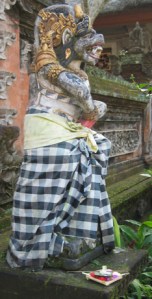
I asked him about some of those I saw frequently that look somewhat like serpents or dragons and he disclosed that they were translators, conduits. They took the messages of the gods and translated them so we could understand them. And when I asked him about the black and white checked sarongs on just about all of them, which I was quite fascinated by, this is what he said.

“They remind us that we all have both good and not so good inside of us. This is to remember balance.”

In Bali, those reminders abound. Balance. Work gets done, but the days aren’t overly long. Acceptance of both sides of human nature without going to either extreme, or rejecting part of the self. Connection. And the middle road is valued. No wonder I was so touched—and relaxed.

Categories: cultural interests, Indigenous Wisdom, Sacred Reciprocity, Spiritual Travel, Travel Experiences | Tags: , , , | Leave a comment

Blog at WordPress.com.