Indigenous Wisdom

Seed Intelligence: Indigenous Perspectives and Our Collective Birthright

In October 2010, Flordemayo was in Los Angeles attending a conference. At break she returned to her room on the 23rd floor. Before lying down to rest her eyes, she noticed an emerald green glow on the wall. When she opened them again the light had taken up the entire wall and a vision unfolded. “There was a panoramic landscape and everything was emerald,” she said. “It was so beautiful that I said to myself, ‘I’m going into this light.’ I have absolute memory of walking in a field dialoguing with everything. I noticed a mountain to my right. Then everything began to change! At the top, it split and there was movement like an avalanche! The forest and everything in it came tumbling down—trees, animals, stones, water. It crossed the road below and I saw that all domestic life was being swept away! I thought, ‘I have to get to my cornfield!’ I was praying and running as fast as I could, and then I’m grabbing the yellow corn, the blue, the red, the black…and then I grabbed all the rainbow corn I could grab! I bundled all the corn I could carry up in my long skirt. But I couldn’t run fast enough! I heard a voice from above, ‘Flordemayo! What are you doing? The military is coming!’ I answered in a cry to the Universe, ‘It just doesn’t matter anymore!’ Then I was standing in the hotel room again facing the wall. The emerald light was gone. I had tears in my eyes. I fell back on my bed. I was devastated.”
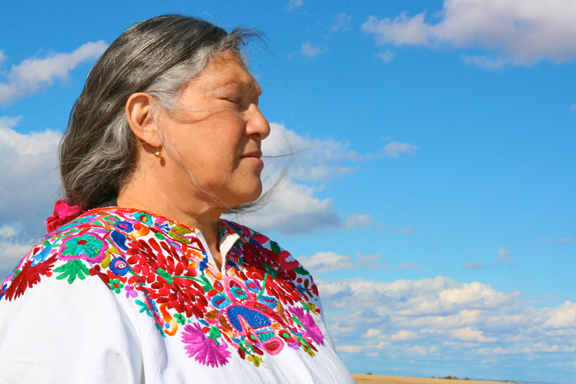
Flordemayo

Grandmother Flordemayo
Photo credit: Linda Rettinger

As a young child, Flordemayo was recognized as a seer. By the age of four, she had already begun her training as a curandera espiritu, a healer through divine spirit, a gift inherited through long family lineage, originating from the Maya highlands of Central America. She is a member of the International Council of 13 Indigenous Grandmothers, standing for peace and healing of the Mother Earth. When messages come strongly, Flordemayo knows to answer them—no matter the obstacles.

What is the timeliness of this vision?

Apab’yan Tew is an Ajq’ij, a Day Keeper, and spiritual guide of the sacred K’iche Maya tradition from the village of Nawalja’ in Sololá of the Guatemalan highlands. His ceremonial work most often takes place in caves, engaging with resident energies of the natural site and timing of the Tzolkin calendar in conjunction with needs of communities or individuals. Like Flordemayo, his gifts evolved from childhood until he ultimately answered the call through a series of difficult shamanic challenges.

Apab'yan Tew

Apab’yan Tew
Photo source: Apab’yan Tew

Apab’yan elaborates on the Maya worldview: “We cannot be who we must be without the land. Another principle is that the body we have is not really ours. It is lent from the Mother Earth herself. So if you create any kind of danger to your body, you are also hurting the Mother Earth. What the Earth produces and what we produce is part of the same cycle, the same system. We are not separated from the Earth—and the Earth is not to be thought of as just another provider of goods. The term that is used in the West is ‘natural resources’ as something to be taken, something to be transformed. For us, we don’t use this term. We use the term ‘elements of life.’ It is our life! It is not a resource.”

In Indigenous traditions, every aspect of life is integrated and sacred. This Maya spiritual leader is quite clear that to surpass a cycle creates imbalance. Nothing should be moved from its place in the Universe. His people think of the seed as a living feminine entity, not a commodity. There is a proper way to carry her, to talk to her, the Sky and the field in the act of sowing according to specific timing. This in itself is a ceremony, integration of a flow that already exists and must not be taken from those like himself who hold these ways close.

There are those who seek to eradicate the sacred ways.

Apab’yan talks about the Maya ways of respect: “It is our purpose not to take more than we can give back. But it is also our purpose not to change. We must not touch what is not ours. It is not ours from the beginning. It is ours to have a dialogue. The seeds talk to us. We have five seeds. Only one of the five is for us. One is for the Sky. One is for the Earth. One is for the brothers in the fields. Maybe there’s a crow that’s going to come. The last one is for anybody who needs it. In my harvesting, maybe I’ll have some extra seeds to give to someone or sell them. There’s no harvesting for commercial purposes. But we have extra if someone needs it. We are Corn Beings. So we must not even play with the seeds.”

He believes there is no current problem with GMO seed infiltration in the high altitude area of his village: “You don’t sell milk to a cow!” For the Guatemalan highlands, there’s not enough room for the politics of Monsanto. What the West calls “organic” these Maya farmers have been doing for eons—and the best selection has long ago been made. However, he sees a danger as any of his people become more influenced, perhaps by emigrating and then returning home, to set aside their ancient ways of living.

That same protection isn’t available to Native and heritage farmers in the US. Five years ago I sat in a conference session and heard a Zuni man sadly express the fear he held: the real possibility of GM seeds blowing into the fields that he and his ancestors had planted with their pure Native strain for hundreds of years. It was disheartening and outrageous.

If the spirits of Earth and Sky are no different than the seeds they sow, the food they eat, what their bodies are made of…then to tamper with any part is an outright act against religious freedom and quality of life, rights the US constitution is supposed to uphold. For giant agribusinesses to also attempt to spread their seed where people have few rights equates to preying upon those who have a voice but are ignored. When spiritual tradition falls apart, grounding dissolves; detrimental influences make additional in-roads; suffering takes over—a process proven over history. Spiritual pride is lost; ethnic groups are additionally marginalized.

A grassroots movement has sprung up.

Learn About GMOsPeople are starting to come together, much as in past times of threat or needed change. Coalitions are appearing like GMO-Free Prescott, a small, volunteer-run nonprofit organization in Prescott, Arizona specifically formed to educate and support everyone’s right to choose food and products that have not been genetically modified. Founder Shea Richland states, “I got involved due to health issues when I was leaving ‘no stone unturned’ to find answers. The more I learned, the more concerned I became. When the documentary Thrive was being shown in our area, I felt it was an opportune time to do more. So, GMO-Free Prescott was born. If people were walking what the Native people teach, then our organization wouldn’t be necessary.”

Winona LaDuke, an Anishinaabekwe (Ojibwe) enrolled member of the Mississippi Band Anishinaabeg, is known as an environmental activist. She is the Executive Director of Honor the Earth, where she works on a national level to advocate, raise public support and create funding for frontline Native environmental groups. She lives and works on the White Earth Reservation. Her organization offers a number of naturally derived products that may be found via Native Harvest online to help fund the White Earth Land Recovery Project.

Winona LaDuke Source: Native Harvest

Winona LaDuke
Source: Native Harvest

She shares this: “When I was a young woman, my father would listen to me patiently, with great compassion, as I explained to him the many environmental issues facing our community and the complexities of the world. His name was Sun Bear, or Vincent LaDuke. He used to tell me, ‘Winona, you are a smart young woman, but I don’t want to hear your philosophy unless you can grow corn.’

I remembered this for many years but was not as smart as he thought. It took me until the turn of the millennium to become a corn grower. I thought about this often and wondered about the corn varieties my ancestors in northern Minnesota would have grown. I began a quest, one of many. The first corn that came to me was a Bear Island Flint corn, eight to twelve inch, multicolored cobs. The seeds were gifted from Ricardo Salvador, then a professor at Iowa State University. He had found them in a seed bank. The corn came from an island in the middle of Leech Lake Reservation, where I later learned, after many interviews and much research, that our people often grew corn on islands, away from predators, in micro-climates surrounded by water. Ingenious. We began to grow. Then, I moved onto Manitoba White Flint, the northernmost varieties of the Ojibwe, grown about 100 miles north of Winnipeg.”

Winona notes the importance of growing Native seeds and seed saving: “Never a crop failure after all these years with this corn! It is hearty (with) twice the protein and half the calories of market corn. And it is resilient. (Through) frost, drought and high winds, it stays. We were the northernmost corn growers in the world. And yet, we had lost much of our corn and our seeds. So, we have grown that corn now for a decade. Again…resilient. Monsanto’s crops failed in 2012, but ours did not. We are grateful. That was the beginning. Today, we are growing an 800-year-old squash, found in an archeological dig in Wisconsin. And we are growing many other varieties. It is our hope to create a northern Anishinaabe seed bank.”

The vision that Flordemayo received was a strong message coming from the Creator to uphold the welfare of our interconnections. As she accepted what seemed like a monumental task, things quickly began to fall in place—as it so often does when a vision is true. Exactly the funds required to purchase the forty acres of land that came available near her home in Estancia, New Mexico appeared. She established the Seed Temple as a volunteer-run project under her nonprofit organization, The Path. Smaller donations came to excavate the underground seed vault, construct the classroom building that covers it, and to create its accompanying medicine circle and fire temple. Flordemayo said, “You can’t have plants without water. We need a place to go and pray…to hold the spirits of water and plants in prayer.”
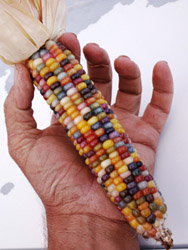
Rainbow Corn

Rainbow Corn
Photo: Greg Schoen

Local volunteers and those from some distances come regularly to continue building and advise. Greg Schoen is one of them. He’s impassioned about seed preservation: “Crops are being stripped and ‘dumbed down,’ the diversity bred out of them. When we do this to the corn, we do this to ourselves.” He got his start as a seed saver in the mid-1980s receiving his original “Glass Gem” jewel-like kernels from Carl L. Barnes, a mixed blood man of Cherokee/Irish/Scots ancestry now in his eighties living near Liberal, Kansas. Over the years, Greg received other Native varieties from Carl, planted them himself and gifted them to such organizations as Native Seeds/SEARCH in Tucson, Arizona.

“I think of corn as holding a knowledge, like a recordkeeper. Sometimes when Carl would grow corn in his fields, Native strains that had gone extinct would re-emerge. When Native people here lost the corn they carried, it’s like they lost the central point that anchored them to the land, like they lost their language. So, when Carl would reintroduce their ancestral corn to them, they would light up. It would be like you were wandering in the desert and your ancient scrolls were returned to you!”

Greg freely gifts baggies of “Glass Gem” seeds to anyone who wants them. In the coming year he will plant at the Sufi community near Silver City, New Mexico where he now lives. When asked what direction the Seed Temple would take, he said, “We’re starting to provide educational support to seed savers. There will also be a ‘seed lending library.’ Individuals can take portions of the seed stock of one of more items from the seed bank, with the agreement that they will grow out the seed according to proper growing practices, and return a portion of the seed produced to the seed bank. Those are just some of our plans.”

Flordemayo affirmed Greg’s statement and added, “The seed has a spirit, but it doesn’t have a voice. We are giving the seeds a voice! We are welcoming Native and heritage seeds from growers. The only restriction is that the seeds are organically grown; and we know where they came from and who is growing them. So we need to have documentation in receiving them.”

Kenosis Spirit Keepers is the volunteer-run nonprofit I founded to help preserve Indigenous wisdom traditions. We see the Native seed issue as an integral aspect of Indigenous spiritual traditions and are helping to support the Seed Temple. More is still to be done in the way of construction and obtaining all things necessary to start up and maintain. One way Flordemayo plans to help fund the project is through classes in the growing and use of medicinal herbs, sacred bathing, and vision and dream work. She has turned the Hogan, located next to the seed vault, into the Temple of the Golden Child, which will be used for this purpose.

More and more independent seed saving operations are being established in pockets around the globe. Greg Schoen continues to quietly do what he can to preserve our heritage by sharing his passion, experiences and seeds with others on a similar track. Shea Richland believes so strongly in our birthright for health and well-being that she reluctantly stepped into the public eye to form GMO-Free Prescott and educate regarding our choices. Winona LaDuke works at the national level through organized environmental activism. Flordemayo answered a vision. Apab’yan Tew performs ceremonies for the well-being of the planet in the dark recesses of caves.

It takes all of us, each bringing our own way, in the face of such forces that would act against us, to support and maintain our collective birthright—and succeed.

***

This article is being incorporated into the Anishinaabekwe (Ojibwe) Farming Curriculum that will be part of the Tribal Community Colleges in the region where Honor the Earth Foundation is active.

***

Kenosis Spirit Keepers is sponsoring Grandmother Flordemayo and seed savers Greg Schoen and Dianna Henry for events on January 31-February 1, 2014 in Phoenix, Arizona. The proceeds from ticket sales go to support the seed saving project founded by Grandmother Flordemayo. For information and to purchase tickets, please go here.

***

Sources:

Interviews with Flordemayo, October 17, 2012 and February 1, 2013.

Interviews with Greg Schoen, October 17, 2012 and February 8, 2013.

Interview with Apab’yan Tew, November 6, 2012.

Interview with Winona LaDuke, November 27, 2012.

Interviews with Shea Richland, November 9, 2012 and January 2, 2013.

Categories: cultural interests, Indigenous Rights, Indigenous Wisdom, Sacred Reciprocity, Uncategorized | Tags: , , , , | 4 Comments

The Dream Is the Reality

Dreams are usually pushed asidemeaningless, inconsequential snippets of brain junk that visit us in the night when our defenses are down. Don’t be so fast to dismiss them. Under certain conditions, they are only too relevant. If you don’t pay attention, then you miss the message and actual guidance.

As Above, So Below ©2012 Carla Woody

As Above, So Below
©2012 Carla Woody

When I’m mentoring people I suggest they be aware of their dreams in the course of our work together. Most say they don’t remember them at all, or they slip away so quickly it’s like grasping at clouds. The same is true for me. However, when I’m in the midst of deep transformation, dreams become more than memorable. They’re emblazoned on my consciousness and part of my evolutionary process. This is also true for those who enlist me to help guide their process.

I take time in the beginning of our session for a check-in, an opportunity for folks to relay insights or things that have come up since the last time. What emerges is often a direct communication from the unconscious on where to focusand we hit pay dirt. Here’s a case in point. I’m changing the name to protect my client’s privacy. Grace said she’s happy to have her story shared in case it helps someone.

At the tail end of our check-in, Grace mentioned she’d had a dream that morning. She spoke about “not getting up right.” I immediately noticed her agitation. She told the small pieces she remembered and added that the dream had awakened her, leaving her disoriented and angry. Strong emotions were evident as she spoke. She said she felt betrayed. I was clear this was a message from a part of her we had been working with that was now ready to release a pattern. With permission, I stabilized the bodily felt sensations attached to the emotions in order to use them as guidance, going back to the originating occurrence. Almost immediately, she returned to the age of two awakening in a similar manner as the dream but with emotions that were intense. I’m going to preserve the details of the situation but will offer this. The incident wasn’t a severe trauma in the way we might think of it. However, it was traumatic in the sense of a two-year-old perceiving no options, feeling trapped.  That perception had affected her all her life in ways that held her back and kept her stuck. The dream was the message that allowed us to reframe the past incident and open a future toward freedom of movement and options that she’s not experienced before. She later told me that she knew about that incident, hadn’t thought of it in a long time, and hadn’t seen it important. Obviously, a part of her did.

Dreamtime and the Vision Serpent ©2013 Carla Woody

Dreamtime and the Vision Serpent
©2013 Carla Woody

In many Native traditions, dreams are interchangeable with daily reality. One bleeds over to the other. Children learn how to behave in their dreams without their parents teaching them. Medicine people receive their calling. Ritual musicians learn to play their instruments. Weavers receive requests from saints for new vestments. Warnings come. All of these things are received through dreams and given relevance.

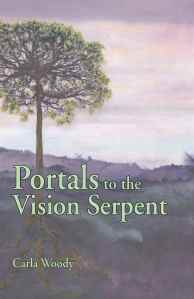
In my new novel Portals to the Vision Serpent, a Maya woman receives her calling this way.

“For me, it started like this. When I was thirteen years old I had a dream. I was walking through my village like I was going somewhere, and I needed to be there fast. But every place I passed, it wasn’t the place I was supposed to be. Then suddenly the road wasn’t dirt anymore. It turned into a creek, and I was floating along, being taken with the waters. But it was gentle. I wasn’t afraid. I could see there were many fish in the creek swimming all around me. And still the water took me past many houses. My mother was there when I went by, and she smiled at me. I saw my grandmother, too, and other women. More and more came and stood by the banks of the creek as I floated by, until I was no longer in my village.” Her eyes grew moist.

“Something woke me up then. I opened my eyes. And the room was glowing—a beautiful blue! I wanted to tell my sisters, but I saw they were asleep. And then in the corner of the room, I saw a woman in a long dress. But it was hazy, like I was seeing her underwater. Her hair was wrapped in a cloth. There was white light all around her and when she moved, this light moved. She came over to my bed right there and reached out her hand like she would touch me. And the light came from her hand, and I felt it with my whole body, like such a love came to me that I have never felt. I feel it now when I tell you this. And we stayed like that, she and I, for what seemed to be a long time. Still my sisters slept. And I knew something was happening just for me. Slowly she disappeared, and then the blue glow left. It was just the bedroom again.”

Doña Flora’s eyes shone, her face serene. Her body radiated, the very act of recounting her calling activated a luminescence that only became stronger with the silence she now held. Tears leapt from Sybilla’s eyes but, transfixed, she didn’t reach to wipe them away. After a time, Doña Flora shifted in her chair and spoke softly, “Yes, this is how it first happened.”

Now, an interesting thing happened related to this excerpt. Shortly after I’d written this chapter a well-known Wisdom Keeper came to stay in my home for a few days. Over breakfast, she recounted how her calling came, very similar to the waking dream that I had written, down to the blue glow. The synchronicity is astounding to me. I also believe that, sometimes, the dream is relayed through writing, just another channel.

Over the years, the night dreams I remember have served me well. They’ve foretold a path I’d take, attempted to warn me off another and repeatedly kept me on track. They’ve lent metaphoric meaning to the past and future in ways my conscious mind doesn’t always grasp but a deeper aspect does. When they’ve chosen to show themselves in a way that I can recall, they serve as allies on a path that is sometimes invisible.

We need to be intuitive enough to heed the guidance and the way it points. The dream is the reality.

***

What are some ways you’ve received important messages in your dreams? I invite you to share them in the comments space below.

Categories: Healing, Indigenous Wisdom, Spiritual Evolution | Tags: , , , , , , | Leave a comment

What You Can Do in the Face of Devastation and Make a Difference

I received a very disheartening message. I want to share it with youeven though research statistics show that most people would prefer to see uplifting blog content. My feeling is there are just things I can’t ignore. I discount that, due to the immensity of a travesty, I can do nothing about it. That would be the easy way out, to push something aside.

I subscribe to Glenn Shepard’s blog Notes from the Ethnoground. Glenn is an ethnobotanist, medical anthropologist and filmmaker who lives in Brazil and has spent many years doing on-the-ground research in remote rainforest places. Yesterday his latest post ”A letter of protest: In defense of the rights of indigenous peoples and traditional populations in Amazonia” arrived via email. 

The post is about a proposed change to a law currently in the Brazilian House of Representatives “to make changes to Article 231 of the Brazilian Federal Constitution of 1988 defining the public interest in demarcating Indigenous Lands.” It has to do with ancestral land rights of the Indigenous peoples of Amazonia. If passed, it would take away many of their rights in favor of those who have encroached: cattle ranchers, mining operations and more.

Guarani People

Photo credit: Survival International

This is not a new issue. It has been going on for decades with terrible consequences. Not only is the rainforest threatened but Terena, Guarani and other Native peoples have been murdered in defending what is theirs. We rarely hear of these things because they don’t get reported. I did some research of my own and turned up this August 8 news article from the Guardian in the UK. It reports on the killing of a Guarani man believed by Survival International to have been ordered by a landowner, as well as other murders of Native peoples numbering “452 between 2002 and 2010, sharply up on the 167 killed during the previous eight years.” The article accuses the Brazilian government of “pandering to agro-business lobby rather than reallocating areas to indigenous peoples.”

Guarani and Kaiowa Indians are in conflict with ranch owners over the allocation of land in Brazil. Photograph: Celso Junior/AP

Guarani and Kaiowa Indians are in conflict with ranch owners over the allocation of land in Brazil.
Photograph: Celso Junior/AP

 If you’ve read this far, then you likely recognize a familiar story. Although the struggle of the Indigenous people of Brazil is especially heightened, similar things are happening in Native lands the world over. It’s a form of genocide. When the right to live on their own lands, grow their own crops and perform their own religious ceremonies is taken away, it’s devastating.

Have any of you ever lost a home? Been told your religious practices are evil, antiquated or ridiculous? Has your voice not been heard? Probably many of you have had such experiences. For traditional Native people, connection to ancestral lands, community, the foods they grow and ceremonies runs deep. It’s a matter of survival and what keeps them spiritually grounded. Take away these things and a sense of identity vanishes.

What to do about such things? It’s not an easy answer. Personally, I founded Kenosis Spirit Keepers  in 2007, a grassroots volunteer-run nonprofit organization, expressly because I believe so strongly in the contributions that these traditions make to the betterment of the world through continued existence.

Has it been a walk in the park to support projects we’ve committed to fund? No. We’ve had to be very creative to do so. I wish we were able to do so much more.

Does it feel to me as though my efforts and those of my board are like lonely raindrops in the wind? You better believe itespecially when I hear about such things as Glenn reported.

Yet, I can’t turn away. No matter how discouraged and tired I get…I just can’t. That’s because I truly believe the more people who feel the way I doand stay strong in that intentthat the tides will turn. We can make a difference. Looking back in history, I see the shift has happened too many times not to believe in what’s possible. I hold that you do, too.

***

Kenosis Spirit Keepers

To learn more about Kenosis Spirit Keepers and how you can help preserve Indigenous wisdom traditions, go here.

Categories: cultural interests, Indigenous Rights, Indigenous Wisdom, Sacred Reciprocity, Spiritual Evolution | Tags: , , , , | Leave a comment

New Book Release: Portals to the Vision Serpent

Portals to the Vision SerpentI am pleased to announce that my latest book has been released and is now available in trade paperback and/or Kindle versions in North America,  Europe and the UK. The Kindle version is also available in Japan, Brazil and India.

As with all my books, I’m donating 10% of profits from book sales to Kenosis Spirit Keepers, the nonprofit I founded to help preserve Indigenous wisdom traditions—like those featured in the novel. Know that if you’re drawn to read the book, you’re also supporting these important projects.

Description

Preston Johns Cadell is tormented. He attempts to outrun discontent and the void in his heart. His mother is hardly around. His father’s origins and disappearance are shrouded by family secrets. His sole remembrance of his father is flying through the stars nestled in his arms.

Any comfort Preston derives is from an unseen advisor who teaches him of the invisible world. Now he is coming of age. Memories arrive from long ago when a brown-skinned woman cared for him. But she, too, vanished. Finding the buried remains of his father’s altar, Preston must answer the draw to his destiny, to discover his lineage—even though he has no idea how or where it will lead him.

Portals to the Vision Serpent is a Hero’s Journey into the realms of shamanism and the Maya world. Interwoven are the struggles of indigenous peoples to preserve their way of life and tragedies that often come from misunderstandings. Through a family saga of dark wounds and mystery, spiritual healing unfolds.

Editorial Reviews

The search to find one’s True Self is a journey that often challenges cultural preconceptions and assumptions. Portals to the Vision Serpent takes this journey deep into the heart of the True People, delivering a story of longing and mystery woven like a story cloth between two worlds.

—Sharon Brown, Publisher, Sacred Fire Magazine

Bloodlines are story lines. In Portals to the Vision Serpent, Carla Woody invites the reader to explore the mysterious, ever-unfolding tale that each one must tell with our lives…one chapter at a time. Step into these pages. Invoke your true name. Re-member who you have always been.

—Jamie K. Reaser, author of Sacred Reciprocity: Courting the Beloved in Everyday Life and Note to Self: Poems for Changing the World from the Inside Out

Portals to the Vision Serpent is a transcendent spiritual adventure of a soul’s inner and outer journey into the rainforests of Guatemala and Mexico and brings awareness to the struggles of native people amidst the onslaught of cultural genocide.

—Matthew Pallamary, author of Land Without Evil

Other Books

Standing Stark Cover Trade paperback currently available in North America. (Watch for wider distribution soon.) Kindle ebook available in North America, Europe, Japan, India and Brazil.

Calling Our Spirits HomeCurrently available in trade paperback in North America. Wider distribution coming soon.

Categories: cultural interests, Healing, Lacandón Maya, Maya, Spiritual Evolution | Tags: , , , , , , , | Leave a comment

Spiritual Travel: Destination or Process?

Some years ago I had an inquiry from someone who was interested in the Entering the Maya Mysteries program I was sponsoring; specifically he was enticed by a destination on the itinerary. He’d done a search and I was the only one offering the opportunity. “But,” he said. “I’m not so sure about this ‘spiritual travel’ stuff.”

Curing ritual image

Curing ritual in San Juan Chamula.
Photo: Carla Woody

How to explain something so intangible? In one respect, it contains elements of tangibility: sites and interactions. Invisible to the naked eye, perhaps unanticipated by the mind, are myriad ways to be drawn into the deeper journey that define these potentially uncharted waters—without conscious realization in the moment that you’ve taken the plunge. Hence, enter aspects that: may have no words or audible sound, cannot be held in your hands, your eye can’t get a bead on, can seem ordinary but aren’t. Yet it produces something akin to a lightning strike that splits the rough outer covering and creates an opening, a probable pathway — and a tangible result. There appears a fork in the road inviting decision. It’s not the territory for a faint-hearted tourist but the traveler of a different sort.

I personally welcome those unending layers and outcomes, only bits and pieces of the larger picture solidifying long after closure of the initiation. I’ve had the great fortune, maybe even destiny, to create such organic spaces, through many years’ relationship-building and travel with special intent: being alert to those people and places who offer themselves as powerful conduits. These elements being necessary to push the energy—our energy—to catapult us beyond places that have grown familiar.

My brand of spiritual travel is physically comprised of sacred sites, ceremonies and those who keep the rituals and stories. The travelers who show up to participate equally act as catalysts. An entrainment occurs and each one gains what they need to further the collective and their own journey. And we find out what it’s like to be at play in a field of mirrors: coming face-to-face with aspects that call out for healing and simultaneously create beauty. I personally celebrate it all.

God pot lighting

Lighting the god pots during a
balché ceremony in Najá.
Photo: Carla Woody

The question arises: do you have to travel to experience such initiation? In some form, you do. We are creatures of habit who tend to cling to a mindset that is familiar, even if not particularly healthy. You must be willing to move outside the container: to be fearless, to be open, to explore. You must embody courage to create a wider life. That’s travel.

The fast track requires putting the daily life on pause and dropping yourself into an unfamiliar environment to rediscover what you forgot. When people gather with this common intent, magic happens. They give themselves permission to explore parts of themselves they’re not so in touch with. Add exposure to Native peoples who inherit a sense of the sacred as an integral aspect of life—and a landscape of possibility appears.

When that happens it leaves an indelible impression and shifts who you are in the world. I frequently face a challenge finding words to express the profound value of the intangible elements running through the lifework I’ve chosen. I currently live in a culture that values the immediate result while ignoring the process that’s all-important in creating something of deep meaning that endures. My sense is that if we’re able to finally find comfort floating in the abyss, it will produce all that’s ever needed–beyond what we could imagine. But it takes travel. I’ll leave you with this quote from A Million Miles in a Thousand Years by Donald Miller:

And once you live a good story, you get a taste for a kind of meaning in life; and you can’t go back to being normal; you can’t go back to the meaningless scenes stitched together by the forgettable thread of wasted time.

*********************
Author’s note: Those years ago I must have found the right words. I’m happy to report that the man concerned about the “spiritual travel” stuff has since traveled with me twice. And even more importantly, in the process, we’ve become friends.

For information on our upcoming “Entering the Maya Mysteries” programs, go here. For other spiritual travel destinations, go here. A portion of tuitions are donated to Kenosis Spirit Keepers for projects that help preserve Indigenous wisdom traditions.

To view other stories on the subject of “Journey” go to the Daily Prompt.

Categories: Energy Healing, Indigenous Wisdom, Lacandón Maya, Maya, Spiritual Evolution, Spiritual Travel | Tags: , , , , , | 5 Comments

Lifepath Dialogues Gathering: The Question of Spiritual Responsibility (Audio Archive)

Lifepath Dialogue Gathering

The Lifepath Dialogues Gathering was a local monthly gathering held in Prescott, Arizona. The intent was to build like-hearted community and dialogue about what truly matters. I chose monthly topics from my blog and hosted the evening with special invited guest(s) whose philosophies and work are relevant to the topic. The format involved my presentation of material to create a framework and interview of the special guests. This portion was recorded to share with the world community. Then we turn off the recorder and turn to intimate sharing.

The Lifepath Dialogues discussion will now continue in a virtual format. Periodically, I will interview folks world-wide who are involved in life-affirming practices and lifeways. The recording will be posted here. I invite your comments and questions always.

From the March Lifepath Dialogues Gathering

with special guest

Filmer Kewanyama:
The Question of Spiritual Responsibility
The complete unedited audio is about 40 minutes long. Click below to listen. I hope you enjoy.

This discussion was based on the post:
Spiritual Responsibility? Duty? Cargo?
By Carla Woody
Author of Calling Our Spirits Home and Standing Stark
Founder, Kenosis and Kenosis Spirit Keepers

Filmer Kewanyama Photo

Filmer Kewanyama is an award-winning Hopi artist from Shungopavi, Second Mesa, Arizona, whose work depicts the sacred Hopi way of life. He learned the ceremonies that his ancestors passed on to him. Such knowledge comes with its own set of responsibilities, complicated by modern life.

Categories: cultural interests, Hopi, Sacred Reciprocity, Spiritual Evolution | Tags: , , , , , , | 1 Comment

March 27 Lifepath Dialogues Gathering: The Question of Spiritual Responsibilty

Lifepath Dialogue Gathering

Exploring the many threads that weave together an expressive, celebrated life.

MARK YOUR CALENDAR AND JOIN US FOR DIALOGUE THAT MATTERS

You are invited! Please pass to friends and family.

MARCH 27, 6:30-8 PM

FREE Gathering

Creekside Center, 337 N. Rush Street, Prescott, Arizona

March topic:

“The Question of Spiritual Responsibility”

Based on the post: “Spiritual Responsibilty? Duty? Cargo?
By CARLA WOODY
Author of Calling Our Spirits Home and Standing Stark
Founder, Kenosis and Kenosis Spirit Keepers

SPECIAL MARCH GUEST:

Filmer Kewanyama Photo
FILMER KEWANYAMA

Filmer Kewanyama is an award-winning Hopi artist from Shungopavi, Second Mesa, Arizona, whose work depicts the sacred Hopi way of life. He learned the ceremonies that his ancestors passed on to him. Such knowledge comes with its own set of responsibilities, complicated by modern life.

Email: info@kenosis.net or call 928.778.1058

Categories: cultural interests, Hopi, Maya, Sacred Reciprocity, Spiritual Evolution | Tags: , , , , , | 2 Comments

Book Review – The Drum Wars: A Modern Maya Story

The Drum Wars: A Modern Maya Story

By Carol Karasik

Drum Wars Cover ImageIn the 1990s, a friend and I were walking on the road to the Palenque ruins. We noticed a narrow dirt road that led into the rainforest. Curious, we followed it and came to an enclave containing ramshackle treehouses—one with a sign that said “Yoga”—and a camping area. We looked at each other and said, “What is this place?” We had stumbled upon El Panchan in its beginnings. Since then it’s grown considerably to a mishmash of cabanas, camping, a couple of competing open-air restaurants with live music, culminating with late-night fire dancers and drumming.

Now all these years later, as part of our annual “Entering Maya Mysteries” pilgrimage, lodging at the Panchan has become a tradition for its close proximity to the ruins—but maybe even more so for its out-of-time, otherworldly value all its own. A year ago, my group sat in Don Mucho’s Restaurant eating tasty cuisine, watching odd characters wander by, listening to live Salsa music, when one of the travelers turned to me and said, “This is like being in a movie!” He had a look of wonder on his face. Just this past January, another traveler looked around and pronounced, “Surreal!” That said even though the day was still quite young.

Carol Karasik has written a historical adventure, an enthralling ride, about a dysfunctional family dynasty, seekers of the unknown and unknowable, and the ancient land and people who issued a calling card to the crossroads called El Panchan. The Drums Wars is an entertaining story that is stranger-than-life, but true. With wry humor, Karasik recounts the origins and intrigues of the residents and transients of this jungle community, grown up near the Maya ruin of Palenque. The gritty, often tedious work, of archeologists, and those of similar eke, are chronicled aptly, adding a bit of mysticism, romance and education along the way.  I was particularly taken with the discovery of the Red Queen’s remains, later to be identified as Lady “Conjurer” who was Pakal the Great’s wife—and the important role played by women at Palenque, the place of transformation.

As I read this crazy backstory it occurred to me that by virtue of its proximity to Palenque that, of course, the Ancient Maya world had to inform it. The planets of the Panchan are in continual alignment, merely a mirror, to create a container. Those drawn there are acting out their fantastic journeys into the Underworld, catapult to the Upperworld, and manifest delivery into the bohemian Middleworld called El Panchan.

Howler Photo

Howler Monkey

Whether you’ve been a traveler in my Maya Mysteries programs, or want to enter this curiosity of human condition—taken to the extreme on your own—reading The Drum Wars may point to some explanation of your own journey…or, at the very least, you’ll find it a fascinating read. Available through Amazon.

Categories: Book Review, Maya, Spiritual Travel | Tags: , | 3 Comments

Speaking Truth

I’ve been reviewing some of my archived newsletter content and came across this paragraph I included in my old “Metaphors for Life” column back in 2009. This one bears repeating. Knowing the truth, or backstory, instead of taking something at face value is always a good idea before opening your mouth to speak, particularly when doing so could inadvertently create damage when none is deserved.

The Media Mantra on Coca

Despacho Photo

Despacho, or prayer offering, containing coca leaves.
Photo credit: Peter Coppola.

Several weeks ago while driving into town I was listening to NPR. A BBC correspondent who had been in Bolivia was being interviewed about the political situation there. During the course of the program, he made a side comment that he’d had a problem with altitude sickness. Then in a sneering tone said something to the effect, “You know what they did for it? Brought me coca tea. You know what they use that for!”

The reporter had absolutely no idea what he was talking about, but merely passed on propaganda. If he had bothered to find out what coca is really about, he’d have discovered it’s largely the spiritual and nutritional mainstay of the Quechua culture. Coca in its natural form is not a drug. Nor do they use it as such, but instead in sacred ceremonies and as a food source. The black market for coca, for purposes of processing into cocaine, is only sustained through demand from the USA and Europe. Take care of the issue at home and the black market trade virtually disappears.

By making the statement he did, especially on NPR, the reporter helped spread an assumption that the Quechua people who chew coca must be addicts. Out of ignorance, people often pick up a carefully manufactured mantra meant to further a misguided cause, parrot the message and create more damage.

Categories: Compassionate Communication, cultural interests, Healthy Living, Indigenous Wisdom, Spiritual Travel | Tags: , , , | 1 Comment

A Hopi Spirit Keeper’s Travels in Mayalands

Note from Carla Woody: In December 2012, I offered a special Winter Solstice “Entering the Maya Mysteries” program. Kenosis Spirit Keepers sponsored Charlene Joseph, a Hopi Spirit Keeper from Moencopi, on this journey as a part of ongoing efforts to bring together Indigenous Wisdom Holders for mutual spiritual support. Char’s presence, and the heartfelt connections she made with her Maya relations, brought even greater depth to our shared experiences. Truly, it was a gift to have her with us. Below she has generously shared her journey and what it meant to her.

My Mexico/Guatemala  Spiritual Adventure

By Charlene Joseph

What an adventure!  I traveled to Peru in 2009 and had a very rich cultural and spiritual experience.  Knowing the Hopi ancient history and growing up in the traditional Hopi way, I was able to connect to the indigenous people and their way of life.  My travel to Mexico and Guatemala in December 2012 was just as spiritual and the connection to the people culturally and traditionally was immense, just as it was when I went to Peru.

Charlene Joseph and Carla Woody departing for Chiapas, Mexico.

Charlene Joseph and Carla Woody
departing for Chiapas, Mexico.

I spent one week in Tucson with my daughter’s and son’s families the week before my trip. The day before we were to fly out of Phoenix, I left Tucson for Phoenix to meet up with Carla Woody, the organizer of the trip, and spend the night.  Not only did I have trouble finding my way to the hotel, but the next morning as I was reorganizing my luggage, I discovered that I didn’t have my passport! I had left it in Tucson.

It was still early enough to drive back to Tucson and be back before our plane left at 3:00 p.m. so I called my daughter.  Even while studying for her final exams at University of Arizona, it was very thoughtful of her to bring my passport halfway to meet me at Casa Grande. So now, I’m set with my passport and ready to board the plane to Mexico, wondering what laid ahead for me.

San Cristóbal de las Casas


As we were driving to San Cristóbal from Tuxtla after spending the night, I thought about my family back home, the upcoming Hopi New Year and prayers that I will miss for the first time in years, my father who taught me about the Hopi migration from the South. At the same time, I was enjoying the beautiful scenery.

Arriving in the colonial town of San Cristóbal and checking into our hotel felt to me like we were in seclusion.  It was chilly in the hotel lobby and I was wondering why the heater was not on. Once we got checked in and made our way to the room, I found it was just as cold there.  Soon found out that there are no heaters.  We had to dress warm at night or even wear our jackets to bed.  During the day the weather got very warm so we soaked in as much sun and warmth to our liking.

Processional during Festival of Our Lady of Guadalupe.©2012 Carla Woody.

Processional during Festival of Our Lady of Guadalupe.
©2012 Carla Woody.

It was lively day and night in downtown San Cristóbal with fireworks, parades honoring the Lady of Guadalupe, locals selling their art and craft work, food, and even fresh boiled corn, which was my favorite! Also many tourists walked the streets looking, eating, buying from locals, and just enjoying their time.

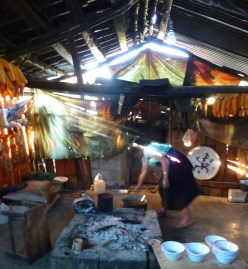
Family kitchen.©2012 Carla Woody.

Family kitchen.
©2012 Carla Woody.

One evening we drove about twenty minutes up to the indigenous village of Chamula to participate in ceremony with Don Xun Calixto.  As we were driving through the village, I saw ladies and young girls washing clothes at the water spring, just like we used to when I was growing up.  That scene took me way back to my childhood days. I felt at home seeing the people working in their gardens, fields, drying their harvest, carrying water from the water spring to their homes, and firewood for the evening loaded on the person’s back and everyone working in harmony, it seemed.

We stopped at the bottom of a hill and walked up the steps to Don Xun’s family home, a traditional brick home with an outside shed-like kitchen where they also kept their harvest of corn, beans, squash, variety of melon, and cauliflower stored. On the open fire-pit was a pot of boiling stew being prepared for our meal with the family.  In the yard chickens were being fed, and the group gathered talking and admiring the craft work the family had for sale.

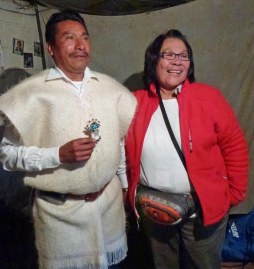
Don Xun Calixto, Spiritual leader of San Juan Chamula, and Charlene Joseph.©2012 Carla Woody.

Don Xun Calixto, Spiritual leader of San Juan Chamula, and Charlene Joseph.
©2012 Carla Woody.

Don Xun  started the ceremony in the main house in front of the altar as we sat around him on wooden benches or chairs.  We sat quietly and watched while one group member did the interpretation.  After ceremony was over, I gave a talk and encouraged Don Xun to continue his and his people’s way of life,  that it is good to find that they are still growing their own food and eating off of the land.  I shared with him that my people, the Hopi, live that way also but that we are slowly forgetting.  I told Don Xun that what I shared are my father’s words that he had wanted me to tell our people from the South and that we are connected.  We are brothers and sisters.  Don Xun was happy to hear this.

I presented him with a katsina rain spirit doll (Corn Boy) and asked him to remember my people on Hopi when he is doing his prayers because we need rain for our corn to grow. I asked him to send the rain clouds to Hopi with his prayers because we have been getting little moisture and we need it for our corn to grow.  Don Xun chuckled and said that they did not get enough rain this year either.

Southern Guatemala

Charlene Joseph and Don Nicholas, who attends San Maximón, in Santiago Atitlán.©2012 Carla Woody.

Charlene Joseph and Don Nicholas, who attends San Maximón, in Santiago Atitlán.
©2012 Carla Woody.

A few days later, we left for Guatemala and were on the road all day.  On the way down to Lake Atitlán, Guatemala, there were cornfields everywhere, all the way from San Cristóbal, Mexico to Guatemala.  I was happy because this made the connection for Hopi, and me personally, even more significant.  Corn is very important to Hopi just as it is to the Maya people in the South.

Lake Atitlán is very beautiful, especially at sunset and sunrise.  The weather was much warmer at night which made it very comfy to sleep.  In the morning, after a night’s rest, we got on the boat to take a 40-minute ride across the lake to Santiago Atitlán, below a volcanic mountain.  There we participated in ceremony with Don Nicholas honoring San Maximón.   After ceremony, we headed back to our hotel to board our private bus for Antigua.  It was a 3-hour ride and we got there around 8 p.m.

Ajq'ij Felipe Mejia (Maya Daykeeper) at Iximche.©2012 Carla Woody

Ajq’ij Felipe Mejia (Maya Daykeeper) at Iximche.
©2012 Carla Woody

Ajq'ij Apab'yan Tew (Maya Daykeeper) at Iximche.©2012 Carla Woody

Ajq’ij Apab’yan Tew (Maya Daykeeper) at Iximche.
©2012 Carla Woody

This time we checked into our hotel for three nights.  On December 15, we drove to Iximche for a fire ceremony with Maya Daykeepers Felipe Mejia and Apab’yan Tew at a sacred place where there are pyramids.  It felt very welcoming to see school children playing games and having a cookout.  It was very lively!  The ceremony was interesting and was very colorful.  Again, I felt a strong connection to the Mayas when offerings were made to the fire with food.  I shared with them that Hopi does the same thing.  We also feed the fire and make food offering to the sun.  There were other similarities that I observed that reaffirmed the history of the Hopi to the Mayas of the South.

Palenque

Temple of the Sun at Palenque, Winter Solstice 2012.©2012 Carla Woody.

Temple of the Sun at Palenque,
Winter Solstice 2012.
©2012 Carla Woody.

Nearing the end of our travels and looking forward to Palenque in the jungle.  We left Antigua, went through border checkpoint, and got back into Mexico on December 17th.  Took the whole day to get back to San Cristóbal where we spent two more nights before heading to Palenque where the great pyramids are in the jungle.

It was amazing!  I can’t even begin to express how I felt when we went to the pyramids in Palenque.  Magazines, movies, and pictures are never the same as experiencing the real thing.  Driving to Palenque through the mountains was awesome, too.  All of a sudden a person or people will come out of the forest, people walking along the road with hoes, wood, carrying traditional pottery filled with water.  Wow!

We visited the pyramids on December 20th.  We did a great amount of walking and climbing at the pyramids.  I managed to climb up several with the help of my group members, and especially Ed from Prescott, Arizona who pulled me up and helped me down.  It was interesting to find that the temples are named for the sun, moon, snake, corn, and others I can’t quite remember.  Hopis honor those same things.  There was a ballcourt and a shrine representing the Twin Warriors and the Grandmother which Hopi includes in the Hopi Way of Life ceremonies today.

December 21st was the day of Winter Solstice in Mayaland.   On Hopi, Winter Solstice is also happening at this same time when the men are in the kiva praying and preparing for the New Year.  A time of sacrifice without sleep, praying and working hard so life can continue. They do this for, not only the Hopi, but for all life on earth including animals, plants, sun, moon, water, Mother Earth and all humankind.

On this Winter Solstice Day, the rain was coming down hard and it had started the night before.  Hoping that the rain would subside, we left at seven in the morning for the pyramids to observe Winter Solstice. Sitting on the steps of the Temple of the Sun waiting and getting drenched, after a couple of hours, some of us decided to go back to our cabanas to dry,   We didn’t get to observe the Solstice because the rain took over until five in the afternoon.  As I always say, things happen for a reason!

This journey to Mexico and Guatemala reaffirmed the Hopi migration and some history from the South for me and the Hopis.  My father talked about Palatqwapi , the Snake Serpent, the Twin Warriors and their Grandmother, and more that they brought with them when migrating from the South.  These are all still very much alive today in the Hopi Way of Life.

My father always emphasized that we need to keep faith and continue the Hopi Way to keep the world evolving. I feel very humbled to have participated in this journey and to be able to honor my father and his knowledge and wisdom in this way.

Categories: cultural interests, Hopi, Indigenous Wisdom, Maya, Spiritual Travel | Tags: , , , , , | Leave a comment

Blog at WordPress.com.