Posts Tagged With: Indigenous traditions

Holy Intent, Invisible Threads

This season is a holy time for many peoples in the world. While multitudes participate fully in—what has become—frenzied materialism, others take a pause or at least strike a balance.

Hopi Ceremonial Calendar by Filmer Kewanyama

Hopi Ceremonial Calendar
by Filmer Kewanyama

Hopi artist friend Filmer Kewanyama says this about December: “The earth’s crust is very fragile. For us, we are supposed to be quiet and reflect on who we are. It is a time for us to be quiet and listen.” This is when storytelling takes place, passing on oral history to the next generation, and the Soyal Ceremony occurs in the kiva, looking to the coming year with great spiritual focus. It’s when the men fashion prayers feathers. Traditionally when Hopi Spirit Keepers have accompanied my groups to Mayalands, they’ve given prayer feathers to those of us holding the center of the journey. The paho, or prayer feather, we each receive is from the roadrunner and meant to protect us as we travel and enter the new year. I wear mine throughout the journey and, upon return home, place each one in a special vessel I keep on my altar.*

This season has become a quiet time for me in the sense that I step back from external activity, a way to remember my own roots, an instilled period of reflection and solitude. And explicitly because there is such space and time for exposure, it’s become heightened with insights, dreams and creative surges for me. Messages come through from the Infinite and that still point inside is given voice.

In that spirit, I’m sharing a dream here that I had early Christmas morning.  I was sponsoring an event, and the person who was to present didn’t show. I knew I needed to step in with an impromptu talk. The audience was getting restless. I thought to speak about the work I believe in: preserving the sanctity of Native traditions to inform the next generations, to bring us back to those core elements that hold the world together. But the words wouldn’t come. How do you express something whose meaning runs so deeply that it can only be felt, that words wouldn’t do justice?

I floundered. Anxiety was showing its face. Just as some of the audience started to collect their coats and leave, Native and non-Native people began to materialize out of the ether to stand on either side of me. Some I knew; others I didn’t. In turn they related the effect, tangible and intangible, that our projects and journeys had on them personally, the importance of continuity toward spiritual grounding, hope, or a wound tended that would otherwise have gone unhealed.

Acknowledge My Relations

Acknowledge My Relations
by Filmer Kewanyama

I came fully awake, feeling resolve to continue holding the vision, even when it seems like few others do, roadblocks appear, or I don’t personally see the ultimate outcome of the intent. For me, these are aspects of true faith realized in this sacred season.

Typically, I don’t remember my dreams. When I do, I know it’s from that invisible realm that retains more wisdom than I do on a daily basis. I would be lying if I said I don’t falter, feel like giving up many times and throwing in the towel. It’s a human condition, especially so when any of us hold a vision that runs counter to the mainstream world, and progress is defying gravity uphill. This is what I sense happens in the kiva: restoring of faith, strengthening of purpose.

True advancements come not from the mainstream but from a collective retaining the holy vision, with understanding how invisible threads may be woven.

That was the prayer feather of my dream Christmas morning that protected me from loss of faith. With renewed intent, I share it here as my own offering—for the circle of life—to guide the next year.

***

Kenosis Spirit Keepers is the nonprofit arm of Kenosis. To learn more about our work, please go here. Your end-of-year donation is tax-deductible and strengthens our mission to preserve Indigenous wisdom for a better world.

The words and artwork of Filmer Kewanyama are used with his full permission. To view a collection of his expressive artwork, go here.

*Most years Entering the Maya Mysteries spiritual travel journeys occur in January.

Categories: cultural interests, Healing, Hopi, Sacred Reciprocity | Tags: , , , , | 5 Comments

Interview with Dianna “Snow Eagle” Henry, Seed Saver

Flordemayo documenting seeds.

Grandmother Flordemayo documenting seeds.
Photo credit: The Path

Grandmother Flordemayo had twice mentioned Dianna “Snow Eagle” Henry to me during my visits to the Seed Temple in Estancia, New Mexico. Each time she lamented, “You just missed her! She was here helping but went back home.”  Home turned out to be Arkansas. When Flordemayo began to establish the Seed Temple, which Kenosis Spirit Keepers helps support, she called Dianna to consult her expertise regarding seed preservation. Dianna has gone back and forth providing service ever since.

The last time I was there, Flordemayo put a book in my hands. Dianna’s coffee table book Whispering Ancestors: The Wisdom of Corn is an illustrated treasure trove of information on Native varieties, some lost to time and then resurrected. In certain ways it takes you back in time by identifying which Native Tribes carried different strains, planting instructions—and hints at the esoteric, ancestral knowledge in the Seed Collective. I was intrigued.

Native Seeds

Native seeds.
Photo Credit: Wisdom of Corn.

Dianna consented to an interview for The Lifepath Dialogues. Below you’ll find the audio recording uploaded to You Tube. She graciously shares how the seed-saving path opened to her, rather unexpectedly as passions sometimes do, and the ways that spiritual knowledge from seeds began to come. One of the many things I appreciate about Dianna is her willingness to follow a path that’s unknown but fueled by intent. She shares it all.

Kenosis Spirit Keepers is pleased to sponsor Grandmother Flordemayo, Dianna Henry and Greg Schoen for events in Phoenix on January 31-February 1, 2014. Greg is also a respected seed saver with many years’ experience and will take us “down the rabbit hole” into the mysticism of seeds. You can read his article about Rainbow Corn in Mother Earth News here.

This Friday night talk and Saturday experiential workshop will directly benefit the Seed Temple’s preservation work. You’re invited to join us and know that—as you are receiving the teachings—you’re also benefiting the wider work of global consciousness.

(Note: The benefit dates mentioned in the recorded interview were changed so that Grandmother Flordemayo could also personally participate, offer her knowledge and prayers.)

Categories: cultural interests, Healthy Living, Indigenous Wisdom, Interview, Sacred Reciprocity, Spiritual Evolution | Tags: , , , , , | Leave a comment

Book Review – Full Moon Feast: Food and the Hunger for Connection

Full Moon Feast

Jessica Prentice is a chef and food activist in the San Francisco Bay area who is an avid proponent for locally grown foods. In other words, she urges us toward tradition. Full Moon Feast is a book about food and more with stories from Indigenous cultures of appreciation for what nourishes. It also tells of challenges and confusion related to relationship with food. Jessica advocates for small farmers who choose to uphold commitment and passion toward their way of life. At the same time, she documents methods of modern food production that have lost their humanity and encourage disconnection from our food sources and each other.

The author calls us back to a more engaged, mindful way of nourishing ourselves by connecting us to what food once held—the circle of life. She grounds the meaning and timing of food selection by our own natural rhythms and the thirteen lunar cycles. This book comforts and takes back to our roots—easily forgotten in a fast food universe. And it’s full of tempting recipes like Salmon Cured with Maple and Juniper, Summer Berries with Lavender Créme Anglaise or Sourdough Cheese Herb Scones. If you allow it, Full Moon Feast will deepen your appreciation for the food in your life and cause you to start searching out locally grown produce as it did me. The book is available through Amazon and bookstores. 

Categories: Book Review, Healing, Healthy Living, Indigenous Wisdom, Sacred Reciprocity | Tags: , , , | Leave a comment

When Hopi Spirits Come to Life: Home Dance at Moenkopi

In July 2009 I was invited by Harold and Char Joseph to Home Dance, the first one in the Hopi village of Moenkopi in 50 years—a very historic event. It’s during this July dance ritual that the Katsina spirits are ushered back to the San Francisco Peaks, the mountain range north of Flagstaff, Arizona, where they live until their return to Hopi in February of each year.*

A friend and I arrived at Moenkopi village outside Tuba City just before dawn. Harold was already leaving home. Moenkopi being Char’s home village, Harold acted as a helper. Normally Harold would have been at Second Mesa’s Shungopavi, already a long time in the kiva, a subterranean chamber reserved for religious rituals, engaged in ceremony in his home village. But this time being quite special he was lending a hand the way relatives do.

The previous night we’d ventured down to the plaza with other family members, carrying chairs, staking out a place in one of several rows already formed. The dirt plaza was long and narrow, enclosed by the original stone homes dating back to the 1870s. I felt like I’d stepped back to another era.

Going Home Shungopavi

Going Home Shungopavi
Oil on canvas
depicting Home Dance.
©2011 Carla Woody

That early morning we sat at the edge of the village with others who had gathered, high on the bluff overlooking the lush cornfields below, a sharp contrast to the red rock cliffs surrounding them. I only discovered later that we actually perched on a kiva. An elder came and asked everyone to move. He slid the wood covering over to reveal its secret and climbed down.

We waited, slightly chilled by the light wind. Glancing around me, some of the people were in special dress, the women in beautiful shawls, and a few young girls wore the traditional hairstyle with fluted buns over each ear. There was a low buzz of conversation and greetings. Everyone waited patiently for the sunlight to hit the cornfields below. A number of pick-up trucks were parked to the side of the fields. In my mind, I converted them to horses. A sound was on the breeze that led me into another time and dimension.

At first it was faint but then it grew, rising up as though from the bowels of the earth. A chant that rose and fell, coming from an area of trees near the field. Those around me went quiet in anticipation, eyes glued, fingers pointing. And finally when the light hit the field just so, Katsinam emerged from the copse forming a single line as they began the slow walk up to the village, carrying cornstalks. It seemed like the line had no end. Finally, all Katsinam came into full view from the woods. They numbered 130, give or take.

As we shifted to our seats at the far end of the plaza, Katsinam poured in one-by-one, forming an ellipsis, continuing the chant, making the small repetitive movements that created the dance, virtually right in front of us. The sound of bells and rattles, strapped to each knee, accompanied each step and joined the drone of their voices. Even though sun now heated the air, I got chicken skin.

They gave cornstalks, a symbol of prosperity, to those watching and gifts of fruit and piki, a paper-thin rolled tortilla made from blue corn. The dancing continued. Then it was time for the first round to end. And the Kachinam left the plaza to be sequestered again. They performed at great sacrifice, foregoing food and water in the blistering sun until much later in the day.

But it was now time for the rest of the village to eat. We returned to the Joseph home and feasted on hominy stew and drank strong coffee. When the phone rang, I’d hear them tell the person on the other end, “Come eat!” One of the family members told me, “This is the Hopi way!” Indeed it was. As people poured through the door, they were directed to grab a plate and ladle a good helping.

The Katsinam were to dance eight times that day. Between dances families and friends gathered at homes, many from out of town it being such a special time. Each time food was shared. We were encouraged to nap in the heat of the day—which I did, in a room full of people that felt like family to me even though it was my first time meeting some of them.

How was it that this was the first Home Dance in Moenkopi in 50 years? Many Hopi people have fallen away from the traditions, and the necessary initiations haven’t occurred to support the ceremonies. Shungopavi is the only village that keeps the complete cycle of religious ceremonies unbroken, the elders staunch.

A strong older woman instigated the 2009 Home Dance. Her son was marrying. She wanted to show off the wedding robes of her son’s bride as part of the ritual. Other brides would be able to do the same. Through her commitment the village re-engaged, others coming from elsewhere to support the ceremony, accounting for the large number of Katsinam, a profound example of what determination can do—and for good cause. Traditions take us back to where we began. For my part, an appreciative outsider greatly stirred by the experience, I hope the Home Dance continues in Moenkopi. At this writing, it’s recurred once. That was in 2011.

***
*A Katsina is a spirit being of the Pueblo Tribes, an invisible natural force that can be called upon to bestow protection and wellbeing for the village. Katsinam is the plural form. In the Hopi tradition there are approximately 400 different Katsinam, each one different and having a separate purpose. For days prior to religious dances, initiated males enter the kiva and undertake long rituals. When they emerge from the kiva to dance, they are no longer who they were when they entered. Instead, they are the embodiment of these powerful spirit beings, dancing in human form, on the earth.
***
I will sponsor Spiritual Travel to Hopi: Sacred Guardians of the World during March 6-9, 2014. This is a rare chance to experience Hopi Spirit Keepers in their homes, hear the ancient stories, visit sacred sites, learn about medicine ways and attend the Night Dances, all that weaves the very identity of the Hopi people as guardians of the world. Only recently is it now possible to be invited to such an experience. It’s only through relationships I’ve developed over a number of years that this program has been born. Join us for this adventure of the spirit! Early registration discount ends November 6. A portion of tuition is tax-deductible to support Kenosis Spirit Keepers’ projects preserving Native traditions.
Categories: cultural interests, Hopi, Indigenous Wisdom, Sacred Reciprocity, Spiritual Travel, Travel Experiences | Tags: , , , , , , , | Leave a comment

Book Review: The Last Report on the Miracles at Little No Horse

The Last Report on the Miracles

In The Last Report on the Miracles at Little No Horse, Louise Erdrich has written a book that transports the reader not only to another time, but also to a field where all could dwell with increased respect and understanding.

Agnes is the main character, an inventive person of strong character who found a way to deal with living in a time when women had few choices—the early 1900s. Timing, opportunity and a desire to leave her old situation behind allowed her to step into the identity of Father Damien Modeste, a priest who was expected shortly at a remote Ojibwe reservation in North Dakota called Little No Horse. The narrative takes us over nearly a century of what it was like to have a foot planted in both worldsa woman living as a manministering in one culture yet not intruding with another, developing roots and living with a sporadic fear of one day being found out. Would everything Father Damien built in his beloved community, all trust and love given to him, be discarded if Agnes was discovered?

The telling of this chronicle comes about through the investigation of one Sister Leopolda who is up for sainthood. When the church’s emissary comes to interview Father Damien, we have the opportunity to witness a life well lived, intricately woven and deeply connected to community. Not the life of Sister Leopolda but that of Father Damien.

Equally important is the telling of the Obijwe traditions, the sometimes funny and bizarre antics of medicine man Nanapush and the difficulties often endured. Peppered throughout are enormous gems of wisdom. A couple of examples are shown here.

…even careful plans cannot accommodate or foresee all the tricks of creation…

…We see the seasons pass, the moons fatten and go dark, infants grow to old men, but this is not time. We see the water strike against the shore and with each wave we say a moment has passed, but this is not time. Inside, we feel our strength go from a baby’s weakness to a youth’s strength to a man’s endurance to the weakness of a baby again, but this is not time, either, nor are your whiteman’s clocks and bells, nor the sun rising and the sun going down. These things are not time… (Nanapush)

It’s also punctuated with Father Damien’s frequent, unanswered notes to the Pope such as this one.

Pope!

Perhaps we are no more than spores on the breath of God, perhaps our life is just one exhalation. One breath. If God pauses just a moment to ruminate before taking in a new breath, we see. In that calm cessation, we see. All I’ve ever wanted to do is see.

Don’t bother with a reply.

Modeste

The characters in this novel are so rich and their stories so resonant, there’s a part of me that secretly hopes the writings are based on fact. They have an underlying inherent truth. Life is indeed layers of complexity, with all its attendant emotions. Here it’s delivered to us through Agnes and Father Damien, their voices intermingled. This book is much more than entertainment, and it’s one of my all-time favorites.

Available on Amazon and retail bookstores.

Categories: Book Review, cultural interests, Indigenous Rights, Indigenous Wisdom | Tags: , , , , | Leave a comment

Seed Intelligence: Indigenous Perspectives and Our Collective Birthright

In October 2010, Flordemayo was in Los Angeles attending a conference. At break she returned to her room on the 23rd floor. Before lying down to rest her eyes, she noticed an emerald green glow on the wall. When she opened them again the light had taken up the entire wall and a vision unfolded. “There was a panoramic landscape and everything was emerald,” she said. “It was so beautiful that I said to myself, ‘I’m going into this light.’ I have absolute memory of walking in a field dialoguing with everything. I noticed a mountain to my right. Then everything began to change! At the top, it split and there was movement like an avalanche! The forest and everything in it came tumbling down—trees, animals, stones, water. It crossed the road below and I saw that all domestic life was being swept away! I thought, ‘I have to get to my cornfield!’ I was praying and running as fast as I could, and then I’m grabbing the yellow corn, the blue, the red, the black…and then I grabbed all the rainbow corn I could grab! I bundled all the corn I could carry up in my long skirt. But I couldn’t run fast enough! I heard a voice from above, ‘Flordemayo! What are you doing? The military is coming!’ I answered in a cry to the Universe, ‘It just doesn’t matter anymore!’ Then I was standing in the hotel room again facing the wall. The emerald light was gone. I had tears in my eyes. I fell back on my bed. I was devastated.”
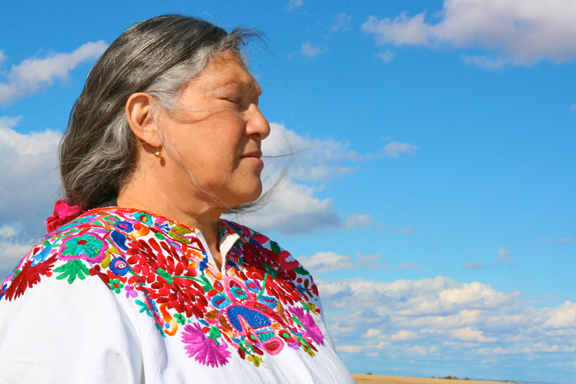
Flordemayo

Grandmother Flordemayo
Photo credit: Linda Rettinger

As a young child, Flordemayo was recognized as a seer. By the age of four, she had already begun her training as a curandera espiritu, a healer through divine spirit, a gift inherited through long family lineage, originating from the Maya highlands of Central America. She is a member of the International Council of 13 Indigenous Grandmothers, standing for peace and healing of the Mother Earth. When messages come strongly, Flordemayo knows to answer them—no matter the obstacles.

What is the timeliness of this vision?

Apab’yan Tew is an Ajq’ij, a Day Keeper, and spiritual guide of the sacred K’iche Maya tradition from the village of Nawalja’ in Sololá of the Guatemalan highlands. His ceremonial work most often takes place in caves, engaging with resident energies of the natural site and timing of the Tzolkin calendar in conjunction with needs of communities or individuals. Like Flordemayo, his gifts evolved from childhood until he ultimately answered the call through a series of difficult shamanic challenges.

Apab'yan Tew

Apab’yan Tew
Photo source: Apab’yan Tew

Apab’yan elaborates on the Maya worldview: “We cannot be who we must be without the land. Another principle is that the body we have is not really ours. It is lent from the Mother Earth herself. So if you create any kind of danger to your body, you are also hurting the Mother Earth. What the Earth produces and what we produce is part of the same cycle, the same system. We are not separated from the Earth—and the Earth is not to be thought of as just another provider of goods. The term that is used in the West is ‘natural resources’ as something to be taken, something to be transformed. For us, we don’t use this term. We use the term ‘elements of life.’ It is our life! It is not a resource.”

In Indigenous traditions, every aspect of life is integrated and sacred. This Maya spiritual leader is quite clear that to surpass a cycle creates imbalance. Nothing should be moved from its place in the Universe. His people think of the seed as a living feminine entity, not a commodity. There is a proper way to carry her, to talk to her, the Sky and the field in the act of sowing according to specific timing. This in itself is a ceremony, integration of a flow that already exists and must not be taken from those like himself who hold these ways close.

There are those who seek to eradicate the sacred ways.

Apab’yan talks about the Maya ways of respect: “It is our purpose not to take more than we can give back. But it is also our purpose not to change. We must not touch what is not ours. It is not ours from the beginning. It is ours to have a dialogue. The seeds talk to us. We have five seeds. Only one of the five is for us. One is for the Sky. One is for the Earth. One is for the brothers in the fields. Maybe there’s a crow that’s going to come. The last one is for anybody who needs it. In my harvesting, maybe I’ll have some extra seeds to give to someone or sell them. There’s no harvesting for commercial purposes. But we have extra if someone needs it. We are Corn Beings. So we must not even play with the seeds.”

He believes there is no current problem with GMO seed infiltration in the high altitude area of his village: “You don’t sell milk to a cow!” For the Guatemalan highlands, there’s not enough room for the politics of Monsanto. What the West calls “organic” these Maya farmers have been doing for eons—and the best selection has long ago been made. However, he sees a danger as any of his people become more influenced, perhaps by emigrating and then returning home, to set aside their ancient ways of living.

That same protection isn’t available to Native and heritage farmers in the US. Five years ago I sat in a conference session and heard a Zuni man sadly express the fear he held: the real possibility of GM seeds blowing into the fields that he and his ancestors had planted with their pure Native strain for hundreds of years. It was disheartening and outrageous.

If the spirits of Earth and Sky are no different than the seeds they sow, the food they eat, what their bodies are made of…then to tamper with any part is an outright act against religious freedom and quality of life, rights the US constitution is supposed to uphold. For giant agribusinesses to also attempt to spread their seed where people have few rights equates to preying upon those who have a voice but are ignored. When spiritual tradition falls apart, grounding dissolves; detrimental influences make additional in-roads; suffering takes over—a process proven over history. Spiritual pride is lost; ethnic groups are additionally marginalized.

A grassroots movement has sprung up.

Learn About GMOsPeople are starting to come together, much as in past times of threat or needed change. Coalitions are appearing like GMO-Free Prescott, a small, volunteer-run nonprofit organization in Prescott, Arizona specifically formed to educate and support everyone’s right to choose food and products that have not been genetically modified. Founder Shea Richland states, “I got involved due to health issues when I was leaving ‘no stone unturned’ to find answers. The more I learned, the more concerned I became. When the documentary Thrive was being shown in our area, I felt it was an opportune time to do more. So, GMO-Free Prescott was born. If people were walking what the Native people teach, then our organization wouldn’t be necessary.”

Winona LaDuke, an Anishinaabekwe (Ojibwe) enrolled member of the Mississippi Band Anishinaabeg, is known as an environmental activist. She is the Executive Director of Honor the Earth, where she works on a national level to advocate, raise public support and create funding for frontline Native environmental groups. She lives and works on the White Earth Reservation. Her organization offers a number of naturally derived products that may be found via Native Harvest online to help fund the White Earth Land Recovery Project.

Winona LaDuke Source: Native Harvest

Winona LaDuke
Source: Native Harvest

She shares this: “When I was a young woman, my father would listen to me patiently, with great compassion, as I explained to him the many environmental issues facing our community and the complexities of the world. His name was Sun Bear, or Vincent LaDuke. He used to tell me, ‘Winona, you are a smart young woman, but I don’t want to hear your philosophy unless you can grow corn.’

I remembered this for many years but was not as smart as he thought. It took me until the turn of the millennium to become a corn grower. I thought about this often and wondered about the corn varieties my ancestors in northern Minnesota would have grown. I began a quest, one of many. The first corn that came to me was a Bear Island Flint corn, eight to twelve inch, multicolored cobs. The seeds were gifted from Ricardo Salvador, then a professor at Iowa State University. He had found them in a seed bank. The corn came from an island in the middle of Leech Lake Reservation, where I later learned, after many interviews and much research, that our people often grew corn on islands, away from predators, in micro-climates surrounded by water. Ingenious. We began to grow. Then, I moved onto Manitoba White Flint, the northernmost varieties of the Ojibwe, grown about 100 miles north of Winnipeg.”

Winona notes the importance of growing Native seeds and seed saving: “Never a crop failure after all these years with this corn! It is hearty (with) twice the protein and half the calories of market corn. And it is resilient. (Through) frost, drought and high winds, it stays. We were the northernmost corn growers in the world. And yet, we had lost much of our corn and our seeds. So, we have grown that corn now for a decade. Again…resilient. Monsanto’s crops failed in 2012, but ours did not. We are grateful. That was the beginning. Today, we are growing an 800-year-old squash, found in an archeological dig in Wisconsin. And we are growing many other varieties. It is our hope to create a northern Anishinaabe seed bank.”

The vision that Flordemayo received was a strong message coming from the Creator to uphold the welfare of our interconnections. As she accepted what seemed like a monumental task, things quickly began to fall in place—as it so often does when a vision is true. Exactly the funds required to purchase the forty acres of land that came available near her home in Estancia, New Mexico appeared. She established the Seed Temple as a volunteer-run project under her nonprofit organization, The Path. Smaller donations came to excavate the underground seed vault, construct the classroom building that covers it, and to create its accompanying medicine circle and fire temple. Flordemayo said, “You can’t have plants without water. We need a place to go and pray…to hold the spirits of water and plants in prayer.”

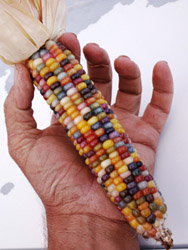
Rainbow Corn

Rainbow Corn
Photo: Greg Schoen

Local volunteers and those from some distances come regularly to continue building and advise. Greg Schoen is one of them. He’s impassioned about seed preservation: “Crops are being stripped and ‘dumbed down,’ the diversity bred out of them. When we do this to the corn, we do this to ourselves.” He got his start as a seed saver in the mid-1980s receiving his original “Glass Gem” jewel-like kernels from Carl L. Barnes, a mixed blood man of Cherokee/Irish/Scots ancestry now in his eighties living near Liberal, Kansas. Over the years, Greg received other Native varieties from Carl, planted them himself and gifted them to such organizations as Native Seeds/SEARCH in Tucson, Arizona.

“I think of corn as holding a knowledge, like a recordkeeper. Sometimes when Carl would grow corn in his fields, Native strains that had gone extinct would re-emerge. When Native people here lost the corn they carried, it’s like they lost the central point that anchored them to the land, like they lost their language. So, when Carl would reintroduce their ancestral corn to them, they would light up. It would be like you were wandering in the desert and your ancient scrolls were returned to you!”

Greg freely gifts baggies of “Glass Gem” seeds to anyone who wants them. In the coming year he will plant at the Sufi community near Silver City, New Mexico where he now lives. When asked what direction the Seed Temple would take, he said, “We’re starting to provide educational support to seed savers. There will also be a ‘seed lending library.’ Individuals can take portions of the seed stock of one of more items from the seed bank, with the agreement that they will grow out the seed according to proper growing practices, and return a portion of the seed produced to the seed bank. Those are just some of our plans.”

Flordemayo affirmed Greg’s statement and added, “The seed has a spirit, but it doesn’t have a voice. We are giving the seeds a voice! We are welcoming Native and heritage seeds from growers. The only restriction is that the seeds are organically grown; and we know where they came from and who is growing them. So we need to have documentation in receiving them.”

Kenosis Spirit Keepers is the volunteer-run nonprofit I founded to help preserve Indigenous wisdom traditions. We see the Native seed issue as an integral aspect of Indigenous spiritual traditions and are helping to support the Seed Temple. More is still to be done in the way of construction and obtaining all things necessary to start up and maintain. One way Flordemayo plans to help fund the project is through classes in the growing and use of medicinal herbs, sacred bathing, and vision and dream work. She has turned the Hogan, located next to the seed vault, into the Temple of the Golden Child, which will be used for this purpose.

More and more independent seed saving operations are being established in pockets around the globe. Greg Schoen continues to quietly do what he can to preserve our heritage by sharing his passion, experiences and seeds with others on a similar track. Shea Richland believes so strongly in our birthright for health and well-being that she reluctantly stepped into the public eye to form GMO-Free Prescott and educate regarding our choices. Winona LaDuke works at the national level through organized environmental activism. Flordemayo answered a vision. Apab’yan Tew performs ceremonies for the well-being of the planet in the dark recesses of caves.

It takes all of us, each bringing our own way, in the face of such forces that would act against us, to support and maintain our collective birthright—and succeed.

***

This article is being incorporated into the Anishinaabekwe (Ojibwe) Farming Curriculum that will be part of the Tribal Community Colleges in the region where Honor the Earth Foundation is active.

***

Kenosis Spirit Keepers is sponsoring Grandmother Flordemayo and seed savers Greg Schoen and Dianna Henry for events on January 31-February 1, 2014 in Phoenix, Arizona. The proceeds from ticket sales go to support the seed saving project founded by Grandmother Flordemayo. For information and to purchase tickets, please go here.

***

Sources:

Interviews with Flordemayo, October 17, 2012 and February 1, 2013.

Interviews with Greg Schoen, October 17, 2012 and February 8, 2013.

Interview with Apab’yan Tew, November 6, 2012.

Interview with Winona LaDuke, November 27, 2012.

Interviews with Shea Richland, November 9, 2012 and January 2, 2013.
Categories: cultural interests, Indigenous Rights, Indigenous Wisdom, Sacred Reciprocity, Uncategorized | Tags: , , , , | 4 Comments

The Dream Is the Reality

Dreams are usually pushed asidemeaningless, inconsequential snippets of brain junk that visit us in the night when our defenses are down. Don’t be so fast to dismiss them. Under certain conditions, they are only too relevant. If you don’t pay attention, then you miss the message and actual guidance.

As Above, So Below ©2012 Carla Woody

As Above, So Below
©2012 Carla Woody

When I’m mentoring people I suggest they be aware of their dreams in the course of our work together. Most say they don’t remember them at all, or they slip away so quickly it’s like grasping at clouds. The same is true for me. However, when I’m in the midst of deep transformation, dreams become more than memorable. They’re emblazoned on my consciousness and part of my evolutionary process. This is also true for those who enlist me to help guide their process.

I take time in the beginning of our session for a check-in, an opportunity for folks to relay insights or things that have come up since the last time. What emerges is often a direct communication from the unconscious on where to focusand we hit pay dirt. Here’s a case in point. I’m changing the name to protect my client’s privacy. Grace said she’s happy to have her story shared in case it helps someone.

At the tail end of our check-in, Grace mentioned she’d had a dream that morning. She spoke about “not getting up right.” I immediately noticed her agitation. She told the small pieces she remembered and added that the dream had awakened her, leaving her disoriented and angry. Strong emotions were evident as she spoke. She said she felt betrayed. I was clear this was a message from a part of her we had been working with that was now ready to release a pattern. With permission, I stabilized the bodily felt sensations attached to the emotions in order to use them as guidance, going back to the originating occurrence. Almost immediately, she returned to the age of two awakening in a similar manner as the dream but with emotions that were intense. I’m going to preserve the details of the situation but will offer this. The incident wasn’t a severe trauma in the way we might think of it. However, it was traumatic in the sense of a two-year-old perceiving no options, feeling trapped.  That perception had affected her all her life in ways that held her back and kept her stuck. The dream was the message that allowed us to reframe the past incident and open a future toward freedom of movement and options that she’s not experienced before. She later told me that she knew about that incident, hadn’t thought of it in a long time, and hadn’t seen it important. Obviously, a part of her did.

Dreamtime and the Vision Serpent ©2013 Carla Woody

Dreamtime and the Vision Serpent
©2013 Carla Woody

In many Native traditions, dreams are interchangeable with daily reality. One bleeds over to the other. Children learn how to behave in their dreams without their parents teaching them. Medicine people receive their calling. Ritual musicians learn to play their instruments. Weavers receive requests from saints for new vestments. Warnings come. All of these things are received through dreams and given relevance.

In my new novel Portals to the Vision Serpent, a Maya woman receives her calling this way.

“For me, it started like this. When I was thirteen years old I had a dream. I was walking through my village like I was going somewhere, and I needed to be there fast. But every place I passed, it wasn’t the place I was supposed to be. Then suddenly the road wasn’t dirt anymore. It turned into a creek, and I was floating along, being taken with the waters. But it was gentle. I wasn’t afraid. I could see there were many fish in the creek swimming all around me. And still the water took me past many houses. My mother was there when I went by, and she smiled at me. I saw my grandmother, too, and other women. More and more came and stood by the banks of the creek as I floated by, until I was no longer in my village.” Her eyes grew moist.

“Something woke me up then. I opened my eyes. And the room was glowing—a beautiful blue! I wanted to tell my sisters, but I saw they were asleep. And then in the corner of the room, I saw a woman in a long dress. But it was hazy, like I was seeing her underwater. Her hair was wrapped in a cloth. There was white light all around her and when she moved, this light moved. She came over to my bed right there and reached out her hand like she would touch me. And the light came from her hand, and I felt it with my whole body, like such a love came to me that I have never felt. I feel it now when I tell you this. And we stayed like that, she and I, for what seemed to be a long time. Still my sisters slept. And I knew something was happening just for me. Slowly she disappeared, and then the blue glow left. It was just the bedroom again.”

Doña Flora’s eyes shone, her face serene. Her body radiated, the very act of recounting her calling activated a luminescence that only became stronger with the silence she now held. Tears leapt from Sybilla’s eyes but, transfixed, she didn’t reach to wipe them away. After a time, Doña Flora shifted in her chair and spoke softly, “Yes, this is how it first happened.”

Now, an interesting thing happened related to this excerpt. Shortly after I’d written this chapter a well-known Wisdom Keeper came to stay in my home for a few days. Over breakfast, she recounted how her calling came, very similar to the waking dream that I had written, down to the blue glow. The synchronicity is astounding to me. I also believe that, sometimes, the dream is relayed through writing, just another channel.

Over the years, the night dreams I remember have served me well. They’ve foretold a path I’d take, attempted to warn me off another and repeatedly kept me on track. They’ve lent metaphoric meaning to the past and future in ways my conscious mind doesn’t always grasp but a deeper aspect does. When they’ve chosen to show themselves in a way that I can recall, they serve as allies on a path that is sometimes invisible.

We need to be intuitive enough to heed the guidance and the way it points. The dream is the reality.

***

What are some ways you’ve received important messages in your dreams? I invite you to share them in the comments space below.

Categories: Healing, Indigenous Wisdom, Spiritual Evolution | Tags: , , , , , , | Leave a comment

What You Can Do in the Face of Devastation and Make a Difference

I received a very disheartening message. I want to share it with youeven though research statistics show that most people would prefer to see uplifting blog content. My feeling is there are just things I can’t ignore. I discount that, due to the immensity of a travesty, I can do nothing about it. That would be the easy way out, to push something aside.

I subscribe to Glenn Shepard’s blog Notes from the Ethnoground. Glenn is an ethnobotanist, medical anthropologist and filmmaker who lives in Brazil and has spent many years doing on-the-ground research in remote rainforest places. Yesterday his latest post ”A letter of protest: In defense of the rights of indigenous peoples and traditional populations in Amazonia” arrived via email. 

The post is about a proposed change to a law currently in the Brazilian House of Representatives “to make changes to Article 231 of the Brazilian Federal Constitution of 1988 defining the public interest in demarcating Indigenous Lands.” It has to do with ancestral land rights of the Indigenous peoples of Amazonia. If passed, it would take away many of their rights in favor of those who have encroached: cattle ranchers, mining operations and more.

Guarani People

Photo credit: Survival International

This is not a new issue. It has been going on for decades with terrible consequences. Not only is the rainforest threatened but Terena, Guarani and other Native peoples have been murdered in defending what is theirs. We rarely hear of these things because they don’t get reported. I did some research of my own and turned up this August 8 news article from the Guardian in the UK. It reports on the killing of a Guarani man believed by Survival International to have been ordered by a landowner, as well as other murders of Native peoples numbering “452 between 2002 and 2010, sharply up on the 167 killed during the previous eight years.” The article accuses the Brazilian government of “pandering to agro-business lobby rather than reallocating areas to indigenous peoples.”

Guarani and Kaiowa Indians are in conflict with ranch owners over the allocation of land in Brazil. Photograph: Celso Junior/AP

Guarani and Kaiowa Indians are in conflict with ranch owners over the allocation of land in Brazil.
Photograph: Celso Junior/AP

 If you’ve read this far, then you likely recognize a familiar story. Although the struggle of the Indigenous people of Brazil is especially heightened, similar things are happening in Native lands the world over. It’s a form of genocide. When the right to live on their own lands, grow their own crops and perform their own religious ceremonies is taken away, it’s devastating.

Have any of you ever lost a home? Been told your religious practices are evil, antiquated or ridiculous? Has your voice not been heard? Probably many of you have had such experiences. For traditional Native people, connection to ancestral lands, community, the foods they grow and ceremonies runs deep. It’s a matter of survival and what keeps them spiritually grounded. Take away these things and a sense of identity vanishes.

What to do about such things? It’s not an easy answer. Personally, I founded Kenosis Spirit Keepers  in 2007, a grassroots volunteer-run nonprofit organization, expressly because I believe so strongly in the contributions that these traditions make to the betterment of the world through continued existence.

Has it been a walk in the park to support projects we’ve committed to fund? No. We’ve had to be very creative to do so. I wish we were able to do so much more.

Does it feel to me as though my efforts and those of my board are like lonely raindrops in the wind? You better believe itespecially when I hear about such things as Glenn reported.

Yet, I can’t turn away. No matter how discouraged and tired I get…I just can’t. That’s because I truly believe the more people who feel the way I doand stay strong in that intentthat the tides will turn. We can make a difference. Looking back in history, I see the shift has happened too many times not to believe in what’s possible. I hold that you do, too.

***

Kenosis Spirit Keepers

To learn more about Kenosis Spirit Keepers and how you can help preserve Indigenous wisdom traditions, go here.

Categories: cultural interests, Indigenous Rights, Indigenous Wisdom, Sacred Reciprocity, Spiritual Evolution | Tags: , , , , | Leave a comment

Lifepath Dialogues Gathering: The Question of Spiritual Responsibility (Audio Archive)

Lifepath Dialogue Gathering

The Lifepath Dialogues Gathering was a local monthly gathering held in Prescott, Arizona. The intent was to build like-hearted community and dialogue about what truly matters. I chose monthly topics from my blog and hosted the evening with special invited guest(s) whose philosophies and work are relevant to the topic. The format involved my presentation of material to create a framework and interview of the special guests. This portion was recorded to share with the world community. Then we turn off the recorder and turn to intimate sharing.

The Lifepath Dialogues discussion will now continue in a virtual format. Periodically, I will interview folks world-wide who are involved in life-affirming practices and lifeways. The recording will be posted here. I invite your comments and questions always.

From the March Lifepath Dialogues Gathering

with special guest

Filmer Kewanyama:
The Question of Spiritual Responsibility
The complete unedited audio is about 40 minutes long. Click below to listen. I hope you enjoy.

This discussion was based on the post:
Spiritual Responsibility? Duty? Cargo?
By Carla Woody
Author of Calling Our Spirits Home and Standing Stark
Founder, Kenosis and Kenosis Spirit Keepers

Filmer Kewanyama Photo

Filmer Kewanyama is an award-winning Hopi artist from Shungopavi, Second Mesa, Arizona, whose work depicts the sacred Hopi way of life. He learned the ceremonies that his ancestors passed on to him. Such knowledge comes with its own set of responsibilities, complicated by modern life.

Categories: cultural interests, Hopi, Sacred Reciprocity, Spiritual Evolution | Tags: , , , , , , | 1 Comment

March 27 Lifepath Dialogues Gathering: The Question of Spiritual Responsibilty

Lifepath Dialogue Gathering

Exploring the many threads that weave together an expressive, celebrated life.

MARK YOUR CALENDAR AND JOIN US FOR DIALOGUE THAT MATTERS

You are invited! Please pass to friends and family.

MARCH 27, 6:30-8 PM

FREE Gathering

Creekside Center, 337 N. Rush Street, Prescott, Arizona

March topic:

“The Question of Spiritual Responsibility”

Based on the post: “Spiritual Responsibilty? Duty? Cargo?
By CARLA WOODY
Author of Calling Our Spirits Home and Standing Stark
Founder, Kenosis and Kenosis Spirit Keepers

SPECIAL MARCH GUEST:

Filmer Kewanyama Photo
FILMER KEWANYAMA

Filmer Kewanyama is an award-winning Hopi artist from Shungopavi, Second Mesa, Arizona, whose work depicts the sacred Hopi way of life. He learned the ceremonies that his ancestors passed on to him. Such knowledge comes with its own set of responsibilities, complicated by modern life.

Email: info@kenosis.net or call 928.778.1058

Categories: cultural interests, Hopi, Maya, Sacred Reciprocity, Spiritual Evolution | Tags: , , , , , | 2 Comments

Blog at WordPress.com.