Posts Tagged With: Mysticism

Book Review: Acedia and Me – A Marriage, Monks, and A Writer’s Life

acedia

If you are one of those people who is unrelentingly committed to a path, particularly one that the world may little understand, and yet you have periodically fallen into doubt, there is actually a name for this affliction – much to my relief. Doubt is not really a good word for a state that can reach a level of deep despair and sense of futility. And yet it’s not depression in the clinical sense.

Acedia was included in the “eight bad thoughts” of the desert monks but was later inexplicably dropped when translated into the Catholic Church’s “seven deadly sins.” If only over the years I would have had a word for it, not as a sin but as a thought that can assail a person who has monkish tendencies or artists, advocates and others who probe the edges of convention. Then there could have been a level of comfort and normalcy in the experiences. But instead, the term and understanding of it was dropped into time, to be hidden in little known annals or diaries of people who had the courage to express it.

Kathleen Norris has done many of us a favor by writing a book about acedia, giving many personal examples and historical references. Taken from the book, “… the monk struggling with acedia is dealing with more than bad moods, psychic fluctuations, or moral defeats. It is a question of resolve that arises in the wake of a decisive choice for which the monk has risked his life’a danger to anyone whose work requires great concentration and discipline yet is considered by many to be of little practical value…”

Along with the author’s own writings, a real plus is in the last chapter, a collection forty-odd pages long of quotes, personal experiences from such luminaries as John of the Cross, Emily Dickinson, Petrarch, Dante, Evelyn Waugh and many others. Sometimes it helps to name something and I can sense a future essay of my own percolating. Read a Q&A with the author, plus an excerpt.

You may recognize the author’s name from her other books such as The Cloister Walk and Dakota: A Spiritual Geography. Read this latest book if your path has ever taken you into an unnamed state that may be acedia—or if you anticipate it could.

Available on Amazon and elsewhere.

Categories: Book Review, Personal Growth, Spiritual Evolution | Tags: , , , , , | Leave a comment

January 23 Lifepath Dialogues Gathering: Voice and Expression

Lifepath Dialogue GatheringExploring the many threads that weave together an expressive, celebrated life.

MARK YOUR CALENDAR AND JOIN US FOR DIALOGUE THAT MATTERS

You are invited! Please pass to friends and family.

JANUARY 23, 6:30-8 PM

FREE Monthly Gathering on Fourth Wednesdays

Creekside Center, 337 N. Rush Street, Prescott, Arizona

January’s topic:

“Voice and Expression”

Based on the post: “Voice and Expression”
By CARLA WOODY
Author of Calling Our Spirits Home and Standing Stark
Founder, Kenosis and Kenosis Spirit Keepers

SPECIAL JANUARY GUEST HOST:

YAQIN LANCE SANDLEBEN

Yaqin Lance Sandleben Photo

Yaqin Lance Sandleben is a Cherag, an ordained minister of American Sufism following the Chisti Sufi lineage of India. He leads the Dances of Universal Peace, Universal Worship Service and offers guidance on the path of spiritual awakening. Yaqin lives in Prescott, Arizona, where he has practiced pharmacy for 35 years, raised a family, and served the community in different ways—mostly through volunteering.  His interests in religion, spiritual development, and the awakening process began at the age of 12 in the Christian Church.   For many years he studied well known and obscure paths of awakening.  He began meditating 40 years ago and embraced American Sufism 33 years ago.   He has also studied and practiced Buddhism with many teachers, including HH the Dalai Lama and other Tibetan teachers.  His Sufi connection has led him to India, to the shrines of saints, and to the study of Raga, Indian Classical music.

Email: info@kenosis.net or call 928.778.1058

Categories: Healing, Healthy Living, Meditation, Spiritual Evolution, Uncategorized | Tags: , , , , , | Leave a comment

Lifepath Dialogues Gathering: The Ways of Inclusion (Audio)

The Lifepath Dialogues Gathering is held on the fourth Wednesdays, 6:30-8 PM, at Creekside Center in Prescott, Arizona. The intent is to build like-hearted community and dialogue about what truly matters. I choose monthly topics from my blog and host the evening with special invited guest(s) whose philosophies and work are relevant to the topic. The format involves my presentation of material to create a framework and interview of the special guests. This portion is recorded to share with the world community—wherever you are. Then we turn off the recorder and turn to intimate sharing.

The November 28 Lifepath Dialogues Gathering:

The Ways of Inclusion

The complete unedited audio is about 40 minutes long. Click below to listen. Please be patient as it may take a few minutes to download! I hope you enjoy.

This discussion was based on the post: The Gift of Mother India

By CARLA WOODY
Author of Calling Our Spirits Home and Standing Stark
Founder, Kenosis and Kenosis Spirit Keepers

Yaqin Lance Sandleben PhotoNovember’s special guest was Yaqin Lance Sandleben. Yaqin is a Cherag, an ordained minister of American Sufism following the Chisti Sufi lineage of India. He leads the Dances of Universal Peace, Universal Worship Service and offers guidance on the path of spiritual awakening. Yaqin lives in Prescott, Arizona, where he has practiced pharmacy for 35 years, raised a family, and served the community in different ways—mostly through volunteering.  His interests in religion, spiritual development, and the awakening process began at the age of 12 in the Christian Church.   For many years he studied well known and obscure paths of awakening.  He began meditating 40 years ago and embraced American Sufism 33 years ago.   He has also studied and practiced Buddhism with many teachers, including HH the Dalai Lama and other Tibetan teachers.  His Sufi connection has led him to India, to the shrines of saints, and to the study of Raga, Indian Classical music.

Categories: Compassionate Communication, Healing, Healthy Living, Meditation, Personal Growth, Spiritual Evolution | Tags: , , , , , | 2 Comments

The Holy Places

A Chance Encounter

In July 2012 I visited Ireland with my folks. We’d driven to the Cliffs of Moher finding the coast socked in with fog, nothing visible. Somewhat disappointed, we continued on the narrow, winding road toward the village of Liscannor following the map back to the cottage where we were lodged miles beyond. I almost didn’t see the small sign pointing off to the right that said: Saint Brigid’s Holy Well.

At the time, I didn’t know anything about Saint Brigid or Ireland’s holy wells. But I did know that springs, caves and other natural formations are often special places of ceremony and prayer for ancient and present-day peoples who connect with the Creator through those means. Due to the countless rituals and natural properties of such sites, pronounced energy resides in an ongoing way, a container. I’ve experienced many of them.

Shrine

Altar at Saint Brigid’s Holy Well.
Photo: Carla Woody

 Saint Brigid’s Holy Well

The holy well wasn’t immediately apparent. In fact, we doubled back on the country lane that took us way back in farmers’ fields to return to the original intersection. On top of the hill was a cemetery but below was a small courtyard. Tucked into the hill was a slit just wide enough to hold one person. Visible even from the outside, figures of saints sat in a tight row leading into the darkened inner chamber; layers of rosaries adorned them. The short path ended in front of the spring. Prayer cards, handwritten messages and photos of loved ones covered the walls. One step inside and there was no doubt that we had entered sacred space; the energy was palpable. Petitions for healing, devotion and hope hung in the air. My mother said she felt sadness. I’m sure that was present, too.

But there was also celebration and gratitude. The note from five year-old Jimmy Delany said that at three weeks old he stopped breathing in his mother’s arms. He was revived but in a coma. He recovered without the side effects expected by the docs—that he’d be a “vegetable.” “Unexplainable,” they said.

Jimmy Delany's Note of Thanks

Jimmy Delany’s note of thanks.
Photo: Carla Woody

Holy Waters

Holy Waters
Photo: Carla Woody

I stayed there for quite a while, long after my folks went ahead to the cemetery, and performed my own ritual. Kneeling before the spring, I dipped my palms and brought the waters over my head, whispering my own prayer. And in that moment, I felt the sweetest sense of fullness, an energy transmission that deposited itself in my sacral chakra. I have no other way to speak of it—and it’s with me still, present every morning during meditation.

On the stairs up to the cemetery a small tree was covered with ribbons, small pieces of cloth and more rosaries. An old custom most often maintained by Ireland’s Travellers, when something is hung from a “rag tree” it’s believed to heal the person it belongs to as the item weathers and disintegrates.

I had no foreknowledge that: “…This site has a particularly mysterious atmosphere which may be felt at once by the pilgrims as they enter…” But I can speak from experience just as from other times at the holiest of places.

Before being claimed by the Christians, Brigid was known as the “exalted one” credited with miraculous healings and patron saint of the Celtic Druids. Saint Brigid’s crosses are seen all over Ireland. The story goes that, after healing a chieftain, she made a cross out of rush in thanks. I bought one to bring home but I need no reminder of my time at her holy well.

Categories: Healing, Meditation, Spiritual Evolution, Travel Experiences | Tags: , , , , , | 7 Comments

November 28 Lifepath Dialogues Gathering

Lifepath Dialogue Gathering

Exploring the many threads that weave together an expressive, celebrated life.

MARK YOUR CALENDAR AND JOIN US FOR DIALOGUE THAT MATTERS

You are invited! Please pass to friends and family.

NOVEMBER 28, 6:30-8 PM

FREE Monthly Gathering on Fourth Wednesdays

Creekside Center, 337 N. Rush Street, Prescott, Arizona

November’s topic:

The Ways of Inclusion

Based on the post: The Gift of Mother India

By CARLA WOODY
Author of Calling Our Spirits Home and Standing Stark
Founder, Kenosis and Kenosis Spirit Keepers

Yaqin Lance Sandleben PhotoNovember’s special guest is Yaqin Lance Sandleben. Yaqin is a Cherag, an ordained minister of American Sufism following the Chisti Sufi lineage of India. He leads the Dances of Universal Peace, Universal Worship Service and offers guidance on the path of spiritual awakening. Yaqin lives in Prescott, Arizona, where he has practiced pharmacy for 35 years, raised a family, and served the community in different ways—mostly through volunteering.  His interests in religion, spiritual development, and the awakening process began at the age of 12 in the Christian Church.   For many years he studied well known and obscure paths of awakening.  He began meditating 40 years ago and embraced American Sufism 33 years ago.   He has also studied and practiced Buddhism with many teachers, including HH the Dalai Lama and other Tibetan teachers.  His Sufi connection has led him to India, to the shrines of saints, and to the study of Raga, Indian Classical music.
PLEASE NOTE: There will be no December Lifepath Dialogues Gathering due to the holidays. We will return to our regular schedule on January 23, 2013.

Email: info@kenosis.net or call 928.778.1058

Categories: Healing, Meditation, Personal Growth, Sacred Reciprocity, Spiritual Evolution | Tags: , , , , , , , | 1 Comment

Review: “The Shaman’s Heart Program” and “Nada Terma”

In November 2008 Byron Metcalf and Mark Seelig generously gave of their time and talents to perform to a very appreciative crowd at our annual Kenosis Spirit Keepers Benefit Concert. If you were there you’d need no introduction to their work that takes you into another realm entirely. I’d like to revisit the reviews I gave at that time so that new readers are also aware.

Nada Terma CD CoverNada Terma

Music by Byron Metcalf, Mark Seelig and Steve Roach

Byron Metcalf is an international recording artist who happens to live in my area. I had the good fortune to sample Nada Terma in his studio with all its high-quality sound technology — and the effect was memorable. The music itself was mesmerizing. What was so surprising were the vibrations it produced in my body, and the field surrounding it—that took me even deeper into the experience. Something totally unexpected.

I confess that I have about a 30 year-old sound system and no headset. So I was skeptical that the music would produce anywhere near the same result in my own home, but I was wrong. It was close in comparison and different segments of the CD generated energy movement focused in separate energy centers in my body.

Nada Terma is an immersion in mysticism through sound and vibration. The merging of ambient music, Tibetan-like toning and bansuri flute has an undulating quality that delivers the listener to a threshold. So that, when the gentle drumming finally appears, it’s a vehicle that delivers you into a sacred inner landscape. And then its rising insistence keeps you there.

Just as a writer or artist must embody their subject in order to convey it masterfully, it’s evident that Metcalf, Seelig and Roach have experienced deep states of consciousness themselves. We are fortunate that, through their grasp of these inner realms and trance music, we can be guided to such a place ourselves.

Nada Terma is translated as: discovering spiritual treasures through the world of sound—and it is that.

Continue reading

Categories: Healing, Healthy Living, Meditation, Music Review, Spiritual Evolution | Tags: , , , , , | Leave a comment

Sacred Reciprocity – Part II

Excerpted from Navigating Your Lifepath by Carla Woody.

THE NATURE OF TRUE COMMUNITY

In Part I, I wrote about ayni, which can be loosely translated from the Quechua as “sacred reciprocity.” In my estimation, it bears exploring over and over again, as we can dip more deeply into the meanings that rest beneath the surface. Ayni is not merely a concept, something nice to talk about, to the people of the Andes and other Native peoples. It is an actual day-to-day practice so embedded that they don’t even question it.

Carla and Q'ero Waikis

The author greeting Doña Carmina and other Q’ero waikis (friends) before a despacho (blessing) ceremony outside Cusco.
Photo credit: Oakley Gordon

In Western culture we think more in terms of giving and receiving. I give you something. You owe me something in return. In the Andean tradition there’s a much different flavor to giving and receiving. It has to do with the support of the entire community, not just one person.

If one person knows how to do something very well and the other person doesn’t, the one who has the skill automatically shares the teaching. The reciprocity comes to the first person in two ways. First, the teacher is validated for her knowledge base and may also learn more through the teaching. Maybe even more importantly, the entire community benefits because there are now two people with added value instead of just one.

COLLABORATION ONLY WELCOME

In 2004 I heard a radio program on global cultural change called “Andean Harvest” on Worlds of Difference that lent a further distinction to ayni and its influence. The interview took place in one of the mountain villages in Peru and had to do with the potato crop, of which there are a few hundred varieties. The challenge had to do with the farmers growing more of the different kinds of potatoes and getting them to market. To do so would give the opportunity to increase their livelihood. As a part of this undertaking, they were being advised by outside sources.

But the farmers rejected most of the sources’ advice. In the interview one of the elders said, “We will do nothing that would put one of us in competition with the other.” He went on to explain that introducing competitiveness would negatively impact the overall health of the community. What he said gave me pause and a great deal of consideration by contrasting it with my home culture.

THE WORTH OF WHO WE ARE

In Western culture, competition is considered healthy, naturally a part of our capitalistic society. Sports teams compete. Sportsmanship behavior is encouraged. But there are a few other strange, although familiar twists, which get in the way and preclude the practice of true ayni as yet.

The programming of our society says that success means we have to “be somebody.” That translates to a profession: doctor or lawyer but not “merely” a mother or father. If we define our worth and identity through career choice, or lack of thereof, there’s a huge convolution to the psyche; it sends the ego scrambling. The natural follow-on is one of competition, individual gratification, the need to “win” in order to be validated. The behaviors that come of this particular mindset produce not community, but a fractured society generating discordant energy.

Competition introduced into locales such as those in the Andes would create confusion, disrupting their underlying spiritual tradition. People there are known not so much by what they do, but by who they are. Many of the shamans and mystics that I have come across in Peru and elsewhere can determine who we are by seeing our energy field. That tells everything. A light energy field and the intent to evolve are what garner respect, not a livelihood.

Witnessing our own thoughts and actions is a slippery slope at best. The ego has all kinds of rationale to convince us that what we do is for our own good and that of those around us. Coming from the culture we do, unconsciously ingesting what we have, we perform a service to ourselves, and ultimately our communities, by being alert and wiser than the ego mind. The Core Self insists on it. Here are a couple of questions to consider.

– How do you find the level of competition around you?

– How can you make space for and “sponsor” others?

***

Go to Sacred Reciprocity, Part I.

Categories: Indigenous Wisdom, Personal Growth, Sacred Reciprocity, Spiritual Evolution, Spiritual Travel, Travel Experiences | Tags: , , , , , , , | 2 Comments

What Is Renewal? – Part I

(Original article written in 2007 with additions here.)

Recently I had the good fortune to be invited to participate in a conference on global renewal sponsored by the Bali Institute. It was held in Ubud, considered to be the cultural and spiritual center of Bali. This was a significant gathering bringing together people from many countries with at least one thing in common — a vision for a better, kinder world and the strong desire to make it happen now. I’m still digesting all that happened for me. Part of it I will share with you here.

GLOBAL RENEWAL

Balinese temple figure

Balinese temple figure.
Photo: Carla Woody

It was the second day of the conference and I had arrived early to the Bali Classic Centre where it was held. It’s a site too beautiful for words with temples, lush foliage and meandering pathways throughout. I was standing in the open-air pavilion where people tended to gather during breaks, just enjoying my surroundings, when a young man approached me asking if he could speak to me. He indicated he had seen some literature on the programs I’m doing with the Maya in the Chiapas region of Mexico. In particular he was interested in Don Antonio Martinez, the last Spirit Keeper practicing the ancient sacred traditions of the Lacandón Maya. Then he said something I didn’t at all expect.

 Do you think it’s time for some traditions to die

so the next thing can come along?

 Whether his question came out of earnest interest or a flip attitude didn’t really matter. His words hit me like a shock wave that reverberated in hidden, interior places. This was a question I had come to Bali to hear.

FRAGILE TRADITIONS
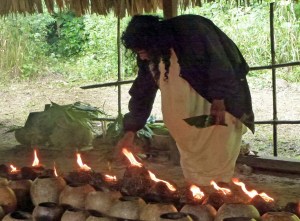
Don Antonio and Balche Ceremony

Don Antonio Martinez of the Lacandón Maya during the balché ceremony.
Photo: Carla Woody

While I’m fairly sure the effect of the missile wasn’t apparent from the outside, my mind was immediately flooded with images. I replayed a time earlier that year with Don Antonio in the middle of the rainforest village of Najá, in his lone god house, burning copal in two of his god pots, chanting, invoking connection with Hachäkyum, the principal deity of the Lacandón, and another god in honor of our visit. He’d chuckled softly when the copal in one of the pots had at first refused to light saying that god was shy that day.

There was evidence of hundreds of such ceremonies in the burnt residue in his god pots, mounded to overflowing. He needed to retire these god pots and replace them with new ones. When asked why he hadn’t, he said that since the road had cut through the jungle to Najá it brought too much noise for the sacred renewal ritual. I remember remarking to myself how very little disturbance there was in contrast with what we visitors had at home. But still, it was an affront to the gods.*

Q'eros of Peru

Sitting in circle with Q’ero spiritual leaders.
Photo credit: Monty DeLozier

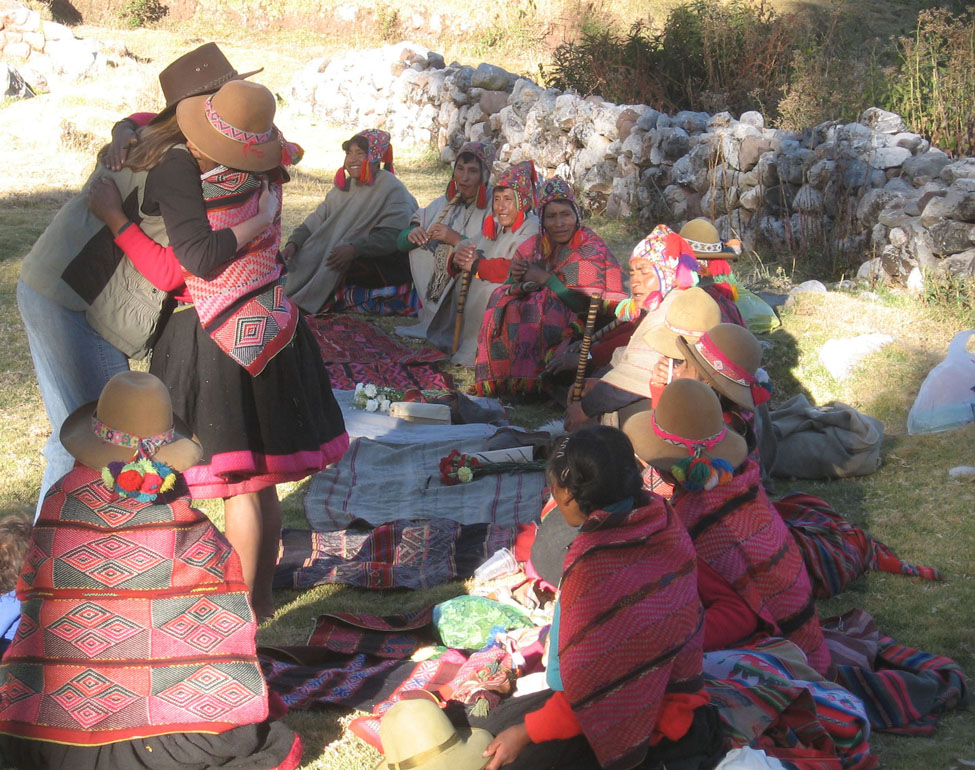
Another image came to me in the next split second, this time in the high mountains of the Andes in Peru, sitting in circle with Q’ero paq’os, or shamans, and other members of the Q’ero Nation, participating in a despacho, or blessing, ceremony. The absolute sense of collectively touching something beyond what is ordinarily presented, my eyes swept the circle of travelers who had come with me; I noted the ceremony’s subtle and sometimes dramatic effect on them.

These experiences are precious and will perhaps soon border on extinction just like in the Lacandón rainforest and the myriad other places where the footprint of modern society has been placed. A road is planned to Q’ero, which, until this time, has remained isolated at 17,000 feet in altitude with traditions pure and intact.

Hopi Spirit Keepers 2007

The author with Hopis Clarence Washington (lft) and David Washington (rt) at Salk’awasi, Mollamarka, Peru.
Photo: Darlene Dunning

Then my mind came to rest on the memory of the Hopi father and son that we sponsored to the Andes that past summer. I recalled the gratitude they expressed frequently, through tears, to be gifted with the opportunity to be in circle with their Quechua brothers and sisters and what it meant to them.

As I absorbed the ultimate meaning of the young man’s question coupled with these recollections, I was surprised to find tears welling up from my heart, through my throat, discovering moisture in my eyes. And in a cracking voice, this is what I said to him.

The thought of that happening hurts my very soul.

***

Go to Part II.

*In an area now thoroughly infiltrated by missionaries and decimated by logging companies, Najá was the last hold-out until Chan K’in Viejo, their powerful Spirit Holder, passed in 1997 at about 105 years old. Don Antonio, his son-in-law, is now the last Spirit Keeper maintaining the traditional beliefs and ceremonies.

If you are called to support preservation of these fragile traditions—and have a life-transforming experience yourself—I invite you to join us for Entering the Maya Mysteries, January 13-25. Among other opportunities to engage with authentic Maya spiritual leaders, Grandmother Flordemayo, a member of the International Council of 13 Indigenous Grandmothers, will travel with us…lending her prayers to our circles.
Categories: Healing, Indigenous Wisdom, Lacandón Maya, Spiritual Evolution, Spiritual Travel, Travel Experiences | Tags: , , , , , , , | 1 Comment

Spiritual Travel: Destination or Process?

Some years ago I had an inquiry from someone who was interested in the Entering the Maya Mysteries program I was sponsoring; specifically he was enticed by a destination on the itinerary. He’d done a search and I was the only one offering the opportunity. “But,” he said. “I’m not so sure about this ‘spiritual travel’ stuff.”

How to explain something so intangible? In one respect, it contains elements of tangibility: sites and interactions. Invisible to the naked eye, perhaps unanticipated by the mind, are myriad ways to be drawn into the deeper journey that define these potentially uncharted waters—without conscious realization in the moment that you’ve taken the plunge. Hence, enter aspects that: may have no words or audible sound, cannot be held in your hands, your eye can’t get a bead on, can seem ordinary but aren’t. Yet it produces something akin to a lightning strike that splits the rough outer covering and creates an opening, a probable pathway — and a tangible result. There appears a fork in the road inviting decision. It’s not the territory for a faint-hearted tourist but the traveler of a different sort.

Offering I

Offering I
Mixed media on Arches 88
©2012 Carla Woody

I personally welcome those unending layers and outcomes, only bits and pieces of the larger picture solidifying long after closure of the initiation. I’ve had the great fortune, maybe even destiny, to create such organic spaces, through many years’ relationship-building and travel with special intent: being alert to those people and places who offer themselves as powerful conduits. These elements being necessary to push the energy—our energy—to catapult us beyond places that have grown familiar.

My brand of spiritual travel is physically comprised of sacred sites, ceremonies and those who keep the rituals and stories. The travelers who show up to participate equally act as catalysts. An entrainment occurs and each one gains what they need to further the collective and their own journey. And we find out what it’s like to be at play in a field of mirrors: coming face-to-face with aspects that call out for healing and simultaneously create beauty. I personally celebrate it all.

The question arises: do you have to travel to experience such initiation? You do. We are creatures of habit who tend to cling to a mindset that is familiar, even if not particularly healthy. You must be willing to move outside the container: to be fearless, to be open, to explore. You must embody courage to create a wider life. That’s travel.

The fast track requires putting the daily life on pause and dropping yourself into an unfamiliar environment to rediscover what you forgot. When people gather with this common intent, magic happens. They give themselves permission to explore parts of themselves they’re not so in touch with. Add exposure to Native peoples who inherit a sense of the sacred as an integral aspect of life—and a landscape of possibility appears.

When that happens it leaves an indelible impression and shifts who you are in the world. I frequently face a challenge finding words to express the profound value of the intangible elements running through the lifework I’ve chosen. I currently live in a culture that values the immediate result while ignoring the process that’s all-important in creating something of deep meaning that endures. My sense is that if we’re able to finally find comfort floating in the abyss, it will produce all that’s ever needed–beyond what we could imagine. But it takes travel. I’ll leave you with this quote from A Million Miles in a Thousand Years by Donald Miller:

And once you live a good story, you get a taste for a kind of meaning in life; and you can’t go back to being normal; you can’t go back to the meaningless scenes stitched together by the forgettable thread of wasted time.

*********************
Author’s note: Those years ago I must have found the right words. I’m happy to report that the man concerned about the “spiritual travel” stuff has since traveled with me twice. And even more importantly, in the process, we’ve become friends.

For information on our upcoming “Entering the Maya Mysteries” programs, go here. For other spiritual travel destinations, go here.

Categories: Indigenous Wisdom, Personal Growth, Spiritual Travel | Tags: , , , , , | 1 Comment

Blog at WordPress.com.