Posts Tagged With: Native spirituality

Lifepath Dialogues Gathering: The Question of Spiritual Responsibility (Audio Archive)

Lifepath Dialogue Gathering

The Lifepath Dialogues Gathering was a local monthly gathering held in Prescott, Arizona. The intent was to build like-hearted community and dialogue about what truly matters. I chose monthly topics from my blog and hosted the evening with special invited guest(s) whose philosophies and work are relevant to the topic. The format involved my presentation of material to create a framework and interview of the special guests. This portion was recorded to share with the world community. Then we turn off the recorder and turn to intimate sharing.

The Lifepath Dialogues discussion will now continue in a virtual format. Periodically, I will interview folks world-wide who are involved in life-affirming practices and lifeways. The recording will be posted here. I invite your comments and questions always.

From the March Lifepath Dialogues Gathering

with special guest

Filmer Kewanyama:
The Question of Spiritual Responsibility
The complete unedited audio is about 40 minutes long. Click below to listen. I hope you enjoy.

This discussion was based on the post:
Spiritual Responsibility? Duty? Cargo?
By Carla Woody
Author of Calling Our Spirits Home and Standing Stark
Founder, Kenosis and Kenosis Spirit Keepers

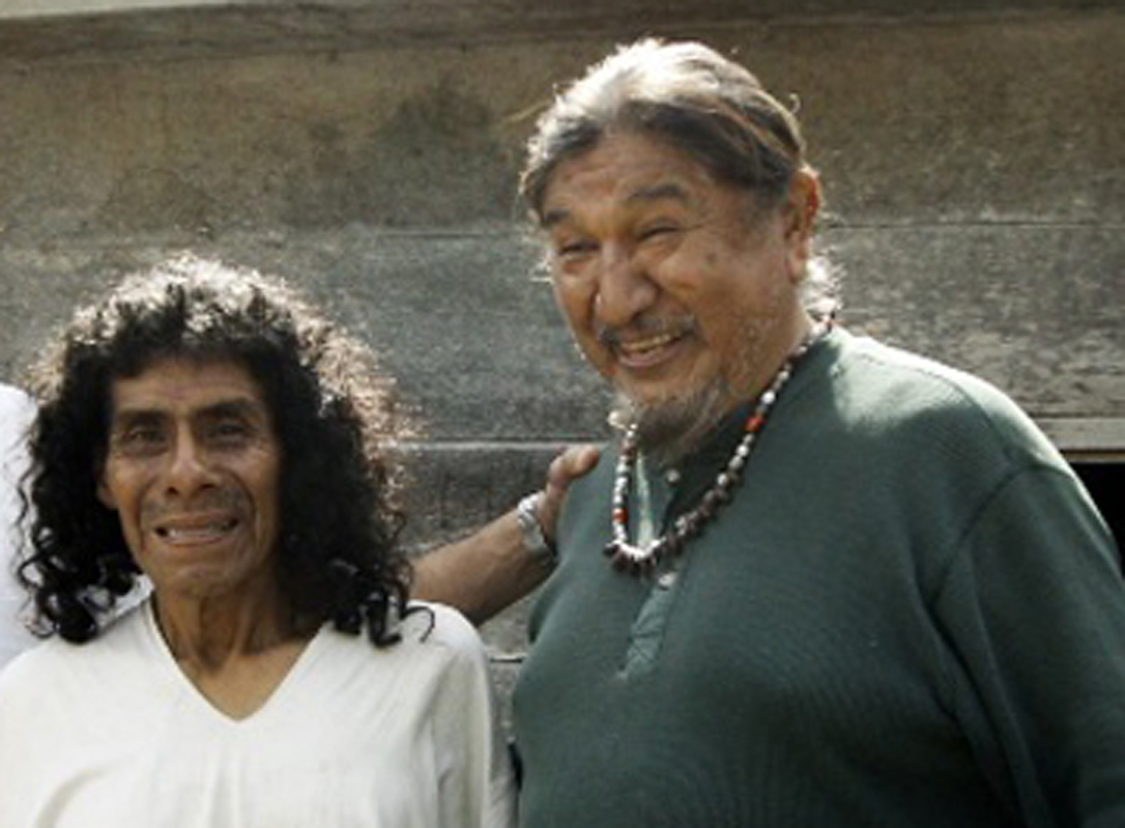
Filmer Kewanyama Photo

Filmer Kewanyama is an award-winning Hopi artist from Shungopavi, Second Mesa, Arizona, whose work depicts the sacred Hopi way of life. He learned the ceremonies that his ancestors passed on to him. Such knowledge comes with its own set of responsibilities, complicated by modern life.

Categories: cultural interests, Hopi, Sacred Reciprocity, Spiritual Evolution | Tags: , , , , , , | 1 Comment

March 27 Lifepath Dialogues Gathering: The Question of Spiritual Responsibilty

Lifepath Dialogue Gathering

Exploring the many threads that weave together an expressive, celebrated life.

MARK YOUR CALENDAR AND JOIN US FOR DIALOGUE THAT MATTERS

You are invited! Please pass to friends and family.

MARCH 27, 6:30-8 PM

FREE Gathering

Creekside Center, 337 N. Rush Street, Prescott, Arizona

March topic:

“The Question of Spiritual Responsibility”

Based on the post: “Spiritual Responsibilty? Duty? Cargo?
By CARLA WOODY
Author of Calling Our Spirits Home and Standing Stark
Founder, Kenosis and Kenosis Spirit Keepers

SPECIAL MARCH GUEST:

Filmer Kewanyama Photo
FILMER KEWANYAMA

Filmer Kewanyama is an award-winning Hopi artist from Shungopavi, Second Mesa, Arizona, whose work depicts the sacred Hopi way of life. He learned the ceremonies that his ancestors passed on to him. Such knowledge comes with its own set of responsibilities, complicated by modern life.

Email: info@kenosis.net or call 928.778.1058

Categories: cultural interests, Hopi, Maya, Sacred Reciprocity, Spiritual Evolution | Tags: , , , , , | 2 Comments

Speaking Truth

I’ve been reviewing some of my archived newsletter content and came across this paragraph I included in my old “Metaphors for Life” column back in 2009. This one bears repeating. Knowing the truth, or backstory, instead of taking something at face value is always a good idea before opening your mouth to speak, particularly when doing so could inadvertently create damage when none is deserved.

The Media Mantra on Coca

Despacho Photo

Despacho, or prayer offering, containing coca leaves.
Photo credit: Peter Coppola.

Several weeks ago while driving into town I was listening to NPR. A BBC correspondent who had been in Bolivia was being interviewed about the political situation there. During the course of the program, he made a side comment that he’d had a problem with altitude sickness. Then in a sneering tone said something to the effect, “You know what they did for it? Brought me coca tea. You know what they use that for!”

The reporter had absolutely no idea what he was talking about, but merely passed on propaganda. If he had bothered to find out what coca is really about, he’d have discovered it’s largely the spiritual and nutritional mainstay of the Quechua culture. Coca in its natural form is not a drug. Nor do they use it as such, but instead in sacred ceremonies and as a food source. The black market for coca, for purposes of processing into cocaine, is only sustained through demand from the USA and Europe. Take care of the issue at home and the black market trade virtually disappears.

By making the statement he did, especially on NPR, the reporter helped spread an assumption that the Quechua people who chew coca must be addicts. Out of ignorance, people often pick up a carefully manufactured mantra meant to further a misguided cause, parrot the message and create more damage.

Categories: Compassionate Communication, cultural interests, Healthy Living, Indigenous Wisdom, Spiritual Travel | Tags: , , , | 1 Comment

A Hopi Spirit Keeper’s Travels in Mayalands

Note from Carla Woody: In December 2012, I offered a special Winter Solstice “Entering the Maya Mysteries” program. Kenosis Spirit Keepers sponsored Charlene Joseph, a Hopi Spirit Keeper from Moencopi, on this journey as a part of ongoing efforts to bring together Indigenous Wisdom Holders for mutual spiritual support. Char’s presence, and the heartfelt connections she made with her Maya relations, brought even greater depth to our shared experiences. Truly, it was a gift to have her with us. Below she has generously shared her journey and what it meant to her.

My Mexico/Guatemala  Spiritual Adventure

By Charlene Joseph

What an adventure!  I traveled to Peru in 2009 and had a very rich cultural and spiritual experience.  Knowing the Hopi ancient history and growing up in the traditional Hopi way, I was able to connect to the indigenous people and their way of life.  My travel to Mexico and Guatemala in December 2012 was just as spiritual and the connection to the people culturally and traditionally was immense, just as it was when I went to Peru.

Charlene Joseph and Carla Woody departing for Chiapas, Mexico.

Charlene Joseph and Carla Woody
departing for Chiapas, Mexico.

I spent one week in Tucson with my daughter’s and son’s families the week before my trip. The day before we were to fly out of Phoenix, I left Tucson for Phoenix to meet up with Carla Woody, the organizer of the trip, and spend the night.  Not only did I have trouble finding my way to the hotel, but the next morning as I was reorganizing my luggage, I discovered that I didn’t have my passport! I had left it in Tucson.

It was still early enough to drive back to Tucson and be back before our plane left at 3:00 p.m. so I called my daughter.  Even while studying for her final exams at University of Arizona, it was very thoughtful of her to bring my passport halfway to meet me at Casa Grande. So now, I’m set with my passport and ready to board the plane to Mexico, wondering what laid ahead for me.

San Cristóbal de las Casas


As we were driving to San Cristóbal from Tuxtla after spending the night, I thought about my family back home, the upcoming Hopi New Year and prayers that I will miss for the first time in years, my father who taught me about the Hopi migration from the South. At the same time, I was enjoying the beautiful scenery.

Arriving in the colonial town of San Cristóbal and checking into our hotel felt to me like we were in seclusion.  It was chilly in the hotel lobby and I was wondering why the heater was not on. Once we got checked in and made our way to the room, I found it was just as cold there.  Soon found out that there are no heaters.  We had to dress warm at night or even wear our jackets to bed.  During the day the weather got very warm so we soaked in as much sun and warmth to our liking.

Processional during Festival of Our Lady of Guadalupe.©2012 Carla Woody.

Processional during Festival of Our Lady of Guadalupe.
©2012 Carla Woody.

It was lively day and night in downtown San Cristóbal with fireworks, parades honoring the Lady of Guadalupe, locals selling their art and craft work, food, and even fresh boiled corn, which was my favorite! Also many tourists walked the streets looking, eating, buying from locals, and just enjoying their time.
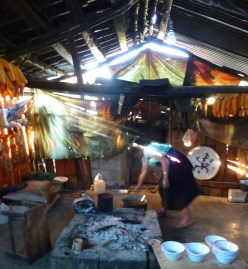
Family kitchen.©2012 Carla Woody.

Family kitchen.
©2012 Carla Woody.

One evening we drove about twenty minutes up to the indigenous village of Chamula to participate in ceremony with Don Xun Calixto.  As we were driving through the village, I saw ladies and young girls washing clothes at the water spring, just like we used to when I was growing up.  That scene took me way back to my childhood days. I felt at home seeing the people working in their gardens, fields, drying their harvest, carrying water from the water spring to their homes, and firewood for the evening loaded on the person’s back and everyone working in harmony, it seemed.

We stopped at the bottom of a hill and walked up the steps to Don Xun’s family home, a traditional brick home with an outside shed-like kitchen where they also kept their harvest of corn, beans, squash, variety of melon, and cauliflower stored. On the open fire-pit was a pot of boiling stew being prepared for our meal with the family.  In the yard chickens were being fed, and the group gathered talking and admiring the craft work the family had for sale.
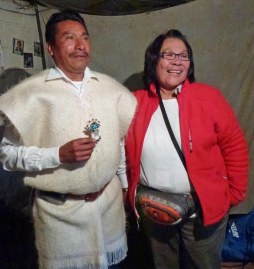
Don Xun Calixto, Spiritual leader of San Juan Chamula, and Charlene Joseph.©2012 Carla Woody.

Don Xun Calixto, Spiritual leader of San Juan Chamula, and Charlene Joseph.
©2012 Carla Woody.

Don Xun  started the ceremony in the main house in front of the altar as we sat around him on wooden benches or chairs.  We sat quietly and watched while one group member did the interpretation.  After ceremony was over, I gave a talk and encouraged Don Xun to continue his and his people’s way of life,  that it is good to find that they are still growing their own food and eating off of the land.  I shared with him that my people, the Hopi, live that way also but that we are slowly forgetting.  I told Don Xun that what I shared are my father’s words that he had wanted me to tell our people from the South and that we are connected.  We are brothers and sisters.  Don Xun was happy to hear this.

I presented him with a katsina rain spirit doll (Corn Boy) and asked him to remember my people on Hopi when he is doing his prayers because we need rain for our corn to grow. I asked him to send the rain clouds to Hopi with his prayers because we have been getting little moisture and we need it for our corn to grow.  Don Xun chuckled and said that they did not get enough rain this year either.

Southern Guatemala

Charlene Joseph and Don Nicholas, who attends San Maximón, in Santiago Atitlán.©2012 Carla Woody.

Charlene Joseph and Don Nicholas, who attends San Maximón, in Santiago Atitlán.
©2012 Carla Woody.

A few days later, we left for Guatemala and were on the road all day.  On the way down to Lake Atitlán, Guatemala, there were cornfields everywhere, all the way from San Cristóbal, Mexico to Guatemala.  I was happy because this made the connection for Hopi, and me personally, even more significant.  Corn is very important to Hopi just as it is to the Maya people in the South.

Lake Atitlán is very beautiful, especially at sunset and sunrise.  The weather was much warmer at night which made it very comfy to sleep.  In the morning, after a night’s rest, we got on the boat to take a 40-minute ride across the lake to Santiago Atitlán, below a volcanic mountain.  There we participated in ceremony with Don Nicholas honoring San Maximón.   After ceremony, we headed back to our hotel to board our private bus for Antigua.  It was a 3-hour ride and we got there around 8 p.m.

Ajq'ij Felipe Mejia (Maya Daykeeper) at Iximche.©2012 Carla Woody

Ajq’ij Felipe Mejia (Maya Daykeeper) at Iximche.
©2012 Carla Woody
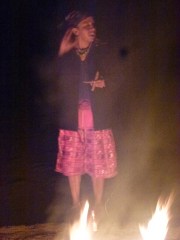
Ajq'ij Apab'yan Tew (Maya Daykeeper) at Iximche.©2012 Carla Woody

Ajq’ij Apab’yan Tew (Maya Daykeeper) at Iximche.
©2012 Carla Woody

This time we checked into our hotel for three nights.  On December 15, we drove to Iximche for a fire ceremony with Maya Daykeepers Felipe Mejia and Apab’yan Tew at a sacred place where there are pyramids.  It felt very welcoming to see school children playing games and having a cookout.  It was very lively!  The ceremony was interesting and was very colorful.  Again, I felt a strong connection to the Mayas when offerings were made to the fire with food.  I shared with them that Hopi does the same thing.  We also feed the fire and make food offering to the sun.  There were other similarities that I observed that reaffirmed the history of the Hopi to the Mayas of the South.

Palenque

Temple of the Sun at Palenque, Winter Solstice 2012.©2012 Carla Woody.

Temple of the Sun at Palenque,
Winter Solstice 2012.
©2012 Carla Woody.

Nearing the end of our travels and looking forward to Palenque in the jungle.  We left Antigua, went through border checkpoint, and got back into Mexico on December 17th.  Took the whole day to get back to San Cristóbal where we spent two more nights before heading to Palenque where the great pyramids are in the jungle.

It was amazing!  I can’t even begin to express how I felt when we went to the pyramids in Palenque.  Magazines, movies, and pictures are never the same as experiencing the real thing.  Driving to Palenque through the mountains was awesome, too.  All of a sudden a person or people will come out of the forest, people walking along the road with hoes, wood, carrying traditional pottery filled with water.  Wow!

We visited the pyramids on December 20th.  We did a great amount of walking and climbing at the pyramids.  I managed to climb up several with the help of my group members, and especially Ed from Prescott, Arizona who pulled me up and helped me down.  It was interesting to find that the temples are named for the sun, moon, snake, corn, and others I can’t quite remember.  Hopis honor those same things.  There was a ballcourt and a shrine representing the Twin Warriors and the Grandmother which Hopi includes in the Hopi Way of Life ceremonies today.

December 21st was the day of Winter Solstice in Mayaland.   On Hopi, Winter Solstice is also happening at this same time when the men are in the kiva praying and preparing for the New Year.  A time of sacrifice without sleep, praying and working hard so life can continue. They do this for, not only the Hopi, but for all life on earth including animals, plants, sun, moon, water, Mother Earth and all humankind.

On this Winter Solstice Day, the rain was coming down hard and it had started the night before.  Hoping that the rain would subside, we left at seven in the morning for the pyramids to observe Winter Solstice. Sitting on the steps of the Temple of the Sun waiting and getting drenched, after a couple of hours, some of us decided to go back to our cabanas to dry,   We didn’t get to observe the Solstice because the rain took over until five in the afternoon.  As I always say, things happen for a reason!

This journey to Mexico and Guatemala reaffirmed the Hopi migration and some history from the South for me and the Hopis.  My father talked about Palatqwapi , the Snake Serpent, the Twin Warriors and their Grandmother, and more that they brought with them when migrating from the South.  These are all still very much alive today in the Hopi Way of Life.

My father always emphasized that we need to keep faith and continue the Hopi Way to keep the world evolving. I feel very humbled to have participated in this journey and to be able to honor my father and his knowledge and wisdom in this way.
Categories: cultural interests, Hopi, Indigenous Wisdom, Maya, Spiritual Travel | Tags: , , , , , | Leave a comment

Book Review: The Woman at Otowi Crossing

otowicrossing

By Frank Waters

I discovered The Woman at Otowi Crossing in the late 1990s. It spoke to me in such a way that I wrote the executors of Frank Waters’ estate to get permission to use a paragraph in the flyleaf of my own book Calling Our Spirits Home—and they graciously complied. 

So all these scribbled pages, Jack, are to help you understand that an awakening or Emergence, as the Indians call it, is more than a single momentary experience. It requires a slow painful process of realization and orientation… How many thousands of obscure people like me all the world over are having the same experience right now? And for no apparent reason, like me. Keeping quiet about it, too.

                                                       —From Helen Chalmers’ journal in The Woman at Otowi Crossing

The book by Frank Waters is a fictional account of the real-life Edith Warner, there called Helen Chalmers, who ran a tearoom at Otowi Crossing, near both Los Alamos and San Ildefonso Pueblo, for more than twenty years until the Chile train line shut down. Set during the time of the research and development of the atomic bomb, it creates a juxtaposition between the ancient ways and beliefs of pueblo life, modern science and so-called progress. The secrets of those things kept hidden were in the air, the goings-on at Los Alamos as well as influences from her close relationship with the Pueblo people. They permeated Helen’s days in such a way that it created awakenings in her, what she called Emergences. The Woman at Otowi Crossing is replete with such rich aphorisms as the one below, reflecting, too, Waters’ own journey of consciousness.

 … Perhaps none of us really learn anything by degrees. We just keep absorbing things unconsciously without realizing what they mean. Till suddenly, for no apparent reason, it all comes into focus with a blinding flash… 

Historically, Waters’ book would be of interest, too, weaving in the likes of Neils Bohr, Robert Oppenheimer, local Pueblo people and others who frequented Helen’s tearoom. If you’re like me, then, after you read The Woman at Otowi Crossing, you’ll rush out to get The House at Otowi Bridge by Peggy Pond Church. It could almost be considered a companion, one not to be read without the other. Church’s book is a biography of the legendary Edith Warner, a complex woman who lived simply in an out-of-the-way place in a controversial time, and gained wide respect by those who knew her.

Categories: Book Review, cultural interests, Indigenous Wisdom | Tags: , , , , | Leave a comment

Last of the Spirit Keepers – and Gift Offering from Sacred Fire

Announcing Publication of My Article by Sacred Fire Magazine

and Gift Offering for You

For several years I have been sponsoring spiritual travel programs to Chiapas Mexico that include time in the rainforest village of Najá. I’ve been quite honored that Don Antonio Martinez, a Lacandón Maya elder, has been willing not only to meet with us, but to hold the balché ceremony while we’re there. Don Antonio is the last elder still practicing the sacred ways. When he passes it’s likely that these ancient traditions will be gone forever. Over these years I’ve watched the aggressive impact of evangelicals eating away at the Lacandón Maya culture and spiritual traditions, aside from influences from Western culture.

Don Antonio Martinez and Harold Joseph

Lacandón Maya elder Don Antonio Martinez
and Hopi elder Harold Joseph.
Photo credit: Darlene Dunning

Beginning 2009 through Kenosis Spirit Keepers, the nonprofit extension of Kenosis, we’ve been sponsoring Hopi Wisdom Keepers from Shungopavi on these same programs. I’ve written an article highlighting this progressive story of connection between the Hopi and Lacandón Maya and what can happen when relations come together in a beautiful way.

Kenosis Spirit Keepers is a friend and affiliate of Sacred Fire Magazine, published by Sacred Fire Foundation.  Sacred Fire is the only magazine I know of that shares the stories of ceremony, healing and community that bring us all together so we can thrive in these changing times.

Sacred Fire Magazine Issue #16

Fittingly, the article I wrote…

LAST OF THE SPIRIT KEEPERS:
Surrounded by the growing influence of
evangelicals, a Lacandón Maya
Elder tries to keep the godpots burning.

…will be featured in the next issue of Sacred Fire, due out  in early November.

The Magazine would like to gift my readers, colleagues and clients in the US a free copy as a way of introduction. If you would like to know more about Sacred Fire and receive the issue with my article click here.

To receive your gift copy—a $10 value—you can enter your shipping information with this link. Please note that you must submit your order by October 31 to receive your gift copy.

Sharon Brown, the publisher of Sacred Fire, has asked me to tell you that while the gift offer is for US folks at this time, they are working to make a similar offer to those of you outside the US with payment only for shipping. Stay tuned and I hope to make that announcement soon.

Until then…I hope you join me in thanking Sacred Fire for their generosity and important work in service of the planet and global community.

Categories: Healing, Indigenous Wisdom, Lacandón Maya, Sacred Reciprocity, Spiritual Travel | Tags: , , , , | 2 Comments

Review: The Spirit Hunters

Alto Madre de Dios

Rio Alto Madre de Dios flowing through Manu.
Photo: Oscar Panizo

This 1994 film documents the beliefs, traditions and everyday life of the Matsigenka—The People—an isolated tribe of the Upper Amazon in the Manu region of Peru. The documentary opens with breath-taking scenes of the rainforest and moves into the story of a particular village. It relates the communal focus, hunting practices—and a matrilineal culture, unusual for most parts of the world.

We’re provided a look into exchanges between Glenn Shepard, an American anthropologist then living with the Matsigenka, and elder healer Mariano, who is also a gifted storyteller, an important role since their tradition is completely oral. In a walk through the rainforest, Mariano points out medicinal plants and shares their use. The film is packed full of interesting material on the ritual use of plant spirits: how shamans leave their bodies to gain knowledge and see the future. Even the dogs are given plant medicine to help in a hunt. And it relays warnings on how witches can steal people’s souls. One of my favorite jungle sounds is the primeval roar of the howler monkey. So I was particularly taken when I discovered here that the Matsigenka believe they carry a shaman’s soul.

Pasqualito

Don Pasqualito and his newly made flute.
Photo: Alonso Mendez

Another interesting note was contact the Matsigenka had with the Inca. For me, that piece of information brought back fond memories. I arranged for half my 2009 spiritual travel program in Peru with Don Américo Yábar to be spent in Manu. I invited three Q’ero spiritual leaders to accompany us; the Q’eros being the descendants of Inca priests and holders of that ancient tradition. Since my friends live at very high altitude, going to the jungle took them way out of their element. They were quite excited and it was a delight to watch them, particularly when they found bamboo. They spent much of the time making flutes and testing them out! We didn’t meet any Matsigenka but it was a return trip to the rainforest for these Inca descendants.

But back to “The Spirit Hunters.” Truly, this film is worth your time. It’s a glimpse into an Indigenous people who live a simple life, but it doesn’t romanticize the lifestyle or protect our Western eyes from the perils. More than anything it reveals a rich imprint, a complex belief system that guides their days.

Written and produced by Kim MacQuarrie. Narrated by James Earl Jones. The film is 50 minutes. Watch the complete film on Culture Unplugged. To learn more on the Matsigenka here’s an article by Glenn Shepard: “The People of Manu.”

Categories: Arts, Film Review, Healing, Indigenous Wisdom, Spiritual Travel | Tags: , , , , , , , , | Leave a comment

Blog at WordPress.com.