Arts

Our Visible Wings

I came across the inspirational short Invisible Wings when it was first featured on Karma Tube in 2015 and have watched it several times since. It touches a soft spot in me. It opens my heart, and I feel the flow of my own life moving through me. It generates reflection and gratitude…all channeled through the words of a 65-year-old tea seller named Vijayan against visually beautiful backdrops.

His use of the metaphor ‘journey’ in the film is important as well as the way he validates it. A bona fide journey isn’t over smooth ground but fraught with challenges along the way. If we meet those obstacles eye-to-eye, it encourages our growth, nurtures the spirit and frees our dreams…to manifest. If we don’t, it harnesses the soul.

All this from a man many may overlook: the owner of a small stall in India where he pours tea, his wife Mohana working beside him. They appear to have little in the way most would see them. But Vijayan carries a dream— to travel the world, to open his heart and mind to other lands and ways of living—and his wife shares that dream. They have traveled the globe. Even though, at the start of their marriage, she’d never been out of her own hometown.

It takes courage to face the Unknown, to step out of your comfort zone. But the comfort zone so quickly widens when you do…no matter that others think you’re crazy or try to hold you back. There is so much beauty to be experienced when you ignore those who remain in the corral.

Whether you take the initiative to make life happen or sit back and let life happen to you, it’s a choice—even if you don’t think the latter is. And while the title of this tribute to Vijayan and Mohana is called Invisible Wings, the wings any of us wear are visible and how we wear them: fully extended, clutched to the side, or somewhere in-between. Others easily see them if they pay attention. And we ourselves can feel them.

Nothing is more valuable than the felt presence of your own unleashed spirit, intimacy with family and friends…and a life fully lived…however you travel. I’m sharing this little film here—short in time but saying so much—with intent that it brings to you the sweetness and consideration it has for me.

Categories: Film, Gratitude, Spiritual Travel, Travel Experiences, Uncategorized | Tags: , , , | Leave a comment

Book Review – Georgia: A Novel of Georgia O’Keeffe

GeorgiaI’ve read biographies on Georgia O’Keeffe. But this is different. You might think because this is a novel it’s a poof piece. It’s not. The author portrays the relationship between O’Keeffe and her patron-photographer-husband Alfred Stieglitz from the first enchantment to its lingering disintegration. It’s written from the painter’s perspective. While no one can ever get completely inside someone else’s head, it’s evident that Dawn Tripp has done the extensive research necessary that makes the book plausible. Believable. This is essentially a book about the precise care and manipulation Stieglitz gave to the creation of O’Keeffe’s public persona from the point she was moldable to when she was not. It’s a story laid against the backdrop of their great talents and marriage—the play between Steiglitz’s control and O’Keeffe’s internal conflict. It’s about the position women were historically placed and their treatment … and how this woman claimed her rightful recognition as one of the greatest American artists. Perhaps there’s an argument that O’Keeffe wouldn’t have made it there without Stieglitz. But I don’t find merit in it. She was a force all her own.

As an artist myself I appreciate the way the author wrote from an artist’s sensitivities on the form. That, too, made the book believable.

…It occurs to me now that art is exactly this: making what’s unseen but all around, visible. Having that sort of faith…

And it pained me to read what she wrote of O’Keeffe going blind. She enlists the gardener’s help:

…to lead my left hand onto the first sheet of paper… He leaves and I’m alone. I paint shapes—a wave, a circle—the circle slides like grace over the page. I make forms that echo those early abstract forms I made when I was no one, and it occurs to me that art is a separate country, outside the body, outside time, like death or desire, an element beyond our physical selves we are traveling toward…


Available on Amazon and elsewhere.


Categories: Book Review, Creativity Strategies, Visual Arts | Tags: , , | 5 Comments

The Dialogue of Creative Intelligence

Ann Hamilton describes herself as a “maker” rather than artist, and characterizes the start of her projects this way: I just try to listen for what something needs to become. Michelangelo relayed a similar process so long ago: I saw the angel in the marble and carved until I set him free.

Delivery doesn’t come in an instant but evolves in a process ⏤ bit by bit. It’s about being patient with the unfolding. It takes a dialogue with what wants to emerge, creating space for the communication. Sitting with it.

If what emerges has depth then it isn’t formulaic. For me, it’s about synthesis. In what form does this communication want to be held? Two-dimensional? Three-dimensional? Oil? Mixed media? Or written form? I introduce options to the conversation and question the best fit ⏤ and am open to changing directions in mid-stream because it’s suddenly called for.

I’m not a person who has one way of doing things. That would bore me to tears, limit flexibility and impede problem-solving. I enjoy stockpiling choices at my fingertips. It fuels my creative energy. Ongoing learning, adding this and that to my repertoire, inspires me. I believe this strategy sparks a type of creative intelligence. I wouldn’t fit on an assembly line and abhor restrictions. It sucks the life right out of me.

I’ve written before about the expectations establishment galleries and publishers hold. Recording companies, too. They want what they call ‘consistency’ which translates to limitation of subject matter and form. Of course, they’re invested in bottom line dollars. But what they’re doing in the process is obstructing artistic growth. The artists I revere most are those who deviate.

Shawn Phillips is a case in point:

…The mere fact that he was a musician as much as a singer and songwriter made him stand out, and helped him attract a dedicated following. His refusal to shape his music — which crosses between folk-rock, jazz, progressive, pop, and classical — to anyone else’s expectations allows him to hold onto a large and dedicated cult following, without ever achieving the stardom that his talent seemed to merit…He never courted an obvious commercial sound, preferring to write songs that, as he put it, “make you feel different from the way you felt before you started listening”…

My respect for Picasso grew exponentially when I was in Paris last year and went to the Picasso Museum, which houses representations of all the journeys he’d taken. I’d known him mostly as a Cubist, and for his Rose and Blue Periods. I discovered he was not only a painter of many diverging techniques, but also a sculptor, printmaker, ceramicist, stage designer, poet and playwright.


PicassoGoat

She-Goat. Picasso, 1950. Constructed of found objects then bronze cast.

Picasso’s ability to produce works in an astonishing range of styles made him well respected during his own lifetime. After his death in 1973 his value as an artist and inspiration to other artists has only grown. He is without a doubt destined to permanently etch himself into the fabric of humanity as one of the greatest artists of all time.

There’s something to be said for being unorthodox. Especially if you don’t care about mainstream success. Although it may come unexpectedly…precisely because you deviate.

In this round-about way I’m now introducing my latest venture. For a while I’d felt the pull to move into more three-dimensional artwork and had been casting about to see what drew me. Then I discovered the separate works of Jan Huling and Nancy Josephson…unlike anything I’d seen before…which spoke to my unconventional soul. They’ve both had their artwork featured in a multitude of galleries, museums, newspapers and magazines. I decided to go study with them for a week in April in Puerto Vallarta at Hacienda Mosaico and came away with a treasure trove of new knowledge from their generous teachings. And they’re good people.  No affected airs there despite all their accomplishments.

Das Bug

Das Bug. 8′ long. Jan Huling. Currently showing at the Duane Reed Gallery in St. Louis and slated for the Art Market + Design Fair in Bridgehampton, July 7-10. Photo used with permission.

In her artist statement Jan says:

In a recent review, the New York Times dubbed my work “oddball assemblages,” and aptly so. My three-dimensional collages combine found objects with surface design, sometimes touching on narrative themes. I’m also drawn to religious and political icons, inspired by a continuing fascination with indigenous or popular culture and world religions…Czech seed beads adorn objects in colorful patterns, camouflaging their original circumstance, allowing us to see them as pure form without their usual connotations. The process is slow and meticulous, Zen-like, with the choice of forms motivating color schemes and iconography.

Bird Goddess

Erzulie Kouvez, Bird Goddess. 10′ tall x 6′ diameter. Nancy Josephson. Exhibiting at the Visionary Art Museum in Baltimore until September 4. Photo used with permission.

Erzulie Kouvez

Erzulie Kouvez, detail. Photo used with permission.

Musician, artist, Vodou priestess…Nancy shares this:

I started in music. I only wanted to do ‘real’ music…rootsy, soulful and elemental. I wanted to get to the core of what music is in the way it lifts the spirit from the inside…Then I started using my hands instead of my voice. Visual art gave me a more solitary way to explore how to surround myself in physical beauty and meaning. Trial and Error was my alma mater…Then I went to Haiti…My first trip opened up questions about physical home, one’s spiritual ‘home’, how one ‘gets by’, what one must risk during the creative process, what IS the creative process. With every trip I found more questions as well as a few answers.

Here’s the piece I’ve thus far created since returning home. A plethora of ideas hover in the ether nagging at me. I believe most of them will get their turn over time. I’ll integrate what I’ve learned into both two and three-dimensional pieces, an extension of my meditation practice. Indeed, I’d been describing the process as Zen-like before I read the same in Jan’s artist statement. But then there’s a bit of obsessive quality to it, too…
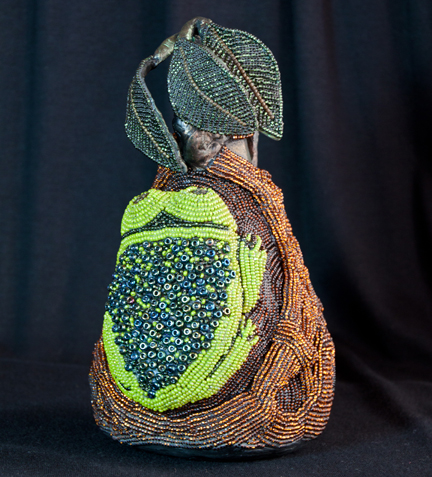
Rain God Front

The Rain God. Carla Woody. Mixed media: Czech glass beads, resin clay, found object, acrylics. 7.5″ tall x 14″ diameter.*

The Rain God

The Rain God, side view.

On another note, I’ve been asked about my artwork: How can you let them go?

When there’s a dialogue of great depth I find that I do need to keep them on the easel or table for a while, maybe even a few months, to see what else we may have to say to each other ⏤ to make sure the conversation has come to a close. When there’s a sense of finality then I can release it with the intent the piece itself will take the dialogue to others.

Sometimes that happens in surprising ways. A few years ago I painted an oil I called My Magdalen Heart which was displayed at The Gallery in Williams. On a day I was there, a French Canadian man approached me with an incredulous look saying the piece had spoken to him. It’s a blessing for me when I hear how the dialogue continues. A few days later the Magdalen went to live in New Mexico with a woman who’d had a relationship with her since childhood.

It’s important to put our expressions out into the world, in whatever way we do, without conforming to others’ rules, and then sending them on their way…so they can take on a life of their own. There may be someone just waiting to engage in the dialogue ⏤ with an anticipation they didn’t know they had.

♦︎♦︎♦︎

*The Rain God is currently available through The Gallery in Williams or inquire by email through this blog.
Categories: Arts, Creativity Strategies, Visual Arts | Tags: , , , | 4 Comments

The Fierce Quiet Place

We give a gift to ourselves when we allow connection with our innermost being. This is the one untouched by circumstances but fierce in its inviolate sanctity. The silence in this place is so loud you can hear it, so palpable you can feel it. And yet there’s no adequate way to express the comfort and inspiration it brings. Comfort here meant as nurturing. Coupled with inspiration, it urges us on…through…and beyond…to what we can’t yet know. And the circumstances of our lives⏤the challenges⏤fall away. It doesn’t mean they’re not there but are approached differently. A state of grace through the chaos and surrounding confusion.

And that Fierce Quiet Place wants expression in any way we can. It creates a portal and finds its way into the material world through narrative art, music, poetry and prose, ceremony and ritual…a touch…complete presence we give to others. It’s funneled from non-ordinary reality that exists out-of-time to land here.

This is what I’ve recognized more and more. And knowing that when I give myself over to that Fierce Quiet Place the most beautiful things happen. I live from a deeper place. I meet people who hold similar expression. I want to introduce you to one of them through the way it happened.

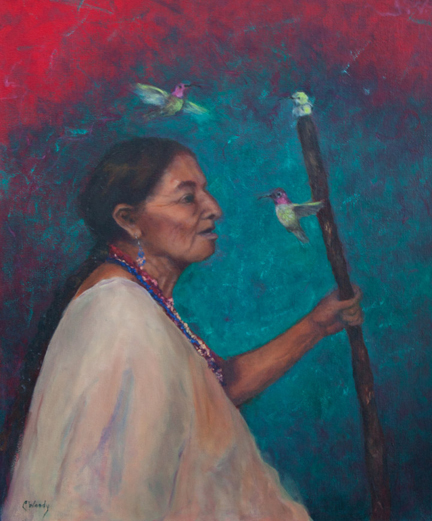
In February I completed This Is My Walk in Life, an oil painting. Over the course of its creation, it came to life. The portal opened. A silent dialogue ensued and conveyed itself as best I could onto canvas. It was not a casual process.

This is my walk in life

Title: This Is My Walk in Life Oil on canvas, 20×24. ©2016 Carla Woody. All rights reserved.

This is the description I gave it.

We all have a walk in life, perhaps chosen before we set our feet on Mother Earth. And amidst hardships there’s unexpected joy. If we open our eyes to it, there’s magic in fleeting moments when we truly experience what life is. This painting is inspired by the Lacandón Maya women of the rainforest village of Nahá in Chiapas, Mexico.

Then at the end of March I met Laura Weaver. She came from Colorado to take part in the fire ceremony guided by Tat Apab’yan Tew during our Spirit Keepers Series. I didn’t know she’s an accomplished poet. I’m quite sure she didn’t know I’m an artist and writer.

Then a few weeks ago I saw a poem she wrote in March.

 A Way of Walking

There is a way of walking

from point A to point B

as if there is nothing

of significance in between.


We have been taught to move

in straight lines, to lay life out

along a grid of efficiencies.

But there is another way to navigate.


This way carves a serpentine road

full of mysterious meetings.

Along this path, the directives come

from the world itself speaking


through all of its voices. And because

something else is guiding us—because

we are listening—at the next crossroads

we turn left instead of right—


and find a never before seen village

where an old man harvests golden apples

he offers to those who pass by. And over

the silken hills, cowbells sound out


like ancient monk song, and the last

of the sunlight breaks through the rainclouds

so that everything is shimmering and awake.

And the oak tree that cracked in last


night’s storm is dripping with honeycomb

and bee hum. And as this moment swells

and blooms open with its own fullness,

suddenly the idea of Point A & Point B


makes no sense at all. For now

you have no idea who you are

or if you have arrived. You only know

that you are everywhere.

I couldn’t help but note the strong similarities in the titles of our respective works and common message. Then yesterday I read her poem Making Passage which reaches an even deeper platform. I urge you to read it. It will speak to your soul.

I don’t think I’m presuming. When the Fierce Quiet Place is fully expressed we all say the same thing. Only the variation in our medium is different.

Earlier I described Laura as an accomplished poet but that’s not quite sufficient. Her words have a way of gently, persistently making their way inside us on a path all their own and touches the universal. And—in my experience—I feel heard. Even held.

 ♦♦♦

♦︎ The reprint of A Way of Walking is used with permission. Subscribe to Soul Passages and receive Laura Weaver’s poetry as she publishes.

♦︎ My original oil This Is My Walk in Life is currently available. Inquire for more information. Archival prints are available here.


Categories: Arts, Creativity Strategies, Spiritual Evolution, The Writing Life, Visual Arts | Tags: , , , | Leave a comment

Film Review – The Red Queen: A Mayan Mystery

In 1994 a tomb was excavated in Temple XIII in the main plaza of Palenque, the large Maya ruin complex in Chiapas, Mexico. It was the finest thus far uncovered, even more so than the great ruler Pakal II’s in the Temple of the Inscriptions just a couple of doors down. The quantity of jadeite, sacred objects and two skeletons on either side of the sarcophagus indicated someone of the highest standing. And a very curious thing: The remains were completely covered in a powdery red substance that turned out to be cinnabar.

A physical anthropologist determined the remains to be female. The temple richness  pointed to the final resting place of an esteemed ruler. But for women to attain such a capacity was unusual. Thus began The Red Queen. And then it immediately garnered my attention when archaeologist David Friedal took the screen saying, “The history of the past is not the history of men but men and women together. And at times women change the course of history. Not men.”

The Red Queen is not a boring historical documentary. Rather it entertains the question: Who was the Red Queen? She was nicknamed so because of the cinnabar. Attendants carefully covered her in the toxic powder at burial. It made its way into her very bones. We’re on board as the film tracks the mysteries, technical methods and data that lead to a conclusion from the three likeliest candidates.

  • Was it Yohl Ik’nal, the grandmother of Pakal? As far as we know she was the first Maya female to rule on her own…for 21 years.
  • Was it Sak K’uk, who took over the throne when her brother was killed? She held rule until she was able to put her son Pakal on the throne when he turned twelve. Likely she guided him from behind for some time after that.
  • Or was it Tz’akbu Ajaw, the wife of Pakal? And sometimes called Lady Conjurer as noted in Carol Karasik’s book The Drum Wars where she devoted a chapter to the Red Queen.

Those who know me are well acquainted with my love for Palenque, having been drawn back regularly since 1995 when I first had the pleasure. So the story of the Red Queen was an interest on that level. But more so, I found it heartening to have women recognized for who they are, their accomplishments and learn something of their story—not quietly influencing behind the scenes but front stage center.

Produced by the Discovery Channel, 2005. Watch it free on You Tube.

The Red Queen 1

Part One: View it here. 1 hour, 9 minutes.

Red Queen-2

Part Two: View it here. 24 minutes.

*****

For more information on our next scheduled Maya Mysteries spiritual travel program in Chiapas…where we visit Palenque and pay respects to the Red Queen, go here.


Categories: cultural interests, Film, Maya | Tags: , , | 1 Comment

An Inspired Life: Xavier Quijas Yxayotl

In late 2013 Xavier Quijas Yxayotl—Huichol composer, musician and artist—shared his life story with me. It was a real privilege to hear of his origins, struggles and inspirations. The thing about Xavier is that you’d normally never know the details of his backstory. But maybe you would pick up there’s something deeper. He carries a sense of humility that typically only comes by having gone through hard times…survived…and having instilled great meaning in his life, touching others through his craft and presence.

Xavier Quijas Yxayotl

Portrait of Xavier Quijas Yxayotl with one of his handmade ancestral flutes. ©2015 Barry Wolf. All rights reserved. Used with permission.

With permission I turned his disclosures into a narrative that was picked up in 2014 by Still Point Arts Quarterly for their Fall 2015 issue. I thank editor Christine Cote for giving this important story space. I can now share the story in its entirety here as Xavier told it to me. I hope you are as inspired as I was.

 ***

 Through the Dark

 The boy fidgeted. He was in foreign territory, held prisoner by his mother’s hand on his arm. They sat side-by-side in matching chairs before the great divide of a massive desk. His mother’s voice rose and fell. Words tumbled over each other as though, if she didn’t get them out fast enough, the man considering them would summarily swat them out the door, no different than pesky insects.

An hour before, his mother pulled him along inner city streets into a massive building. They finally stopped in front of one door among several down the long hall. She smoothed her skirt and combed fingers through his black hair. With a deep breath, she opened the door. The secretary looked up.

“Please, I would like to see the director,” his mother said.

“Do you have an appointment?” The secretary appraised them, noting their dusky skin and worn clothing. When she shook her head, the secretary motioned them to a row of chairs against the wall and picked up the phone. They waited.

The man behind the desk was impeccably dressed in a gray suit matching the color shot through his dark hair and mustache. The lines in his face softened as he listened, shifting attention from the Indian woman before him to the boy, eyes downcast, clutching a notebook in his lap.

“Maestro Caracalla, I am Señora Isabel. This is my son Xavier. He’s different, a good artist. In school he always fights because no one understands him, not the teachers, not the other kids. He’s always thinking. Since he was old enough to hold a pencil, he always draws and writes about everything. He’s like an old person in a little boy’s body!”

The woman continued at length relating how, in the last two years, her son kept running away to live on the streets. Xavier slept in parks, skipped school, survived by selling newspapers and shoe shines. Terrified, she would search and drag him home, if she was fortunate to find him. But the next day he’d be gone again. He wouldn’t do what his father wanted: to set aside these silly pastimes, to work making shoes to help support the family.

“We have seven children. Xavier is the youngest boy. We are very poor. But he is so different and I’m afraid what might happen to him. Is there something you can do?” She finished softly.

Maestro Caracalla gestured to the boy’s notebook, “Is this your work?”

Xavier froze in his chair and prayed to disappear. He didn’t think the Maestro would hit him like his father did, but he dreaded the reprimand he knew would come. He whispered, “Yes.”

“Show it to me then.” The room was silent save the sound of Maestro Caracalla slowly turning pages after scrutinizing each one. Finally he closed the book. Looking over wire-rimmed glasses, his eyes seemed to bore into Xavier’s very soul. He gazed at Señora Isabel then back at the boy, whose reddened face was moist with sweat. “Señora, I don’t think you have any idea what a beautiful child you have. What ideas! His writing doesn’t match his age. He’s not a normal child. You have to do something with him. We have to help him!”

Maestro Caracalla told her to bring the boy back the following Monday, handing over a long list of art materials to buy. There’s not enough to eat! How can we buy art supplies? Guilt flooded Xavier’s mind. He was certain of a dead end. But at the appointed time his mother delivered him to the Maestro. She could only muster a clean new drawing tablet and 6B pencil, keeping even that small expenditure hidden from her husband. The secretary ordered a sandwich for Xavier, although he said he didn’t need anything.

“Ah, there you are,” the Maestro swept in from his office. He took Xavier by the hand and led him down the hall. They stopped in all the classrooms where he spoke to the teachers, “I want to introduce Xavier. He’s coming to take classes.”

That is how an eleven-year-old Huichol Indian boy from the streets came to attend Escuela des Artes Plásticas, the art school in Guadalajara, Mexico—the youngest pupil ever to sit alongside regular university students. They became his peers and friends. Maestro Caracalla continued as his benefactor for six years, making sure he had all the classes he needed: writing, painting, art history and more…

Xavier Painting 1

Painting by Xavier at the age of 18. Photo courtesy of Xavier Quijas Yxayotl. All rights reserved.

Xavier painting-2

Xavier with one of his painted pow wow drums. Photo courtesy of Xavier Quijas Yxayotl. All rights reserved.

Continue reading Xavier’s story here and find out how he returned to the Huichol roots denied him as a child, and went on to resurrect ancient instruments lost to time through visitations from his ancestors.

Categories: Indigenous Wisdom, Interview, Music Review, The Writing Life, Visual Arts | Tags: , , , , | 4 Comments

New Art by Kayum Ma’ax Garcia

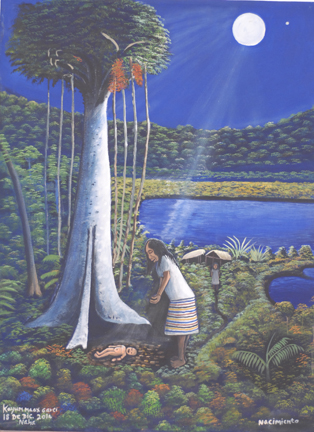
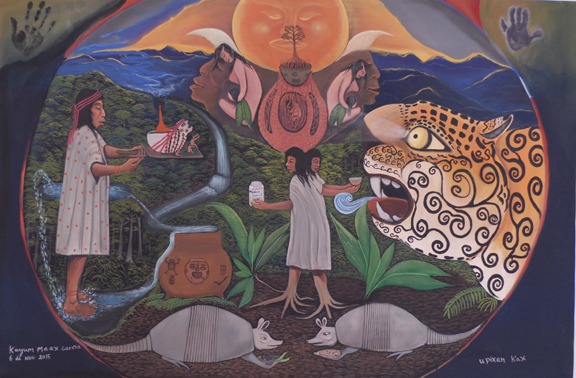
In a previous post I told the story of visiting artist Kayum Ma’ax Garcia in his home in the Lacandón Maya village of Nahá during our January 2015 Maya program. During that visit the online Allies Gallery was born. The entire journey was pure magic. The gallery was just one instance of something that evolved organically. As a result, Kayum is able to offer his art to a wider world and has sold some prints. I’m very happy about that, and Kayum and family are ecstatic.

Recently Kayum’s work was featured in Galería MUY located in San Cristóbal de Las Casas. The MUY, now part of our Kinship Circle, gives exposure to contemporary art of Indigenous artists of Chiapas. With their help, we’ve been able to bring more of Kayum’s artwork to you.

Birth

Title: Birth. Acrylic on canvas. ©2014 Kayum Ma’ax Garcia

The Heart of the World

Title: The Heart of the World. Acrylic on canvas. ©2015 Kayum Ma’ax Garcia.

To view more, go directly to the Allies Gallery. Kayum rarely leaves his isolated rainforest village. His art is unique. By purchasing through our online gallery, proceeds support this Indigenous artist document a way of life that is increasingly lost.


Categories: cultural interests, Lacandón Maya, Visual Arts | Tags: , , | 1 Comment

Through the Dark in Still Point Arts Quarterly

Fire flute

Xavier playing the fire flute, his own translation of a ceremonial experience. Courtesy photo.

I was privileged to interview Xavier Quijas Yxayotl, who grew up on the streets of Guadalajara, Mexico. Until adolescence he was spurned by peers, misunderstood by teachers and family alike, often abused. Then an unlikely benefactor came forward whose support opened possibilities. But it was the boy who stepped up, seized them, grew his talents and embraced the Huichol Indian lineage his family denied. Especially notable, he resurrected ceremonial instruments of his homeland that were lost to time; the way to do so came through dreams. His is an inspirational story of a boy who answered his calling—against all odds—and went on to become internationally known as a composer, ritual musician, artist and spiritual healer.

I’m delighted to announce that my article Through the Dark is being published in the Fall 2015 issue of Still Point Arts Quarterly, a literary arts journal, with much appreciation going to Xavier for indulging me. Here’s the preview of a story of true intent.

The boy fidgeted. He was in foreign territory, held prisoner by his mother’s hand on his arm. They sat side-by-side in matching chairs before the great divide of a massive desk. His mother’s voice rose and fell. Words tumbled over each other as though, if she didn’t get them out fast enough, the man considering them would summarily swat them out the door, no different than pesky insects.

An hour before, his mother pulled him along inner city streets into a massive building. They finally stopped in front of one door among several down the long hall. She smoothed her skirt and combed fingers through his black hair. With a deep breath, she opened the door. The secretary looked up.

“Please, I would like to see the director,” his mother said.

“Do you have an appointment?” The secretary appraised them, noting their dusky skin and worn clothing. When she shook her head, the secretary motioned them to a row of chairs against the wall and picked up the phone. They waited.

The man behind the desk was impeccably dressed in a gray suit matching the color shot through his dark hair and mustache. The lines in his face softened as he listened, shifting attention from the Indian woman before him to the boy, eyes downcast, clutching a notebook in his lap. “Maestro Caracalla, I am Señora Isabel. This is my son Xavier. He’s different, a good artist. In school he always fights because no one understands him, not the teachers, not the other kids. He’s always thinking. Since he was old enough to hold a pencil, he always draws and writes about everything. He’s like an old person in a little boy’s body!”

The woman continued at length relating how, in the last two years, her son kept running away to live on the streets. Xavier slept in parks, skipped school, survived by selling newspapers and shoe shines. Terrified, she would search and drag him home, if she was fortunate to find him. But the next day he’d be gone again. He wouldn’t do what his father wanted: to set aside these silly pastimes, to work making shoes to help support the family.

“We have seven children. Xavier is the youngest boy. We are very poor. But he is so different and I’m afraid what might happen to him. Is there something you can do?” She finished softly.

Maestro Caracalla gestured to the boy’s notebook, “Is this your work?”

Xavier froze in his chair and prayed to disappear. He didn’t think the Maestro would hit him like his father did, but he dreaded the reprimand he knew would come. He whispered, “Yes.”

“Show it to me then.” The room was silent save the sound of Maestro Caracalla slowly turning pages after scrutinizing each one. Finally he closed the book. Looking over wire-rimmed glasses, his eyes seemed to bore into Xavier’s very soul. He gazed at Señora Isabel then back at the boy, whose reddened face was moist with sweat. “Señora, I don’t think you have any idea what a beautiful child you have. What ideas! His writing doesn’t match his age. He’s not a normal child. You have to do something with him. We have to help him!”

Maestro Caracalla told her to bring the boy back the following Monday, handing over a long list of art materials to buy. There’s not enough to eat! How can we buy art supplies? Guilt flooded Xavier’s mind. He was certain of a dead end. But at the appointed time his mother delivered him to the Maestro. She could only muster a clean new drawing tablet and 6B pencil, keeping even that small expenditure hidden from her husband. The secretary ordered a sandwich for Xavier, although he said he didn’t need anything.

“Ah, there you are,” the Maestro swept in from his office. He took Xavier by the hand and led him down the hall. They stopped in all the classrooms where he spoke to the teachers, “I want to introduce Xavier. He’s coming to take classes.”

That is how an eleven-year-old Huichol Indian boy from the streets came to attend Escuela des Artes Plásticas, the art school in Guadalajara, Mexico—the youngest pupil ever to sit alongside regular university students. They became his peers and friends. Maestro Caracalla continued as his benefactor for six years, making sure he had all the classes he needed: writing, painting, art history and more.

Still Point Arts QuarterlyTo obtain the Fall 2015 Still Point Arts Quarterly—a beautifully illustrated journal featuring art portfolios and featured articles—and read the rest of his fascinating story, go here.

Categories: Arts, Creativity Strategies, Indigenous Wisdom, Spiritual Evolution | Tags: , , , , | 2 Comments

Interview in 5enses Magazine

5ensesBack in April before I left to walk the Camino de Santiago, Jacques Laliberté made the trek out to my place to interview me for 5enses Magazine, a local publication featuring the arts and science in the Greater Prescott, Arizona area. Jacques is a fellow artist, and over the 20+ years he’s lived in this area has had regular columns on art and related subjects. Even so, we were barely acquaintances; our paths had crossed just a couple of times. I’ve been interviewed several times. But not like this. Before I knew it nearly three hours had passed. And I’d spoken of things I normally keep to myself on the deeper elements of my life and work, not usually the stuff for mainstream consumption. This was more like a chat between friends sharing life experiences and some of those things that are unexplainable in the spiritual realm.

The interview has just been published in print and online. Somehow he was able to condense all the ground we’d covered into a quite readable story…and kept some of the most personal things I’d disclosed to himself. Thank you very much. It’s an apparent talent.

Here is a bit:

 Wisdom through stillness: Carla Woody integrates indigenous ideas in art, life

‘Set your intent and let it go. Your intent is your beginning. Worrying about the details detracts from the intent . . . the attraction will take care of the details.’

Thus — in her ‘The Lifepath Dialogues’ blog — Prescott artist Carla Woody imparts the first of many lessons in a way of living. Artwork and writing are two of the primary ways she’s integrated her far-flung experiences circumscribing a circuitous path around the globe.

‘I was fortunate to spend a significant portion of my 1960s childhood living in a suburb of Paris influenced by French culture where the arts are valued,” Woody writes on her website. “We traveled all over Europe. I remember spending a lot of time in art museums and exploring narrow cobblestone streets with my parents.’

With her childhood mercifully free of the influence of organized religion, Woody was primed to encounter mystic traditions whenever they showed themselves. First, though, came a potential — perhaps vital — obstacle: her service in the military as a consultant in leadership development. Perhaps full immersion in her culture created the momentum to fling her so energetically toward subsequent events…

If you’d like to read the entire article, please go to 5enses.

After many years in Prescott, Jacques moved down the road a bit. He now considers himself a Paulden artist, writer and graphic designer creating book covers for those who self-publish. His first novel The Fictional Autobiography of the 21st Century’s Greatest Artist Andienne Brünsilder was published in February. It’s available locally at the Peregrine Book Company. I haven’t read it yet. But if he writes fiction the way he puts an interview together…it’s got to be good. I noticed the foreword was written by Mick Jagger, which has got my curiosity up.

Autobiography************

Please note a couple of corrections to the 5enses article: Kenosis Spirit Keepers, founded in 2007 to help preserve Indigenous wisdom traditions, is the nonprofit extension of Kenosis, the mother organization I founded in 1999. The mission of Kenosis is to serve human potential—as an assist to live through spiritual values and hold the vision “One tribe, one world.”

For more information on the mission of Kenosis Spirit Keepers, events and what we support, go here. For more on Kenosis spiritual travel and other programs, go here.

Categories: Arts, Interview | Tags: , , , , , | Leave a comment

In Remembrance: Mary Magdalen

My Magdalen Heart

Prophet Series: My Magdalen Heart
Oil with gold leaf on canvas. by Carla Woody

Today is Mary Magdalene’s Feast Day. A few years ago I created My Magdalen Heart as one of my Prophet Series, an oil with gold leaf on canvas. This artwork pays respect to Mary Magdalen who has been denied recognition for her true role by the traditional church, and honors all teachers who go quietly about their service with humility.

The original artwork now lives in Albuquerque with a woman who’d had a relationship with The Magdalen since childhood. She came into The Gallery in Williams where I show my work and fell in love. I happened to be in The Gallery that day. She told me her stories with misty eyes and left very happy. It was emotional for us both. I later received a note from her thanking me again and said, “We put her in the place of honor over the fireplace. I was afraid the painting would get lost because of the size of the fireplace, which is huge. But she commands the room and her eyes follow me everywhere.”

I felt so blessed to received this communication, just as blessed as when I was painting the piece…because it felt that Mary spoke to me as I was doing so.

In Sophia’s Children Jamie Walters writes: Who was Mary Magdalene, really?

And why is this question important at all given that we’re talking about a woman who lived 2,000 years ago, and about whom we have only slender references?

Read more on Jamie’s blog.

Categories: Arts, Creativity Strategies, Gratitude, Healing, Sacred Reciprocity | Tags: , | 2 Comments

Blog at WordPress.com.