Creativity Strategies

A Not-So-Secret Access to Consciousness

In The Energy That Finds Its Source, I shared how I stumbled upon a strategy through meditation that greatly affected my artwork in a positive way. I want to build on that by discussing something a number of us do unconsciously—but brought to consciousness can generalize to different contexts of your life. It increases clarity and mental/emotional flexibility, in addition to creativity. I’ll use writing as a springboard for an example here.

One of the biggest challenges fiction writers have is to breathe life into the characters of their stories, to make them believable. This is particularly true if your book is character-driven. You want readers to connect with the story and those in it: to love or hate them. A reader of my latest book Portals to the Vision Serpent wrote to say how she couldn’t stand Sybilla, who features prominently in the novel—until she really understood her. Then she had great empathy. Even if the book is plot-driven, you want the characters’ actions to make some level of sense from their eyes.

We all have a specialized, individual template we live by. Here’s a quick review on how that happens. Your brain codes experiences you have. The original coding usually takes place early in life. The coding becomes your perceptions…translating to the beliefs you have about yourself, others, the world in general, even what’s possible. This template also becomes the filter through which you experience your life. You develop strategies for thinking and living that further reinforce the original beliefs—those that support and those that get in your way. When something significant happens to disrupt the old beliefs, things can shift dramatically.

Characters in a novel are no different. Here’s a way to uncover their templates by “stepping into” different perspectives.

  1. From your “self” position as the writer, note how you experience different characters: the nonverbal signals, the way they speak, your own response to them.
  2. Now taking each character at a time, imagine you can slide right into their body, look out of their eyes, become them—rather than witnessing them—and answer these questions: What is their family of origin like? Based on what they unconsciously ingested then, how do they experience their own identity, who they are? Note the trickle down effect: What beliefs were generated? What about capabilities? Resulting actions? How they experience their environment? This way you can really get inside the hearts and minds of the characters.
  3. Then step back. By being a detached observer you get additional valuable information. Given what you discovered about your individual characters, now you can really get a bead on important dynamics between the major players and incorporate them into your writing.
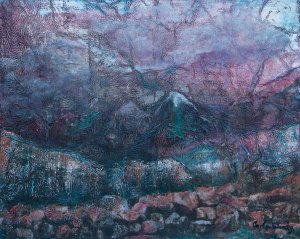
Secret Access

Secret Access
Mixed media on canvas
©2014 Carla Woody

By using a method like this, you also invite your reader to tag along through your writing, to undergo the same discovery and identify with different characters. They’re playing out the human condition, no different than the rest of us. We are all who we are based upon where we’ve been. But when something of great enough significance interjects itself, triggering a change in one character…it also affects the others in close proximity. That’s how things get shaken up; the story becomes so much more interesting; the characters can grow in various ways.

I realize in the writing of this piece that, because this strategy is so engrained in me, it’s another way of describing what I wrote about in The Energy That Finds Its Source. I was very much in the “self” when I was meditating. But when I came out of meditation, I became the “observer.” When the artwork communicated with me, I may have been in “other” position…or an unexplainable esoteric element occurred…

Of course, you can use what I’ve written here as a guideline to explore other aspects of your own life, not just your creative outlets. This is a brief primer toward self-discovery and relationship dynamics that I use with clients as a springboard for transformation.

I’ve adapted the content of this post from my mentoring program Navigating Your Lifepath addressing how to live through your deeply held values—and thrive.

Categories: Compassionate Communication, Creativity Strategies, NLP, Personal Growth | Tags: , , , , , | Leave a comment

The Energy That Finds Its Source

Sometimes it’s powerful to change things up in your geography, to experiment and see how you may further engage creativity…and The Muse. In the last several months, I’ve done just that—albeit unknowingly—and have been fairly astounded at what has unfolded.

I meditate first thing in the morning, usually before dawn. Over the last thirty years of doing so, it’s set the stage for my days and provided a consistent segue for insights, higher guidance. But I’d never considered using it as a tool for my artwork. It happened accidentally.

I would undertake my daily ritual in the back room, sitting cross-legged with straight back, always in the same spot for as long as I’d lived in this home, an anchor to the process. One morning for no apparent reason, I chose to meditate in the front room. Whenever I feel complete, I come back with “soft eyes”…slightly defocused…slowly returning, integrating the state with my day ahead. That morning my gaze came to rest on the easel and canvas I’d been painting for a while. And suddenly I experienced the piece in a whole new way. I saw things I hadn’t seen before. I felt a previously undetected presence, perhaps waiting until I’d opened a door and it could reach through and guide me. I’ve continued this change in geography while keeping my long-time meditation ritual. My artwork has more depth and meaning. I feel the intent of pieces is coming across in a way I’d just hoped for before. I had the beautiful feedback from a couple from Canada who approached me—after seeing My Magdalen Heart in person—saying they’d experienced the piece literally speaking to them.

The Inner Chamber

The Inner Chamber
Mixed media on canvas
©2014 Carla Woody

People have puzzled over the creative process for eons. Some ascribe to a belief that the source of creativity rests within the self absolutely, which places enormous pressure if you find not so much coming through. Others are certain it comes from another source, perhaps a higher power. Author Elizabeth Gilbert spoke eloquently on TED regarding this controversy.

I believe it’s a combination of the two. First, I have the choice to say “yes.” Then it’s a matter of showing up consistently, having faith that something will be delivered…and being patient with the process. I recognize that I’m a vehicle. I’ve chosen to develop certain skills. But, for me, there’s no mistaking when I’ve tapped into another realm entirely outside myself that moves beyond the mundane. My senses are heightened and the energy moves—whether through brush on canvas, fingers on keyboard…whatever the art form—to find ground. There’s a distinct collaboration…and it’s something else again when your subject matter starts communicating with you. Strange as it seems, that’s how it’s happening for me these days.

When I was writing Portals to the Vision Serpent my practice was to begin writing after meditation, at least five days a week for at least three hours at a time. Again, I didn’t realize at the time I was accessing my craft through an altered state of being. It was as though I watched a movie and wrote down what unfolded in front of me. One day I reached a point in the book where I needed to get a main character down to the rainforest of Chiapas, Mexico but had no idea how. Within a few days, a completely new character stepped forward to introduce himself from the shadows where he’d been hidden. It turned out that he provided the way; the novel moved on.

The poet Mary Oliver said, “…The part of the psyche that works in concert with consciousness and supplies a necessary part of the poem—the heart of the star as opposed to the shape of a star, let us say—exists in a mysterious, unmapped zone…Say you promise to be at your desk in the evenings, from seven to nine. It waits, it watches. If you are reliably there, it begins to show itself—soon it begins to arrive when you do. But if you are only there sometimes and are frequently late or inattentive, it will appear fleetingly, or it will not appear at all…”

If it hasn’t yet happened for you in the way you desire, I believe it can. It means opening yourself up, stepping outside your comfort zone, changing up your geography. It’s an agreement you make…an intent you hold…and then let go.

Such an energy finds its reciprocal Source.

Categories: Arts, Creativity Strategies, Meditation, Sacred Reciprocity, Spiritual Evolution, The Writing Life, Visual Arts | Tags: , , , , , , | 5 Comments

Book Review: Quiet – The Power of Introverts in a World That Can’t Stop Talking

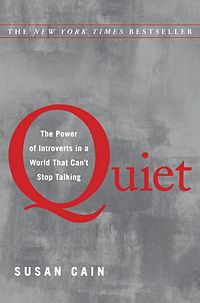
200px-QuietBookCoverPeople are often surprised when I say that I’m an introvert. They’re fooled by the fact that I’m articulate, do public speaking, work with groups and engage socially. They assume that I’m an extrovert. I can do the things I do because I’ve arranged my lifestyle to support my biological make-up and preferences. I love to engage when they’re things I care about deeply—BUT I retreat to regenerate myself. Whether you lean toward introversion or extroversion primarily has to do with how you expend your energy and the way you renew it.

However, our culture values extroversion. There must be something wrong if you’re not talking: You’re secretive, have nothing of value to contribute and probably not so bright.

As a child there were countless times when I heard I was “too quiet.” Not by my parents, who are also introverts, but mostly by teachers, causing me to retreat even further into my inner world. As a teenager, it was even more hurtful, especially when it came from friends. All that input translates to: You’re not good enough. It haunted me for a long time.

 Indeed, your biggest challenge may be to fully harness your strengths. You may be so busy trying to appear like a zestful, reward-sensitive extrovert that you undervalue your own talents, or feel underestimated by those around you. But when you’re focused on a project that you care about, you probably find that your energy is boundless. – From Quiet.

Later in life I have often been called “intense” as though something is wrong with that as well. But by the time I heard it the first time I’d begun to value my own sensibilities and could translate the meaning to “passion.” And the years I worked in a corporate environment…meetings were my most dreaded activity. Those who were most vocal blathered on saying nothing. It was an effort for me to keep in my seat. I wanted to jump out of my skin and flee.

Author Susan Cain has gotten a lot of play in the media since Quiet was published in 2012. It’s been on the bestseller list for many weeks running. Nevertheless, I didn’t know about it until I was perusing my local library for CD books to accompany me on a recent road trip to Utah.

I’m writing this review for those who missed this important book like I did. Whether you’re more introverted or extroverted, Quiet contains highly useful information for valuing both preferences. It also contains data on biological differences and distinctions of introversion. If you’re an introvert, it cites numerous studies and other pointers that will validate your value. If you’re an extrovert, it will help you understand the many introverts around you. I was horrified at one story about two extroverted parents who sought psychiatric intervention and medication for their introverted child. When one psychiatrist found the child to be normal the parents moved on for the next opinion.

My most transformative experiences have never happened in groups. That said, there is extraordinary energy that builds when groups entrain to strong spiritual intent, kickstarting a process of opening. Then integration comes through balancing the internal and external. That is the premise underlying any retreats and spiritual travel programs I sponsor.

The highly sensitive [introverted] tend to be philosophical or spiritual in their orientation, rather than materialistic or hedonistic. They dislike small talk. They often describe themselves as creative or intuitive. They dream vividly, and can often recall their dreams the next day. They love music, nature, art, physical beauty. They feel exceptionally strong emotions–sometimes acute bouts of joy, but also sorrow, melancholy, and fear. Highly sensitive people also process information about their environments–both physical and emotional–unusually deeply. They tend to notice subtleties that others miss–another person’s shift in mood, say, or a light bulb burning a touch too brightly. – From Quiet.

The quote below was quite interesting to me. Such practices don’t just occur in Evangelicalism. I’ve personally had experience of being expected to utter prayers and entreaties out loud while in sweat lodge and other ceremonies, although not as common. I remember the first time it happened I was shocked at the intrusion on my privacy in a spiritual setting. To me, such things are so sacred they’re not pronounced aloud. Of course, the leaders didn’t see it as an affront. Now, if such a thing occurs, I pass to those who want to speak these things out loud and remain comfortable with my own way.

Evangelicalism has taken the Extrovert Ideal to its logical extreme…If you don’t love Jesus out loud, then it must not be real love. It’s not enough to forge your own spiritual connection to the divine; it must be displayed publicly.

 There is a compilation of quotes for the book on Goodreads. Ultimately, this is the teaching of the book.

We know from myths and fairy tales that there are many different kinds of powers in this world. One child is given a light saber, another a wizard’s education. The trick is not to amass all the different kinds of power, but to use well the kind you’ve been granted.

There’s also an excellent TED talk by Susan Cain giving an overview. Quiet is available on Amazon and elsewhere in print, ebook and audiobook.

Categories: Book Review, Compassionate Communication, Creativity Strategies, Healthy Living, Personal Growth, Sacred Reciprocity, Solitude, Spiritual Evolution | Tags: , , , , , , , | 1 Comment

Your Identity in Metaphor

The instructor introduced an icebreaker. State your bio in six words. She asked for volunteers. Mine popped out.

Intrepid traveler living in two worlds.

Her eyes widened. Not the kind of thing you’d typically hear in a county courthouse jury room during child welfare training. But my fellow mediators didn’t miss a beat. They know me—at least to an extent.*

Metaphor seeks lodging in our interior differently than cursory words. Language when used at that level connects with the unconscious mind in such a way that it can inform wider awareness, indeed even act as a guide and attract the experiences that fulfill its significance. It is especially meaningful when it emerges through your own process rather than given to you. It’s an invitation I offer to folks I’m mentoring and who participate in spiritual travel programs: Note what metaphor takes up residence.

Apparitions

Apparitions
Mixed media on panel
©2014 Carla Woody

The afternoon icebreaker generated quite a degree of self-reflection that night. We weren’t asked to use metaphor but my mind naturally gravitated toward what it’s used to these days. I thought back to a time when I was asked to use metaphor, to reach inside and discover what emerged relative to spiritual path. We had already been in retreat several days, experiencing teachings and ceremonies. So I was not in the everyday world. I went off to be alone and sit with the tasking. I’m sure I wrote it down in a journal that has since been lost to time. But I’ve never forgotten what came.

 I am the crane whose wisdom runs swiftly under water…and rises with the waning of the silver moon.

It’s been close to 20 years since I attended Nine Gates Mystery School. It was a powerful experience during a time when I was radically re-aligning a life out of alignment with my deeper values. My core wisdom, that which we all have, did not show itself much back then. It lived in that watery place but did compel me to engage in opportunities that would bring me clarity, even if it seemed off base at the time. It’s a refinement process that wouldn’t have taken nearly that long had I my own spiritual mentor. In those days such a thing wasn’t prevalent.

I can’t tell you exactly when the revolutionary path—the chaotic one—smoothed out to the evolutionary one and found order of a sort. But I look up all these years later astounded to find myself an elder grounded in a life that conveys my values. For this I have gratitude.

That night of reflection I realized just how fully the metaphor from Nine Gates predicted an unfolding. I’ve felt something else hovering on the horizon for some time. It appears that an updated metaphor popped out at the slightest invitation, in an unlikely environment, emphasizing one meaning of “two worlds.” I can only wonder what else is in store—seen and unseen—and welcome it.

*****

An invitation to you:

Sit inside your deeper identity. Listen. Allow a metaphor to emerge.

 *****

*I’ve been doing conflict mediation as a sideline for close to 30 years, the last 16 of them in that courthouse with a few cases a month, when I’m in town, to keep me on my toes.

Categories: Creativity Strategies, Gratitude, Meditation, Sacred Reciprocity, Spiritual Evolution | Tags: , , , , , | Leave a comment

Unexpected Music

Place des Vosges

Place des Vosges

We were exploring Le Marais district when I remembered one of my favorite places. Ah yes, just a short distance away. I succeeded in persuading my friends they really must experience the oldest square in Paris. We turned down a side street that opened into Place des Vosges. Its elegant French classical façade spoke to the aristocracy that once lived above the arcades below. It didn’t take much to imagine Victor Hugo striding along anxious to be home to continue penning his novel of the moment. We noticed a bistro just in time for lunch. Salad, cheese, bread and wine somehow tasting so much better than it ever did at home.

Exiting, we started to round the corner that would take us out of the square when we noticed activity across the way under the arches. Some ten or so people setting up—a musical ensemble! We edged closer to watch. A few others began to gather. The discordant sounds of musicians tuning their violins and cellos ensued. And ensued. And ensued. Until finally my friends were getting impatient, wanting to leave. Oh no! Just a few more minutes, I was saying in my head. Feeling the tug of the group, I started to turn away with them.

And in that moment, the cacophony stopped. A split second of silence brought chaos into perfect order as the haunting strains of Pachelbel’s Canon filled the air. The acoustics amplified the notes to such a degree that we were enveloped, rooted in place. The beauty of the moment was overwhelming. I didn’t want to move from that spot. The energy continued to rise as they went on to play Mozart, Bach and Vivaldi. Thankfully, a violinist broke away and began offering CDs. I gladly purchased one and then discovered their name: Classique Metropolitain. What an unexpected gift, an extraordinary dessert, one we wouldn’t have had if we’d not been willing to pause.

Now when I play their recording, especially when I paint, it takes me right back to that split second of perfect order when my spirits soared—to experience it all again, gaining inspiration. Only much later did I discover that Classique Metropolitain regularly frequented metro stations and Place des Vosges playing to passersby, perhaps to lend pleasure to their day.

◊◊◊

On a nearly annual basis, I sponsor a spiritual travel program called Entering the Maya Mysteries in the Chiapas region of Mexico.  I usually go in January and we spend several days in the highlands participating in ritual and religious festivities for San Sebastián. One particular year music was a thread that ran through our time together—sacred and celebratory, vocal and instrumental—something to be expected considering our itinerary. But it was unexpected music, taking the edge off a situation and lifting our spirits or instilling a hush to any tumbling thoughts, that I most savored and have tucked away in that same place where Classique Metropolitain and Place des Vosges reside.

Lalo Ed Adams lives in New Jersey. Some years ago his search for someone going to Piedras Negras brought him to me. He joined our travels, in the process discovering a new name that he wore proudly. On his second trip with me, Lalo came along again wearing the glow I saw develop on the first one. Early on, he brought out a guitar saying he’d learned to play a couple of years ago and now gathered weekly with guitarists back home. During our days staying at El Panchan outside the Palenque ruins, he inched his way from casually playing at our table at Don Mucho’s Restaurant—until fully on stage with microphone and sound system going! I admired his chutzpah and his playing.

One thing about Lalo was that he understood how music can intervene and shift the energy in a moment. We’d been on our way to the Lacandón Jungle village of Najá anticipating the upcoming ceremony with Don Antonio Martinez when the van began to hesitate and sputter. Our driver was worried. “Bad gas,” he said, finally pulling over. We all bailed out; it appeared there would be a long wait while the situation was remedied. It was hot. We were in the middle of nowhere milling around on the side of the road.

Lalo Ed Adams

Lalo Ed Adams (2nd from right).
Photo credit: Bob Moore

It didn’t take long before Lalo pulled out his guitar. I finally couldn’t resist. I joined in with what he later called my “vocal chops”—that hadn’t been let loose in years. Some of the others chimed in until we had a plein air concert of sorts going. It turned a difficult situation to a light one full of fun. We continued to find moments to sing, all the way up to our closing dinner when we essentially took over a restaurant, and the other patrons joined our musical frivolity that ranged from “I Shall Be Released” to “Nowhere Man.”

But backtracking a bit, the latter half of our journey we stayed in San Cristóbal de las Casas in the Chiapas highlands. While we were visiting Na Bolom I heard faint notes of piano music and wandered into a room. Beautiful, I thought. Taking note of the pianist but not wanting to disturb, I examined the religious icons in the room. At leaving, I saw a poster announcing Richard Pierce Milner as the current artist-in-residence with evening concerts being held regularly. In the next day when we were in the Maya village of Zinacantán witnessing the raucous festivities for San Sebastián, I noticed the pianist there with a friend. This time I made sure we met and, on a whim, invited him to come with us. We were on our way to Don Xun Calixto’s home above San Juan Chamula where a special ritual awaited us. In return, I joked to Richard, I must have a concert.

Indeed. A few nights later, after the group had flown home, I went back to Na Bolom. At one time, before it had been the home of Frans and Trudy Blom, or a museum, the old hacienda had housed a seminary. One long room still bore reminders of that time, an altar at one end, religious paintings on nearly every inch of wall. But a grand piano at the other end dominated the space.  The only light source was candlelight. I took a seat. Richard began to play. And I was transported.

Richard Pierce Milner

Richard Pierce Milner at Na Bolom.
Photo credit: Carla Woody

Truly, Richard’s compositions are hard to categorize, a blend of neo-classical and crossover jazz as descriptor not at all doing them justice. What do you say about pieces that snatch you up to share a deeply personal journey with the artist? That wend their way through memories of a moment by the sea, a difficult healing process, or tribute to a mentor now passed? That touch on something not often touched? I can only say that Richard exposes his innermost feelings through his music and extends an invitation for listeners to join him. As I write these words, piano solos from his CD entitled Other Ways of Knowing are taking me back to that candlelit time at Na Bolom when I first heard him play.

◊◊◊
 In these times when so much of life is artificially structured, perhaps even constricted, that we can no longer breathe, do moments other than that—should we allow them—create openings. Chance encounters, courage mustered, intuition followed, and willingness to engage possibilities provide a distinct loosening that allows us to take flight. For me, unexpected music, especially when I find it within myself, has been a theme that has provided a springboard.
◊◊◊
   To see what other bloggers have posted in response to the Daily Post Writing Challenge: Moved by Music go here.
Categories: Creativity Strategies, Music Review, Travel Experiences | Tags: , , , , | 5 Comments

How to Make Your Characters Come to Life

Gallery shot

Patiently waiting for life.
Photo credit: Carla Woody

One of the biggest challenges fiction writers have is to breathe life into the characters of their stories, to make them believable. This is particularly true if your book is character-driven. You want readers to connect with the story and those in it, to love or hate them. A reader of my latest book Portals to the Vision Serpent wrote to say how she couldn’t stand Sybilla, who features prominently in the novel—until she really understood her. Then she had great empathy. Even if the book is plot-driven, you want the characters’ actions to make some level of sense from their standpoint. 

We all have a specialized, individual template that we live by. Here’s a quick review on how that happens. Your brain codes experiences you have. The original coding usually takes place early in life. The coding becomes your perceptions, which translates to the beliefs you have about yourself, others, the world in general, and what’s possible. This template also becomes the filter through which you experience your life. You develop strategies for thinking and living that further reinforce the original beliefs—those that support and those that get in your way. When something significant happens to disrupt the old beliefs, things can shift dramatically.

Your characters are no different. Here’s a way to uncover their templates by “stepping into” different perspectives.

  1. From your “self” position as the writer, note how you experience different characters: the nonverbal signals, the way they speak, your own response to them.
  1. Now taking each character at a time, imagine you can slide right into their body, look out of their eyes, become them—rather than witnessing them—and answer these questions: What is their family of origin like? Based on what they unconsciously ingested then, how do they experience their own identity, who they are? Note the trickle down effect: What beliefs were generated? What about capabilities? Resulting actions? How they experience their environment? This way you can really get inside the hearts and minds of the characters.
  1. Then step back. By being a detached observer you get additional valuable information. Given what you discovered about your individual characters, now you can really get a bead on important dynamics between the major players and incorporate them into your writing.
Antigua bells

Antigua bells.
Photo credit: Carla Woody

By using a method like this, you also invite your reader to tag along through your writing, to undergo the same discovery and identify with different characters playing out the human condition, no different than the rest of us. We are all who we are based upon where we’ve been. But when something of great enough significance interjects itself triggering a change in one character…it also affects the others in close proximity. That’s how things get shaken up; the story becomes so much more interesting; the characters can grow in various ways.

Of course, you can use what I’ve written here as a guideline to explore aspects of your own life, not just writing. This is a brief primer toward self-discovery and relationship dynamics that I use with clients as a springboard for transformation. I’ve adapted the content of this post from my mentoring program Navigating Your Lifepath, which guides folks on how to live through their deeply held values—and thrive.

What are ways you can imagine exploring perspectives would be useful to you? Let me know your ideas or experiences in the comments below.

Categories: Compassionate Communication, Creativity Strategies, Healing, Healthy Living, NLP, The Writing Life | Tags: , , , , , , | Leave a comment

Lifepath Dialogues Gathering: Voice and Expression (Audio Archive)

Lifepath Dialogue Gathering

The Lifepath Dialogues Gathering was a local monthly gathering held in Prescott, Arizona. The intent was to build like-hearted community and dialogue about what truly matters. I chose monthly topics from my blog and hosted the evening with special invited guest(s) whose philosophies and work are relevant to the topic. The format involved my presentation of material to create a framework and interview of the special guests. This portion was recorded to share with the world community. Then we turn off the recorder and turn to intimate sharing.

The Lifepath Dialogues discussion will now continue in a virtual format. Periodically, I will interview folks world-wide who are involved in life-affirming practices and lifeways. The recording will be posted here. I invite your comments and questions always.

From the January 2013 Lifepath Dialogues Gathering

with many thanks to special guest host

Yaqin Lance Sandleben:
Voice and Expression
The complete unedited audio is about 40 minutes long. Click below to listen. I hope you enjoy.

This discussion inspired by  the post:
Voice and Expression
By Carla Woody
Author of Calling Our Spirits Home and Standing Stark
Founder, Kenosis and Kenosis Spirit Keepers

Yaqin Lance Sandleben Photo

Yaqin Lance Sandleben is a Cherag, an ordained minister of American Sufism following the Chisti Sufi lineage of India. He leads the Dances of Universal Peace, Universal Worship Service and offers guidance on the path of spiritual awakening. Yaqin lives in Prescott, Arizona, where he has practiced pharmacy for 35 years, raised a family, and served the community in different ways—mostly through volunteering.  His interests in religion, spiritual development, and the awakening process began at the age of 12 in the Christian Church.   For many years he studied well known and obscure paths of awakening.  He began meditating 40 years ago and embraced American Sufism 33 years ago.   He has also studied and practiced Buddhism with many teachers, including HH the Dalai Lama and other Tibetan teachers.  His Sufi connection has led him to India, to the shrines of saints, and to the study of Raga, Indian Classical music.

Categories: Creativity Strategies, Healing, Meditation, Spiritual Evolution | Tags: , , , , | Leave a comment

Refrigerator Poetry

At the tail end of National Poetry Writing Month, I want to sneak in this story of a way my creative juices were unexpectedly activated. Several years ago I traveled to L.A. to participate in a group experience. A friend of mine flew down from Denver to accompany me. We would be staying with friends who had recently bought an old mansion in an area undergoing gentrification. It was an incredible place—three stories’ worth—with a conservatory and even a library. The new owners envisioned it as gathering place for the arts community, avant-garde thinkers and adventurers, as well as their home. They were intent on bringing it back to original condition.

While I went to the event, my traveling companion—a horticulturist by profession—had volunteered to design a garden and brought his computer for that purpose. When I returned a day later from my group activity, I discovered that things hadn’t progressed as planned. It would be some hours added to our original departure point. There wasn’t much room for me in the design process. Everyone was crowded around the computer screen in the breakfast room. I was more interested in enjoying the ambience of the house anyway.

Next to all the design activity was a huge old-fashioned kitchen, a big island in the middle and a formal butler’s pantry. My eye caught the jumble on the refrigerator door: hundreds of words on little magnets, arranged into witty sayings, others silly or downright gross. That was the first time I’d seen magnetic poetry—and I was intrigued.

The longer I stood there looking at the possibilities, words became fragments and then merged to form a thread. After an hour of fun, this is what presented itself.

We must be mad

soaring playfully like a thousand storms

under the winter moon.

Will you think me crazy

for smearing my skin with a diamond symphony?

Ache deliriously, run frantically

when I shine,

drunk on beauty.

Magnetic words now grace my own refrigerator door. I couldn’t wait to get home and purchase some. I keep some finished pieces displayed. Others are phrases lodged there to remind me they could be worked more when I’m in the mood. I threaten to publish them all one day in a little book called Refrigerator Poetry, maybe illustrated with my artwork. Magnetic wordsBut what I like best is how these word magnets work on your creativity. They’re almost irresistible. And I always chuckle when I discover some poems or messages that friends left, unbeknownst to me. The latest was a brief note from my latest house sitters, discovered weeks after I’d returned home. P1040134If you can’t wait to have some of your own, you can find magnetic words here. But I warn you: You’ll find yourself dawdling in front of your refrigerator consistently—not to tempt yourself with ice cream or pie—but to feed your inner poet!  

This story recalled through The Daily Prompt: Unleash Your Inner Dickinson.

Categories: Arts, Creativity Strategies, The Writing Life | Tags: , | 4 Comments

Eugene O’Neill and Me

Eugene O'Neill PhotoI have a relationship with Eugene O’Neill, and it has endured over fifteen years. Like some other close friends I have, we live apart. There may be long periods when we don’t see each other. But when we pick up the threads of communication again, the exchange cuts to the chase. Understanding is immediate. We have history.

A small photo of him sits on my desk. When my eyes glance over in the course of my days, I subliminally recall important times, the same with other friends and family whose photos sit around my home. But much of the time, his image gets covered over with stacks of papers, shunted off, buried in notes. Our relationship seems to go underground.

He made an overt appearance the other day that I’ll tell you about a little later, but first perhaps you’d like to know more about how it all began. It was so significant that I relayed the start and development in my two previous books.

Guidance

 Excerpt from Standing Stark published in 2004:

Calling Our Spirits HomeIn my book Calling Our Spirits Home I relayed a dream that gave me both a warning and a prophecy. Eugene O’Neill appeared in the course of the dream metaphorically compelling me to write and advising that it would become part of my livelihood. It showed me essentially ignoring him and becoming distracted down another avenue. I had this dream well before I considered undertaking the book in question, or even any writing for that matter. I also knew very little about Eugene O’Neill and hadn’t, in my memory, been exposed recently to anything he’d penned. Much later, when I finally decided to write, my attention was indeed split by a venture that proved, in the end, not only disappointing but also distinctly unprofitable. I hadn’t been smart enough at the time to heed his advice.

Again, it’s possible that this is just an interesting and coincidental story. But after I had started this present book and was finding all ways imaginable not to write—as writers sometimes do—Eugene O’Neill appeared to me again in a dream. This time it was very brief. But it was a flash I clearly recalled. 

“I’ll have to go,” he said to me and began to turn away.

“Wait!” I cried out desperately, waking myself up.

After that I once again picked up my pen, so to speak. A few weeks later, I was cross-country visiting my parents. While there, I had dinner with an old friend. In the midst of our conversation, I told him about my unusual relationship with Eugene O’Neill. We laughed about it and went on to other topics.

When I returned to my parents’ home late that night, they were already in bed. Being too energized by my hours long discussion with my friend, I looked for a way to unwind so that I could go to bed. Reading the newspaper is not a habit of mine. However, the newspaper was there and after scanning the front page, I opened it. There staring back at me was a photograph of Eugene O’Neill! In a column entitled “This Day in History,” I was informed that on that date in 1946 “The Iceman Cometh” had opened on Broadway. I also noticed from the article that he had passed the year I was born. I may have been chuckling with my friend earlier that evening, but someone was having a big laugh at my expense then. It was a few more hours before I was able to retire for the night.

Standing Stark CoverHow is it that I could be the “protegé” of Eugene O’Neill? Or that simple events could arrange themselves in a way that I definitely glean meaning in them for my life? The only answer I have is that at those times when he actively manifested in my awareness, there must have been a resonance of some sort between us. If vibrations are similar, they often attract. I noticed that I saw him only when I was using delaying tactics, or was generally unconscious in my actions. Perhaps in his life, he knew those same patterns all too well. I can only feel deeply touched by his clipped, direct guidance and be grateful for it.

I haven’t seen my mentor in a metaphysical manner in quite some time. But writing has become a regular practice for me. Maybe it’s his intense dark eyes staring at me from the newspaper photo that I preserve on my desk that keeps me in line. He’s had no further need to reappear.

My illustrations here lend a new meaning to possibility. If something has ever existed in some form, then it’s still present on a certain level. In the instances above, I stumbled upon this truism. But we can consciously open to it. Holding the intent to connect with what would guide us, we can do so.

Acknowledgement

As I noted in Standing Stark, I no longer need encouragement to write. But it’s always nice to be acknowledged and to do the same in turn. Several days ago, I was clearing my desk, throwing out a plethora of notes I no longer needed. The project had come to completion. I had just sent off the last advance copy of my new book Portals to the Vision Serpent to the editorial reviewers. 

In my straightening up, Eugene O’Neill was suddenly visible again, the photo yellowed with age. Our eyes hadn’t met for a long time, and when they did, I could swear that he bowed his head slightly to me. I smiled and bowed mine in return.

***

Portals to the Vision Serpent is the initiation journey of a young man, carried by faith to fill the gaping hole left by not knowing his people, even as they insistently call to him. The story moves through Georgia, Arizona and into the rainforests of Guatemala and Mexico. Interwoven are the struggles of native people to preserve their way of life and tragedies that often come through misunderstanding between cultures. This is a tale of dark wounds, healing, hope and cross-cultural acceptance.

The novel will be published in print and e-book by June. Watch for the announcement.

Categories: Creativity Strategies, Sacred Reciprocity, The Writing Life | Tags: , , , | 2 Comments

Acts of Creation

A few years ago, I was in the Musée d’Orsay in Paris and copied these words from a plaque on the wall in one of the many rooms that contained art works from the mid-1800s through the early 1900s.

A young painter asked Gaugin for advice and he answered, ‘Do not paint too much from nature. Art is an abstraction; extract it from nature while dreaming in front of it and pay more attention to the act of creation than to the result.’ 

Reminders

Cézanne's refuge on Ste. Victoire mountain.

Cézanne’s refuge on Ste. Victoire mountain.

Paul Gaugin’s words punctuated, for me, similar reminders coming over the course of travels in Provence with my group, which then culminated in Paris. As always, those things that stand out to us are what we’re there to encounter. This theme was mine to hear and one that is still prevalent in pockets of France, especially Provence.

Mont Ste. Victoire is a hulking giant of a mountain dominating the Provençal landscape. Post-Impressionist artist Paul Cézanne was fascinated with it. Painting it numerous times, he even had a refuge near the top, to the point we hiked and picnicked having our own luncheon on the grass painters Manet and Picasso might have found acceptable.*

Near Ste. Victoire’s base sits Mas de Cadenet, a winery that has been in the same family since 1813 producing exquisite examples of Côtes de Provence. We stopped by and Matthieu Négrel was waiting for us.

For such a young man, Matthieu was quite the inspiration. Only 25 at that time, he was set to take on a large role when his father retires. Indeed, he had already stepped into sharing many of the important decisions about cultivation of the vineyard and wine-making. We even had a discussion about what it was like to have such a family legacy and the expectations that may come with it, whether it was a harness or a sort of freedom. For Matthieu, it was obvious that he had found his passion early on—and it rested in the land, rhythms of nature, things tended with care, patience. He seemed to contain a distinct knowledge of his place in the world, rare for someone his age. With unabashed charm and a lot of gesturing typical of the region, he exuberantly related fact and philosophy about grapes and wine-making. We were not bored and much of what he relayed was done through metaphor. Matthieu and his family produce wine from vines that range from 35 to 50 years old.

Photo: Making Christmas Wine

Matthieu Négrel making Christmas wine in the old way.

Standing in the vineyard, with Ste. Victoire as the backdrop, he told us about his life. How it was to plant a vine and wait—to harvest only after 5 years. Pointing out a vine planted when his grandfather was a young man and then another planted when he himself was a child, he laughed and said, “Things are very s-l-o-o-o-w here in Provence.”

Then he went on, “In Provence they say, when the vine is young it produces much. But the quality is medium. When older it produces less but the quality is much better. Ahhhh…but when it is the oldest it’s very wise and it holds it all inside and it gives out very little!”

On another day we traveled through the beautiful countryside on winding roads, climbing in elevation and finally came to a Religious House with lavender fields surrounding it. Tucked away in the Alpes de Haute Provence region, discreetly out of sight, three sisters of the Soeurs Coopératrices Maison St Joseph live in an old farmhouse. They are known for cultivating lavandan, a prized type of lavender only grown at this particular altitude, producing the highest medicinal quality essential oil, in the old way, mostly by hand and not technology. Sister Marie Michelle, who greeted us, had a similar glow about her as the one Matthieu had, but many, many more years.

Sister Marie Michelle

Sister Marie Michelle

She showed us their fields and, even though it was late in the season, we could smell lavender faintly in the air. She talked about how they carefully harvested and let the blossoms lay in the sun a certain amount of time so that the oils they made would be at the best strength for all the ways they could be used. She bemoaned the fact that other lavender farmers used machinery that cut the stalks in such a way as to lessen the quality and then didn’t allow them to “strengthen” in the sun after harvest as needed. It was all done quickly, cut and dried—so to speak. And she was quite clear that what sold as lavender essential oils in the world market was lavandin, having much lesser properties, and not lavandan. I was curious how three elderly sisters managed all the fields and harvest until she told us that people from the local community helped. When the sisters are gone, will this art become lost?

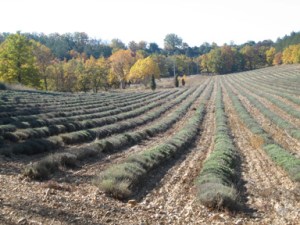
Lavender farm photo.

Lavender farm at
Soeurs Coopératrices Maison St Joseph.

Creek Chincultik

Creek Chincultik
©2010 Carla Woody
First oil painting after a 12-year hiatus.

Honoring the Process

I’m going to come full circle and talk a little about painting. I’m an artist, using mostly oils as my medium. During my lifetime, I periodically took a hiatus from that art form for various reasons. The last rationale was because I moved cross country and no longer had a studio—or so I told myself. I took up black and white photography for several years, but found it not as tactilely satisfying. For a long time, my friend and spiritual mentor Don Américo Yábar had been urging me to paint again and said it would be quite different than what I’d done before. I thought he meant that my subject matter and style would be esoteric based on my experiences in the last number of years. In the fall of 2009, after a 12-year pause, I began to paint again. It just seemed right somehow, without Don Américo ever mentioning it at all when I had been in Peru that summer. And I discovered what he may have meant—however else my canvases may eventually develop. When I was much younger I painted fast and furious, always with a goal in mind, turning out a completed work typically in somewhere between 4-8 hours. Now I’m painting on the same canvas for weeks, sometimes longer. Quite content in the process, I’m allowing the colors to emerge and what expression is more deeply inside me. Perhaps I’m becoming like the older vine Matthieu talked about. Not quite the elder and I’m not yet holding it all inside. Too much to discover still!

But I think what I’ve learned over the years, that is coming out in my painting, and what was echoed through the people we engaged with in Provence, is this. There’s great value to immersion in the integrity of a process. Then the quality of the outcome is naturally delivered. I’ve been taught patience for things to come to fruition. Some things need to happen for others to evolve. When you know this at a visceral level, it brings that joie de vivre written so plainly on the faces of those who live through that understanding like Sister Marie Michelle and Matthieu. It also takes faith—and sometimes more than a little stamina.

*******************

*Édouard Manet turned the French art world upside down with his controversial painting Le Déjeuner sur l’herbe. Pablo Picasso later did his own versions of Luncheon on the Grass.

View information about our October 2013 “La Source de Provence” program here. Limited to 7 travelers.

Categories: Creativity Strategies, Spiritual Evolution, Spiritual Travel, Visual Arts | Tags: , , , , | 2 Comments

Blog at WordPress.com.