cultural interests

Film Review – The Red Queen: A Mayan Mystery

In 1994 a tomb was excavated in Temple XIII in the main plaza of Palenque, the large Maya ruin complex in Chiapas, Mexico. It was the finest thus far uncovered, even more so than the great ruler Pakal II’s in the Temple of the Inscriptions just a couple of doors down. The quantity of jadeite, sacred objects and two skeletons on either side of the sarcophagus indicated someone of the highest standing. And a very curious thing: The remains were completely covered in a powdery red substance that turned out to be cinnabar.

A physical anthropologist determined the remains to be female. The temple richness  pointed to the final resting place of an esteemed ruler. But for women to attain such a capacity was unusual. Thus began The Red Queen. And then it immediately garnered my attention when archaeologist David Friedal took the screen saying, “The history of the past is not the history of men but men and women together. And at times women change the course of history. Not men.”

The Red Queen is not a boring historical documentary. Rather it entertains the question: Who was the Red Queen? She was nicknamed so because of the cinnabar. Attendants carefully covered her in the toxic powder at burial. It made its way into her very bones. We’re on board as the film tracks the mysteries, technical methods and data that lead to a conclusion from the three likeliest candidates.

  • Was it Yohl Ik’nal, the grandmother of Pakal? As far as we know she was the first Maya female to rule on her own…for 21 years.
  • Was it Sak K’uk, who took over the throne when her brother was killed? She held rule until she was able to put her son Pakal on the throne when he turned twelve. Likely she guided him from behind for some time after that.
  • Or was it Tz’akbu Ajaw, the wife of Pakal? And sometimes called Lady Conjurer as noted in Carol Karasik’s book The Drum Wars where she devoted a chapter to the Red Queen.

Those who know me are well acquainted with my love for Palenque, having been drawn back regularly since 1995 when I first had the pleasure. So the story of the Red Queen was an interest on that level. But more so, I found it heartening to have women recognized for who they are, their accomplishments and learn something of their story—not quietly influencing behind the scenes but front stage center.

Produced by the Discovery Channel, 2005. Watch it free on You Tube.
The Red Queen 1

Part One: View it here. 1 hour, 9 minutes.

Red Queen-2

Part Two: View it here. 24 minutes.

*****

For more information on our next scheduled Maya Mysteries spiritual travel program in Chiapas…where we visit Palenque and pay respects to the Red Queen, go here.
 

Categories: cultural interests, Film, Maya | Tags: , , | 1 Comment

New Art by Kayum Ma’ax Garcia

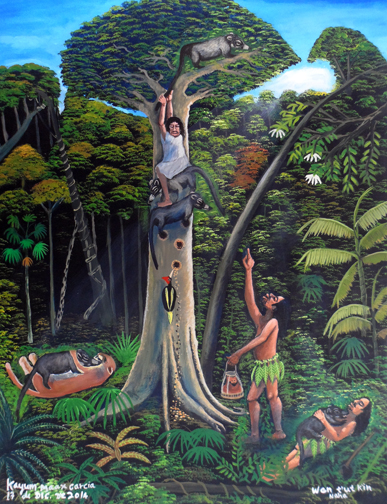
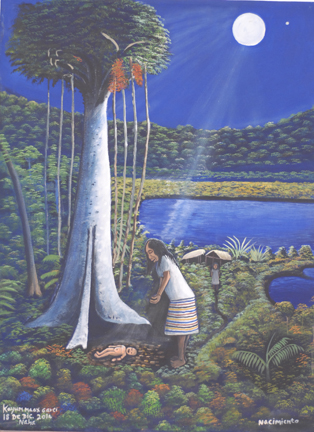
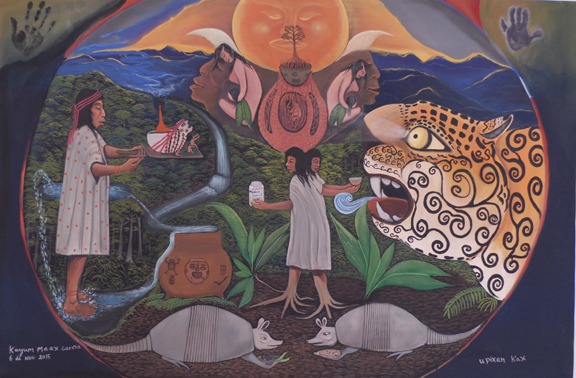
In a previous post I told the story of visiting artist Kayum Ma’ax Garcia in his home in the Lacandón Maya village of Nahá during our January 2015 Maya program. During that visit the online Allies Gallery was born. The entire journey was pure magic. The gallery was just one instance of something that evolved organically. As a result, Kayum is able to offer his art to a wider world and has sold some prints. I’m very happy about that, and Kayum and family are ecstatic.

Recently Kayum’s work was featured in Galería MUY located in San Cristóbal de Las Casas. The MUY, now part of our Kinship Circle, gives exposure to contemporary art of Indigenous artists of Chiapas. With their help, we’ve been able to bring more of Kayum’s artwork to you.

Birth

Title: Birth. Acrylic on canvas. ©2014 Kayum Ma’ax Garcia

The Heart of the World

Title: The Heart of the World. Acrylic on canvas. ©2015 Kayum Ma’ax Garcia.

To view more, go directly to the Allies Gallery. Kayum rarely leaves his isolated rainforest village. His art is unique. By purchasing through our online gallery, proceeds support this Indigenous artist document a way of life that is increasingly lost.


Categories: cultural interests, Lacandón Maya, Visual Arts | Tags: , , | 1 Comment

Those Who Carry Planetary Consciousness

In 2008 Kenosis Spirit Keepers sponsored Hopi Harold Joseph on my spiritual travel program to Peru. The intent being an opportunity for two relations—Q’ero and Hopi—to share a journey from Cusco to Lake Titicaca along their common migration path. Two videographers also came along to document the nature of this work of the heart. Jacob Devaney, of Culture Collective and now blogger for Huffington Post, was one of them.

Last week Jacob contacted me via email related to writing about his experience and said, “My time in Peru was so profound it took me 7 years to even start writing about it… Thanks, Carla! The magic continues to unfold.”

Hopi and Q'ero

Hopi Harold Joseph with Q’ero Wisdom Keepers. Photo: Darlene Dunning.

I can tell you those were quite the momentous times. We fellow travelers were privileged to be there and participate in the circle with these Wisdom Keepers still so committed to their core traditional values. Those who carry consciousness for planetary wellbeing are becoming an endangered strain of humanity.

Thankfully, the track that called me back in 1994 has continued, deepening in so many ways I couldn’t have predicted. In this year’s program Hopi Marvin Lalo from First Mesa will be meeting his Q’ero relations for the first time. Our journey begins at Tiwanaku, the legendary Creation Place in Bolivia, and travels along an initiation path all the way to the Manu rainforest in Peru. Marvin is so excited.

Jacob’s article is titled Wisdom of an Andean Mystic:

This is not your usual story of going to the jungle to try Ayahuasca…

Few people realize that the Hopi Tribe of Northern Arizona have clans that are descendants of tribes from the northernmost to southernmost tips of the Americas (and quite possibly beyond that). The Q’ero are believed to be descendants of the Inca, who fled high into the Andes where they successfully hid from outsiders until recent decades. Kenosis Spirit Keepers had created the cultural exchange program, and Don Americo Yabar was playing a central role in translating between cultural leaders. I was brought along by Carla Woody to help document and assist my Hopi friend, Harold Joseph…

Read the entire article on Uplift.

Categories: cultural interests, Indigenous Wisdom, Spiritual Travel | Tags: , , , , , | 2 Comments

Film Review – Agafia’s Taiga Life

Agafia’s Taiga Life

A Documentary by Vice Media

Agafia

Agafia Lykov. Photo credit: Siberian Times.

In 1936 Karp Lykov took his family and fled into the Siberian wilderness to avoid Stalin and persecution because of their religion. Called the Old Believers, they belonged to a sect of Russian Orthodox fundamentalists. Over the years they retreated deeper and deeper into the Taiga, a forested region in the heart of Siberia, where temperatures are extreme and civilization is non-existent.

Agafia was born into that life in 1943. Agafia saw no one but family for 40 years. And then no one at all for 25 years until a geologist moved a short distance away. All that time, she’d been a woman alone, living off the land.

Journalists from Vice Media visited Agafia to shoot a documentary about her life for their Far Out series. She relates what it’s like to live in the company of her animals, her faith, occasional encounters with bears and rocket debris, a way of life that gets much more difficult as she ages. Her story is an example of pockets in the world where people are living in solitude by circumstance and often by choice.

Watch it online for free. Length: 36 minutes.

To read about another in this series and watch the documentary, see Faustino’s Patagonian Retreat.

Categories: cultural interests, Film, Solitude | Tags: , , , | Leave a comment

Allies

In January I took a group to Nahá as usual during my Maya spiritual travel program. Nahá is a tiny Lacandón Maya village deep in the Lacandón Biosphere of Chiapas, Southern Mexico. We go there to be with Don Antonio Martinez for ceremony and show our respect that he’s still holding traditions when there’s so much pressure for him to let them go. We also visit with the widows of the late spiritual leader Chan K’in Viejo, as well as spending time at sacred Lacandón sites.

This time we stopped by Kayum’s home. I hadn’t seen him in years. Kayum Ma’ax Garcia is a Lacandón Maya artist of the monkey onen, or clan. He’s also one of Chan K’in Viejo’s sons. He works in acrylics on canvas. In his artwork Kayum conveys actual events, lifeways, creation stories and rituals of a culture nearly gone—as well as his dreams, an important aspect of traditional life. So, in his own way, Kayum is preserving the traditions of his people. I’ve always been fascinated by his art.

Kayum Art

Traveler Frostie Torres purchases a painting from Kayum during our 2007 program. Photo: Alonso Mendez.

But he has little exposure to the world outside his village. I thought to myself, it’s important for his work to get out there, not only to help sustain his family but for others to appreciate Lacandón lifeways and traditions. I suggested to him that he offer his work as archival prints through an online service as I do. But he has no camera, computer or technical knowledge even if he did. Aside from that there’s only Internet at the little lodge where we stay. And the connection is so poor it may as well be non-existent. He had no one to support this possibility, and it was something he really wanted to do after I explained it.

An opportunity landed in my lap, another one that truly matters. The group witnessed the process of this conception. They were excited. I went home and put a vote before the Kenosis Spirit Keepers Board.*

The Allies Gallery is now a program supported by Kenosis Spirit Keepers to sponsor Indigenous artists who have extremely limited capabilities to offer their work. Kayum is our first artist. Proceeds of any of his art sales go directly to him. The same will be true for any other artist we include.

Man of the Wild Acrylic on canvas Kayum Ma'ax Garcia

Man of the Wild
Acrylic on canvas
Kayum Ma’ax Garcia

Our online gallery is now up! You’re invited to check it out and support Kayum through purchase of his work and sharing Allies Gallery with others. We currently have prints available for four of his pieces, in various sizes and formats, and will add more as time goes on.

*******

Kenosis Spirit Keepers is the volunteer-run, grassroots organization I founded in 2007 to help preserve Indigenous traditions, a 501(c)3 nonprofit extension of Kenosis.

Categories: Arts, cultural interests, Lacandón Maya | Tags: , , , , | Leave a comment

Learnings from Hopi: What Is Your Blue Star?

Since 2007 Kenosis Spirit Keepers has been sponsoring Hopi Wisdom Keepers on my spiritual travel programs to reconnect with relations along their migration path from South America.* As much as it’s been spiritually meaningful to them, it’s been an extraordinary privilege for the rest of us on those travels to witness how they find proof in the common symbols, creation stories and even Indigenous language in Peru, Mexico and Guatemala, letting them know—indeed—those were their origins.

One of my favorite memories from Peru is when Harold Joseph met Don Miguelito, an Elder who only spoke Quechua. Yet Harold understood him. Another is when the reed serpent-shaped boats on Lake Titicaca excited Harold. He brought a replica home and showed it to his late father-in-law, the last Hopi oral historian of his clan. Char Joseph told me of her father’s response, “It made him so happy! It proved to him that our stories are real!” All Hopis who have come on the Maya journeys as well have made the connection between the Jaguar Twins in Maya traditional stories and their own, along with many other commonalities.

When such things happen it supports spiritual grounding. Something intangible finds its inherent slot. It’s part of identity and who we are in the world. For so many of us today, ancestry is unclear… lost to time or hidden.

I can easily link my own migrations through this lifetime that have brought me to where I am today. But what about lineage? Mine is a mixed bag. Some can be traced back to the late 1700s through records that tell of my Irish and English ancestors’ wanderings from place to place. However, there’s a good chunk of my heritage only known through veiled family stories or random comments … untraceable. During the first half of the last century, my people were taught to be ashamed of their Native origins and perhaps attempted to pass for something they weren’t. And in earlier years, they were just trying to keep their lives.

What we know of our roots and what we don’t commingles and informs the stories we choose to create through the making of our own lives. And we can pay attention to what runs in our blood that needs no proof.

Pam Hale Trachta, a spiritual mentor and author of Flying Lessons, participated in my Spiritual Travel to Hopi program in March. She’s written a beautifully informative article that encompasses what I’m writing about here: Hopi migrations and our own guiding light.

What Is Your Blue Star?

Blue Star

Blue star petroglyph. Photo: Pam Hale Trachta.

The Hopi people we met in Arizona on a spiritual tour with Carla Woody allowed us to see and photograph a petroglyphic symbol of a blue star that appeared long ago, to signal their way home. The story they told us was that when they emerged through a sipapu or opening in the earth in northern Arizona, they met Masau, the guardian of the earth, who told them they could inhabit this world if they would abide by his instructions…He told them to make migrations into the four directions, and after spreading far and wide he told them they would be signaled back to the place of their emergence… Read more.

Pam also wrote about precious time we spent in the Harold and Char’s home. I wanted to include this, too, as added reading to convey how special it is to be invited.

Hopi Feast

Post-ceremony breakfast feast. Photo: Pam Hale Trachta.

A Hopi Feast

On a literal level, this feast was prepared for us by Charlene Joseph, a Hopi woman from the village of Moenkopi. We were welcomed into her home to learn about the Hopi way of life, which is all about Spirit. Perhaps you can’t see Spirit in the photograph, but it is the major ingredient–the primary flavor in every event, every “dish” that is part of her family’s life…This feast is a tradition the morning after the night Kachina dances, which we were privileged to attendRead more.

******

*I founded Kenosis Spirit Keepers, the nonprofit extension of Kenosis, in 2007 to help preserve Indigenous wisdom ways.

Categories: cultural interests, Hopi, Indigenous Wisdom | Tags: , , , , | 1 Comment

Film Review: The Wellbriety Journey to Forgiveness

I will tell you up front that this is a difficult film to watch and can bring up all kinds of emotion. But if you’re going to watch it, then do so until the end because toward its finish there is much hope conveyed.

During our recent Spirit Keepers Series held in Phoenix on the subject of PTSD and Native healing ways, I had invited Eli PaintedCrow, an Iraq War veteran of the Yaqui Nation and co-founder of Turtle Women Rising, to take part based on her own experiences and to frame further aspects of our Series. She showed a portion of Wellbriety Journey to Forgiveness, a documentary produced by White Bison, Inc. They’re a Native American-operated 501(c)3 nonprofit dedicated to culturally-based healing for Indigenous peoples.

The film starts out with a prophecy given by the Old Ones about the light skins who would arrive, create confusion and great destruction. How everything would be taken from the Native American but their spirituality. There would be tremendous suffering, genocide and a time of testing. But opportunity for healing would present itself. After this time of healing, the buffalo, Native people and all manner of sustenance would return. Harmony would prevail. Native people believe that we entered this time of healing in the early 1990s.

This is the story of that destruction, particularly centered on boarding schools and their effect. If you’re not familiar, in 1879 the first Indian boarding school was opened in New Carlisle, PA. Native children were forcibly taken from their families and shipped off to such schools around the US where they were stripped of their language and anything having to do with their culture. They endured ongoing violence and humiliation in silence—many didn’t survive—and it had horribly detrimental effects reaching all the way to today. This is called intergenerational trauma, certainly a form of PTSD.

As a part of the Wellbriety Movement, Native organizers undertook a 7000-mile journey all over the US to give Elders and their children a chance to tell their stories, perhaps for the first time, and express grief. In this undertaking they hoped to break the cycle of addiction and violence, begin the road to forgiveness and a return to spiritual traditions. The film covers Native values and how to live in harmony as taught by the Old Ones, along with a model called the Four Directions of Forgiveness and a call to Greater Purpose.

This is an extremely powerful film and could be called the Schindler’s List for Native Americans. It was created as an Indian Give-Away by White Bison for purposes of truth-telling and healing.

Whether you have Indigenous members in your family line who suffered the atrocities, have ancestors who perpetrated any part of it, or are born of mixed blood as many of us are…the message presented here is relevant to all. The effects of genocide, abuse and shame are equally carried through the family line. This is a film for anyone whose ancestors have experienced anything of the like. That doesn’t leave out many people on the planet.

This is a move for truth—no more secrets—and healing accomplished when we live in harmony as the Old Ones taught. Seeing the complete film instilled even more significance to me in how I personally live and greater understanding of the important work Kenosis Spirit Keepers does, even if we reach only a few.

This is a film for the Next Seven Generations. Critical mass is important. View the film for free on You Tube and share widely. Length: 1 hour, 13 minutes. Also visit White Bison to learn of their healing institution and classes.

Categories: cultural interests, Film, Healing, Indigenous Rights | Tags: , , , | Leave a comment

Video: Coyote Medicine with Lewis Mehl-Madrona, MD, PhD

In January 2015 Kenosis Spirit Keepers was pleased to collaborate with Johns Hopkins Center for American Indian Health to bring Lewis Mehl-Madrona, MD, PhD, to Baltimore to speak on Coyote Medicine: Lessons in Native American Healing. Dr. Mehl-Madrona, Lakota-Cherokee author of the Coyote Trilogy, shared about historical trauma, lessons about community healing and resilience that come from Native communities.

We were able to video his presentation and offer it to you here. Enjoy…

Categories: cultural interests, Healthy Living, Indigenous Wisdom | Tags: , , | 1 Comment

Series Review: Sacred Journeys with Bruce Feiler

In December, PBS aired a series called Sacred Journeys with Bruce Feiler. Given that I offer spiritual journeys myself, it caught my attention. Bruce Feiler is the bestselling author of several books on religion and contemporary lifestyle, as well as New York Times columnist for This Life in the Sunday newspaper. In the program, he goes along with US travelers to six separate sites around the globe as they participate in sacred gatherings and pilgrimages. As viewers we get hour-long glimpses of:

  • Lourdes, France where the young peasant girl, Bernadette Soubirous, claimed the Virgin Mary appeared to her over a period of time in 1858;
  • A 750-mile pilgrimage route on the Japanese island of Shikoku to 88 temples and shrines honoring the esteemed Buddhist monk Kobo-Daishi, responsible for bringing Buddhism from China in the 9th century;
  • The holy sites in Jerusalem encompassing Judaism, Christianity and Islam;
  • The annual Hajj pilgrimage to Mecca in Saudi Arabia, which mirrors Muhammad’s return to his home as leader of the new Islamic religion;
  • The Kumbh Mela, the largest religious gathering in the world, occurring every 12 years at the intersection of the Ganges and Yamuna Rivers in Allahabad, India;
  • The annual festival of Osun-Osgobo in Osogbo, Nigeria, honoring the goddess of fertility, Osun, of the Yoruba religion.

All features in this series are worth the watch. They’re inspiring and caused me to look at my own reasons for pilgrimages I’ve taken…and the one I’m preparing to take.

The Lourdes segment focused on the annual International Military Pilgrimage that has been ongoing since WWII. This filming showed US veterans of the Iraq and Afghanistan wars, carrying visible and invisible wounds, and was especially poignant.

The Yoruba feature was particularly interesting to me, showing elements of initiation rituals. An explanation offered why there were influences from other religions incorporated into Yoruba: As with many sacred traditions, those who are indigenous to the land incorporate the conqueror’s religion in order to stay alive. They become so intertwined in order that the original form may survive, even if hidden. The statement validated what I’ve seen in some Native traditions I’ve known, and sought to explain myself.

Inasmuch as this series is a visual feast for variety of cultures and spiritual rituals, there’s a thread that remains constant: the sense of seeking and renewal. The pilgrims “move between the questions in their lives” and “step outside themselves to reach for higher meaning.”

I found the pilgrims’ expressions and intent in these segments to be no different than those of the travelers on the spiritual travel journeys I sponsor.

Streaming free at PBS online for a limited time. Also available via DVD or to download.


Categories: cultural interests, Film Review, Healing, Spiritual Evolution, Spiritual Travel | Tags: , , , , , | Leave a comment

Special Notice: Coyote Medicine with Lewis Mehl-Madrona, MD

Kenosis Spirit Keepers logo

SPECIAL NOTICE:

We are pleased to announce our special collaboration with Johns Hopkins Center for American Indian Health bringing Coyote Medicine with Lewis Mehl-Madrona, MD, PhD to Baltimore for a free public talk, January 15, 12 noon-1:15 p.m.

Dr. Mehl-Madrona, Lakota-Cherokee author of the Coyote Trilogy, will share about historical trauma, lessons about community healing and resilience that come from Native communities.

Location: John Hopkins Bloomberg School of Public Health, 615 N. Wolfe Street, Room 1020.

To reserve your space contact Nicole Pare, John Hopkins University, npare1@jhu.edu or phone 410-955-6931.

KSKMehlMadrona2-page-0

***

With special thanks to Mike Weddle, MD, KSK Board Member, and Dr. Allison Barlow, Associate Director, John Hopkins Center for American Indian Health, in their efforts to make this event possible.

Categories: cultural interests, Healthy Living, Indigenous Wisdom | Tags: , , | Leave a comment

Blog at WordPress.com.