Indigenous Wisdom

A Hopi Discovery in Bolivia

It was the first day of The Heart of the Andes. This year’s spiritual travel program included Bolivia as our starting point with culmination in Cusco, closely replicating the initiation journey of the first Inka couple Manco Capac and Mama Ocllo. Directed by their father-god Viracocha, they sought a most holy place to build a city—a place of the sun and navel of the world.*

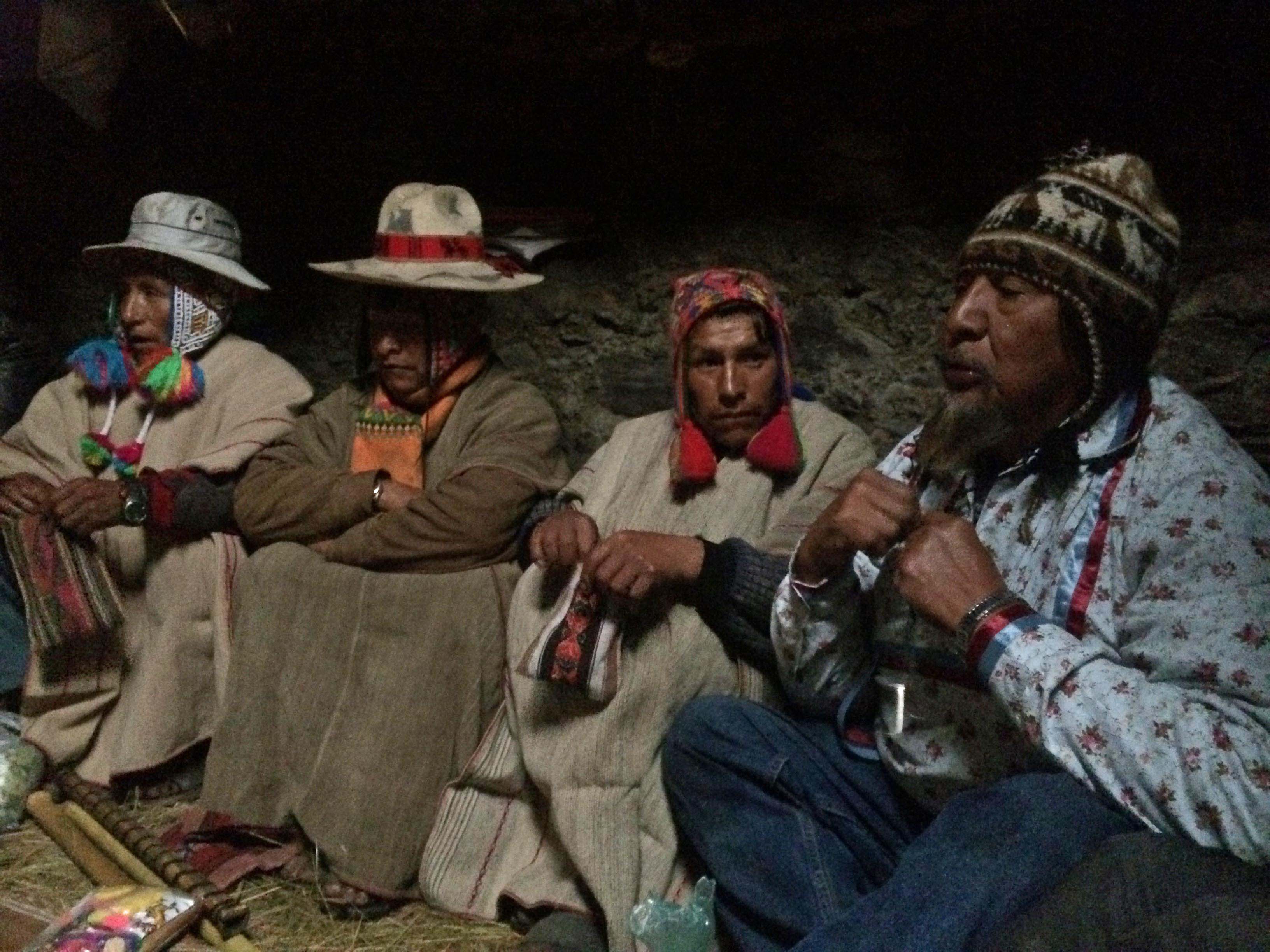
Prior to setting foot in Tiwanku, said to be the Creation Place where Manco Capac and Mama Ocllo first emerged, we made a stop. On a high windy ridge overlooking the area—a ritual site— Q’ero paq’o friends led a despacho ceremony. Offering sacred cornmeal to each of us, Hopi Suhongva Marvin Lalo made his own prayers to the land as we all released our intent to the winds.**

Marvin had begun to share his feelings and his mission for coming on this journey.

Hopi Elders talk about and remind generations after generations of Hopi oral history, including the migration stories of various clans after the flooding of Palatkwapi, a unknown ancient village located somewhere in the south. Exact routes, established villages, and events have long been forgotten with time. Still, ancient ceremonies remain intact with clans responsible for carrying religious ceremonies through thousands of years of migrations to present-day Hopi villages where the ceremonies are still practiced today.

The Heart of the Andes journey offered an opportunity to connect with ancestral history, to visit the land of the ancients and its descendents, the Q’ero. To what extent my experience would take me, I didn’t know. The first despacho ceremony, I experienced a strong connection as I was presented with a Chakana; a sacred stone necklace and woven cords tied to my wrist. I gave thanks with offerings of my hooma.

At Tiwanku, Marvin already noted the possibility of his own people having set foot on this land. We wandered the ruins, a place of ancient mystery. We were all especially moved in a ritual square, the interior lined with stone faces—a portal perhaps.

Finally pulling ourselves away, in the last half hour before closing we ventured over to an adjacent site. Puma Punku may be the biggest mystery of all. Some conjecture it may have been a docking point, as thousands of years ago Lake Titicaca also covered this area. Now what was left were huge toppled stone slabs and much smaller structures fashioned with extraordinary precision … seemingly impossible for those times. It cannot be explained to this day.

And it was here that Marvin—who had traveled south all the way from Hopi Land on a mission for signs that his people had passed this way—found the Hopi migration petroglyph. The one that was known to point the way to his ancestors. The one that pointed north.

Atypical of other petroglyphs I’ve seen all over the US Southwest or elsewhere, it was large. I’d say three feet, maybe more. Also curious, there was a large serpent petroglyph in front of it, as though verifying the direction.

Even that large, it was easy to miss. The sun was at that point in the day when its rays glare as it’s headed toward the horizon ready for the night. Light bounced off rock surfaces, washing out details. Even with sunglasses my eyes were at its mercy. I missed it.

But not Marvin. He zeroed in on a symbol he knew to be his people’s…and his hair was on fire.

Hopi Migration Symbol

Hopi migration petroglyph at Puma Punka, black and white to better view. Not pictured in its entirety. Nor is the serpent petroglyph pictured. Photo credit: Janet Harvey.

What does this mean exactly? In 2008 Hopi Harold Joseph came on our program that included Puno. On the Peruvian side of Lake Titicaca, we went by boat to the reed islands. There Harold saw the reed boats with serpent heads that he knew from Hopi oral history. He took a replica back to Hopi to show his father-in-law, the last great oral historian of the Tribe…who got tears in his eyes when Harold presented him with an artifact that he already knew.

For Marvin and his Elders, how do you explain the presence of the Hopi migration symbol at Puma Punka if the Hopi had not been there? He talked with excitement of sharing this discovery with the Elders. When our guides spoke of a great city that once existed in this region, now lost, and the great flood that took it, he listened. Geologically, it appears valid. The same story exists in his oral history. The locals even raised the idea that the place we know as Atlantis and the great city they cite are the same.

After we came home, Marvin offered his words, to be included in this documentation, more overview of his time with us in a land he found not to be foreign to him.

The Q’ero and spiritual guides honored me by inviting me to sit in on the ceremonies and observe. I recognized the po.nga (altar) and offerings to be similar to Hopi. At one point I was asked to pray with my hooma for them: to ask the deities’ especially Hopi to help and assist the people to prosper. I quietly prayed, gave offerings of hooma, drank the cool tasty water and bathed symbolically at the springs.

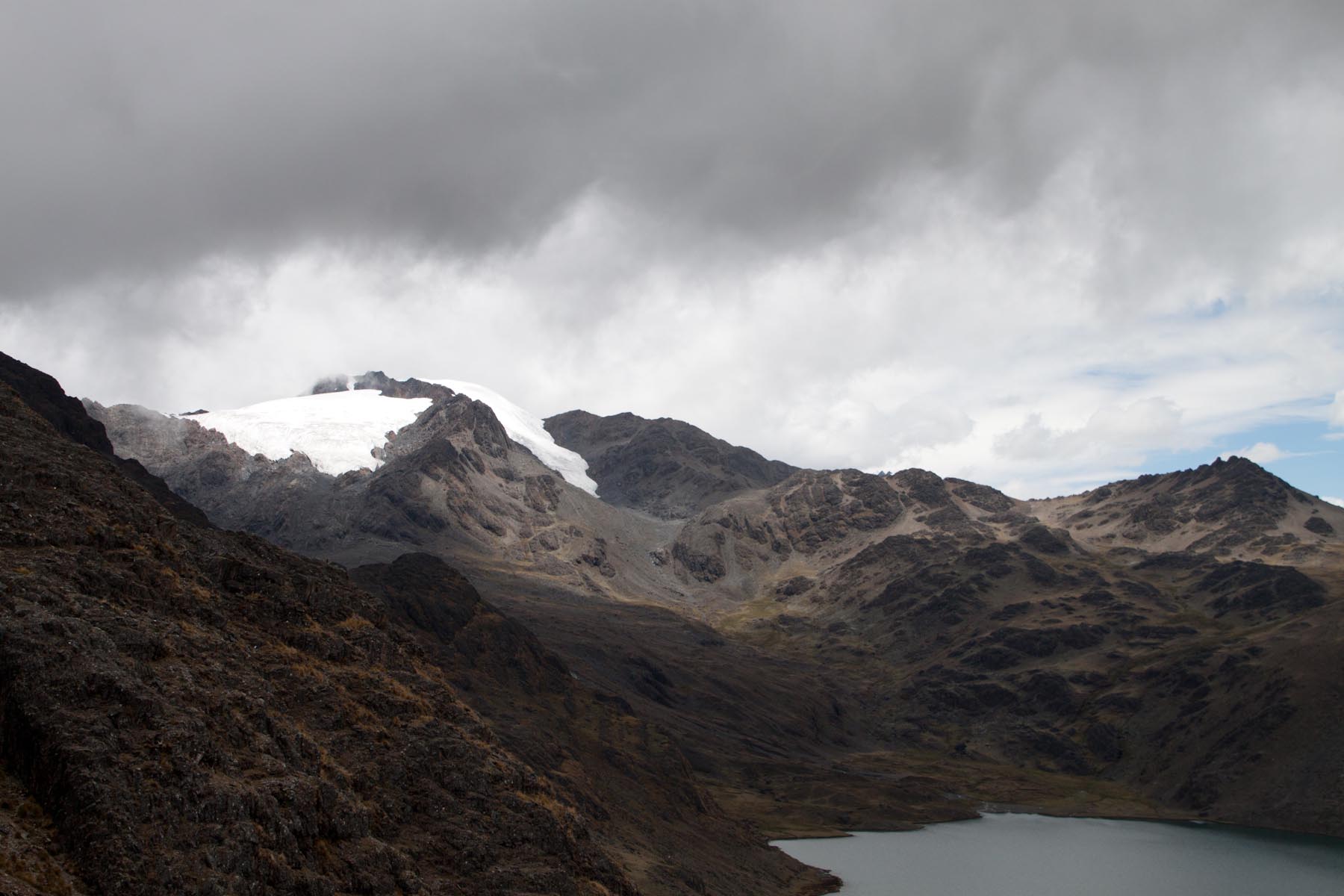
Each day I visited archeological sites with our group and host. Visiting the great Titicaca Lake, to hear a local legend of a great city, which was flooded thousands of years ago sitting at the bottom of the lake. The more I saw, the more I was reminded of how the structures, stone walls, the land and historical stories are similar in the Hopi Southwest. The migration symbol is common to the Southwest but seeing it in South America helps support our Elders’ stories of Hopi migration from the south: ‘Palatkwapi.’

Suhongva Marvin Lalo

Suhongva Marvin Lalo, Island of the Moon. Photo credit: Carla Woody.

When we know our origins, it grounds spiritual identity. We know our place in the world through all the places our people traveled, the ground their feet have touched. It goes beyond mere belief. I’m not sure the word ‘faith’ is even sufficient.

And when you’ve followed something that you know, even as you don’t know what’s ahead or why…and it comes to some kind of fruition in a way you couldn’t even have imagined…that instills something for which I have no words.

That’s what happened for me on this journey. Next year it will be ten years since an eagle and condor flew together overhead at Huaypo Lake outside Cusco after a despacho ceremony with Q’ero friends. And I had an immediate vision of bringing Hopi people to Peru on my 2007 program…not knowing any Hopi…not knowing it was their migration path…not knowing how it would ever happen…not knowing of the Eagle Condor Prophecy.

I have no words.

********

* Viracocha, Creator-Sun God, is also known as Inti.

** Q’ero paq’os (meaning priests, mystics and/or wisdom keepers) traveled to Bolivia from their home in the high Peruvian Andes as sponsored guests and experience the site of their origin for the first time. At important points in the journey they guided despacho ceremonies, a prayer ritual.

Suhongva Marvin Lalo of Walpi, First Mesa in Northern Arizona was our sponsored Hopi guest for the purpose he mentions in this article. Marvin consults for the Hopi Cultural Center in validating sacred sites and artifacts.

For more on why Kenosis Spirit Keepers has been sponsoring Indigenous guests on our spiritual travel programs, go here.

Categories: Gratitude, Hopi, Indigenous Wisdom, Spiritual Travel | Tags: , , , | 6 Comments

Spiritual Travel to Hopi, March 2-8

If you’re subscribed to The Lifepath Dialogues, then I’m guessing you’d be someone who would engage in our upcoming program on Hopi in Northern Arizona—such an experience unlikely available to you on your own. Only in the last two years has it been possible to hold this in-depth program…in all respect…sanctioned by the Hopi religious leader.

Hopi TEW KSK Final-low

Since 2007 the nonprofit I founded, Kenosis Spirit Keepers, has been sponsoring Hopi Wisdom Keepers on spiritual travel programs to Bolivia, Peru, Guatemala and Mexico to reconnect with their relations from their migration path up from South America.

Now for the first time, we are sponsoring an Indigenous relation of the Hopi from outside the US. We are honored to bring Apab’yan Tew, Maya Daykeeper, spiritual leader, dancer and musician, to Hopi to share traditions and witness similarities to his Maya traditions as the Hopi have in his own homeland.

Apab'yan-15-1

These are spiritually-oriented programs, also supporting preservation of Native traditions in danger of decimation. In fact, a tuition portion of all spiritual travel programs are tax-deductible for that purpose. The elements are carefully put together to give you an experience that builds upon itself…and continues to evolve long after you’ve returned home.

For more information or to register, go here. Any questions or comments are always welcome. Feel free to contact me directly. Registration deadline is January 29.

Categories: Hopi, Indigenous Wisdom, Maya, Spiritual Evolution, Spiritual Travel | Tags: , , | Leave a comment

An Integrated Life

Living in a Western culture your life is compartmentalized. Maybe not across the board but largely so unless you’ve made a concerted effort to change what’s handed to us. That means creative expression is separate from work, which in turn is isolated from spirituality. Possibly the closest overlap may be spirituality relating to family or relationship. Or if you’re in a creative field of work where your deeper needs may be unleashed. Such disconnection results in dissatisfaction—an underlying sense of emptiness and lack of freedom that snowballs over time. Containment. I’m quite sure it wasn’t always that way but probably began with the Industrial Revolution and a move away from the land and community. The fact remains: it’s undeniably present. People attempt to fill the hole with ways that don’t work and are often quite harmful.

I had two reminders recently that initiated this post. A young woman from Los Angeles came into The Gallery in Williams, an artist cooperative where I’m a member. I happen to be on duty. When we struck up a conversation, I identified myself as one of the artists.

“I’m an artist,” she said then gestured to her partner. “But he’s a fine artist.”

“What does that mean?” I asked.

“He’s a full-time artist. But I work in a corporation. If I ever have time, then maybe I can do a little something.” Her shoulders slumped, and I could see she rarely had the time or energy left over to devote, given her hours and pressures at work.

Full moon over Bolivia. View from Island of the Sun, Lake Titicaca. ©2015 Carla Woody.

Full moon over Bolivia. View from Island of the Sun, Lake Titicaca. ©2015 Carla Woody.

I told her I used to live the same way. But over time I made conscious decisions to realign my life to what I believe, care about and what gives me energy rather than takes it…that it’s truly possible…that I had to do it for my own wellbeing or suffer the consequences. She asked for my contact information and said, “You’re going to hear from me.” Whether I do or not, I sensed we weren’t just making small talk. In those few moments, possibility created a crack in a previously closed space. And as Leonard Cohen said, “That’s how the light gets in.”

The issue: We don’t have many role models within our culture for those who lead an integrated life. I feel fortunate that I’ve had ongoing influences over twenty years. But it didn’t come from my own culture. I began to understand there was another way to live because I witnessed it within traditional Indigenous communities, especially those where I’ve spent consistent amounts of time. That’s how I know what I’ve seen isn’t isolated. Spiritual beliefs aren’t relegated to one day or a few minutes a week. They permeate everything: the way fields are tilled, the manner food is cooked, how children are raised, the things they create, and how communities interact.*

All is soundly grounded in such a way that gives life meaning and depth throughout. I have so much gratitude for this exposure, which has taught me the “how.” After a time of repetitive experiences, I consciously began to change how I live my own life. In the beginning, it seemed radical and difficult. Now it would be so to live any other way. Any aspect of my life organically dovetails into another.

Modesto

Modesto, long-time Q’ero friend and father to my godson, making prayers to the Pachamama (Mother Earth) and Apus (sacred mountain spirits) during ceremony outside Cusco. ©2015 Carla Woody.

I’ve just returned from this year’s spiritual travel program in Bolivia and Peru. Our Hopi program is coming soon in March, an opportunity for a solid week of witnessing what I discuss here. So my thoughts on integration are very present.

In closing circles I’ve heard concerns from travelers whether they’ll be able to experience the same depth at home. Of course, you can. Any deeply spiritual experience lives inside you always—no matter the form of its delivery. It becomes part of your identity and can be readily called into consciousness if you need a reminder.

I’ve also heard comment about withholding such spiritual consciousness, as though it would become tainted, if carried over to another aspect of life—usually work. Why would you want to keep it in the closet? That would cause internal conflict. (Understand I’m not talking at all about proselytizing, a different matter entirely I find an offensive intrusion.)

When you live through your spiritual values, there’s a trickle down effect shaping who you are in the world, what you believe about yourself and others, how you approach matters, what you create. It doesn’t even involve talking about those values. Yet, all shifts. It’s often visible to others as well. Even if they can’t put their finger on the difference.

I long ago realized folks come to engage in these journeys for reasons they may not be able to articulate but are present throughout all the same. It may play out in different forms but the desire for clarity, resolution and integration are primary and inform re-entry home.

We’re all tested all the time. It comes down to belief about possibility, choice and knowing the “how to.” It means staying strong so you can walk through life with grace. It means knowing the full sense of your birthright and giving yourself a chance to own it.

*********

*That doesn’t mean influences for Indigenous peoples to get off track are nonexistent. There are, mostly coming from Western ways. If they give in to them, the same angst occurs and harms wellbeing…maybe more so because their blood knows another way.

********

Invitation: Join us for our December 4-5 Spirit Keepers Series in Phoenix where Eli PaintedCrow, Yaqui-Mexica Wisdom Keeper, and I offer a primer on ways to walk in two worlds—Indigenous and Western—and live through spiritual values. Donation basis.

Categories: Global Consciousness, Gratitude, Healthy Living, Indigenous Wisdom, Spiritual Travel | Tags: , , , | 2 Comments

Spiritual Travel to Hopi: Sacred Guardians of the World

Going Home Shungopavi

Special Announcement

Spiritual Travel to Hopi: Sacred Guardians of the World

March 2-8, 2016

Immersion Experience in the Hopi Way of Life.

Early registration discount until November 6.

We are pleased to announce our Spiritual Travel Program to Hopi: Sacred Guardians of the World. This is a rare opportunity to experience Hopi Spirit Keepers in their homes, hear the ancient stories, visit hidden sacred sites, learn about medicine ways and attend the Night Dances, all that weaves the very identity of the Hopi people as guardians of the world. Only recently has it become possible to be invited to an immersion experience unlikely to have on your own.


Aoab'yan TewSponsored Maya Guest

Apab’yan Tew is an Ajq’ij, a Day Keeper, spiritual guide, dancer and musician, of the sacred K’iche’ Maya tradition from the village of Nawalja’ in Sololá of the Guatemalan highlands. Sought after as a speak and consultant, we are fortunate to have Tat Apab’yan traveling with us as translator of Maya traditions as they may relate to Hopi ways.


Response to our previous programs has been overwhelming. The group size is limited to maintain respect and the intimate nature. A portion of tuition is tax-deductible to help preserve continuity of Native wisdom traditions through the initiatives of Kenosis Spirit Keepers, the nonprofit extension of Kenosis. More information, including detailed itinerary, tuition and bios, is on the website.

Registration deadline January 29. Early registration discount until November 6. Register now to hold your space! For questions call 928-778-1058 or email.

Blessings of the Four Directions.

Categories: Hopi, Indigenous Wisdom, Maya, Spiritual Evolution, Spiritual Travel | Tags: , , , | Leave a comment

Those Who Carry Planetary Consciousness

In 2008 Kenosis Spirit Keepers sponsored Hopi Harold Joseph on my spiritual travel program to Peru. The intent being an opportunity for two relations—Q’ero and Hopi—to share a journey from Cusco to Lake Titicaca along their common migration path. Two videographers also came along to document the nature of this work of the heart. Jacob Devaney, of Culture Collective and now blogger for Huffington Post, was one of them.

Last week Jacob contacted me via email related to writing about his experience and said, “My time in Peru was so profound it took me 7 years to even start writing about it… Thanks, Carla! The magic continues to unfold.”

Hopi and Q'ero

Hopi Harold Joseph with Q’ero Wisdom Keepers. Photo: Darlene Dunning.

I can tell you those were quite the momentous times. We fellow travelers were privileged to be there and participate in the circle with these Wisdom Keepers still so committed to their core traditional values. Those who carry consciousness for planetary wellbeing are becoming an endangered strain of humanity.

Thankfully, the track that called me back in 1994 has continued, deepening in so many ways I couldn’t have predicted. In this year’s program Hopi Marvin Lalo from First Mesa will be meeting his Q’ero relations for the first time. Our journey begins at Tiwanaku, the legendary Creation Place in Bolivia, and travels along an initiation path all the way to the Manu rainforest in Peru. Marvin is so excited.

Jacob’s article is titled Wisdom of an Andean Mystic:

This is not your usual story of going to the jungle to try Ayahuasca…

Few people realize that the Hopi Tribe of Northern Arizona have clans that are descendants of tribes from the northernmost to southernmost tips of the Americas (and quite possibly beyond that). The Q’ero are believed to be descendants of the Inca, who fled high into the Andes where they successfully hid from outsiders until recent decades. Kenosis Spirit Keepers had created the cultural exchange program, and Don Americo Yabar was playing a central role in translating between cultural leaders. I was brought along by Carla Woody to help document and assist my Hopi friend, Harold Joseph…

Read the entire article on Uplift.

Categories: cultural interests, Indigenous Wisdom, Spiritual Travel | Tags: , , , , , | 2 Comments

Through the Dark in Still Point Arts Quarterly

Fire flute

Xavier playing the fire flute, his own translation of a ceremonial experience. Courtesy photo.

I was privileged to interview Xavier Quijas Yxayotl, who grew up on the streets of Guadalajara, Mexico. Until adolescence he was spurned by peers, misunderstood by teachers and family alike, often abused. Then an unlikely benefactor came forward whose support opened possibilities. But it was the boy who stepped up, seized them, grew his talents and embraced the Huichol Indian lineage his family denied. Especially notable, he resurrected ceremonial instruments of his homeland that were lost to time; the way to do so came through dreams. His is an inspirational story of a boy who answered his calling—against all odds—and went on to become internationally known as a composer, ritual musician, artist and spiritual healer.

I’m delighted to announce that my article Through the Dark is being published in the Fall 2015 issue of Still Point Arts Quarterly, a literary arts journal, with much appreciation going to Xavier for indulging me. Here’s the preview of a story of true intent.

The boy fidgeted. He was in foreign territory, held prisoner by his mother’s hand on his arm. They sat side-by-side in matching chairs before the great divide of a massive desk. His mother’s voice rose and fell. Words tumbled over each other as though, if she didn’t get them out fast enough, the man considering them would summarily swat them out the door, no different than pesky insects.

An hour before, his mother pulled him along inner city streets into a massive building. They finally stopped in front of one door among several down the long hall. She smoothed her skirt and combed fingers through his black hair. With a deep breath, she opened the door. The secretary looked up.

“Please, I would like to see the director,” his mother said.

“Do you have an appointment?” The secretary appraised them, noting their dusky skin and worn clothing. When she shook her head, the secretary motioned them to a row of chairs against the wall and picked up the phone. They waited.

The man behind the desk was impeccably dressed in a gray suit matching the color shot through his dark hair and mustache. The lines in his face softened as he listened, shifting attention from the Indian woman before him to the boy, eyes downcast, clutching a notebook in his lap. “Maestro Caracalla, I am Señora Isabel. This is my son Xavier. He’s different, a good artist. In school he always fights because no one understands him, not the teachers, not the other kids. He’s always thinking. Since he was old enough to hold a pencil, he always draws and writes about everything. He’s like an old person in a little boy’s body!”

The woman continued at length relating how, in the last two years, her son kept running away to live on the streets. Xavier slept in parks, skipped school, survived by selling newspapers and shoe shines. Terrified, she would search and drag him home, if she was fortunate to find him. But the next day he’d be gone again. He wouldn’t do what his father wanted: to set aside these silly pastimes, to work making shoes to help support the family.

“We have seven children. Xavier is the youngest boy. We are very poor. But he is so different and I’m afraid what might happen to him. Is there something you can do?” She finished softly.

Maestro Caracalla gestured to the boy’s notebook, “Is this your work?”

Xavier froze in his chair and prayed to disappear. He didn’t think the Maestro would hit him like his father did, but he dreaded the reprimand he knew would come. He whispered, “Yes.”

“Show it to me then.” The room was silent save the sound of Maestro Caracalla slowly turning pages after scrutinizing each one. Finally he closed the book. Looking over wire-rimmed glasses, his eyes seemed to bore into Xavier’s very soul. He gazed at Señora Isabel then back at the boy, whose reddened face was moist with sweat. “Señora, I don’t think you have any idea what a beautiful child you have. What ideas! His writing doesn’t match his age. He’s not a normal child. You have to do something with him. We have to help him!”

Maestro Caracalla told her to bring the boy back the following Monday, handing over a long list of art materials to buy. There’s not enough to eat! How can we buy art supplies? Guilt flooded Xavier’s mind. He was certain of a dead end. But at the appointed time his mother delivered him to the Maestro. She could only muster a clean new drawing tablet and 6B pencil, keeping even that small expenditure hidden from her husband. The secretary ordered a sandwich for Xavier, although he said he didn’t need anything.

“Ah, there you are,” the Maestro swept in from his office. He took Xavier by the hand and led him down the hall. They stopped in all the classrooms where he spoke to the teachers, “I want to introduce Xavier. He’s coming to take classes.”

That is how an eleven-year-old Huichol Indian boy from the streets came to attend Escuela des Artes Plásticas, the art school in Guadalajara, Mexico—the youngest pupil ever to sit alongside regular university students. They became his peers and friends. Maestro Caracalla continued as his benefactor for six years, making sure he had all the classes he needed: writing, painting, art history and more.

Still Point Arts QuarterlyTo obtain the Fall 2015 Still Point Arts Quarterly—a beautifully illustrated journal featuring art portfolios and featured articles—and read the rest of his fascinating story, go here.

Categories: Arts, Creativity Strategies, Indigenous Wisdom, Spiritual Evolution | Tags: , , , , | 2 Comments

When the Fire Speaks

cave ceremony

Cave ceremony with Apab’yan. Photo courtesy: Apab’yan Tew.

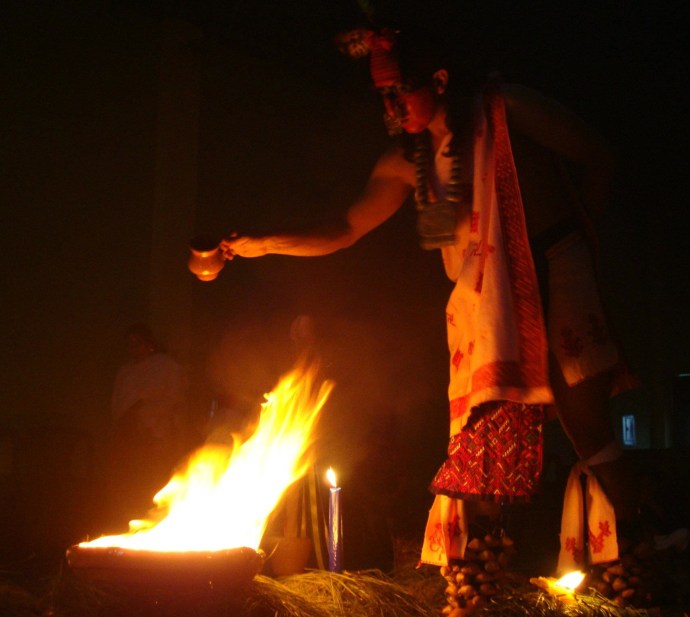
Apab’yan Tew is an Ajq’ij, a Day Keeper, traditional dancer, musician and spiritual guide of the sacred K’iche Maya tradition from the village of Nawalja’ in Sololá of the Guatemalan highlands. His ceremonial work most often takes place in caves, engaging with resident energies of the natural site and timing of the TzolkinCholq’ij in K’iche’—calendar in conjunction with needs of communities or individuals. His gifts evolved from childhood until he ultimately answered the call through a series of difficult shamanic challenges.

Apab'yan in ceremonial dance. Photo courtesy: Apab'yan Tew.

Apab’yan in ceremonial dance. Photo courtesy: Apab’yan Tew.

In the last few years, Apab’yan has become an important, integral part of our Maya spiritual travel program. Being a spiritual guide himself, he’s able to connect with the other Maya leaders and healers in such a way that provides even deeper openings for all of us.

To extend a brief introduction on the Maya worldview…here’s an excerpt of an article I wrote in which he’s quoted, drawing material from an interview we had, speaking eloquently about natural laws.

We cannot be who we must be without the land. Another principle is that the body we have is not really ours. It is lent from the Mother Earth herself. So if you create any kind of danger to your body, you are also hurting the Mother Earth. What the Earth produces and what we produce is part of the same cycle, the same system. We are not separated from the Earth—and the Earth is not to be thought of as just another provider of goods. The term that is used in the West is ‘natural resources’ as something to be taken, something to be transformed. For us, we don’t use this term. We use the term ‘elements of life.’ It is our life! It is not a resource…

…It is our purpose not to take more than we can give back. But it is also our purpose not to change. We must not touch what is not ours. It is not ours from the beginning. It is ours to have a dialogue…

For this additional article I’d asked Apab’yan to offer a summary on the Maya fire ceremony of his homeland, a very special engagement—a portal really—probably unlike what most of us would have experienced as a fire ceremony.

Fire altar

Fire altar before lighting. Photo: Carla Woody

Everything is alive. Everything has a form of communication. Everything has meaning and belongs to a natural system.

The Maya ceremony consists of preparing a ceremonial pyre. It is called a gift but also a payment in the sense of reciprocity. The K’iche’ ceremonial pyre is not a bonfire; it does not burn a long time. It does not need to last. The importance has to do with what happens while the fire is active: There must be a dialogue.

When the fire starts to burn, the sky and the earth begin to speak. The clouds are speaking. The wind speaks. The birds talk and sing. Everyone…everything…participates in that moment.

It’s only the human being—especially the adult—that needs to be pushed to believe this is possible. I must repeat again and again that it is possible to understand everything… anything…to just hear, feel and communicate in that unique moment.

Nothing—apart from humans—offers so much resistance.

For millennia selected specialists dedicated to maintaining culture and spirituality have continued the work of consultation, healing and reading messages of the form of intelligence that is not human. It is translated through what is seen in the moving flames, not in a human scale. What is hidden in the past, present and future can be accessed by the cadence of the voice and poetry of the ceremonial language.

Ajq’ij is the name given to the specialist, woman or man, devoted to the study of time measurement and time as a substance.

The fire is alive, speaks and does so with discernment. That is, it allows negotiation because it is listening, too. The sacred fire opens up possibilities. One can review decisions, consult your own heart, enter into an affinity with nature, interact with the ancestors, experience communion with the universe.

I am inviting you to be participants in our ceremonies and travels.

For any reader skeptical about the potency of the fire and Apab’yan’s ability to call forth and read its messages: During a fire ceremony in our January 2015 spiritual travel program in Chiapas, Mexico he said to the group, “The fire is speaking.” Indeed, to my eyes it appeared to suddenly be dancing. After a few moments he continued, “Carla, this is for you. The fire says in a few months you will be going on a very long journey, not a normal one.” He went on to tell me what the fire had to say about that journey.

I had not told Apab’yan that at the end of April I was leaving my home to walk the Camino Francés, the ancient 500-mile pilgrimage that begins in Saint Jean Pied-de-Port on the French side of the Pyrenees and culminates in Santiago de Compostela in northern Spain. Certainly not one of my normal journeys… and the fire’s advisement related to it turned out to be true.

 *****

I join Apab’yan in inviting you to join us for Entering the Maya Mysteries in January 2017, an immersion experience in Maya cosmology, arts, medicine and sacred ways of the Living Maya. A very special journey with authentic spiritual leaders who serve their communities and the opportunity to participate in religious festivals and ceremonies in Maya rainforest and highland villages. I’m so pleased that once again Apab’yan will be accompanying us sharing ceremonies and teachings throughout. A portion of tuition is tax-deductible to support a Hopi Spirit Keeper traveling with us and Don Sergio Castro’s humanitarian healing work in impoverished Maya villages.

For more on Maya worldview, and that of other Indigenous traditions, read my complete article Seed Intelligence: Indigenous Perspectives and Our Collective Birthright originally published in Anishinaabe (Ojibwe) Farming Curriculum developed by Honor the Earth for Tribal Community Colleges, 2013.

To listen to my complete interview with Apab’yan go to You Tube.

Categories: Indigenous Wisdom, Maya, Sacred Reciprocity | Tags: , , , , | 3 Comments

Learnings from Hopi: What Is Your Blue Star?

Since 2007 Kenosis Spirit Keepers has been sponsoring Hopi Wisdom Keepers on my spiritual travel programs to reconnect with relations along their migration path from South America.* As much as it’s been spiritually meaningful to them, it’s been an extraordinary privilege for the rest of us on those travels to witness how they find proof in the common symbols, creation stories and even Indigenous language in Peru, Mexico and Guatemala, letting them know—indeed—those were their origins.

One of my favorite memories from Peru is when Harold Joseph met Don Miguelito, an Elder who only spoke Quechua. Yet Harold understood him. Another is when the reed serpent-shaped boats on Lake Titicaca excited Harold. He brought a replica home and showed it to his late father-in-law, the last Hopi oral historian of his clan. Char Joseph told me of her father’s response, “It made him so happy! It proved to him that our stories are real!” All Hopis who have come on the Maya journeys as well have made the connection between the Jaguar Twins in Maya traditional stories and their own, along with many other commonalities.

When such things happen it supports spiritual grounding. Something intangible finds its inherent slot. It’s part of identity and who we are in the world. For so many of us today, ancestry is unclear… lost to time or hidden.

I can easily link my own migrations through this lifetime that have brought me to where I am today. But what about lineage? Mine is a mixed bag. Some can be traced back to the late 1700s through records that tell of my Irish and English ancestors’ wanderings from place to place. However, there’s a good chunk of my heritage only known through veiled family stories or random comments … untraceable. During the first half of the last century, my people were taught to be ashamed of their Native origins and perhaps attempted to pass for something they weren’t. And in earlier years, they were just trying to keep their lives.

What we know of our roots and what we don’t commingles and informs the stories we choose to create through the making of our own lives. And we can pay attention to what runs in our blood that needs no proof.

Pam Hale Trachta, a spiritual mentor and author of Flying Lessons, participated in my Spiritual Travel to Hopi program in March. She’s written a beautifully informative article that encompasses what I’m writing about here: Hopi migrations and our own guiding light.

What Is Your Blue Star?

Blue Star

Blue star petroglyph. Photo: Pam Hale Trachta.

The Hopi people we met in Arizona on a spiritual tour with Carla Woody allowed us to see and photograph a petroglyphic symbol of a blue star that appeared long ago, to signal their way home. The story they told us was that when they emerged through a sipapu or opening in the earth in northern Arizona, they met Masau, the guardian of the earth, who told them they could inhabit this world if they would abide by his instructions…He told them to make migrations into the four directions, and after spreading far and wide he told them they would be signaled back to the place of their emergence… Read more.

Pam also wrote about precious time we spent in the Harold and Char’s home. I wanted to include this, too, as added reading to convey how special it is to be invited.

Hopi Feast

Post-ceremony breakfast feast. Photo: Pam Hale Trachta.

A Hopi Feast

On a literal level, this feast was prepared for us by Charlene Joseph, a Hopi woman from the village of Moenkopi. We were welcomed into her home to learn about the Hopi way of life, which is all about Spirit. Perhaps you can’t see Spirit in the photograph, but it is the major ingredient–the primary flavor in every event, every “dish” that is part of her family’s life…This feast is a tradition the morning after the night Kachina dances, which we were privileged to attendRead more.

******

*I founded Kenosis Spirit Keepers, the nonprofit extension of Kenosis, in 2007 to help preserve Indigenous wisdom ways.

Categories: cultural interests, Hopi, Indigenous Wisdom | Tags: , , , , | 1 Comment

Video: Coyote Medicine with Lewis Mehl-Madrona, MD, PhD

In January 2015 Kenosis Spirit Keepers was pleased to collaborate with Johns Hopkins Center for American Indian Health to bring Lewis Mehl-Madrona, MD, PhD, to Baltimore to speak on Coyote Medicine: Lessons in Native American Healing. Dr. Mehl-Madrona, Lakota-Cherokee author of the Coyote Trilogy, shared about historical trauma, lessons about community healing and resilience that come from Native communities.

We were able to video his presentation and offer it to you here. Enjoy…

Categories: cultural interests, Healthy Living, Indigenous Wisdom | Tags: , , | 1 Comment

Pilgrimage

Pilgrimage infers travel, a journey undertaken with intent—not as a lark, although fun can be a part of it. Sometimes the mission is known ahead. Or it’s discovered along the way. Just as true, it may only be in hindsight, a lengthy time passed from the conclusion, that all comes into focus. Ah, there’s the reason I went…

One thing is certain. It’s a passage made with holy purpose, and you must leave the homeland in order for the pilgrimage to occur. I’m using the word ‘holy’ for a reason. It’s a term people usually back away from because of its connotations, often for the same reasons ‘pilgrimage’ is given wide berth. Here I’m using both for common purpose, giving them due because they take us to a place we normally don’t dwell.

To undertake a pilgrimage, your soul must come through, reaching out from that core level. It’s a call to engage, go deeper. It’s a yearning to venture into the unknown. Some conclusion is sought. It’s time to step beyond a threshold, out of the status quo.

Your soul is offering the invitation. But it’s your everyday self that has to accept it at some level because…

 You’re offering yourself up to a foreign land…

Little is likely to be what you’re used to…

There’s certain to be physical, emotional or mental discomfort—maybe all three!

And it’s through such radical departure that you discover what you’re made of—sometimes quite the surprise. As a result, you’re enlivened. Your constructs are stretched. You’re taken beyond your limits. Your new world emerges.

Sometimes folks attempt to fool themselves into it by saying such things as:

 I’m expected to do it.

I’m here to support my spouse…friend…(fill in the blank).

That’s a place I always wanted to visit.

 Whatever it takes to get you there is fine. In the end, there will be certain recognition for most:

 This is spiritual travel. And it’s pure medicine.

In early November I returned from The Heart of the Andes during which we made a pilgrimage to the Q’ero village of Ccochamocco, perched at 14,300 feet.* Harold Joseph, a Hopi Wisdom Keeper from the village of Shungopavi, Second Mesa, Arizona, was sponsored by Kenosis Spirit Keepers as an emissary for his religious leader Lee Wayne Lomayestewa with a mission to request prayers from the Q’ero community for continuity of threatened Hopi traditions. Harold said, “The Q’ero spiritual leaders make strong prayers!”

There is no road up to the village. In order to get there we sometimes rode on horseback, much of it walking through some of the most beautiful and steep landscape I’ve experienced. Harold stopped a number of places on our journey to give his own prayers and leaving offerings, as well as during despacho ceremony during our time in the village.* We were truly privileged to be part of all of it.

Hopi Harold Joseph (rt) during despacho ceremony with Q'ero spiritual leaders. Photo credit: Sage Garrett.

Hopi Harold Joseph (rt) during despacho ceremony with Q’ero spiritual leaders. Photo credit: Sage Garrett.

The highest point to and from the village is 16,000 feet before descending. On our return, as some of us were already ascending, I began to hear a voice echoing from the valley below, calling forcefully every few minutes. I couldn’t understand the words or see who it was. Later I learned it was Harold giving us all a message that Hopi Spirit Keepers used with each other during times of challenge in the kiva, after many long hours of prayer or enduring inclement weather during ceremonial dances.

Be strong!

Pilgrimage to Ccochamocco

The highest point at 16,000 ft on the pilgrimage to Ccochamocco. Photo credit: Carla Woody.

Return from Q'eros.

Returning from Q’eros. Photo credit: Carla Woody

He said it’s meant to strengthen spiritual warriors, to remind them they’re doing what they’re doing for more than just themselves. They’re doing it for their community and more…for all humanity. I will never forget Harold’s message bouncing from mountain to mountain.

After we were home for a few weeks, Harold sent me a note about our spiritual travel journey: “The effect on my life has been enormous in terms of the spiritual connections that was made in behalf of the Kikmongi.*** The awareness that we are spiritually connected to creators and keepers of life: Katsi. No changes in my life but emphasis on the importance of carrying on my responsibility as a Hopi and its ceremonial practices that rejuvenates life here on Mother Earth and the Universe for future generations.”

Harold Joseph. Photo credit: Sage Garrett

Harold Joseph. Photo credit: Sage Garrett

In early May I will begin walking the Camino de Santiago, a 500-mile pilgrimage in northern Spain. My old friend Oscar Panizo is going with me. People ask me why I’m doing such a thing. I can’t honestly give a concrete reason. I just know I’m called to undertake it. The whisper had been hovering in the background for a while, and now is the time.

I also know without a doubt: I will repeatedly hear echoes through time—Harold’s voice encouraging me.

*********************

*The next Heart of the Andes will be October 23-November 5, 2015 and include Bolivia and Peru as a special initiation journey mirroring the path designated by Viracocha, the Incan Creator God. Six Q’ero Spirit Keepers have been invited to accompany us in a pilgrimage that will take them back to their origins. A portion of tuition is tax-deductible to support their sponsorship.

**A despacho is a prayer or blessing bundle made in ceremony by Quechua and Q’ero peoples of the Andes.

*** Kikmongi is Hopi for religious leader.


Categories: Hopi, Q'ero, Spiritual Evolution, Spiritual Travel, Travel Experiences | Tags: , , , , , | 5 Comments

Blog at WordPress.com.