In 2008 Kenosis Spirit Keepers sponsored Hopi Harold Joseph on my spiritual travel program to Peru. The intent being an opportunity for two relations—Q’ero and Hopi—to share a journey from Cusco to Lake Titicaca along their common migration path. Two videographers also came along to document the nature of this work of the heart. Jacob Devaney, of Culture Collective and now blogger for Huffington Post, was one of them.
Last week Jacob contacted me via email related to writing about his experience and said, “My time in Peru was so profound it took me 7 years to even start writing about it… Thanks, Carla! The magic continues to unfold.”
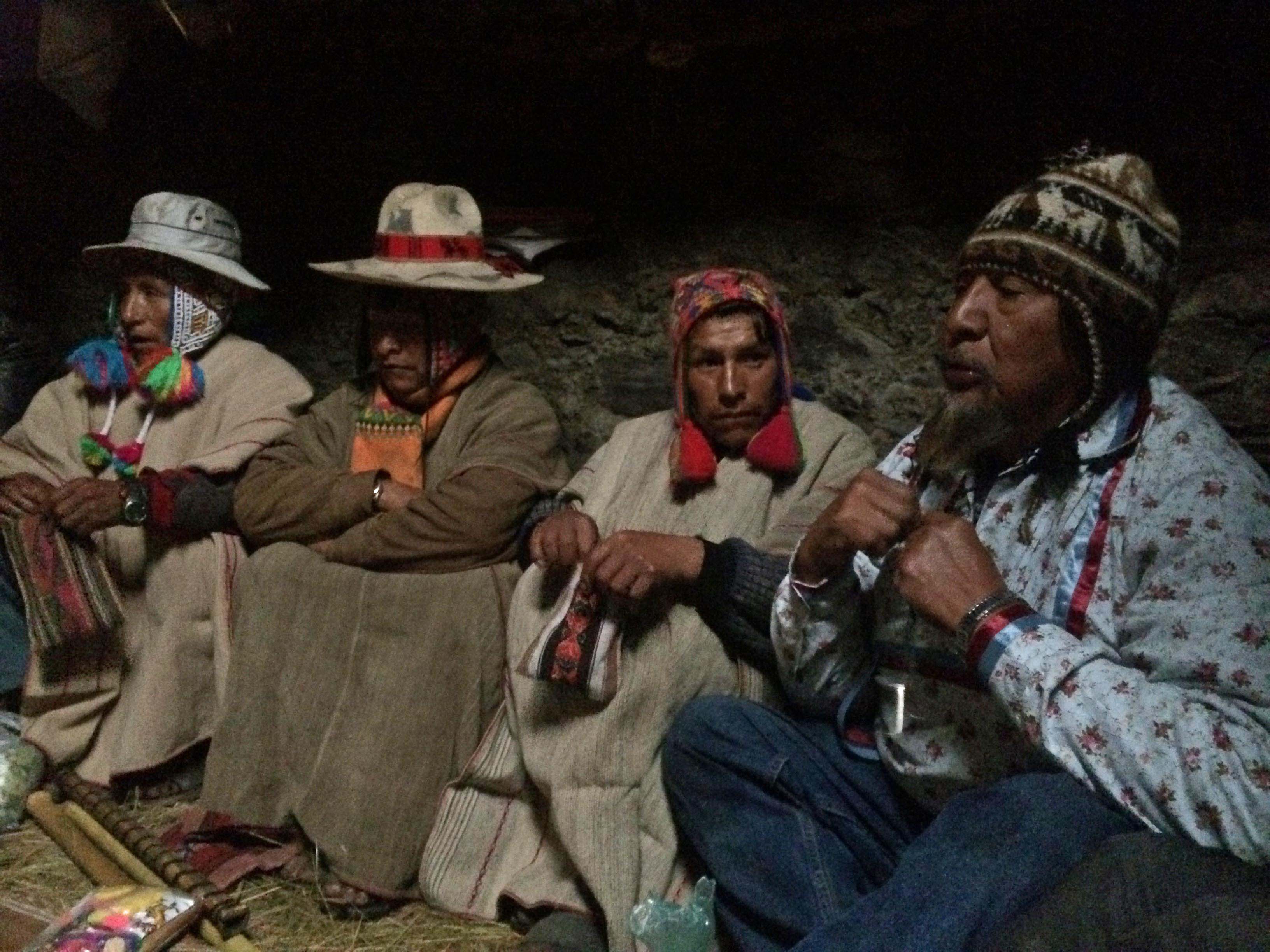
Hopi Harold Joseph with Q’ero Wisdom Keepers. Photo: Darlene Dunning.
I can tell you those were quite the momentous times. We fellow travelers were privileged to be there and participate in the circle with these Wisdom Keepers still so committed to their core traditional values. Those who carry consciousness for planetary wellbeing are becoming an endangered strain of humanity.
Thankfully, the track that called me back in 1994 has continued, deepening in so many ways I couldn’t have predicted. In this year’s program Hopi Marvin Lalo from First Mesa will be meeting his Q’ero relations for the first time. Our journey begins at Tiwanaku, the legendary Creation Place in Bolivia, and travels along an initiation path all the way to the Manu rainforest in Peru. Marvin is so excited.
Jacob’s article is titled Wisdom of an Andean Mystic:
This is not your usual story of going to the jungle to try Ayahuasca…
Few people realize that the Hopi Tribe of Northern Arizona have clans that are descendants of tribes from the northernmost to southernmost tips of the Americas (and quite possibly beyond that). The Q’ero are believed to be descendants of the Inca, who fled high into the Andes where they successfully hid from outsiders until recent decades. Kenosis Spirit Keepers had created the cultural exchange program, and Don Americo Yabar was playing a central role in translating between cultural leaders. I was brought along by Carla Woody to help document and assist my Hopi friend, Harold Joseph…
In his introduction the author begins with: It may well come to pass at a certain point in the course of a life that a person hears of stars dancing in a field at night…I am about to share here a story about stars at dance…
And he immediately had me hooked because I’ve learned over a lifetime to answer a call, never regretting it. I’ve seen stars shining from a high altitude lagoon at the base of Apu Ausangate, a sacred mountain in the Cusco Region of Peru, when none were overhead. I’ve felt waters enter me as I made an offering at one of St. Brigid’s Holy Wells in Ireland. I’ve experienced a transmission through the gaze of Santa Marta after the religious festival of San Sebastián in the highland Maya village of San Juan Chamula. So I believe in such things.
Kevin Codd is a priest. Don’t let that deter you if you’re not Catholic. I’m not. Or let the trappings surrounding the Camino de Santiago stop you, whether it’s a passing interest or a real pull to go. As Codd describes in this book, the 500-mile pilgrimage to Santiago de Compostela is so much more than its religious history. It’s where you discover yourself and what else you’re connected to and how. With centuries of tradition, so many feet covering the same path, the Way to a place, which translates to mean field of stars, is an undertaking to do so.
Codd tells us why through his own experience at age fifty on his first Camino. He is quite generous in his descriptions. As much as I read the book as a spiritual guide, it also serves as a practical one. He walked the Camino Francés.* I’m walking the Camino Francés in May. I appreciate his descriptions of the villages, refugios and more hidden places to visit I might otherwise miss.** He warns about being competitive and the blisters it can get you. But he also tells you how to take care of the blisters and how to prepare in ways he didn’t. Codd openly wrote about his own emotional and mental struggles in the course of the journey. His honesty was compelling because I know I’ll have my own.
I’ve read or perused other books on the Camino as I prepare for my own journey. This one remains my favorite. Available on Amazon and elsewhere in print or e-book.
◆◆◆
*There are many Camino routes that take you to Santiago de Compostela. The Camino Francés begins in the French village of Saint-Jean-Pied-de-Port in the Pyrenees and crosses into northern Spain.
**Refugios are specially run dorms for pilgrims walking the Camino.
Pilgrimage infers travel, a journey undertaken with intent—not as a lark, although fun can be a part of it. Sometimes the mission is known ahead. Or it’s discovered along the way. Just as true, it may only be in hindsight, a lengthy time passed from the conclusion, that all comes into focus. Ah, there’s the reason I went…
One thing is certain. It’s a passage made with holy purpose, and you must leave the homeland in order for the pilgrimage to occur. I’m using the word ‘holy’ for a reason. It’s a term people usually back away from because of its connotations, often for the same reasons ‘pilgrimage’ is given wide berth. Here I’m using both for common purpose, giving them due because they take us to a place we normally don’t dwell.
To undertake a pilgrimage, your soul must come through, reaching out from that core level. It’s a call to engage, go deeper. It’s a yearning to venture into the unknown. Some conclusion is sought. It’s time to step beyond a threshold, out of the status quo.
Your soul is offering the invitation. But it’s your everyday self that has to accept it at some level because…
You’re offering yourself up to a foreign land…
Little is likely to be what you’re used to…
There’s certain to be physical, emotional or mental discomfort—maybe all three!
And it’s through such radical departure that you discover what you’re made of—sometimes quite the surprise. As a result, you’re enlivened. Your constructs are stretched. You’re taken beyond your limits. Your new world emerges.
Sometimes folks attempt to fool themselves into it by saying such things as:
I’m expected to do it.
I’m here to support my spouse…friend…(fill in the blank).
That’s a place I always wanted to visit.
Whatever it takes to get you there is fine. In the end, there will be certain recognition for most:
This is spiritual travel. And it’s pure medicine.
In early November I returned from The Heart of the Andes during which we made a pilgrimage to the Q’ero village of Ccochamocco, perched at 14,300 feet.* Harold Joseph, a Hopi Wisdom Keeper from the village of Shungopavi, Second Mesa, Arizona, was sponsored by Kenosis Spirit Keepers as an emissary for his religious leader Lee Wayne Lomayestewa with a mission to request prayers from the Q’ero community for continuity of threatened Hopi traditions. Harold said, “The Q’ero spiritual leaders make strong prayers!”
There is no road up to the village. In order to get there we sometimes rode on horseback, much of it walking through some of the most beautiful and steep landscape I’ve experienced. Harold stopped a number of places on our journey to give his own prayers and leaving offerings, as well as during despacho ceremony during our time in the village.* We were truly privileged to be part of all of it.
Hopi Harold Joseph (rt) during despacho ceremony with Q’ero spiritual leaders. Photo credit: Sage Garrett.
The highest point to and from the village is 16,000 feet before descending. On our return, as some of us were already ascending, I began to hear a voice echoing from the valley below, calling forcefully every few minutes. I couldn’t understand the words or see who it was. Later I learned it was Harold giving us all a message that Hopi Spirit Keepers used with each other during times of challenge in the kiva, after many long hours of prayer or enduring inclement weather during ceremonial dances.
Be strong!
The highest point at 16,000 ft on the pilgrimage to Ccochamocco. Photo credit: Carla Woody.
Returning from Q’eros. Photo credit: Carla Woody
He said it’s meant to strengthen spiritual warriors, to remind them they’re doing what they’re doing for more than just themselves. They’re doing it for their community and more…for all humanity. I will never forget Harold’s message bouncing from mountain to mountain.
After we were home for a few weeks, Harold sent me a note about our spiritual travel journey: “The effect on my life has been enormous in terms of the spiritual connections that was made in behalf of the Kikmongi.*** The awareness that we are spiritually connected to creators and keepers of life: Katsi. No changes in my life but emphasis on the importance of carrying on my responsibility as a Hopi and its ceremonial practices that rejuvenates life here on Mother Earth and the Universe for future generations.”
Harold Joseph. Photo credit: Sage Garrett
In early May I will begin walking the Camino de Santiago, a 500-mile pilgrimage in northern Spain. My old friend Oscar Panizo is going with me. People ask me why I’m doing such a thing. I can’t honestly give a concrete reason. I just know I’m called to undertake it. The whisper had been hovering in the background for a while, and now is the time.
I also know without a doubt: I will repeatedly hear echoes through time—Harold’s voice encouraging me.
*********************
*The next Heart of the Andes will be October 23-November 5, 2015 and include Bolivia and Peru as a special initiation journey mirroring the path designated by Viracocha, the Incan Creator God. Six Q’ero Spirit Keepers have been invited to accompany us in a pilgrimage that will take them back to their origins. A portion of tuition is tax-deductible to support their sponsorship.
**A despacho is a prayer or blessing bundle made in ceremony by Quechua and Q’ero peoples of the Andes.
In December, PBS aired a series called Sacred Journeys with Bruce Feiler. Given that I offer spiritual journeys myself, it caught my attention. Bruce Feiler is the bestselling author of several books on religion and contemporary lifestyle, as well as New York Times columnist for This Life in the Sunday newspaper. In the program, he goes along with US travelers to six separate sites around the globe as they participate in sacred gatherings and pilgrimages. As viewers we get hour-long glimpses of:
Lourdes, France where the young peasant girl, Bernadette Soubirous, claimed the Virgin Mary appeared to her over a period of time in 1858;
A 750-mile pilgrimage route on the Japanese island of Shikoku to 88 temples and shrines honoring the esteemed Buddhist monk Kobo-Daishi, responsible for bringing Buddhism from China in the 9th century;
The holy sites in Jerusalem encompassing Judaism, Christianity and Islam;
The annual Hajj pilgrimage to Mecca in Saudi Arabia, which mirrors Muhammad’s return to his home as leader of the new Islamic religion;
The Kumbh Mela, the largest religious gathering in the world, occurring every 12 years at the intersection of the Ganges and Yamuna Rivers in Allahabad, India;
The annual festival of Osun-Osgobo in Osogbo, Nigeria, honoring the goddess of fertility, Osun, of the Yoruba religion.
All features in this series are worth the watch. They’re inspiring and caused me to look at my own reasons for pilgrimages I’ve taken…and the one I’m preparing to take.
The Lourdes segment focused on the annual International Military Pilgrimage that has been ongoing since WWII. This filming showed US veterans of the Iraq and Afghanistan wars, carrying visible and invisible wounds, and was especially poignant.
The Yoruba feature was particularly interesting to me, showing elements of initiation rituals. An explanation offered why there were influences from other religions incorporated into Yoruba: As with many sacred traditions, those who are indigenous to the land incorporate the conqueror’s religion in order to stay alive. They become so intertwined in order that the original form may survive, even if hidden. The statement validated what I’ve seen in some Native traditions I’ve known, and sought to explain myself.
Inasmuch as this series is a visual feast for variety of cultures and spiritual rituals, there’s a thread that remains constant: the sense of seeking and renewal. The pilgrims “move between the questions in their lives” and “step outside themselves to reach for higher meaning.”
I found the pilgrims’ expressions and intent in these segments to be no different than those of the travelers on the spiritual travel journeys I sponsor.
Streaming free at PBS online for a limited time. Also available via DVD or to download.
In 2009 an important tradition began, first started by Hopi elder Harold Joseph who accepted an invitation to accompany me on my spiritual travel program Entering the Maya Mysteries. As his religious leader’s emissary, the purpose was to reconnect with relations, those from Hopi migration paths. When I make these invitations on behalf of Kenosis Spirit Keepers, it’s without expectation of outcome. I’ve come to know that as long as we within the circle hold the container sacred…what fills it is rich, often with significance I never could have predicted.
The effect Harold had on Don Antonio Martinez, the last Lacandón Maya elder maintaining his timeless traditions, during a very vulnerable time is well documented in my article The Last Spirit Keeper available for download here. Equally significant are the indications Harold saw during our travels through Mayalands that validated his people’s oral history and common thread with these relations of the south. At certain sites he made offerings and prayers. Over these years several other Hopi Spirit Keepers have replicated what Harold started.
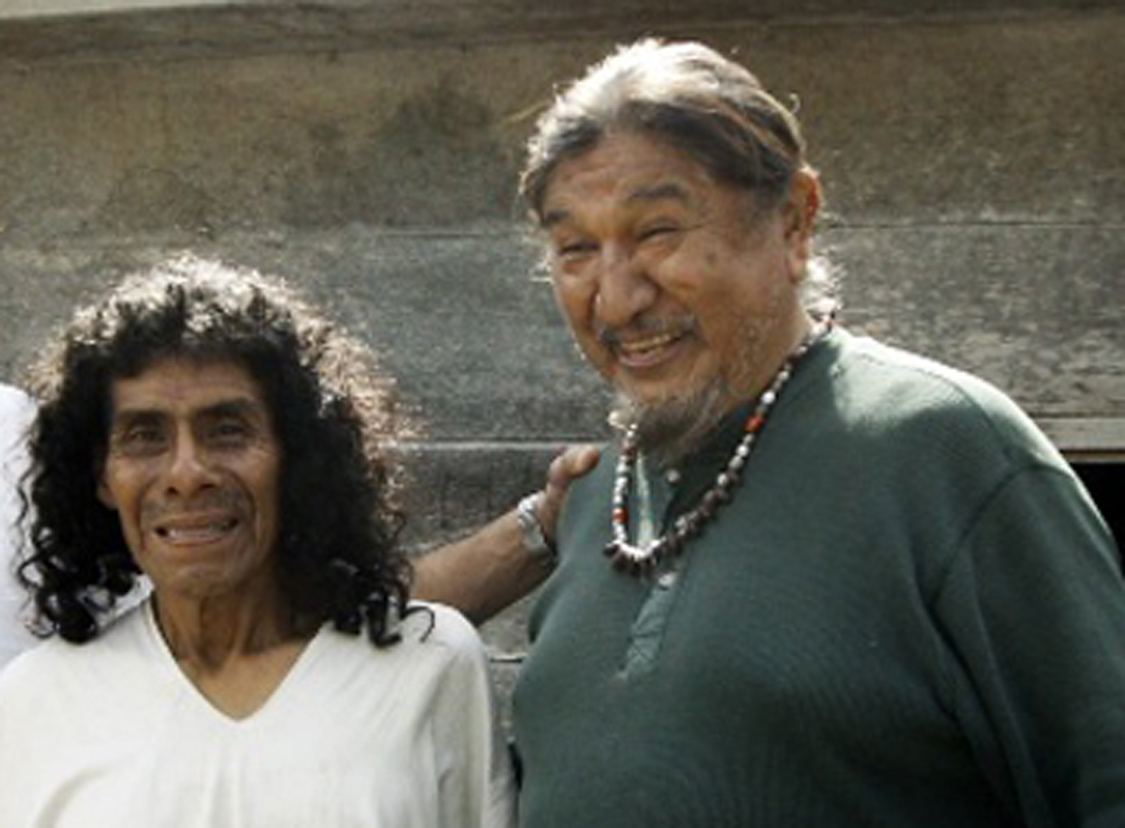
Don Antonio Martinez and Harold Joseph at the Lacandón Maya village of Najá in 2009. Photo credit: Darlene Dunning
This coming January, Merle Namoki, Sun Forehead Clan, from Shungopavi, Second Mesa will continue the tradition, strengthening the bridge of relationship and respect, laying down prayers. A few years ago, Merle said to me, “…We all need to pray to keep our Mother Earth and Father Sky in balance…”
Mike Weddle is a member of the Kenosis Spirit Keepers’ board who, for more than twenty years, has immersed himself in the sacred ways of the Maya of Guatemala. In his essay Are the Maya and the Hopi Two Branches of the Same Ancestral Tree, he compiled examples of common practices linking the two. He also talked about the protectiveness that Hopi people have over their sacred traditions—in order to preserve them.
The intent I hold for spiritual travel has remained the same from the start. It is not to co-opt Indigenous traditions. It is to offer respect through our presence and to hold space that these sacred ways continue. Merle stated the need so well. If in the process we visitors are deeply touched—and we are—we bring this difference home. Who we are in the world is influenced…and felt by our families, friends and communities. Core spiritual elements are strengthened.
The anniversary of an important date is coming up for me. In late Spring 2008 I held my breath as I opened an envelope from the IRS…and exhaled with great relief to see that Kenosis Spirit Keepers was given status as a charitable organization, our nonprofit extension. It was signed and dated October 15, 2007.
In this post about the continuity of traditions, I also want to express much appreciation to those who have made donations over the years, and certainly to those who have traveled with me…holding reverence, making the circles and sponsorships possible. Through your spiritual integrity, this work continues. Last but certainly not least, the folks who have served on the board since the inception of Kenosis Spirit Keepers, worked hard and assisted with direction and decisions…I have gratitude.
*******************
If you are drawn to support connections between the Hopi and Maya peoples, join us January 18-28, 2015 in Chiapas, Mexico for Entering the Maya Mysteries. A portion of tuition is tax-deductible to support the travel of Hopi Merle Namoki and the humanitarian healing work of Don Sergio Castro in impoverished Maya communities.
To learn more about the Maya worldview, listen to an excerpt of my interview with Tat Apab’yan Tew, K’iche Maya Daykeeper, who is part of the Maya spiritual travel program.
Apab’yan Tew is an Ajq’ij, a Day Keeper, spiritual guide, dancer and musician, of the K’iche’ Maya tradition from the village of Nawalja’ in Sololá of the Guatemalan highlands. He approaches his sacred calling with humility and passion. I am honored that he’s part of my spiritual travel program in Mayalands during which he shares openly and holds a fire ceremony to send prayers and call upon the ancestors.
His words are so important for our understanding of the integrative way traditional Maya people live, as well as other Indigenous peoples. I’m sharing an excerpt of our two-hour conversation with you here with his complete permission.
In just this short excerpt Tat Apab’yan covers a lot of ground. He chuckles over the wave of ‘organic’ farming in the West—as though it’s something new—when his people have had such practices for time immemorial. He puzzles over the Western way, now predominant, of dividing land into property when “…the Sky has no conditions…the rains are for everything…” and discusses the sacred sense of reciprocity in everyday Maya lifeways. “…We plant five seeds…only one is for us…”
I hope you enjoy the excerpt and take his words to heart as I did.
To learn more about Spiritual Travel to Chiapas, Mexico: Entering the Maya Mysteries in February 2016, go here. Join us and experience Tat Apab’yan’s teachings in person, along with those of other Maya spiritual leaders and healers who serve their communities. A warning though: It’s life-changing. Tuitions support the continuation of Indigenous traditions and help the spiritual leaders, their families and communities. A portion is tax-deductible through Kenosis Spirit Keepers, the nonprofit extension of Kenosis.
A star shines more brightly now. A week ago I received word that Don Miguelito—pa’qo and ever-present guardian of Salk’awasi—transitioned this planet and took his place in the sky.*
I write this to honor him. He touched a multitude of people, both literally and figuratively, in his 90-plus years. For sure, all the people who traveled with me in Peru will not have forgotten him. Memories of him are carried within us.
Doña Maria and Don Miguelito, 1996. Photo: Carla Woody
Looking back I realize the many things I learned from him over the years. I never knew the kind of things that are common if we’ve known someone long: his last name, if he’d had a wife or children, if he was born in the village of Mollamarka above where he’d lived. He was a solitary fixture, sometimes appearing in front of his small adobe, hand in his coca bag, when visitors arrived at Salk’awasi. Watching.
But I did know that witches from the small village on the next mountain made their way over to consult with him periodically. We called him Miguelito, an affectionate diminutive, which did not at all express the power he held. Although, it did note his small physical stature. I’d be surprised if he’d brushed 58 inches. He did not demand recognition as some do. He was not flamboyant. He spoke few words. Yet, if you paid attention, you’d be aware of the teachings he conveyed.
If you were fooled by appearances, you’d think he was the gardener. In worn, simple clothing, we’d see him raking one of the many paths that wind through the compound with a handful of branches. He built magic ‘rooms’ where given opportunity by a fallen tree and nearby vines to drape. He kept the flowers
Don Miguelito, 2011 Photo: Bobbie Owens
neat. In his last years, he tended them less. The land suffered his absence, going back to nature—perhaps symbolizing Miguelito’s own symbiotic journey. Nevertheless, he touched the Pachamama, Mother Earth, and created sacred containers, leaving his imprint on the land that will never dissipate.
It was only during certain times that his outward appearance gave a hint of who he really was. We would invite him to the circle. He would come—always at night—dressed in full regalia: brightly colored poncho and hat, carrying his mesa.** We’d make sure he had a small table on which to open his mesa, candlelight and pisco to refresh himself. Contained in his mesa were coca leaves for divinations and smooth black stones that had been struck by lightning. He used them for limpia.***
Miguelito had been struck by lightning himself—twice—a known shamanic initiation in many indigenous traditions. He ran his lightning stones over our bodies removing hucha, or heavy energy.
His coca readings were spot on, seeing things in us that we needed to attend to in order to further the journey and foretold futures perhaps not even a blip on our own radar yet. The coca leaves told him so. My own first experience with Miguelito is forever emblazoned in my mind. I was a real newbie, not really knowing which end was up, feeling my way on an invisible-to-me path. I wrote about it in my first book Calling Our Spirits Home. A bit is excerpted here.
Miguelito was bent trance-like over the leaves, sifting them with his gnarly fingers, muttering under his breath…he picked up a few coca leaves and began chewing them…he spit them out on the table. Moving his hands…he seemed to be noting where the pieces fell…he began to speak…Stopping, he turned and looked me directly in the eyes as though searching for something…Miguelito’s words [translated from Quechua] seemed quite unlikely to me. ‘That storm we had the other night?’ I nodded. How could I not recall it? I had started awake in the middle of the night…Lightning lit up the room from its savage dance across the mountaintops right outside my window…’The lightning was for you and its filaments are inside you now. I’m surprised that it was for you.’ No more surprised than I was, unclear of his meaning…Abruptly, he got up from his chair, came over to me and started rooting through the hair on top of my head with his fingers. ‘Ah, there’s where it went in.’ Seeming now satisfied with his finding he sat back down.
Don Miguelito, 2009 Photo: Shelley Wolfe
He went on to tell me of the work I would begin to do, a large part of it bringing groups to Peru with spiritual intent. That was in 1996. Indeed, the reading held true and has evolved from there to include other Indigenous traditions and countries. The last reading I had with Miguelito was in 2011 when he told me that my work would continue to be difficult. This was not something I wanted to hear but recognized what is typically so when anyone is going against the grain of the status quo and mainstream culture. My intent is in holding the challenges lightly.
Miguelito was not afraid of being blunt. In fact, he used no filters in advising what was causing obstructions. Sometimes I saw people wince. It was always interesting to me in that the same issues would come up for the person to deal with during our travels. He also instituted healings. I wrote of one in the recent post Collective Resonance and Healing how the jungle absorbed a woman’s chronic condition.
He was often out in the dead of night. Perhaps he was communing with the mountains, stars and planets, perhaps spirits that best showed themselves in the wee hours. Now he may show himself in just that way.
On June 23rd I wrote my longtime friend Oscar Panizo and told him of the news none of us wanted to hear. He wrote back, “The glaciers are melting and the times are a-changing. Salk’a energy is returning home.”
*Paq’o is the word for shaman in Quechua. Salk’awasi is the ancestral home of Peruvian mystic Don Américo Yábar. Salk’a means undomesticated energy. Wasi is place or house.
**Mesa is the Spanish word used for medicine bundle.
***Limpia is the Spanish word used for rituals working with clearing energy in and around the body.
I’m coming up on the nine-year anniversary of an occurrence so significant that I wanted to share it with you, giving it the special transmission it deserves. In numerology, a secret fascination of mine, the number nine is related to convergence of the three worlds—matter, mind, spirit—holy mission, creation, harmony, rhythm and development. Its meaning is given sanctified space in such religious doctrine as the Kabbalah and Bible, and elevated across a number of cultures: Maya, Egyptian, Greek and more.
Nine years ago outside Cusco something unusual happened that continues to unfold all these years later. In July 2006 during my spiritual travel program in Peru, we were gathered with Q’ero spiritual leaders for ceremony at the edge of Huaypo Lake. We had just come to closure, the despacho burning, prayers ascending…when Q’ero friends began murmuring amongst themselves. Some were pointing directly overhead. A condor and eagle were flying together.
And in the minutes that followed, an inspiration came to me: the compelling urge to somehow start bringing Native people from the US Southwest for intimate circles with their counterparts south. I say “somehow” because I knew no Native people in my home area at the time. Also understand, at the time, I’d never heard of the Condor and Eagle Prophecy.
Long story short: I came home from that journey with a vision. Synchronicities occurred. The next summer I returned to Peru bringing David and Clarence Washington, a Hopi father and son from Shungopavi, Second Mesa, Arizona. More Q’ero Wisdom Keepers gathered with us than ever before until we numbered nearly forty. That journey had incredible affect on us all, especially David and Clarence.
Coming home, I endured intense labor pains to establish Kenosis Spirit Keepers as the nonprofit extension of Kenosis. Anyone who has done this knows what hoops the IRS makes you jump through. It isn’t pretty. I couldn’t have done it without the support of our fledgling board, particularly Doug Easterling and Lucinda Brogden who knew the territory. I didn’t. In October 2007 we became a legitimate nonprofit whose mission helps to preserve threatened Indigenous traditions.
In 2008 Hopi elder Harold Joseph came as our guest to clear the way for other Hopis to safely follow, returning along their migration paths, in the manner given him by the secret society he belongs to. Quietly, he would move away from the group or stay behind while others went on, just for a few minutes then rejoin us. In a number of those places we traveled through in the Cusco and Puno regions that summer, Harold recognized symbols—in a Pachamama cave, in the way the stones were placed in an Inca wall, something carved and almost hidden, in the eagles flying alongside us—which created validation for him.
Harold also paved the way in the highlands and lowlands of Chiapas, Mexico. In 2009 his meeting and offerings to Don Antonio Martinez, Lacandón Maya elder in the tiny rainforest village of Najá, came at a vulnerable time—and made a difference. That story and the effect that followed was published by Sacred Fire Magazine in Fall 2012 and may be downloaded.
Since that time, we have sponsored a number of traditional Hopi Spirit Keepers on programs in Peru, Mexico and Guatemala. With the help of Hopi friends, I’ve started a program in their home villages. Anyone who is drawn may participate and also support preservation.*
In this ninth year from that flight of the condor and eagle and the birth of my personal vision, I’m pleased to offer a video documenting spiritual travel programs with Native leaders and healers from Summer 2007 through Spring 2014.**
In October 2014 Harold returns to Peru with us. Once again he is acting as the emissary of his religious leader, Lee Wayne Lomayestewa. But this time it’s to seek prayers from the Q’ero spiritual leaders for the continuation of the traditional Hopi way of life, now very much threatened. Council will be held in the Q’ero village of Ccochamocco.
Lorna Joseph from Shungopavi will be joining us in January 2015 for our Maya Mysteries program in Chiapas, Mexico. She has heard the stories from those Tribal members who have traveled with us. Now she wants to experience her southern relations personally and what comes from overlapping creation stories. Such validation creates spiritual strength.
The number nine also symbolizes the human gestation period. I never could have predicted all that has occurred since that time I was sitting in circle with Q’ero spiritual leaders in 2006. I had no preconceived notion. Nor do I now.
And yet…I sense we are again upon another threshold with this work. I can feel it. And I invite anyone who wants to be part of it, holding intent, to stand beside me with integrity, and take the step.
We look for the burning bush. But truly, it’s the subtle, quiet moments that open us…
☀ Individuals from different cultures share a meal and discover camaraderie, even though they don’t understand each other’s spoken language.
☀ Two Indigenous people, with common ancestors, put their heads together and compare notes.
☀ A brown hand is extended to a white hand to offer help up a steep trail.
Then the recognition comes: You are my brothers and sisters!
*****
*A portion of tuitions for spiritual travel programs are tax-deductible to fund these efforts. Early registration discount for the October 24-November 2, 2014 Heart of the Andes program ends June 20. Early registration discount for the January 18-28, 2015 Entering the Maya Mysteries program ends September 12.
** Thanks so much to Sunny Heartley who composed and produced the soundtrack for this video with his beautiful Native flute music. Visit his website.
Have you ever had a sense that something is bubbling beneath the surface? That you don’t know what it is…but something is getting ready to give birth…to step forward…to unfold? If you focus on it, you recognize there’s an energy building. It’s palpable. And then when it does present itself, you’re taken with the depth of feeling, realizing it’s come through you? If you’re reading my words here, then you’re likely one of those who has experienced this process consciously, perhaps in a variety of forms, and recognized the gift. If you look back in time, you could identify what kickstarted the process.
I’ve defined spiritual travel as any time you step outside the usual parameters you set for yourself to experience something that’s out of your norm—whether you choose it with intent or unseen forces push you. Either way it’s about growth. In Spiritual Travel: Destination or Process? I wrote about it this way:
…Invisible to the naked eye…are myriad ways to be drawn into the deeper journey that define these potentially uncharted waters…enter aspects that: may have no words or audible sound, cannot be held in your hands, your eye can’t get a bead on, can seem ordinary but aren’t. Yet it produces something akin to a lightning strike that splits the rough outer covering and creates an opening, a probable pathway—and a tangible result. There appears a fork in the road inviting decision…
On March 10, I returned from Hopi and my first spiritual travel program there, only made possible recently—with much gratitude to Hopi Spirit Keeper friends. From opening to closing circle, there was something greater than any there carrying us all. It felt as though another door had opened, some kind of emphasis marking out the great importance of honoring sacred Indigenous ways—now. If I ever had a doubt about the lifework I’ve chosen it was blown out of the water. Such a thing is bigger than any small-minded worry I’ve ever had. Intent gave evidence throughout our time there and unfolds yet in its effect.
An unanticipated gift stood out particularly: permission from Hopi religious leader Lee Wayne Lomayestewa for entry to Prophecy Rock. Such a privilege is not usually granted to outsiders. We all felt the honor, and I’d invited people to sit in meditation and open to whatever was there for them.
One of the travelers had been on a spiritual journey, involving extensive physical travel as well, since major life transitions in 2012. She indicated to me that, while what follows is deeply personal, it’s universal and gave permission to share. Relationship had become foremost in her awareness and the unexpected time at Prophecy Rock became her personal connections in prophecy. Climbing high, up beyond her comfort zone, to find her meditation spot, three figurative “drawings” forged by nature, on weathered rock, spoke to her: “…of prophecy, unity and stages of living and dying…” She said she could form few words to describe the experience, but “…words and song came forth. The experience is etched in my being.” I heard her song floating on the breeze. I tend to think it entered us all.
Since returning home, the group has communicated what continues to unfold for them. There has been talk about clarity and shifts in perception. Deborah Downs of Sedona, Arizona had to get her fingers in the dirt, along with a creative project that came unbidden. Liz Anderson from Prescott said, “…I have been to the Hopi reservation many times, but I have never had the privilege of seeing the petroglyphs or meeting so many fascinating Hopi people…There is a certain quality of the energy on the mesas that gives one the experience of being on truly sacred ground. I had forgotten how powerful this experience can be until this trip…”
Janet Harvey of Asheville, North Carolina said poetry began to pour through her and shared several. Piki Bread, the expressive poem below strikes me as a message about the beauty of simple actions that sustain us over time. They create meaning in life. She mentioned that the physical shape of the lines as they’re shown seemed significant. I told her it reminded me of the backboards worn in some ceremonies by Hopi dancers.
For my part, I’ve noticed another level of ease appearing in my writing. It comes out as though waiting for me to take the initiative. With my artwork, an uncontrived process began shortly before our time on Hopi and has amplified since.
In the morning I began to sit in meditation near my easel, a different part of my home than habit for my daily ritual. And placement of images, color and symbolism, have been relayed to me during this time in a way I can’t describe except by sharing what I’ve recently produced. These pieces have taken on depth of meaning introduced from somewhere other than me. I don’t claim ownership.
But perhaps the greatest gift came inadvertently from the Hopi Spirit Keepers themselves and expressed directly to me by the group in our closing circle. My Hopi friends opened their hearts, gave us their trust and spoke unequivocally of the real dangers acting against continuity of their sacred traditions. It was poignant.
This is a time to listen and integrate from those who, on a daily basis through their prayers and actions, hold the sacred threads that weave our deeper values. There are many voices to be heard, not just one. Hearing them lends respect and supports continuance. We who hold sacred witness become better for it. It affects us, too. Certainly it eschews any hint of commercialism but is rather something of deeper service. Somehow I have been graced with holding such a precious container. The group reinforced what I already knew but drove the point home succinctly in a way I couldn’t set their message aside.* The work continues.
************
*Any of us experience doubt, particularly when we’re called to something. It’s only because we’re called that something steps forward to test intent. When internal conflict is resolved, you step through a threshold.
Note: By participating in our spiritual travel programs you support the ongoing existence of Indigenous wisdom traditions in danger of decimation.
Spiritual Travel to Peru, Oct 24-Nov 2, 2014: I have been invited to the Q’ero village of Ccochamocco, a real honor and rare opportunity. Tuitions help support: sponsorship of Hopi Elder Harold Joseph on this journey seeking prayers for his people from Q’ero relations; the new Q’ero Ancestral Culture Center and natural medicine clinic; and Grandmother Flordemayo’s seed saving program.
Spiritual Travel to Mexico, Jan 19-29, 2015: Tuitions help support sponsorship of David Mowa, Hopi medicine man, to share traditions with Maya relations; and the humanitarian healing work of Don Sergio Castro in Chiapas, Mexico. This program in final planning and will be uploaded here shortly.
If you’re interested in my artwork entitled Testimony or others, go here. Twenty percent of profits go to support Native traditions through Kenosis Spirit Keepers, the nonprofit arm of Kenosis.
Several years ago, my friend Hilary Bee, a professional intuitive and spiritual teacher in the UK, told me that I have a strong inner navigational system guiding me. Over time, I’ve learned to trust it implicitly—even when the next step is obscured from my vision.
I call this navigational system intent, and it produces a high frequency of energy. I recognize completely when it’s communicating a path I am to take, choices to make. I’ve learned to recognize the energetic language. Equally, I’ve come to know over time when I’m straying from the path, or it’s time for an evolutionary change. A totally different level of energy accompanies that alert—and a nagging feeling something isn’t right. Of course, taking that fork in the road may initially produce chaos until order—and realignment—produces a deeper order.
I offer you this poem by C. P. Cavafy and then a caveat.
Ordinary people know what’s happening now,
the gods know future things
because they alone are totally enlightened.
Of what’s to come the wise perceive
things about to happen.
Sometimes during moments of intense study
their hearing’s troubled: the hidden sound
of things approaching reaches them,
and they listen reverently, while in the street outside
the people hear nothing whatsoever.*
While I agree with Cavafy in that the majority of people may be completely unaware, or at least ignore signals, you have an opportunity always to live according to the wisdom of the gods. It’s a fine-tuning process but completely available to you. It requires that you pay attention and then the courage to deviate from any beaten path, sometimes to follow what you can’t readily see.
Here’s a rather dramatic example from my own life. Several years ago, I sponsored two back-to-back programs in Peru. During just one spiritual travel journey the energy is always strong from ceremonies, resident energy in sacred sites and more. With an additional one under my belt and little break between, the veil between the worlds had grown quite thin for me.
After the last group left for home, I was sitting in an Internet café in Cusco. It was the time of Inti Raymi, the festival of the sun, which transforms this usually placid former Incan Empire capital into masses of revelers, huge numbers coming from other locations. I knew that many pickpockets came from Lima to take advantage of the tourists during this time. Consequently, I took precautions. I carefully sat on my coat with my passport and money secured in an inside zipped pocket while I focused on email neglected for several days.
I had been at it for some time with people at computers on either side of me coming and going without any real attention on my part. But then I sensed something, noticing only the color green in my peripheral vision, and went back to my emails. Then again, slight movement out of the corner of my eye. A loud internal voice—not mine—said, Look down! I followed suit. My coat was hanging open, the inner pocket unzipped with passport and money gone!
Literally with no thought in my mind and seeing nothing to go after, I was out of my seat in a split second and onto the street thronged with thousands. Instead of raising a cry with no information to relay, something caused me to turn immediately into the small travel agency next to the Internet café. My hands had a life of their own, clamping onto the arms of two men standing just inside the agency, waiting in line. In a loud authoritative voice I stated, “My money and my passport! My money and my passport!”
They faced me then with shock on their faces as I continued to make the same demand. Both struggled in my grasp; my hands had become pincers of steel. Travel agents and other customers began to turn and get up from seats. The two men managed to turn me toward the entrance in their efforts to be free. One finally managed to duck out the door saying something to the other one, who slipped out of his jacket, leaving it in my hands.
Dropping it, I started to go after the pair but heard a woman’s voice saying, “Are these yours?” She held my passport, money pouch and the green jacket. I thanked her, as well as the others who had risen to aid me. Then I returned calmly to the café and resumed my correspondence.
That night I had a dream: Someone gifted me with a puma.**
As we entrain with a higher vibrational frequency, light energy doesn’t allow us to doubt or contract in fear. It is supreme and grounded. It has peripheral vision. Salk’a—as they call undomesticated energy in the Andes—induces clarity without thought, compassionate detachment and the warrior’s action. This is a state of being we can maintain.
I have a personal tradition. Either during winter or in the first days of spring I seek to remind myself of this Salk’a journey and store further inspiration for the long haul. I want to offer my tradition to you: Watch another of Cavafy’s poems, Ithaca, beautifully set to the music of Vangelis and the resonance of Sean Connery’s voice. This one I fully ascribe to.
********
“Poem by C.P. Cavafy, Collected Poems. Translated by Edmund Keeley and Philip Sherrard. Edited by George Savidis. Revised Edition. Princeton University Press, 1992.
**Known as puma in Peru, we also know this sleek animal as jaguar, cougar or mountain lion. In the Indigenous Andes, it represents how to effectively navigate the Kaypacha, or Middle World, the one we walk in our everyday life.
The Lifepath Dialogues offer an invitation toward embodiment of all that is life-affirming and the deeper meaning of sustainability. Themes are drawn from books "Calling Our Spirits Home" and "Standing Stark" and 30+ years as a conscious living mentor leading spiritual travel journeys with Indigenous Wisdom Keepers serving their communities, group and individual programs. Carla formally closed her work in 2024 but continues to document her many years' experiences and learnings. The author may be reached via cwoody.kenosis@gmail.com.
The Lifepath Dialogues Gatherings
Topics here are meant to open conversations and self-reflection. For more information, go to the "About" page.









 The Lifepath Dialogues