In Remembrance: Mary Magdalen

My Magdalen Heart

Prophet Series: My Magdalen Heart
Oil with gold leaf on canvas. by Carla Woody

Today is Mary Magdalene’s Feast Day. A few years ago I created My Magdalen Heart as one of my Prophet Series, an oil with gold leaf on canvas. This artwork pays respect to Mary Magdalen who has been denied recognition for her true role by the traditional church, and honors all teachers who go quietly about their service with humility.

The original artwork now lives in Albuquerque with a woman who’d had a relationship with The Magdalen since childhood. She came into The Gallery in Williams where I show my work and fell in love. I happened to be in The Gallery that day. She told me her stories with misty eyes and left very happy. It was emotional for us both. I later received a note from her thanking me again and said, “We put her in the place of honor over the fireplace. I was afraid the painting would get lost because of the size of the fireplace, which is huge. But she commands the room and her eyes follow me everywhere.”

I felt so blessed to received this communication, just as blessed as when I was painting the piece…because it felt that Mary spoke to me as I was doing so.

In Sophia’s Children Jamie Walters writes: Who was Mary Magdalene, really?

And why is this question important at all given that we’re talking about a woman who lived 2,000 years ago, and about whom we have only slender references?

Read more on Jamie’s blog.

Categories: Arts, Creativity Strategies, Gratitude, Healing, Sacred Reciprocity | Tags: , | 2 Comments

Review: Companion Books for Sufi Meditation

In May-June of this year I walked the Camino Francés to Santiago de Compostela. During my journey I undertook a daily spiritual practice from the Sufi tradition as a walking meditation. In a post entitled Momentum from my Camino blog The Essential Way, I wrote a bit about wazifa chanting practice, invoking any of the 99 Beautiful Names of Allah, as a spiritual take-along due to its deepening effect on me. I can’t begin to tell you how important the practice turned out to be during this time. I chose specific wazifas that guided me and shaped focus and experience. When my body was having difficulty, they eased my pain and got me up mountains. When the day on the trail became long and my mind grew bored, they brought my awareness to presence and the beauty surrounding me. When I wrestled with uncertainty or issues, they helped usher in clarity.

Prior to embarking I told two Sufi friends about my intent for wazifa practice. Each mentioned a different book as a potential guide: Physicians of the Heart: A Sufi View of the Ninety-Nine Names of Allah and The Sufi Book of Life: 99 Pathways of the Heart for the Modern Dervish. I didn’t know either existed and was happy to learn there were e-book versions. When you’re carrying a backpack with your bare necessities, every ounce counts. Since they added no additional weight, I downloaded both. They proved to be valuable by providing different lenses, sorting perspectives on the same spiritual tenets based on the authors’ backgrounds and interests. All are well-known living Sufi mystics and leaders.

 Physicians of the Heart

Pir Shabda Kahn has been the spiritual lineage holder of the Sufi Ruhaniat International since 2001. In the introduction to Physicians of the Heart he writes about receiving inner direction, shortly after accepting the appointment, to bring forth an English language guidebook on the Beautiful Names to accompany study and practice. He invited three other Sufi teachers to join him in this spiritual work. Faisal Muqaddam is a founder of the Diamond Approach, merging psychology of the human spirit with Sufism. Imam Bilal Hyde is an Arabic and Qur’anic scholar. Murshid Wali Ali Meyer is the head of the esoteric school of the Ruhaniat. Aside from his work as lineage holder, Shabda is a recognized master of raga—Indian classical vocal music—and accomplished musician. This esteemed circle gathered for ten years to undertake deep wazifa study with intent toward producing a spiritual guidebook offering elements to take present-day practitioners to progressive levels of immersion.

For several years beginning in the late ‘90s I attended Sufi retreats featuring Shabda as teacher where he also led wazifa practice and Dances of Universal Peace. In ’98 I went to India with him to study introductory raga. I was already predisposed to embrace Physicians of the Heart without yet laying eyes on the first page.

There are many things I appreciate about its contents. It is easy to see the influence of each contributor’s knowledge, which brings a holistic approach and depth that had been lacking in my own awareness in wazifa practice, even though an effect was still there. I am particularly drawn to their distinction of select wazifas working together along a common theme. For instance, already knowing I was going to work with Ya Fattah I was shown to work with two additional wazifas, encompassing a natural, believable progression: Ya Wahhab (O, Giver of Gifts) to Ya Razzaq (O, Provider) to Ya Fattah (O, Opener). This metaphor is given to frame how they evolve one to the other. It resonated with me.

 …al-Wahhab is the free rain that is given to all, ar-Razzaq is the water that flows in irrigation ditches, and al-Fattah is all the fruit harvested from all the trees that have been irrigated. In other words, al-Fattah is the continuing action of all that will ever be accomplished…

First, a belief in abundance is necessary: There is enough for all. Second, the opportunity accepted, evidenced through work done to lay the foundation. Finally, there’s fruition of all the groundwork, consistently accomplished, so it stretches ahead to be met with each footfall. Should a practitioner encounter inner difficulties working with a wazifa, direction is given toward other wazifas that serve to help transmute limiting beliefs and patterns.

The content of the book covers a lot of ground: Arabic linguistic roots, pronunciation—even connecting to an audio version online—psychological components, Sufi teachings, overview and in-depth explanation of each wazifa. It is a reference for Sufi practitioners.

However, you don’t have to be one to glean value and guidance. I especially appreciate the way the book is organized. I may not be interested in the sound code on which there’s a detailed, technical chapter, but I can quickly find a wazifa, that draws me by the brief description of each one. Then go to the page where that one is discussed in depth and allow the knowledge to permeate my practice in ways I hadn’t foreseen.

Here’s a video treat: the authors speaking about their meetings and practice over ten years that culminated in this book.

Available via the book’s website or Amazon.

The-Sufi-Book-of-Life

I know Saadi Shakur Chishti—Neil Douglas-Klotz—through his books. He is perhaps best known for his translation of words attributed to Jesus from his native Aramaic language. In The Hidden Gospel Saadi compares the King James Version to the translated Aramaic of Jesus’ time. Dry, punitive language is transformed to lyrical prose that holds beauty and hope. In this latter version I can not only engage—but also immerse my soul. I pulled an example to give you an idea.

John 4:24

KJV: God is a Spirit: and they that worship him must worship him in spirit and in truth.

Translated Aramaic: Those who surrender to Unity, bowing to it in utmost adoration, must do so in breath and harmony, like the sense of right direction that drives the universal winds.

Given that his approach and translations in The Hidden Gospel transformed Jesus—to me—into a believable, approachable, forgiving teacher I was also predisposed to embrace The Sufi Book of Life.

In the introduction Saadi encourages the reader to meander through the book and notice which wazifas draw you…and work with those. This is easy to do because the chapter titles are in English illustrating a sense of what is sought or produced. Below the title is the wazifa in Arabic and guidance as to what is likely drawing you to that specific one. In the following paragraphs he lays the foundation in poetic language. Then draws upon Sufi teaching stories and poetry to embellish our understanding. When I read such writing I automatically find myself riding the Breath of Life to that inner place I’m being directed. It goes in a different way. The practice has already begun.

To return to my chosen wazifa Ya Fattah, the descriptive chapter title says Opening to Unity’s Breath. Guidance indicates I chose that one to: …take the opportunity to experience the Sacred Unity opening you to your destiny.

He proceeds to draw from Sufi teachings and the sayings of Muhammad to bring more depth: If they remember me in their heart, I remember them within my heart. If they come toward me walking, I come toward them running.

At the core we all want such a thing and there’s often fear accompanying the heart’s desire. Saadi names such limiting emotions and elaborates with Rumi’s words: Don’t be afraid of nonbeing. If you want to be afraid, fear the existence you have now…

There’s a section entitled Roots and Branches that offers the traditional translations and variations of the word and sound roots. Each chapter ends with a suggested meditation offering a physical centering point, progression using the breath, ending with a question to consider through the process. Since I use breath and energy in my daily meditations, this is naturally appealing to me.

Available on Amazon.

***

I found each of these guidebooks to be beautifully powerful in their own way. They can be used separately. But I found them particularly useful as companion books for practice.
Categories: Book Review, Meditation, Spiritual Evolution | Tags: , , , , | 6 Comments

The Wabi-Sabi Path

More will likely unfold from my Camino Francés pilgrimage for sure as the effect settles itself into my life. But I want to share these insights from The Essential Way, the special journal blog I kept, coming from my recent return home. I hope it gives you a sense toward the beauty of the journey and dimensions expressly woven together—but unintended by me—that made it what it was.

Traditional corn crib in Galicia area of Spain. ©2015 Carla Woody.

Traditional corn crib in Galicia area of Spain.
©2015 Carla Woody.

Carla Woody's avatarThe Essential Way

At this writing I’ve been home from travels twelve days after leaving home nine weeks prior. My pilgrim certificate says I finished the Camino in Santiago de Compostela on June 14, my pre and post Camino not counted. Yet it all seems so very long ago. Perhaps it’s due to an enhanced “now-ness” I’m experiencing. The past having served its significance and the future unpredictable, not yet reality; the present doesn’t feel like limbo but something solid at every moment.

Somewhere along my Camino I realized there were two significant aspects in play. The first had to do with clearing mental, emotional, spiritual elements given perfect opportunity to arise through the physical challenges that came about. In an uncanny way, the walk had become my own personal healing timeline stretching way into the past. Thought forms would come to call uninvited. Some quite old to see if there was still…

View original post 396 more words

Categories: Gratitude | Tags: | Leave a comment

Film Review – Agafia’s Taiga Life

Agafia’s Taiga Life

A Documentary by Vice Media

Agafia

Agafia Lykov. Photo credit: Siberian Times.

In 1936 Karp Lykov took his family and fled into the Siberian wilderness to avoid Stalin and persecution because of their religion. Called the Old Believers, they belonged to a sect of Russian Orthodox fundamentalists. Over the years they retreated deeper and deeper into the Taiga, a forested region in the heart of Siberia, where temperatures are extreme and civilization is non-existent.

Agafia was born into that life in 1943. Agafia saw no one but family for 40 years. And then no one at all for 25 years until a geologist moved a short distance away. All that time, she’d been a woman alone, living off the land.

Journalists from Vice Media visited Agafia to shoot a documentary about her life for their Far Out series. She relates what it’s like to live in the company of her animals, her faith, occasional encounters with bears and rocket debris, a way of life that gets much more difficult as she ages. Her story is an example of pockets in the world where people are living in solitude by circumstance and often by choice.

Watch it online for free. Length: 36 minutes.

To read about another in this series and watch the documentary, see Faustino’s Patagonian Retreat.

Categories: cultural interests, Film, Solitude | Tags: , , , | Leave a comment

The Perfect Order of Unexpected Music

My friend Oscar and I are in Paris for a brief respite before heading south in a few days to walk the Camino de Santiago. Today we ventured out of town via train. I was looking forward to returning to Barbizon, the picturesque village tucked in next to the Fontainebleau Forest where artists like Rousseau, Millet, Corot and others painted and made up the Barbizon School. I didn’t take into account the complications of getting there without a car, particularly the last leg which indicated we’d likely be stuck there for the night. So, quite disappointed I decided we’d better go back. We arrived at Gare de Lyon, one of Paris’ train hubs, and did some people-watching for a while before heading down the stairs to the metro. 

  
I commented to Oscar there used to be musicians playing in the metro. We hadn’t seen any since we’d been there, and I missed it. Half a beat later I heard strains of music, dashed around the corner…and what are the chances?  A bit of real-life déjà vu. As if on cue, the musical ensemble Classique Metropolitain struck up Pachelbel’s Canon in D Major just as they did in 2008 when friends and I stumbled upon them in Place des Vosges. The  unexpected music made my spirits soar immediately as it did back then, the time and place anchored in my memory.


Disappointment forgotten. How often is it that we’re able to relive life’s small pleasures that aren’t so small?

****
To see the original post on Unexpected Music with You Tube video of Classique Metropolitain, go here.
Categories: Gratitude, Travel Experiences | Tags: , , | 1 Comment

Music Review: A Deeper Surrender – Kirtana

A Deeper Surrender

Eleven years ago I received this CD as a gift, and it never gets old. I was embarking on a solo camping trip up to the North Rim of the Grand Canyon. The friend who gave it to me hoped it would help hold the intent of the trip—and indeed it did!

 The sweetness of Kirtana’s voice is enough in itself, and the love songs she sings automatically touch something inside. When I realized that she was disclosing the nature of her relationship with the Divine Beloved, it deepened the effect even more. Throughout my journey north and then home, this sacred music compelled me to witness evidence all around me and within me of That which permeates everything.

Available on Amazon, iTunes and CD Baby.

Categories: Gratitude, Music Review, Spiritual Evolution | Tags: , , | Leave a comment

Allies

In January I took a group to Nahá as usual during my Maya spiritual travel program. Nahá is a tiny Lacandón Maya village deep in the Lacandón Biosphere of Chiapas, Southern Mexico. We go there to be with Don Antonio Martinez for ceremony and show our respect that he’s still holding traditions when there’s so much pressure for him to let them go. We also visit with the widows of the late spiritual leader Chan K’in Viejo, as well as spending time at sacred Lacandón sites.

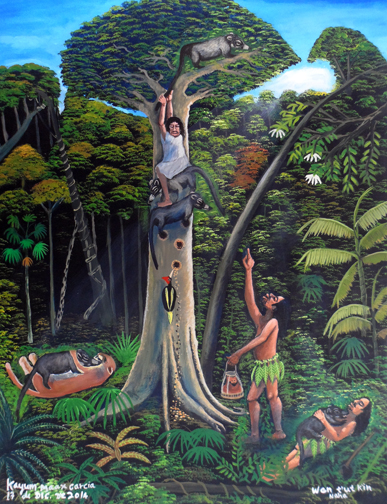
This time we stopped by Kayum’s home. I hadn’t seen him in years. Kayum Ma’ax Garcia is a Lacandón Maya artist of the monkey onen, or clan. He’s also one of Chan K’in Viejo’s sons. He works in acrylics on canvas. In his artwork Kayum conveys actual events, lifeways, creation stories and rituals of a culture nearly gone—as well as his dreams, an important aspect of traditional life. So, in his own way, Kayum is preserving the traditions of his people. I’ve always been fascinated by his art.

Kayum Art

Traveler Frostie Torres purchases a painting from Kayum during our 2007 program. Photo: Alonso Mendez.

But he has little exposure to the world outside his village. I thought to myself, it’s important for his work to get out there, not only to help sustain his family but for others to appreciate Lacandón lifeways and traditions. I suggested to him that he offer his work as archival prints through an online service as I do. But he has no camera, computer or technical knowledge even if he did. Aside from that there’s only Internet at the little lodge where we stay. And the connection is so poor it may as well be non-existent. He had no one to support this possibility, and it was something he really wanted to do after I explained it.

An opportunity landed in my lap, another one that truly matters. The group witnessed the process of this conception. They were excited. I went home and put a vote before the Kenosis Spirit Keepers Board.*

The Allies Gallery is now a program supported by Kenosis Spirit Keepers to sponsor Indigenous artists who have extremely limited capabilities to offer their work. Kayum is our first artist. Proceeds of any of his art sales go directly to him. The same will be true for any other artist we include.

Man of the Wild Acrylic on canvas Kayum Ma'ax Garcia

Man of the Wild
Acrylic on canvas
Kayum Ma’ax Garcia

Our online gallery is now up! You’re invited to check it out and support Kayum through purchase of his work and sharing Allies Gallery with others. We currently have prints available for four of his pieces, in various sizes and formats, and will add more as time goes on.

*******

Kenosis Spirit Keepers is the volunteer-run, grassroots organization I founded in 2007 to help preserve Indigenous traditions, a 501(c)3 nonprofit extension of Kenosis.

Categories: Arts, cultural interests, Lacandón Maya | Tags: , , , , | Leave a comment

Learnings from Hopi: What Is Your Blue Star?

Since 2007 Kenosis Spirit Keepers has been sponsoring Hopi Wisdom Keepers on my spiritual travel programs to reconnect with relations along their migration path from South America.* As much as it’s been spiritually meaningful to them, it’s been an extraordinary privilege for the rest of us on those travels to witness how they find proof in the common symbols, creation stories and even Indigenous language in Peru, Mexico and Guatemala, letting them know—indeed—those were their origins.

One of my favorite memories from Peru is when Harold Joseph met Don Miguelito, an Elder who only spoke Quechua. Yet Harold understood him. Another is when the reed serpent-shaped boats on Lake Titicaca excited Harold. He brought a replica home and showed it to his late father-in-law, the last Hopi oral historian of his clan. Char Joseph told me of her father’s response, “It made him so happy! It proved to him that our stories are real!” All Hopis who have come on the Maya journeys as well have made the connection between the Jaguar Twins in Maya traditional stories and their own, along with many other commonalities.

When such things happen it supports spiritual grounding. Something intangible finds its inherent slot. It’s part of identity and who we are in the world. For so many of us today, ancestry is unclear… lost to time or hidden.

I can easily link my own migrations through this lifetime that have brought me to where I am today. But what about lineage? Mine is a mixed bag. Some can be traced back to the late 1700s through records that tell of my Irish and English ancestors’ wanderings from place to place. However, there’s a good chunk of my heritage only known through veiled family stories or random comments … untraceable. During the first half of the last century, my people were taught to be ashamed of their Native origins and perhaps attempted to pass for something they weren’t. And in earlier years, they were just trying to keep their lives.

What we know of our roots and what we don’t commingles and informs the stories we choose to create through the making of our own lives. And we can pay attention to what runs in our blood that needs no proof.

Pam Hale Trachta, a spiritual mentor and author of Flying Lessons, participated in my Spiritual Travel to Hopi program in March. She’s written a beautifully informative article that encompasses what I’m writing about here: Hopi migrations and our own guiding light.

What Is Your Blue Star?

Blue Star

Blue star petroglyph. Photo: Pam Hale Trachta.

The Hopi people we met in Arizona on a spiritual tour with Carla Woody allowed us to see and photograph a petroglyphic symbol of a blue star that appeared long ago, to signal their way home. The story they told us was that when they emerged through a sipapu or opening in the earth in northern Arizona, they met Masau, the guardian of the earth, who told them they could inhabit this world if they would abide by his instructions…He told them to make migrations into the four directions, and after spreading far and wide he told them they would be signaled back to the place of their emergence… Read more.

Pam also wrote about precious time we spent in the Harold and Char’s home. I wanted to include this, too, as added reading to convey how special it is to be invited.

Hopi Feast

Post-ceremony breakfast feast. Photo: Pam Hale Trachta.

A Hopi Feast

On a literal level, this feast was prepared for us by Charlene Joseph, a Hopi woman from the village of Moenkopi. We were welcomed into her home to learn about the Hopi way of life, which is all about Spirit. Perhaps you can’t see Spirit in the photograph, but it is the major ingredient–the primary flavor in every event, every “dish” that is part of her family’s life…This feast is a tradition the morning after the night Kachina dances, which we were privileged to attendRead more.

******

*I founded Kenosis Spirit Keepers, the nonprofit extension of Kenosis, in 2007 to help preserve Indigenous wisdom ways.

Categories: cultural interests, Hopi, Indigenous Wisdom | Tags: , , , , | 1 Comment

Film Review: The Wellbriety Journey to Forgiveness

I will tell you up front that this is a difficult film to watch and can bring up all kinds of emotion. But if you’re going to watch it, then do so until the end because toward its finish there is much hope conveyed.

During our recent Spirit Keepers Series held in Phoenix on the subject of PTSD and Native healing ways, I had invited Eli PaintedCrow, an Iraq War veteran of the Yaqui Nation and co-founder of Turtle Women Rising, to take part based on her own experiences and to frame further aspects of our Series. She showed a portion of Wellbriety Journey to Forgiveness, a documentary produced by White Bison, Inc. They’re a Native American-operated 501(c)3 nonprofit dedicated to culturally-based healing for Indigenous peoples.

The film starts out with a prophecy given by the Old Ones about the light skins who would arrive, create confusion and great destruction. How everything would be taken from the Native American but their spirituality. There would be tremendous suffering, genocide and a time of testing. But opportunity for healing would present itself. After this time of healing, the buffalo, Native people and all manner of sustenance would return. Harmony would prevail. Native people believe that we entered this time of healing in the early 1990s.

This is the story of that destruction, particularly centered on boarding schools and their effect. If you’re not familiar, in 1879 the first Indian boarding school was opened in New Carlisle, PA. Native children were forcibly taken from their families and shipped off to such schools around the US where they were stripped of their language and anything having to do with their culture. They endured ongoing violence and humiliation in silence—many didn’t survive—and it had horribly detrimental effects reaching all the way to today. This is called intergenerational trauma, certainly a form of PTSD.

As a part of the Wellbriety Movement, Native organizers undertook a 7000-mile journey all over the US to give Elders and their children a chance to tell their stories, perhaps for the first time, and express grief. In this undertaking they hoped to break the cycle of addiction and violence, begin the road to forgiveness and a return to spiritual traditions. The film covers Native values and how to live in harmony as taught by the Old Ones, along with a model called the Four Directions of Forgiveness and a call to Greater Purpose.

This is an extremely powerful film and could be called the Schindler’s List for Native Americans. It was created as an Indian Give-Away by White Bison for purposes of truth-telling and healing.

Whether you have Indigenous members in your family line who suffered the atrocities, have ancestors who perpetrated any part of it, or are born of mixed blood as many of us are…the message presented here is relevant to all. The effects of genocide, abuse and shame are equally carried through the family line. This is a film for anyone whose ancestors have experienced anything of the like. That doesn’t leave out many people on the planet.

This is a move for truth—no more secrets—and healing accomplished when we live in harmony as the Old Ones taught. Seeing the complete film instilled even more significance to me in how I personally live and greater understanding of the important work Kenosis Spirit Keepers does, even if we reach only a few.

This is a film for the Next Seven Generations. Critical mass is important. View the film for free on You Tube and share widely. Length: 1 hour, 13 minutes. Also visit White Bison to learn of their healing institution and classes.

Categories: cultural interests, Film, Healing, Indigenous Rights | Tags: , , , | Leave a comment

The Way Before Me

In May and June 2015 I will be walking the Camino de Santiago. I’ve created a special blog just for this journey: The Essential Way – A Pilgrim’s Narration on the Camino de Santiago. It will be an accounting of that pilgrimage: before, during and after. I intend to record my reflections, trials, joys, practical aspects and interesting tidbits. I’ll mix in images I shoot and sketches for later artwork if the apps on my iPad turn out easy enough to use. I’m extending you an invitation to go to that blog page and subscribe if you’d like to keep up with me. I’ll be keeping it separate from The Lifepath Dialogues, which will be ongoing. Below is the first post for the Camino.

Carla Woody's avatarThe Essential Way

The double entendre of this post title is intended. Standing in the shelter of a threshold I can look back to history as well as gaze forward into the unknown with expectancy. No longer hovering before the threshold, I took the step forward. I’m actively preparing. But the next big move is placing that first footfall on the dirt of the Camino Francés.

PilgrimScallopI can’t tell you exactly why I decided to walk the Camino de Santiago. When I think about it, I realize thoughts of the Camino had been hovering in the background for years—but without any aspirations or inspirations. I may have read about a book about it way back when. I do note that I used the term “pilgrim” as a thematic metaphor in my first book Calling Our Spirits Home. It’s not a word I could recall using before writing that book and haven’t…

View original post 593 more words

Categories: Uncategorized | Leave a comment

Blog at WordPress.com.