Posts Tagged With: collective

One Last Ceremony

Balché Ceremony with Don Antonio Martinez, Nahá. ©2012 Carla Woody

The day I knew would one day come arrived in late January 2024. Since 2007 I’d been bringing small groups to Chiapas, the southernmost Mexican state, for immersion experiences in the sacred ways of the Living Maya. Our time in Nahá, the tiny Lacandón Maya village, a population of less than 200, was always the major high point for me.

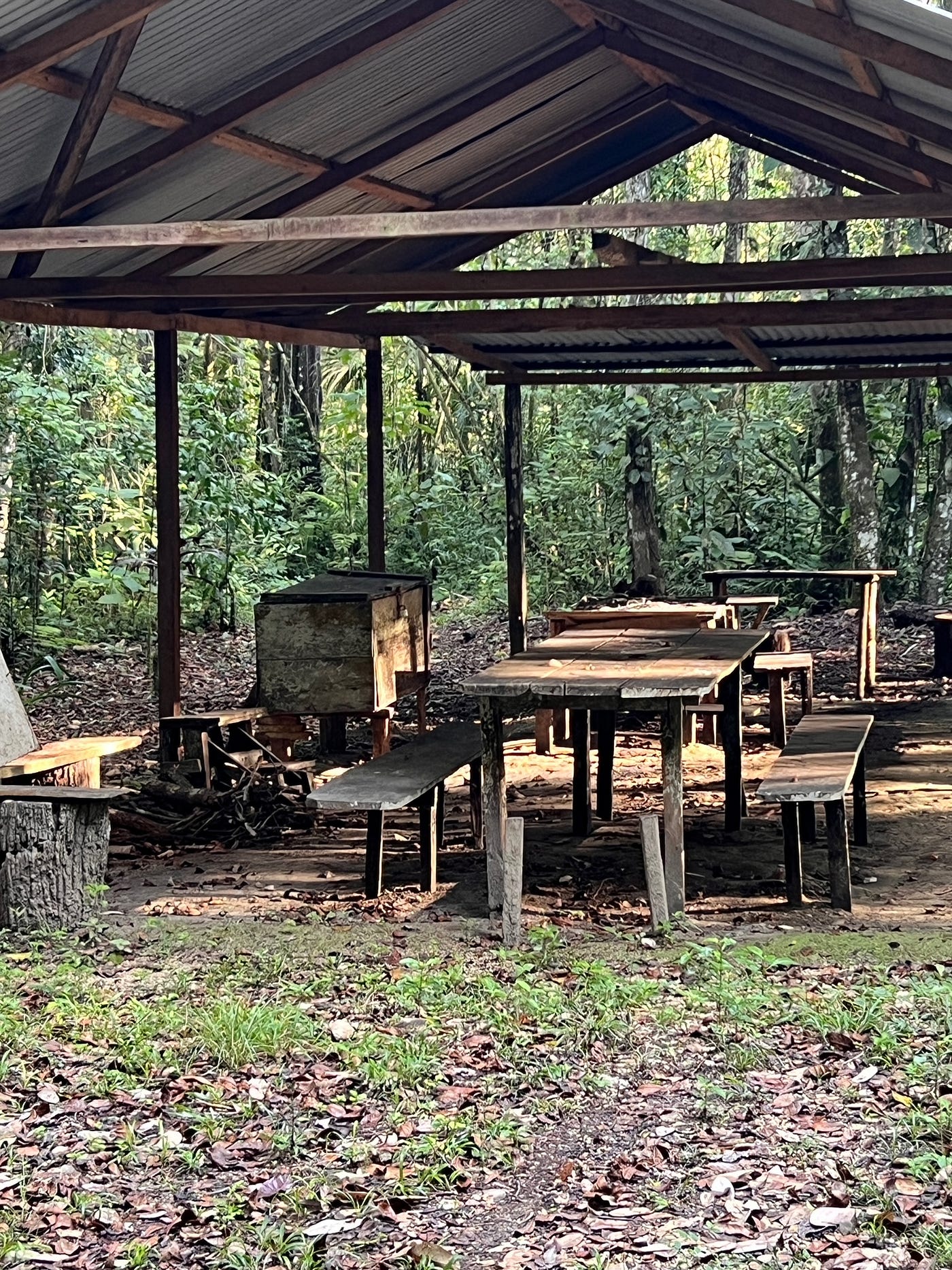
It’s a long bumpy drive through what used to be a thick jungle before loggers appeared in the 1960s. Entering the village, there’s one long dirt road bisecting it. Before any passageway granted access, this was the grass landing strip whereby Trudi and Frans Blom flew in and out since the 1940s. Having befriended the Lancandones, they became advocates for the preservation of their traditions and the rainforest. They’d created a jungle camp, staying there frequently. It still stands. Indeed, it’s impossible not to feel their presence there still. I stayed in their historic camp when the few guest cabins were being restored. Their adopted daughter Doña Beti often came with us. She insisted on cooking our meals over the open fire, feeding us at the camp dining table. I especially imagined Trudi sitting at a place of honor, holding court in her legendary manner. Trudi and Frans passed in 1993 and 1963, respectively, first laid to rest in San Cristóbal de las Casas. In 2011, the Bloms were reburied in the village cemetery, close by their friend and spiritual leader Chan K’in Viejo, at last fulfilling both their long-held wishes. 
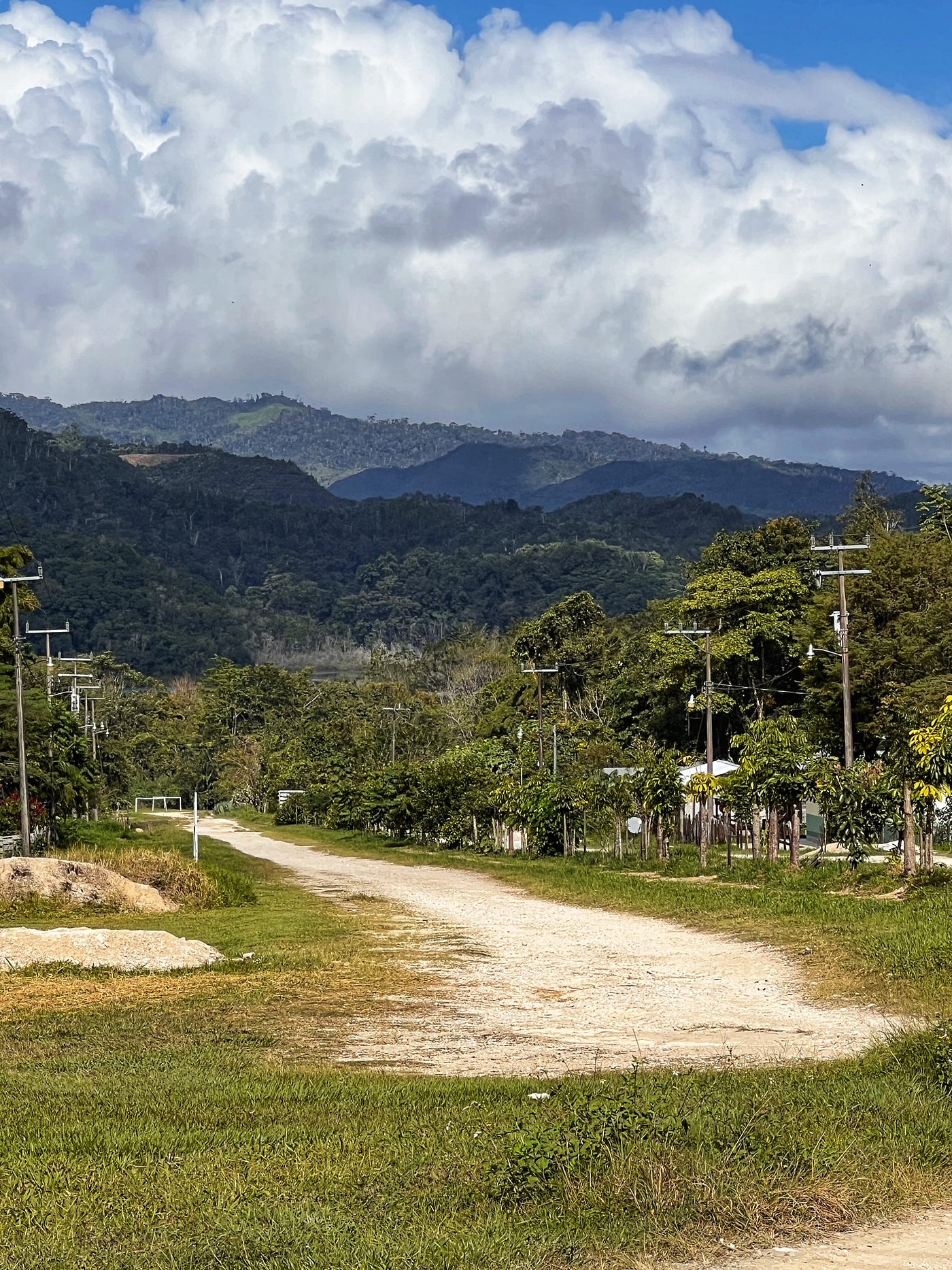
Nahá Road/Landing Strip. ©2024 Carla Woody
The Bloms’ historic jungle camp, Nahá. ©2024 Carla Woody

Nahá means the place of water in the Lacandón language. Indeed, the lake has a mystical quality. I draw on memories of mist hanging over the lake, lily pads at the edges. The other side can’t quite be seen. Gliding along in the traditional dugout canoes, it just might be possible to enter another world. I’ve felt the invitation.

Lake Nahá with traditional canoe. ©2009 Carla Woody

My reason for coming to Nahá all these years was to pay respects to Don Antonio, the last holder of their spiritual traditions and Chan K’in Viejo’s son-in-law. This sweet, humble man carried on courageously for decades, fulfilling his sacred traditions despite great duress and interference from evangelicals. In 2012, I wrote The Last Spirit Keeper tracking manipulations from those outside sources and the beautiful connection made in 2009 between Hopi wisdom keeper Harold Joseph and Don Antonio during his time of grief at the sudden loss of his son.

The pandemic had interfered with my annual return until this year. Once arriving in Nahá, it was practice to check in with Don Antonio to say hello and ask about his plans for the balché ceremony.* My friend Eli PaintedCrow and I walked from the lodge on the edge of the village to Don Antonio’s home according to our norm. A young relation greeted us and went to get Don Antonio. I was shocked by the sight of him. He was quite frail and bent. He had trouble walking. He didn’t recognize me. After all these years of appearing ageless, he now seemed not long for this world. Only his long dark hair remained the same. I was saddened by his appearance. I couldn’t imagine he would hold the ceremony or even have the desire. But he asked us to come to his god house with the group the next afternoon.

It was then I learned he was going blind. He kept gazing at me like perhaps he should know me. When he came quite close, he lit up with recognition and began to talk of past times I’d been there. He had a new god house now located just beyond the house. The old god house where I was used to going was about a quarter mile away. He was no longer able to walk to the old one. He had a stick to help maintain his balance and had trouble getting up when seated or kneeling. When people asked me how old he was I’d say probably eighties and then maybe ninety as years were passing. It was sometimes a challenge to keep track, and I wasn’t even sure of his age the first time we met.

When we arrived the next day, he was preparing for the ceremony. He bustled around the interior of his god house readying the god pots. Each one had a face on it, symbolizing one of their thirteen gods. He placed them on an altar made of large palm fronds lying on the ground and put a copal inside each one. He invited us to sit on the logs just inside the perimeter of the god house. Females were not traditionally allowed inside as males were. But he’d always been gracious. This time was no different. The previous day I made sure to let him know we were eleven women, unsure how he’d feel about that. No men were with us. He looked a little taken aback for a moment but assured us we were welcome.

He’d already ladled balché from the old dugout canoe where it fermented into its large terracotta container. Now he made his offering to each god. Dipping a rolled-up young palm frond into balché, he trickled the liquid over the jutting lower lip of each god pot. Sitting down on the log seat in front of the balché vessel, he sighed with satisfaction and offered gourd bowls containing the drink to each of us. The first sip is always a bit of a shock to my taste buds but quickly becomes tastier as the ceremony progresses. I noticed the same response on the women’s faces in the circle.

After a few healthy gulps, Don Antonio was quiet for a few moments. Then he began to speak softly, saying he hadn’t done the ceremony in a long time, how no one came to see him anymore, and his people no longer cared for the gods. It was then his wife, who rarely joined the circle, came from the house, looking in on him, stroking his hair, lightly touching his face. I’ve heard Don Antonio note the lack of interest his people had every time I’d been there, and how in the old days this ceremony healed people. But the gods weren’t showing up so much anymore either. They’d been forsaken. With his wife’s concern for her husband and the love she clearly showed, his lament took on an even more imminent conclusion. I had tears in my throat and a few slipped down my cheeks. I can only imagine what it’s like to be the last one practicing ancient traditions. I can only imagine the loneliness.

Eli PaintedCrow and Don Antonio. ©2024 Carla Woody

But he began to brighten. Eli sat next to him, talking to him in Spanish. I couldn’t hear what she said but guessed she expressed her great interest in their ways. Eli’s presence on our journey was important to me and even more so to her. She’d come to reconnect with her Maya lineage, having suffered that loss when her dear grandfather passed many years ago. Soon Don Antonio was telling stories and singing traditional songs, even one about the merits of drinking balché.

Don Antonio at his god house. ©2024 Carla Woody

After a while, Don Antonio made an announcement. He told us at one hundred years old he would no longer hold the balché ceremony, and the last one would be with us eleven women. He told stories, sang, lit the god pots, and prayed. He blessed us. We drank balché. This may have been a poignant time, but there was joy just as well. I saw it on his face. This gentle soul held steady for what mattered. We all can learn from his example.

After the balché ceremony. ©2024 Carla Woody

That day marked the end of an era. Don Antonio has no apprentice. There’s no one who would carry on the traditions. This fact was confirmed a couple of days later at Palenque when Eli and I visited with some Lacandón women from Chan K’in Viejo’s lineage who had a booth there. I heard that old friends of Don Antonio’s visiting from the US, went to see him the day after we left. He was still happy and they all drank the leftover balché. That news lifted my heart.

The old dugout canoes have been gone over a decade, save the one at Don Antonio’s god house and another sunken in water at the edge of the lake, just one end sticking up. Fiberglass boats took their place. Then the last couple of young men who used to attend the ceremonies slipped away suddenly, too. On a subsequent trip, I saw one who had made vows, in conversation with me, to continue his traditions. But the next time I saw him, he’d been dressed in Western clothing. I learned later he’d converted to evangelism.

Over the last eighteen years, I’ve witnessed the steady disintegration of Lacandón spiritual practices as foreign influences took their place. Of course, it started long before then with roads cut by loggers and decimation of the rainforest and wildlife habitat. Nahá was once a place that had stepped outside time. I feel fortunate to have experienced it that way.


*The balché ceremony, undertaken by the males in the community, is a conduit for blessings, prayers, and a way of honoring. Individual gods are represented through terracotta god pots, with the face of each god and the interior meant for burning copal. Any god pot may be chosen for use during the traditional ceremonies. Don Antonio, as caretaker of the god pots, communes with the gods that hold the world together. And when he feeds the god pots copal, tamales, and balché, he is feeding the gods, the universe, and everything in it. The ceremony and its preparation take many hours.

One Last Ceremony was originally published in the Illumination publication on Medium in March 2024.

Categories: Global Consciousness, Indigenous Wisdom, Lacandón Maya | Tags: , , | 2 Comments

Film Review: The Crocodile Hunters of Ethiopia

Joey L. is a fine art photographer and documentary film director from Canada based in Brooklyn. He can frequently be found in remote places the outside world knows nothing of, and seems equally at ease working with celebrities and corporate brands.

His work with tribal peoples and ethnic groups is what intrigues me. Joey says he tends to go back to the same places. In doing so, he’s able to get a deeper and deeper sense of the people, their lifeways and environment—a real connection. I understand this because I’ve done the same over nearly 30 years. You create relationships that wouldn’t happen with the quick dash that satisfies the mainstream tourist. You see and experience things you couldn’t have imagined. Doors open. You are invited in.

Another thing happens that, for me, is heartbreaking to witness. Over time, invariably there’s loss of tradition. In his new documentary The Crocodile Hunters of Ethiopia, Joey talks about the hard life and difficult circumstances many Indigenous peoples endure. You can’t blame them for wanting an easier life. I’ve wrestled with these same thoughts. Would that their sacred practices and lifeways be maintained and, at the same time, they’re lifted out of poverty.

Joey has been working on a book about Ethiopian cultural history for 12 years. Some Ethiopian tribes have maintained their traditions over centuries. The Dassanach tribe is one. Some of the things he photographed 12 years ago are gone, lost to climate change and modernization. His mission is underscored with a sense of urgency.

His obsession started as an 18-year-old when he first went to a Dassanach village. During his visit, there was a tragic occurrence. A child was eaten by a crocodile, which are a ready danger in the region. They can grow 4 times as big as a human and retain gargantuan strength. They’re man eaters. Joey heard rumors of a nomadic caste called Dies whose specialty is killing crocodiles—not with guns but in the old way…with handmade harpoons. For years, he wanted to photograph them. But they are few and elusive. To complicate matters, croc hunting only occurs for a limited time during the rainy season.

Finally, the time was now. He was afraid if he waited longer the crocodile hunters would be a thing of the past. The film covers the search, preparation, tribulations, all the way through the complete hunt, which takes place at night. Joey and his team are among the few outsiders ever to see the hunt. Now you can, too.

This documentary merges uncommon, extraordinary footage of landscapes, tribal peoples, ceremonial blessings, along with what it means to be a working photographer and the importance of respect. Joey talks about the roles passion, curiosity, persistence and risk play relative to his photography. He shows you what happens behind the scenes. But also, what drives him to dedicate his life to pursuing the unusual and cultural truth. He has been in demand since he was a teenager with commissions from celebrities and brands. His work takes him into war zones, remote villages, dense jungles, urban areas, and commercial shoots. Joey L. is a rare breed.


I began following Joey L. a few years ago. I’m particularly taken with the Mentawai collection and his ongoing portrait series of Holy Men. To view more documentaries on the Dassanach and the lower Oma Valley see People of the Delta with accompanying shorts.

Categories: cultural interests, Film Review, Indigenous Wisdom | Tags: , , | Leave a comment

Honoring Indigenous Peoples Day

In a time of global movement away from our origins, disintegration of family and disconnection from the natural elements, Spirit Keepers are the true warriors of today. In diminishing pockets throughout the world, in many ways disrespected, they still maintain the invisible threads that connect us to our roots.⁠⁠

Blessings of the Four Directions. ©2013 Carla Woody.

Indigenous wisdom for a better world.

I Hold the Knowledge Inside. ©2015 Carla Woody.

Kenosis Spirit Keepers

We help preserve Indigenous traditions threatened with decimation.⁠⁠

Testimony. ©2013 Carla Woody.

Spirit Keepers are the stewards of our future. The ancient, Indigenous ways instill appreciation for the Mother Earth and all beings. When Spirit Keepers are honored and come together to share their sacred practices, we are all nourished. Our common foundation is strengthened.

Going Home, Shungopavi. ©2014 Carla Woody.

We honor traditional Indigenous spiritual leaders, healers and communities who hold the fragile threads of their sacred ways.

Saved By Fortuity. ©2013 Carla Woody.

We fully believe: If these traditions continue to die, we all lose.

The Choice in Every Moment. ©2021 Carla Woody.

I founded Kenosis Spirit Keepers as the nonprofit extension of Kenosis. I’m pleased to say that we’re now in our 14th year. We continue our work against all odds.


A side note: Although I’ve explored various media in my artwork across decades, the intent of the content remains … those elements most sacred.

Categories: Global Consciousness, Honoring the Earth, Indigenous Rights, Indigenous Wisdom | Tags: , , , | 2 Comments

An Offering: Free Books and Program

First, let me say this isn’t goodbye. I’d mentioned in a post back in May that I’d been going through a process—perhaps you have as well—made convenient by the pandemic. In a certain way, with all pretty much coming to a standstill, the space and time demanded it. The call for sorting was strong: the recapitulation of a life, what really matters, and the future laid open to be taken up in an even deeper way. I can’t say this track is complete. Messages still come winging in as I’m easing back into the loosening future that is now.

…I fully recognize what’s ahead to be a different personal landscape than the one I’d been traveling—and have come to realize I don’t regret it. In fact, I welcome it. There’s a point when what was once off the beaten path becomes a well-traveled road.

…I’m not ready to slip my physical body as yet. But who knows what the future holds? However, I have a body of work that spans about 30 years, and experiences older than that. A lot of it has been documented through books, essays, a mentoring program and audio teachings. Some have yet to be written down. I’ve been fortunate to have engaged with a good number of people who let me know they’ve benefitted through the programs I’ve sponsored, private work and writings.

Alto Madre de Dios – A River of Life. Manu, Peru.

To fully review how guidance presented itself, read From the Archives: A Life Experienced. For me, these promptings are rarely linear but alert me to certain cues that string together decisions.

That said, I’ve archived two of my three books and my mentoring program so that they’re available for free on Medium in serial chapter format. Soon I’ll upload my third book as well. All are about conscious living and the spiritual journey. I hope you find them of benefit.

Link through the writing platform Medium. For each book or program chapter, scroll to the bottom for the table of contents with links to continue.

Books:

Calling Our Spirits Home: Gateways to Full Consciousness

Standing Stark: The Willingness to Engage

A Program to Revolutionize Your Life:

Navigating Your Lifepath: Reclaiming Your Self, Recapturing Your Vision


Anyone may read three free Medium articles a month without creating an account. If you create a free account, you may comment and/or show appreciation by “clapping” on the three free articles a month. However, there are ways to gain unlimited free access and circumvent a pay wall, which you can read about here.

Categories: Contemplative Life, Giveaway, Gratitude, Personal Growth, Spiritual Evolution | Tags: , , , | 2 Comments

My Dream Last Night

I remembered a dream from last night. This is significant because I typically don’t, if I dream at all. I suppose I must though. It’s common knowledge that we all dream most nights. But in this case, I awoke from it—for a few seconds—and observed to myself, that’s peculiar. It’s unclear if anything happened before or after that short clip, but I promptly went back to sleep. It was a few hours after I got up that I recalled the dream.

It’s in times of heightened awareness that such recollection occurs, and there’s a clear message. The messages come in other ways, too, just as it did a few minutes ago, and I’m compelled to write about it. I was reading Rilke’s The Notebooks of Malte Laurids Brigge when suddenly a passage popped out from the page.

But scarcely a day passes now without such an encounter. Not only in the twilight; it happens at midday in the most crowded streets, that a little man or an old woman is suddenly there, nods to me, shows me something,  and then vanishes, as though all the necessary were now done.

It was upon reading these few lines that my dream last night plucked itself out of the depths and advanced in my memory. I’m guessing it will stick with me as others of importance have remained just beneath the surface, at the ready to be called up in great visual detail, unfolding second by second, loosing the visceral response to be reviewed, reminded or having marked a passage.

Here are a couple of the latter sort from the mid-1980s that I’ve kept close and celebrated over the years.

I see myself scurrying away on a path straight through a thick dark forest. I’m wearing one of those medieval capes with its large hood on my head and carry my cat tightly in my arms. It has a fairy tale look. Suddenly, I hear loud crashing from the right, and I see a huge white stallion running through the trees at breakneck speed headed directly for me. It screeches to a halt a few feet in front of me and begins to leap over and over straight up in the air. I stand there and watch it.

It was a short time after that I began to paint again after a 10-year hiatus.

I’m in an old mansion fallen into disrepair, standing at the bottom of one of those sweeping staircases. When I look up, I realize a third of the steps had fallen away. The staircase doesn’t reach the next story.

That was a repetitive dream that lasted for some years. But finally, it shifted. The staircase reached the next story. When I got to the top of the stairs, there was a wide hall that seemed to stretch endlessly that led to other halls, stairs and unusually interesting rooms. By then I’d begun to make major changes in my life that ultimately brought me to where I am now. This dream took the other one’s place as repetitive. It still visits every several years and is always welcome.

I’ve also had dreams that play a part in admonishing me, but also acknowledge. Its tendrils extending into daylight hours with synchronicities like the one last night. My favorite involved a relationship with the playwright Eugene O’Neill.

So, my dream last night…

I’m associated in this dream, meaning in my body looking out of my own eyes. I reach into my mouth, grasp the incisor at the lower left and pull it out. I hold it up, astounded. I go over to a wall mirror—that magically appears. When I open my mouth rather than a gaping hole where the other one was, strangely, I see another tooth that must have been just behind that one plucked out. It’s already half grown.

That’s it. I can imagine its message but will be alert, engaged and experience its unfolding. I also acknowledge this one isn’t just for me but also the Collective.

Categories: Contemplative Life, Gratitude, Spiritual Evolution, What Warms the Heart | Tags: , , , , | 4 Comments

Return to the Center

I’ve come late to Linda Hogan’s writing. I’ve now read two of her books – Solar Storms and People of the Whale –  and in the middle of a third – Mean Spirit. I can’t help but know what is apparent. The message they hold is for all time, but especially now when we’re called upon to pay attention and determine how we shall live. We are called upon to be distinctly cognizant that what we do matters.

The common theme has to do with the clash of cultures. One honors the Earth, all ways of life, and practices a sacred sense of reciprocity. The other is intensely focused on accumulation that can’t be satiated and complete disregard of all life…for the benefit of a few. One is life-giving. One is depleting. There’s no subtlety and here no overlap. It’s the Great Divide for purpose: Pay attention. Heal.

The books involve Indigenous characters who experienced separation from traditional ways of living to varying degrees, and those who remain in touch. Through outside western influences, they’ve had their birthright nearly or completely destroyed. Through manipulations, they’ve borne murder, blurring of identity and loss of homeland. Hogan points so well to the insidiousness of these shenanigans that caused people to fall away from their True North over time, almost without noticing.

What I so appreciate about Hogan’s writings is her willingness to dive deeply and excavate struggle, confusion and collapse at the individual and communal level. But equally she leads the search for a way out that also involves struggle and confusion.  But the shift involves direction aimed toward – and does produce – a return.

The Mythic Journey Engaged, Finisterre. ©2015 Carla Woody.

In People of the Whale, certain sentences popped out to me over the course of the novel that, just in these, told the whole story.

They do not feel the spirits that once lived in the fogs and clouds around them. The alive world is unfelt. They feel abandoned...

For every inch of skin, there is memory...

He was waiting for something to open, but it wasn’t the door...

…they are answers to questions not yet even asked...

…he hears the sound of birds and it is as if behind the human world something else is taking place...

There is just a breeze of something living, like the breath of the universe...

Then he sings an old whale song he has never learned...

Tradition had been waiting their return.

It’s of Mythic stature and, of course, this is what we now engage.

Categories: Book Review, Global Consciousness, Honoring the Earth, Indigenous Wisdom, Spiritual Evolution | Tags: , , , , | Leave a comment

In Time With the Deluge

Nearly twenty years ago, I began writing my second book Standing Stark: The Willingness to Engage. It was a time of exhilarating change and deep insights for me, rampant with significant leaps of faith, without any visible safety net, that brought me to where I am today.  I was presented with another fork in the road as there had been others along the way. Who knows where I’d be if I’d remained on the beaten path? While those personal choices dismantled much of my old foundation, they were proactive in constituting another, likely waiting for the right time to emerge.

Here we are now, as a Collective, with something so major thrust upon us, something so new that little can be predicted, safety net unknown or when it may settle down. It’s torn apart our systemic status quo and exposed what was kept under wraps. Upheaval. The measure of response at both an individual and macro level will necessarily bring revolution and evolution, or (my belief) we wouldn’t have been presented with it. Its time was past due.

I’ve had plenty of time to muse about things over these months in ways I wouldn’t have had before, being so much on the move. Being still has always worked its magic on me.

With that, I began to consider the words that came through me all those years ago. They flowed out of me to become the prologue, setting the stage for Standing Stark. Presently, we are in the time of monsoons, the same period I wrote then, with barely a drop of relief, hoping for the rains to come. Yet they’ll come in their own time or not at all. We have no control over the movements of nature. But, as with any time, we do have control over our own responses and sensibilities.

StarkTree

We have heavy rains in Arizona. They normally start in July and go through August. We call the rains monsoons, which may be hard to imagine for those who have not yet experienced the rhythms of the high desert. Sometimes, though, we have a drought year and the rains start later. The tall pines become over-thirsty, beyond being parched. In those times, all of us develop expectancy — trees, plants, animals and humans alike. We are all in it together after all.

But invariably the monsoons come, often with violent storms. Jagged lightning dazzles the sky and thunder cracks so loudly it can bring us up sharply if we’re not attuned. In a primal way, we are all more susceptible during periods of scarcity.

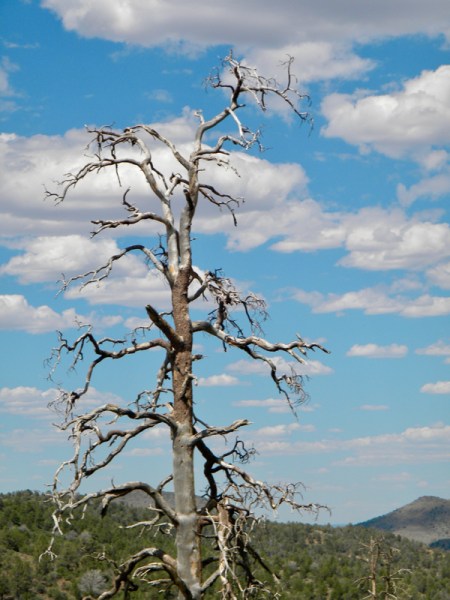
Wandering in the forest later, we can see the aftermath. In a sea of towering ponderosas, or their kin, there are those who stand apart. Not frequently, but infrequently, there will be those who are now shed of their needles, their skins laid open by the snaking of a lightning strike. Standing stark, they appear to be dead. They aren’t. When I go and put my forehead against their trunks, I feel the elemental filaments that have startled another kind of consciousness within them. Still dwelling in their habitat, they are even more alive than before. They draw our attention — our fascination.

The fire that discharged their coverings often may move to some of the surrounding brush and trees, those in close proximity. Sometimes it may travel from a tree to ignite nearly the entire forest. But before that could happen it was first necessary for that tree to be burned of its own covering before the fire that began with that One could affect its brethren…

The lightning strike oftentimes comes suddenly, a bolt unexpected. But there may well be a stirring before the charge and those who have grown the tallest stand most ready to receive…

In order to be ready, we do for ourselves what we know to do as best we can. Yet, there must be no striving. The striving of the material world has no place in this transmission. We need only send our willingness up as a prayer and merely stand waiting. This is for those souls who hold themselves available — to be struck.

— In the time of monsoons

For a few years, prior to a huge personal fork in the road in 1992, I worked as an internal consultant for the US government. (Those who know me find my long stint in civil service hard to believe. Now, so do I.) I was one of several in my small office trained to seed organizational development by focusing on leadership strategies, team building, conflict resolution and the like. The approach most meaningful to me was a holistic one. With intact work teams, we used the Meyer-Briggs Type Indicator or experiential activities that pointed to similar outcomes: the varied styles and capabilities of each individual made a stronger, more creative team. Everyone brings something to the table to contribute. Most of the time, I felt like I was banging my head against a stone wall. It was a challenge to get most of those managers to think beyond protecting their own turf and short-term thinking.

When that happened, we had another trick to pull out of our back pockets: WIIFM (pronounced whiff-um). When wanting them to consider a more holistic, visionary style, we’d guide them to consider, what’s in it for me? Back then I was fresh-faced and hopeful. Now, I see asking that question likely served to entrench rigid individualism rather than open a pathway toward higher values on Maslow’s pyramid and farseeing. It wasn’t long before all came to a head for me. I simply couldn’t do it anymore and cut those ties.

A friend recently said, we’ll all find something to justify our beliefs and actions. Of course, we do. That’s true no matter where you fall in the current deluge that assaults our moral compass or however else you make decisions.

Shortly after leaving disillusionment behind, I was first introduced to traditional Indigenous ways: seventh generation decision-making, sacred reciprocity and actions intent on the well-being of the planet and all beings. This is the world where I choose to dwell, one whose time is long overdue and endangered. In practicing stillness, these are some of the memories and metaphors that have guided my considerations over the last months.

Categories: Contemplative Life, COVID-19, Global Consciousness, Indigenous Wisdom, Sacred Reciprocity | Tags: , , , , | Leave a comment

Make Friends With Whatever Arises

Last week, I had a landscaper deliver and spread much on the few garden beds I have. He’d been out to my place before and is dependable. It’s been a trial over the last several years, finding plants that the wildlife in this outback won’t eat and that can tolerate drought conditions.

It’s certainly been a trial this year in so many ways. Even the flowering plants have largely hidden their color, choosing instead to retain their blooms, leaves frequently curled inward to protect themselves against the raging hot winds.

At dusk, I wandered out to admire what the workers had accomplished. When I rounded the slope alongside my long dirt driveway, I stopped short. I felt a pang in my heart and nearly burst into tears.

103743586_2934181023302070_4461039012575800053_n

Seeking solitude, I moved to this particular spot nearly 20 years ago because I would have a clear view of the San Francisco Peaks nearly 90 miles to the north. They were precious to me, precious to the Indigenous peoples of Northern Arizona.

When I walked this land back then and noticed small mounds dotting the hillside with waxy leaves on branching stems holding quarter-size violet flowers, it cinched my choice. For me, seeing these brilliant points—each flower only lasting for a day—in this sunburned, high desert landscape has been a kiss of beauty I’ve come to cherish. My love affair with these wild four o’clocks, that I’ve never seen elsewhere, has endured.

A few years ago, several of them started volunteering in the lower bed containing only a large juniper and a few shrubs native here, cliff-rose and Apache plume. The four o’clocks made their home around the juniper where little else would grow. I felt blessed and never failed to glance their way when driving down the hill, looking forward to the day they would completely cover the ground.

But now, the four o’clocks were gone.

At first, I thought I was seeing—or not seeing—things. But then I spotted a pile of wilted leaves and branching stems laying on the wild side of my driveway. They held their beauty close to the vest this year, few of the flowers making any appearance whatsoever.

When I showed my landscaper the next day, he said he felt so bad. I could see he did, having mistaken them for weeds. We searched for some to take their place. Most elsewhere had died back in the heat and lack of water, but we finally found a few. I don’t think the transplants are going to take. I’ve been encouraging them in my daily visits but don’t hold out much hope.

A couple of days later, I began to think about my response to the situation, the visceral sadness, the barely held in tears. I knew something was going on with me well beneath the surface.

A few days later, a friend and I were catching up with each other, a rare opportunity for me to be in the physical (safe distancing) presence of another person, these being pandemic days.

We’d just co-facilitated a meeting via videoconferencing in accordance with safety guidelines. She asked me how I’d been faring, and I told her I was personally fine. But I was so concerned about the Indigenous communities I work with. My nonprofit had been fundraising to provide emergency relief for the Hopi and Q’ero villages who had reached out for help—and the fact that I just didn’t have the means to extend assistance to all.

I knew all were suffering in a variety of ways, from isolation to lack of medical care and protective supplies to food insecurities. I was aware that some of the Maya people I work with are also in a bad way. Across the board, there is serious loss of livelihood for any Indigenous community or business dependent on tourism.

A memory surfaced, and I began to tell her of the experience.

“In 2006, my friend Will and I were traveling in Guatemala. There had been some kind of natural disaster, a hurricane or earthquake causing mudslides and washed-out roads. It was impossible to get to Lake Atitlán or surrounding villages for a few months. We went there right after it had opened up again.

The night we arrived, we had dinner there in Panajachel at an open-air restaurant. I ordered fish. But it didn’t taste quite right, like it was old. I picked around on my meal for a while. I noticed two little Maya girls and an even smaller boy sitting on the curb across the street, their eyes glued on us. When Will and I finished our dinner, most of the food remained. The children ran over and asked politely if they could have what we’d left. Of course, they could! We put it all in a series of napkins, and they scurried back to the curb and devoured the food.

It made my heart ache. Clearly, these little ones had been suffering. Up close it was evident. People just don’t realize how on the edge so many live. How can we ignore such a thing? Once you’ve seen it right in front of your face, you can’t ‘unsee’ it. It breaks my heart, and I know for sure that’s happening now in so many places in the world.”

By the time I finished my story, tears were pooling in my eyes, threatening to overflow. My friend was the same. She said, “You’ve made it real, personal.” We went on to talk about the tragedy of George Floyd’s killing and so many others, the same. I could hardly bear it all.

I don’t want to bear it.

For the last several weeks I’d been participating in online teachings with Pir Shabda Kahn, the spiritual director of Sufi Ruhaniat International, reconnecting with practices.

I suddenly remembered he said something I’d known from long ago:

Whatever arises make friends with it.

And in that instant, the discomfort I’d been so valiantly trying to push down—to make invisible—made its presence fully known.

Grief. I was grieving. How could I not be and still be human? How could any of us not be?

I don’t want my grief to be lodged in my body and forever be carrying it. I don’t want my grief to go underground again.

I want it to be fully present. That way, I simply cannot be complacent or allow anyone to be seen as other.

Pir Shabda had talked about the real meaning of justice, bringing things into balance. Peace won’t come from justice alone but transformation. The remedy comes from each of us. Perennial wisdom has to do with the development of compassion. This is our contribution to send into the world.

The Sufi wazifas are the “99 Beautiful Names of God” that, when chanted, seek to call upon the person any sacred attribute that is named and release it globally. In closing our last session, he offered us the phrase “Ya Jabbar” as a strong way to bring things together. Known as the bonesetter, this wazifa is the healer of fractured human existence.

I’ve been placing this sacred phrase on my breath.

***

Make Friends With Whatever Arises was first published in the Elephant Journal on July 6, 2020 and awarded the status of Ecosystem Winner.

Categories: Contemplative Life, Global Consciousness, Healing | Tags: , , , | Leave a comment

Move Slowly Back Into the World

In looking back to This Pilgrimage We’re On, I was surprised to see I wrote it on May 13 when I was 60 days into sheltering at home. Now—in time—here I am just upon a month later when, in some ways, it feels like only yesterday. Yet, it’s been within my reach, even experience, to travel through galaxies—possibilities and probabilities—to come back to the place I am now.

 At some time in our lives, we receive a signal to arouse from a deep sleep. If we answer the cue, we set out on a journey toward authenticity that takes us into the unknown. We begin to separate from the selves we thought we were and search for who we are.*

Having made the monumental journey, albeit enforced, globally we’ve come to the next phase. It’s a precious time to be framed with thoughtful consideration…how to re-enter the world. Yes, it’s a consideration of safety measures and health precautions. But equally important is the measure of who you are and how do you want to be in the world moving forward. That means something not only on a personal level but collectively. What consciousness do you want to hold and act through?

If you’re like me, during this containment, you’ve visited lifetimes, incarnations you thought you’d left behind. Sometimes giving you a fleeting visit, or sticking around for a while, to let you know there are aspects of underdeveloped selves still contained wanting to fly free. Having habitually denied it, you don’t know that one is still there until you’ve jumped right into the middle of it, automatically entranced as you were when the inroads were made in the first place.

Isn’t it fortunate the pandemic has provided the conditions to shake us all up? There are no words for the tragedies that have occurred. Lost lives. Global grief. Righteous anger spilling out for all the historical and present-day inequities. Injustice. Devastation. Generational trauma. Calling for all to be righted.

Carla-FacingTheStorm-low-2_edited-1

Facing the Storm. Oil and cold wax. ©2015 Carla Woody.

Do not waste this. Do not let life go back to what it’s been.

For in this time, we’ve all been given a gift. If you can take it to heart then its expression will translate to right action.

It’s explicitly due to instilled solitude, crowding, whatever your situation, that gives space for exactly our strengths, yearnings and woundedness to arise.

In my contemplations, a memory came that provided me with a metaphor. It was from the very early 2000s. I was traveling in the Altiplano of Peru with Peruvian mystic Américo Yábar and a couple of friends. This remembrance comes from the hours spent on a sacred mesa  in the middle of nowhere.

Don Américo motioned, inviting us to follow him on a walk around the mesa’s edge. I followed closely behind him, the others straggling farther back enjoying the view. After a distance, he came to a sudden halt and brought me over to the very rim and gestured to a flat rock jutting out below, indicating I was to light there and meditate…

I didn’t want to think about the sheer drop of at least a thousand feet and preferred to look instead at the narrow ground where I would place my feet. I charted a short course and then carefully picked my way to the stone and settled into a comfortable seated position. Legs crossed, spine straight and ready to meditate, a bizarre urge ran through me. There was a strong part of me that wanted nothing more than to physically leap into the lonely, empty space in front of me that stretched for miles! Quickly quelling that impulse and pushing it from my mind, I closed my eyes…

After a while, I heard  a tranquil wind from the right, whistling softly, slowly coming along the perimeter of the mesa. Surprisingly, I felt it touch my body and instead of moving around me, it went through me on its way to the left. The wind was immensely long, its blowing gentle, but when its tail finally exited, it left me bodiless, having indulgently thrown me into the abyss I’d wished for after all. I dissipated into the dark nothingness of the Void while, at the same time, I merged with the totality of the landscape, covering it. The silence was such that I have no words for it, but a feeling of profound tranquility and yet expansive joy permeated the being that I call myself.

I have no idea how long I remained in that state, a minute or an hour. It was timeless. Somewhere in the midst of it, something compelled me to open my eyes, and I received a jolt. Not only was my consciousness not fully in my body when I did so, but I had also erased any awareness that I was seated on the precipice of a very high mesa rather than the usual ground! In addition, I had catapulted myself from the blackest black into the brilliant light of the high Andean sun. I slammed my eyes shut, unwilling to experience the colossal contrast.

Slowly though, I began to feel the outlines of my body and the friendly stone supporting me. This time I took my time raising my outer eyelids and gazed without fear across the miles of the Altiplano, all the way to the ring of mountains on the other side. I found that I was taken with the beauty of this place that many would consider barren and lifeless. I had discovered the richness hidden from casual eyes.

While my compulsion to jump into thin air was unexpected at the time, I’ve experienced it before in high places. After having talked with others, I realize that I’m not alone. This is a common urge. What I’ve come to understand is that it’s a petition from the deepest part of us. It’s the soul’s sense of wanting freedom. It’s a strong inner existential yearning that calls for merging rather than separation…

As though a curtain is drawn open to admit the sunlight, we discover that the Truth for which we’ve strived is revealed to be ever-present. We merely partitioned it off. If we’ve chosen to fully immerse ourselves, without fear, into the effervescent warmth of nothingness, we automatically want to remain there. The everyday world matters little in this flow…

If we’re going to travel the deeper path, we need to learn how to navigate it. If we were thrown into such a sea without any tools we would be seriously disadvantaged at best. So, there are the continuing series of re-entries we make to increase our awareness of the geography. If we pass back and forth over similar area enough times, perhaps we will become familiar enough with the territory to make the one transparent to the other. In the meantime, the transitions can be shocking until we recognize them for what they are.

…The silence may come when we make a space, take time out from normal activities. It can come through meditation, using the breath to empty the mind; finally inspiring the no-breath. It can come through a walk in the forest, mindfully, slowly placing the feet firmly on the earth, connecting in such a way that the body is no longer a body, but a bubble of energy skimming along the surface of life. It can come through intentfully opening the crown center of the head during times of creative expression. We only know that silence has visited when we return to our work later and wonder who has written the passages or painted an image nowhere in our memory to have done so. But oftentimes, no matter how we prepare the ground, it doesn’t come. At least not to the depth we would choose, or the habitual voice imposes instead…

Many have already begun to move back into the world with pronounced actions, clearly needed. Others—I fear—are unable to deal with the discomfort  found in a containment where internal and external voices are more apparently loud, and pain ever-present…and the old ways of numbing out appear the only solution.

Carla-Mythic 2_low_edited-1

Mythic II Oil and cold wax. ©2019 Carla Woody.

Soon it will be time for me to walk again in a world other than I’ve known over these last months. But not yet. I know I’m charting another path forward, and I know I’m leaving something behind. I can’t formulate words but can feel the energy slowly presenting itself.

In the meantime, I’m sitting with these questions.

  • What are the choices you’re making in the moment—those that fulfill deeper values?
  • What are you giving care to that you had forgotten or set aside?
  • What has come to the forefront that you’re no longer able to ignore?

I’ve called upon patience. I know the answers will be given in stillness. Silence is the conduit for creation.

***

* Quoted portions are excerpted from Standing Stark: The Willingness to Engage, my narrative nonfiction book of a spiritual path.


Categories: Contemplative Life, COVID-19, Global Consciousness, Healing | Tags: , , , , | 5 Comments

This Pilgrimage We’re On

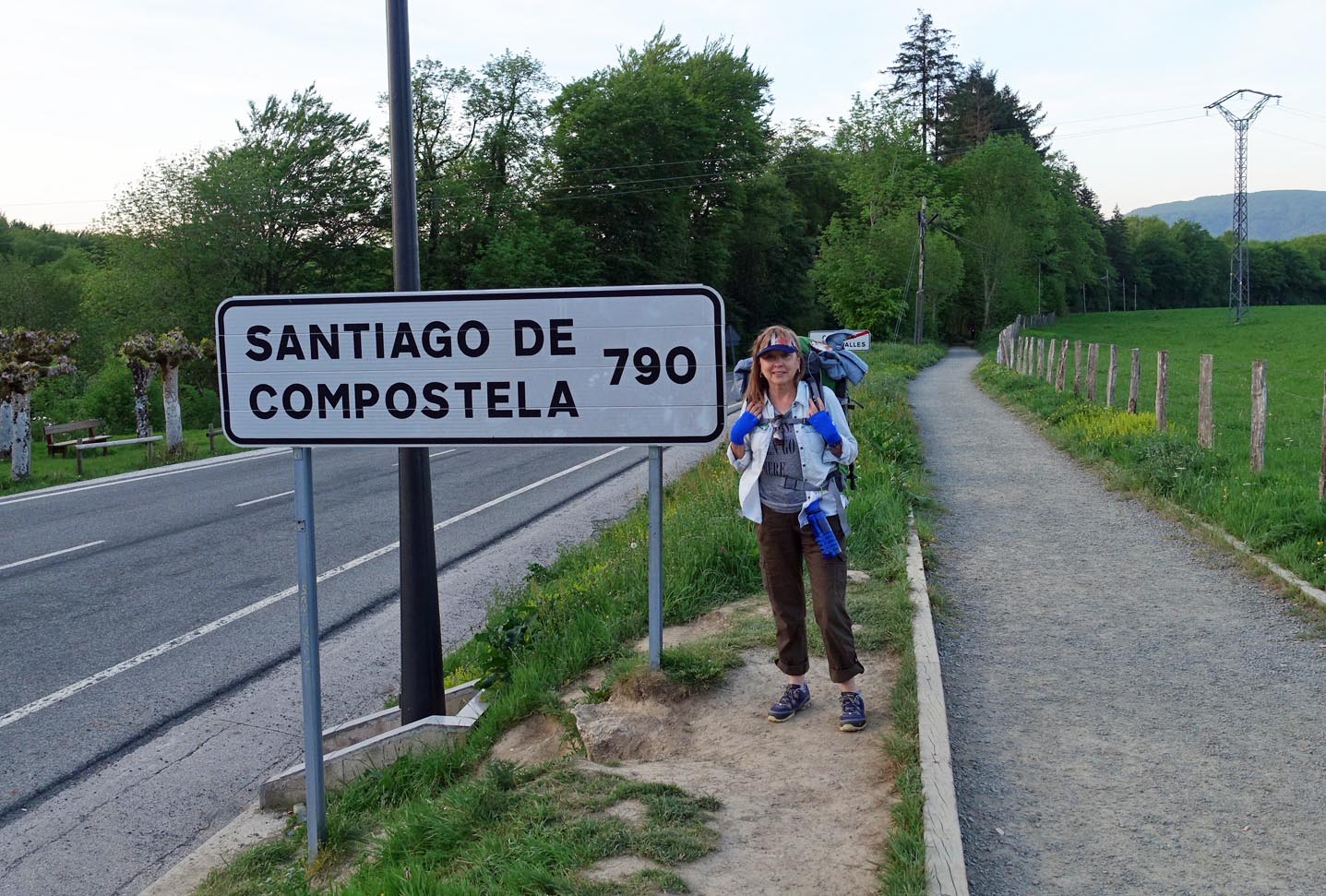
I’ve now been in stay-at-home mode for 60 days. That’s 2 weeks before it became an order here in Arizona. Suddenly, I had all this open space stretching out in front of me. Like everyone else, commitments—work  and otherwise—were cancelled at least for a few months. Part of me was relieved. I haven’t had this much open space in…well…I couldn’t remember when.  I’ve been thinking about this a lot. The only other times I could come up with, other than a few weeks here and there for personal travel, was when I’d undertaken the pilgrimage to Santiago de Compostela in northern Spain.  But now I’m well beyond that in time by 23 days with uncertainty when I’ll emerge.

On May 10, 2015, I donned my pilgrim suit and officially began walking the Camino Francés, which starts on the French side of the Pyrénées in Saint-Jean-Pied-de-Port. Now, it’s a complete synchronicity that I decided to sit down and begin this writing on the same date five years later. I didn’t plan it. Nor did I remember the date I began my walk. I discovered this fact when I just pulled up my blog from that time, The Essential Way, looking to reference something.

DSC00795

But these are strange times, and the synchronicities have occurred with regularity for me in the last several weeks. Maybe I’m more sensitive  to the vibrations around all of us carrying information, or more able to note things clearly visible beneath the surface, since I’ve been wrapped in silence most of the time.

I remember having a sense that something big was coming for some time, and when it finally dropped, I did elect to go into retreat here at home, formally setting aside 10 days of this sojourn framed by long meditations each day, being in silence, ruminating on what came through, writing and artwork. In some ways, I feel it frivolous to even share these things—when others are undergoing great suffering. Not just minor inconveniences. But the fact is my more introverted nature thrives on such opportunities of emptiness.

What is so different between my 2015 pilgrimage and what we’re undergoing now in 2020? Choice. Even though I’ve never been able to articulate it in words, I was called to the Camino. It was my clear choice, and the same for most who have walked it since Medieval times. That’s unless, as happened back then, some who found themselves forced to do so as  penance for some crime. On the other hand, this pandemic came out of nowhere, imposed itself upon most inhabitants of the planet. For crimes? Maybe. It’s stopped us all short and threw the human world into global chaos, while nature continues to do what nature does.

DSC00807

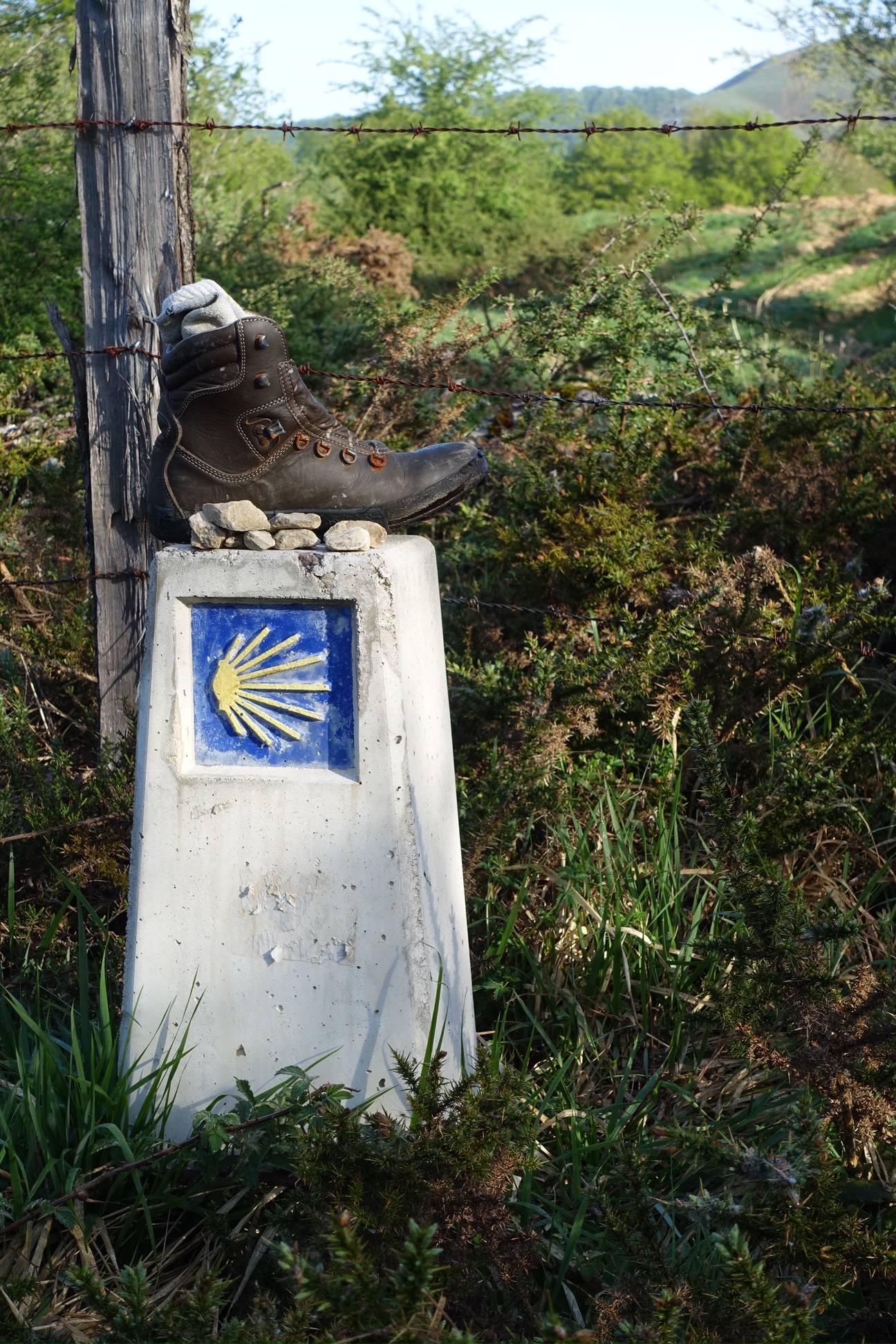
The Camino path is well  marked. If you’re a pilgrim in that setting, you know where you’re going at all times. There’s even a recognizable symbol: the scallop shell. Pilgrims are identified by the shell hanging off their clothes or knapsack, and the directional signs, even in the middle of nowhere, are marked with it.

There’s no clear cut path for us now. It’s empty, hazy at best. We don’t have any measures of distance or time. Many of the foundations we thought we had…have crumbled. Illusions. We’ve been shown the dark underbelly and the essence of light.

If those are differences between a well-marked trail and the pandemic, what are the similarities?

In the Chiapas highlands of Mexico, the Maya petition the owner of the land—the Earth Lord—for protection or other things they want. But the Earth Lord also demands payment, a sacrifice. Consequently, the Maya alternately revere and fear this Underworld being. But if you think about it, isn’t this a Universal truth? Sacred reciprocity. The Indigenous people of Peru call it ayni and live by it. Something transformational always involves releasing, letting go, in order to receive something more. It’s just the ego self that balks.

DSC00920

Prior to embarking on my Camino, I told friends I felt as though I would be placing my feet into the very footfalls of all who had walked there before…all the way back to the Middle Ages.  Be careful what you project especially if, in a sense, it’s true. The 4th day out I sustained what is still a mystery injury that resulted in not being able to put any weight on my right foot without excruciating pain. That’s a story. The pain barely dissipated but I chose to continue on. Now I would say I was making payment. What did it do for me? It forced me to slow down, way down. I shuffled s-l-o-w-l-y along the Camino leaning on a walking stick, and what beauty I noticed that I would otherwise likely have missed. What insights I had. No matter I had to undergo physical therapy upon return home.

DSC01192

It’s usual for pilgrims to leave notes or prayers at shrines beside the trails. I distinctly remember doing so at a particular shrine. But I have no memory at all what that piece of  paper said. I have no need. I left that part of myself there.

Most pilgrims never forget their Camino. To a one there was suffering of some sort. It’s arduous. And we’re different once its end has come.

Won’t this also be true of the pilgrimage called the pandemic? How we undertake this walk? The sacrifices? The suffering? We’re being called upon to be our Best Self ever. Some are wholeheartedly answering this call while others go in a different direction.

Here’s a truth: The follow-on to chaos—if we’re wise—is a sorting process that can lead to a more identified, aligned existence. If mindful, the Collective We can identify the world we want to live in and lay out, to degrees, how it unfolds. That’s an intent. We have choice within a framework: how to make the most of the time given.

DSC01148

On the Camino, there’s companionship with complete strangers. Some of those turned into lifetime friendships. We helped each other. We’re compassionate. We recognized there’s no difference between ourselves and others. We’re the same. We’re all in it together. Don’t we have a multitude of examples such as this now, during the pandemic, from around the world?

On the Camino, we underwent a metamorphosis. We were different than when we started. I’m willing to bet that, whenever we come out the other side of this pandemic, we’ll also find this to be the case.

During the Camino…

Somewhere along the way, once I got the rhythm down pat, I began to note somewhat tongue-in-cheek differences between daily life on the Camino and home. But the more I listed the more I realized it’s an intimate glimpse of common pilgrim experiences you normally wouldn’t be aware of unless you’d undertaken the journey. I also began to have insights, reminders and resolutions related to some of them…

After I got home, I documented all of those I wrote down while walking. On that blog post, I called the first section I’ll Know I’m Home When Here are some from that list.

… I’m no longer looking for markers every few minutes to tell me where to go, except perhaps subliminally.

… I’ll no longer hear the well wishes Buen Camino spoken to me by nearly every pilgrim and so many locals, or say it myself, as we pass each other.

… I’ll have more than one change of clothing.

… I’ll have more choices to wear on my feet than hiking shoes or flip flops

… I’ll know on a consistent basis where I’ll lay my head each night.

 … If I’m sleeping in a roomful of people, I’ll know them all ahead and never in numbers between 12-100 in one room.

I called the second section My Take-Aways.

It’s important to be alert to the lay of the land to avoid becoming lost or overlooking tell-tale signals that things are off track or hidden. I resolve to sharpen my peripheral and x-ray vision.

Flexibility is a virtue. It’s also important to set your limits and abide by them. I resolve to identify with even more depth and breadth what is true for me.

A simple life in the best sense is a pure one, devoid of clutter in the mind or unnecessary material goods, anything that weighs down the spirit. I resolve to up-level my sorting and pitching process.

There are more that I’d written. All still true for me now. But this one particularly caught my attention as I read through the post.

I undertook this journey through willing choice. If you look at the list, you may notice there are aspects that are similar to those whose lives often aren’t through choice but circumstance. In a certain way, I had a light taste of what it’s like to be homeless, to experience restriction. The more days I walked the more this awareness settled on me. It increased my compassion toward anyone who finds themselves in such a place and has difficulty finding a way through. There’s always a way across a threshold. It also deepened the great gratitude I hold for having the life I do, and the capability of coming up with strategies to navigate the tricky times.

I’m going to start my list for the pandemic, what I’ve noticed and how I want to be on the other side. Some of these will be the same. Some will be new in the sense of further revealed.

IMG_0302

On my 2015 pilgrimage, when the going got physically rough for me, I invoked a Sufi wazifa.* On the in-breath I would chant Ya Fattah. On the out-breath, I would repeat Ya Fattah. Over and over and over. That beautiful name got me up mountains and down the other side when I sincerely wondered if I would make it.

Here’s holding these pandemic times are embedded in our Collective Consciousness in a good way and direct tomorrow. There’s a choice in every moment.

Ya Fattah! Ya Fattah! O, Opener of the way!

May all beings be happy. May all beings be well.

***

*The Sufi wazifas are the 99 Beautiful Names of God that, when chanted, seeks to call upon the person any sacred attribute that is named.


Categories: Contemplative Life, COVID-19, Spiritual Travel | Tags: , , , , , | 5 Comments

Blog at WordPress.com.