Arts

Film Review – Agafia’s Taiga Life

Agafia’s Taiga Life

A Documentary by Vice Media

Agafia

Agafia Lykov. Photo credit: Siberian Times.

In 1936 Karp Lykov took his family and fled into the Siberian wilderness to avoid Stalin and persecution because of their religion. Called the Old Believers, they belonged to a sect of Russian Orthodox fundamentalists. Over the years they retreated deeper and deeper into the Taiga, a forested region in the heart of Siberia, where temperatures are extreme and civilization is non-existent.

Agafia was born into that life in 1943. Agafia saw no one but family for 40 years. And then no one at all for 25 years until a geologist moved a short distance away. All that time, she’d been a woman alone, living off the land.

Journalists from Vice Media visited Agafia to shoot a documentary about her life for their Far Out series. She relates what it’s like to live in the company of her animals, her faith, occasional encounters with bears and rocket debris, a way of life that gets much more difficult as she ages. Her story is an example of pockets in the world where people are living in solitude by circumstance and often by choice.

Watch it online for free. Length: 36 minutes.

To read about another in this series and watch the documentary, see Faustino’s Patagonian Retreat.

Categories: cultural interests, Film, Solitude | Tags: , , , | Leave a comment

Allies

In January I took a group to Nahá as usual during my Maya spiritual travel program. Nahá is a tiny Lacandón Maya village deep in the Lacandón Biosphere of Chiapas, Southern Mexico. We go there to be with Don Antonio Martinez for ceremony and show our respect that he’s still holding traditions when there’s so much pressure for him to let them go. We also visit with the widows of the late spiritual leader Chan K’in Viejo, as well as spending time at sacred Lacandón sites.

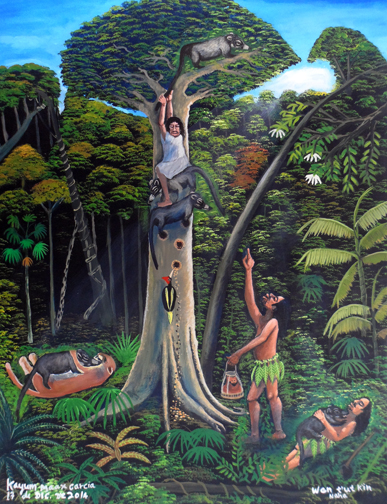
This time we stopped by Kayum’s home. I hadn’t seen him in years. Kayum Ma’ax Garcia is a Lacandón Maya artist of the monkey onen, or clan. He’s also one of Chan K’in Viejo’s sons. He works in acrylics on canvas. In his artwork Kayum conveys actual events, lifeways, creation stories and rituals of a culture nearly gone—as well as his dreams, an important aspect of traditional life. So, in his own way, Kayum is preserving the traditions of his people. I’ve always been fascinated by his art.

Kayum Art

Traveler Frostie Torres purchases a painting from Kayum during our 2007 program. Photo: Alonso Mendez.

But he has little exposure to the world outside his village. I thought to myself, it’s important for his work to get out there, not only to help sustain his family but for others to appreciate Lacandón lifeways and traditions. I suggested to him that he offer his work as archival prints through an online service as I do. But he has no camera, computer or technical knowledge even if he did. Aside from that there’s only Internet at the little lodge where we stay. And the connection is so poor it may as well be non-existent. He had no one to support this possibility, and it was something he really wanted to do after I explained it.

An opportunity landed in my lap, another one that truly matters. The group witnessed the process of this conception. They were excited. I went home and put a vote before the Kenosis Spirit Keepers Board.*

The Allies Gallery is now a program supported by Kenosis Spirit Keepers to sponsor Indigenous artists who have extremely limited capabilities to offer their work. Kayum is our first artist. Proceeds of any of his art sales go directly to him. The same will be true for any other artist we include.

Man of the Wild Acrylic on canvas Kayum Ma'ax Garcia

Man of the Wild
Acrylic on canvas
Kayum Ma’ax Garcia

Our online gallery is now up! You’re invited to check it out and support Kayum through purchase of his work and sharing Allies Gallery with others. We currently have prints available for four of his pieces, in various sizes and formats, and will add more as time goes on.

*******

Kenosis Spirit Keepers is the volunteer-run, grassroots organization I founded in 2007 to help preserve Indigenous traditions, a 501(c)3 nonprofit extension of Kenosis.

Categories: Arts, cultural interests, Lacandón Maya | Tags: , , , , | Leave a comment

Film Review: The Wellbriety Journey to Forgiveness

I will tell you up front that this is a difficult film to watch and can bring up all kinds of emotion. But if you’re going to watch it, then do so until the end because toward its finish there is much hope conveyed.

During our recent Spirit Keepers Series held in Phoenix on the subject of PTSD and Native healing ways, I had invited Eli PaintedCrow, an Iraq War veteran of the Yaqui Nation and co-founder of Turtle Women Rising, to take part based on her own experiences and to frame further aspects of our Series. She showed a portion of Wellbriety Journey to Forgiveness, a documentary produced by White Bison, Inc. They’re a Native American-operated 501(c)3 nonprofit dedicated to culturally-based healing for Indigenous peoples.

The film starts out with a prophecy given by the Old Ones about the light skins who would arrive, create confusion and great destruction. How everything would be taken from the Native American but their spirituality. There would be tremendous suffering, genocide and a time of testing. But opportunity for healing would present itself. After this time of healing, the buffalo, Native people and all manner of sustenance would return. Harmony would prevail. Native people believe that we entered this time of healing in the early 1990s.

This is the story of that destruction, particularly centered on boarding schools and their effect. If you’re not familiar, in 1879 the first Indian boarding school was opened in New Carlisle, PA. Native children were forcibly taken from their families and shipped off to such schools around the US where they were stripped of their language and anything having to do with their culture. They endured ongoing violence and humiliation in silence—many didn’t survive—and it had horribly detrimental effects reaching all the way to today. This is called intergenerational trauma, certainly a form of PTSD.

As a part of the Wellbriety Movement, Native organizers undertook a 7000-mile journey all over the US to give Elders and their children a chance to tell their stories, perhaps for the first time, and express grief. In this undertaking they hoped to break the cycle of addiction and violence, begin the road to forgiveness and a return to spiritual traditions. The film covers Native values and how to live in harmony as taught by the Old Ones, along with a model called the Four Directions of Forgiveness and a call to Greater Purpose.

This is an extremely powerful film and could be called the Schindler’s List for Native Americans. It was created as an Indian Give-Away by White Bison for purposes of truth-telling and healing.

Whether you have Indigenous members in your family line who suffered the atrocities, have ancestors who perpetrated any part of it, or are born of mixed blood as many of us are…the message presented here is relevant to all. The effects of genocide, abuse and shame are equally carried through the family line. This is a film for anyone whose ancestors have experienced anything of the like. That doesn’t leave out many people on the planet.

This is a move for truth—no more secrets—and healing accomplished when we live in harmony as the Old Ones taught. Seeing the complete film instilled even more significance to me in how I personally live and greater understanding of the important work Kenosis Spirit Keepers does, even if we reach only a few.

This is a film for the Next Seven Generations. Critical mass is important. View the film for free on You Tube and share widely. Length: 1 hour, 13 minutes. Also visit White Bison to learn of their healing institution and classes.

Categories: cultural interests, Film, Healing, Indigenous Rights | Tags: , , , | Leave a comment

We Are All Artists

When I’m especially taken with a book, I greatly anticipate the author’s next one. This was the case with one of my favorite novelists, Jim Fergus. Visits to his website had promised one for several years, even with a specific title and subject matter that is of interest to me. But each time I checked … nothing … and I’d log off disappointed. A few weeks ago I checked, this time discovering he had a new one out. I promptly ordered it. Yet again he’d produced a story that touched me in tender places, as much as it informed. I did something I don’t normally do: I emailed him to express my gratitude that he’s writing again.

He responded. It started a conversation.

Jim told me the book had been published in France and done quite well. But when he went searching for a US publisher, no one was interested. Unbelievable, I thought. This is a writer whose two previous books—One Thousand White Women and The Wild Girl—were bestsellers! But with this new one? He’d stepped out of his genre of The West and Native Americans. He was no longer in the neat slot US publishers had placed him—therefore, a risk.

He went on to say the specific title he’d named on his website, Marie-Blanche, was published in France in 2011, currently in development for a mini-series there. Same problem with US publishers. Jim finally decided to self-publish The Memory of Love, the novel I’d most recently read … just to have a new book in print in my own country.*

This goes to show that even widely celebrated writers—and any such artists really—don’t necessarily have it made, as our fantasies tell us. They’re subject to the same tight restrictions and imperious whims if they depend upon the old-school bureaucracies and structures.

Now he’s writing a sequel to One Thousand White Women, the genre he’s known for, accepted by US publishers. There’s no doubt I’m wildly anticipating its publication. And I’m quite sure it will be a commercial success.

However, the unconventional part of me automatically made an appearance. I shared that I’d written three books and had chosen to self-publish specifically to avoid all the nonsense traditional publishers try to lay on you. I don’t have the time or energy to deal with it. Those who have found my books receive them quite well. **

I also mentioned that it’s the same with most art galleries. To accept an artist’s work, they want to make sure you’re consistent, no matter your talent level. Consistent in this definition means same general subject matter and media, same slotting as above. I’m fortunate to have found two galleries who are happy to show my work, no matter how much I experiment. And I do. I’m not a production line.

All aspects of my work—mentoring, spiritual travel programs, writing or art—appeal to a particular small niche, not the mainstream. And I’ve got much gratitude to those who engage with any of it. It means we’re part of the same tribe.

I often listen to Krista Tippett’s On Being interviews when I’m painting. I find them inspiring, and they sometimes inform the piece I’m working on in the moment. Right on the heels of the conversation I relate above, I listened to her interview with Seth Godin on The Art of Noticing, and Then Creating. No coincidence. Here are some relevant take-aways … ***

  • The assembly line is going away. The things that used to make you feel safe are now risky.
  • Putting something new into the world? The industrial order doesn’t want us to do that.
  • Change comes from the margins.
  • When you do something out of the box, you’re not going to be picked by the old regime.
  • Bottom-up change is the future, not top down.
  • One person can make a difference. You matter.
  • Find people who agree with you and lead them to greater depth.
  • You’re an echo of your art if you’re not making new art.
  • Do it as the gods would do it: with intent, no holding back.
Mystery School in process on the easel.

Mystery School currently in process on the easel.

This is the time of year—as we’re on the threshold of the next one—when I remind myself of these truths by viewing Sean Connery’s rendition of Ithaca by C.P. Cavafy, featured in this blog before.

It reinforces my intent.

 Engage your passion. Fine tune. Put it out there.


 ***

 *My conversation with Jim Fergus was relayed here with his complete permission. This is the review for The Memory of Love I uploaded to Amazon and originally sent to Jim with my first email:

Truly, Jim Fergus is one of my favorite novelists having also read  ONE THOUSAND WHITE WOMEN and THE WILD GIRL. This book is indeed a departure but at least equal to the others. I was personally touched by Chrysis’ striving against convention and evolution as an artist, and Bogey was portrayed as though the writer had lived inside those very emotions. The foreword shared why a man could write this way about love, and only at the end did I realize the characters had actually lived. I’d been waiting a long time since THE WILD GIRL for Jim Fergus’ next novel. I’m very glad he’s writing again. Now I’m looking forward to MARIE-BLANCHE.

 **To view my books and readers’ reviews on Amazon, go here. To view artwork online, go here.

***I recommend listening to the unedited versions of On Being interviews with Krista Tippett. They’re much longer but without the fine polish that editing brings. They’re real.

Categories: Arts, Book Review, Creativity Strategies, Interview, The Writing Life | Tags: , , , , , , , | 1 Comment

Music Review – Standing on Sacred Ground

MarshallAlbum-2

Listening to singer-guitarist Kathy Marshall’s latest release, I wanted to curl up in front of a fire with a cup of tea, close my eyes and let her words and music wash over me. I became nostalgic for those traditional folk ballads from times past…and yet found them in the songs contained in Standing on Sacred Ground.

The lyrics are deeply personal and introspective, reflecting values of the musician: respect for Mother Earth, an urging to slow down and find truth within yourself, gratitude for blackberries. She tells stories about elements of life that are familiar to most of us and led me to reflect on my own life where there may be a similar thread of love or loss, and largely…celebration of what is. The guitar and other instruments are a beautiful accompaniment to stories she shares.

From Secrets to Life: Met a grey-haired woman laughing in her rocking chair. ‘Come sit down beside me,’ she crooned, ‘I got secrets to share.’

I particularly love this line from Dreamcatcher: …I dream a song and I sing a dream. Nothing there is impossible to me…

All lyrics and music written by Kathy Marshall. CD available to purchase or download via her website and CD Baby where you may also listen to individual songs.


Categories: Gratitude, Healing, Music Review | Tags: , , , , | 1 Comment

The Energy That Finds Its Source

Sometimes it’s powerful to change things up in your geography, to experiment and see how you may further engage creativity…and The Muse. In the last several months, I’ve done just that—albeit unknowingly—and have been fairly astounded at what has unfolded.

I meditate first thing in the morning, usually before dawn. Over the last thirty years of doing so, it’s set the stage for my days and provided a consistent segue for insights, higher guidance. But I’d never considered using it as a tool for my artwork. It happened accidentally.

I would undertake my daily ritual in the back room, sitting cross-legged with straight back, always in the same spot for as long as I’d lived in this home, an anchor to the process. One morning for no apparent reason, I chose to meditate in the front room. Whenever I feel complete, I come back with “soft eyes”…slightly defocused…slowly returning, integrating the state with my day ahead. That morning my gaze came to rest on the easel and canvas I’d been painting for a while. And suddenly I experienced the piece in a whole new way. I saw things I hadn’t seen before. I felt a previously undetected presence, perhaps waiting until I’d opened a door and it could reach through and guide me. I’ve continued this change in geography while keeping my long-time meditation ritual. My artwork has more depth and meaning. I feel the intent of pieces is coming across in a way I’d just hoped for before. I had the beautiful feedback from a couple from Canada who approached me—after seeing My Magdalen Heart in person—saying they’d experienced the piece literally speaking to them.

The Inner Chamber

The Inner Chamber
Mixed media on canvas
©2014 Carla Woody

People have puzzled over the creative process for eons. Some ascribe to a belief that the source of creativity rests within the self absolutely, which places enormous pressure if you find not so much coming through. Others are certain it comes from another source, perhaps a higher power. Author Elizabeth Gilbert spoke eloquently on TED regarding this controversy.

I believe it’s a combination of the two. First, I have the choice to say “yes.” Then it’s a matter of showing up consistently, having faith that something will be delivered…and being patient with the process. I recognize that I’m a vehicle. I’ve chosen to develop certain skills. But, for me, there’s no mistaking when I’ve tapped into another realm entirely outside myself that moves beyond the mundane. My senses are heightened and the energy moves—whether through brush on canvas, fingers on keyboard…whatever the art form—to find ground. There’s a distinct collaboration…and it’s something else again when your subject matter starts communicating with you. Strange as it seems, that’s how it’s happening for me these days.

When I was writing Portals to the Vision Serpent my practice was to begin writing after meditation, at least five days a week for at least three hours at a time. Again, I didn’t realize at the time I was accessing my craft through an altered state of being. It was as though I watched a movie and wrote down what unfolded in front of me. One day I reached a point in the book where I needed to get a main character down to the rainforest of Chiapas, Mexico but had no idea how. Within a few days, a completely new character stepped forward to introduce himself from the shadows where he’d been hidden. It turned out that he provided the way; the novel moved on.

The poet Mary Oliver said, “…The part of the psyche that works in concert with consciousness and supplies a necessary part of the poem—the heart of the star as opposed to the shape of a star, let us say—exists in a mysterious, unmapped zone…Say you promise to be at your desk in the evenings, from seven to nine. It waits, it watches. If you are reliably there, it begins to show itself—soon it begins to arrive when you do. But if you are only there sometimes and are frequently late or inattentive, it will appear fleetingly, or it will not appear at all…”

If it hasn’t yet happened for you in the way you desire, I believe it can. It means opening yourself up, stepping outside your comfort zone, changing up your geography. It’s an agreement you make…an intent you hold…and then let go.

Such an energy finds its reciprocal Source.

Categories: Arts, Creativity Strategies, Meditation, Sacred Reciprocity, Spiritual Evolution, The Writing Life, Visual Arts | Tags: , , , , , , | 5 Comments

Book Review – Deep Cinema: Film as Shamanic Initiation

Deep Cinema

Mary Trainor-Brigham’s Deep Cinema deserves your time and attention. I found myself re-reading pages and then sitting, to give the words an opportunity to enter my interior space. Immediately evident, this is a book written to connect with your Indigenous Soul, as the author calls it, the one many of us ignore in this Middle World. She guides us to delve into movies and stories so that they play back to us our own humanity, initiatory passages and further potential.

I’ve studied Joseph Campbell’s work in-depth: his instruction on myth, the Hero’s Journey and places we can readily see examples in film and storytelling. Deep Cinema adds to that work in a way that makes it unique by overlaying shamanic templates from Indigenous cultures. We’re then offered the Soul Compass, a model …designed to transform life from a series of dogmatic dictates or chaotic occurrences…into a rich, sacred Self-defining sojourn which we gladly undertake…the key here is that life becomes meaningful…  The path from Child as Nest Dweller to Elder as Diamond Cutter and Pearl Spinner shows the gateways—mundane to spiritual, balance of Female as Womb Weaver to Male as Navigator—that we all must pass through in order to morph into the next level of growth.

The author brings her background as art therapist, film critic, actor and scriptwriter naturally into play, pointing out the metaphors in a multitude of films, older to more current, that relate to the archetypal templates she offers. With lyrical language, she draws the reader in. On the Voudon shamanic tradition: …According to the Haitians, a person’s small self is like a fish that gets hooked in the heart and reeled in throughout life by the love of and for their Great Self, sitting on a throne beneath the Sea in Lower World…

I was glad to see The Serpent and the Rainbow movie included as a failure at translating anthropologist Wade Davis’ book by the same name. Instead of portraying the rich layers of the Voudon traditions Davis experienced, Hollywood chose to further the cartoon-like, fear-based image of practitioners. Mary recommends Divine Horsemen: The Living Gods of Haiti as a true portrayal.

Once Were Warriors indicates the power of film on a population. In the successful translation of Alan Duff’s novel, Maori director Lee Tamahori graphically depicted real-life struggles with alcoholism and domestic violence the Maori people suffered, bringing it back to loss of spiritual traditions and the turning point of re-engagement. It’s noted that one in every three New Zealanders has seen this film. Most importantly: …after the film hit the theaters, there was an upsurge in the number of men seeking help with domestic violence issues, citing ‘Warrior Troubles’…

I had already viewed a number of the movies covered in the book: Whale Rider, Mindwalk, Capote and others. But I’m going to go back and see some again with new eyes and Deep Cinema beside me. As I was reading, I thought to myself it would be really nice to have an index of all the films and where they’re discussed in the book. I was pleased to find just that at the end. Bottom line: Deep Cinema is not just a reference but also an ally for the spiritual journey.

Available through Amazon.


Categories: Book Review, cultural interests, Film, Indigenous Wisdom, Personal Growth, Spiritual Evolution | Tags: , , , , , , | Leave a comment

Film Review: Séraphine

SeraphineTreeofLife

Tree of Life ­­- Séraphine Louis, 1928

Séraphine Louis, also known as Séraphine de Senlis, is the subject of this intense biopic—both inspirational and tragic—of a relatively unknown but brilliant artist who teetered between one reality and another. Her paintings were the product of creative and spiritual rapture, induced by spirits, and her love for nature. She was employed as a housekeeper doing the most menial labor and thought by the people around her to be quite odd and slow. But at night she disappeared into another world and turned out extraordinary works using pigments she made herself from unusual sources.

Her break came when Wilhelm Uhde, German art dealer and critic, saw a painting at his neighbor’s home and was astounded to discover that it had been done by his cleaning lady. At a time when avant garde artists such as Picasso and Rousseau were coming on the scene, Uhde became Séraphine’s sponsor encouraging her and finally including her in a show that he organized of the Sacred Heart Painters. Sadly, his patronage would come to an end with the advent of World War II. Séraphine became increasingly isolated and was finally committed to a hospital for the mentally ill. She passed in 1942.

Few of her paintings survive but some may be viewed here. This is the story of a woman who found deep meaning in life and was unusually resourceful, even in the face of periodic ridicule and little support, save one person who proved to be her angel.

This haunting film was a sleeper when it came out in 2009 but later won seven French Academy Awards. Streaming on Amazon. In French with subtitles. Yolande Moreau stars as Séraphine. Film directed by Martin Provost and co-written with Marc Abdelnour.

Categories: cultural interests, Film Review, Visual Arts | Tags: , , , | Leave a comment

Refrigerator Poetry

At the tail end of National Poetry Writing Month, I want to sneak in this story of a way my creative juices were unexpectedly activated. Several years ago I traveled to L.A. to participate in a group experience. A friend of mine flew down from Denver to accompany me. We would be staying with friends who had recently bought an old mansion in an area undergoing gentrification. It was an incredible place—three stories’ worth—with a conservatory and even a library. The new owners envisioned it as gathering place for the arts community, avant-garde thinkers and adventurers, as well as their home. They were intent on bringing it back to original condition.

While I went to the event, my traveling companion—a horticulturist by profession—had volunteered to design a garden and brought his computer for that purpose. When I returned a day later from my group activity, I discovered that things hadn’t progressed as planned. It would be some hours added to our original departure point. There wasn’t much room for me in the design process. Everyone was crowded around the computer screen in the breakfast room. I was more interested in enjoying the ambience of the house anyway.

Next to all the design activity was a huge old-fashioned kitchen, a big island in the middle and a formal butler’s pantry. My eye caught the jumble on the refrigerator door: hundreds of words on little magnets, arranged into witty sayings, others silly or downright gross. That was the first time I’d seen magnetic poetry—and I was intrigued.

The longer I stood there looking at the possibilities, words became fragments and then merged to form a thread. After an hour of fun, this is what presented itself.

We must be mad

soaring playfully like a thousand storms

under the winter moon.

Will you think me crazy

for smearing my skin with a diamond symphony?

Ache deliriously, run frantically

when I shine,

drunk on beauty.

Magnetic words now grace my own refrigerator door. I couldn’t wait to get home and purchase some. I keep some finished pieces displayed. Others are phrases lodged there to remind me they could be worked more when I’m in the mood. I threaten to publish them all one day in a little book called Refrigerator Poetry, maybe illustrated with my artwork. Magnetic wordsBut what I like best is how these word magnets work on your creativity. They’re almost irresistible. And I always chuckle when I discover some poems or messages that friends left, unbeknownst to me. The latest was a brief note from my latest house sitters, discovered weeks after I’d returned home. P1040134If you can’t wait to have some of your own, you can find magnetic words here. But I warn you: You’ll find yourself dawdling in front of your refrigerator consistently—not to tempt yourself with ice cream or pie—but to feed your inner poet!  

This story recalled through The Daily Prompt: Unleash Your Inner Dickinson.

Categories: Arts, Creativity Strategies, The Writing Life | Tags: , | 4 Comments

Acts of Creation

A few years ago, I was in the Musée d’Orsay in Paris and copied these words from a plaque on the wall in one of the many rooms that contained art works from the mid-1800s through the early 1900s.

A young painter asked Gaugin for advice and he answered, ‘Do not paint too much from nature. Art is an abstraction; extract it from nature while dreaming in front of it and pay more attention to the act of creation than to the result.’ 

Reminders
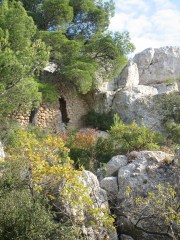
Cézanne's refuge on Ste. Victoire mountain.

Cézanne’s refuge on Ste. Victoire mountain.

Paul Gaugin’s words punctuated, for me, similar reminders coming over the course of travels in Provence with my group, which then culminated in Paris. As always, those things that stand out to us are what we’re there to encounter. This theme was mine to hear and one that is still prevalent in pockets of France, especially Provence.

Mont Ste. Victoire is a hulking giant of a mountain dominating the Provençal landscape. Post-Impressionist artist Paul Cézanne was fascinated with it. Painting it numerous times, he even had a refuge near the top, to the point we hiked and picnicked having our own luncheon on the grass painters Manet and Picasso might have found acceptable.*

Near Ste. Victoire’s base sits Mas de Cadenet, a winery that has been in the same family since 1813 producing exquisite examples of Côtes de Provence. We stopped by and Matthieu Négrel was waiting for us.

For such a young man, Matthieu was quite the inspiration. Only 25 at that time, he was set to take on a large role when his father retires. Indeed, he had already stepped into sharing many of the important decisions about cultivation of the vineyard and wine-making. We even had a discussion about what it was like to have such a family legacy and the expectations that may come with it, whether it was a harness or a sort of freedom. For Matthieu, it was obvious that he had found his passion early on—and it rested in the land, rhythms of nature, things tended with care, patience. He seemed to contain a distinct knowledge of his place in the world, rare for someone his age. With unabashed charm and a lot of gesturing typical of the region, he exuberantly related fact and philosophy about grapes and wine-making. We were not bored and much of what he relayed was done through metaphor. Matthieu and his family produce wine from vines that range from 35 to 50 years old.

Photo: Making Christmas Wine

Matthieu Négrel making Christmas wine in the old way.

Standing in the vineyard, with Ste. Victoire as the backdrop, he told us about his life. How it was to plant a vine and wait—to harvest only after 5 years. Pointing out a vine planted when his grandfather was a young man and then another planted when he himself was a child, he laughed and said, “Things are very s-l-o-o-o-w here in Provence.”

Then he went on, “In Provence they say, when the vine is young it produces much. But the quality is medium. When older it produces less but the quality is much better. Ahhhh…but when it is the oldest it’s very wise and it holds it all inside and it gives out very little!”

On another day we traveled through the beautiful countryside on winding roads, climbing in elevation and finally came to a Religious House with lavender fields surrounding it. Tucked away in the Alpes de Haute Provence region, discreetly out of sight, three sisters of the Soeurs Coopératrices Maison St Joseph live in an old farmhouse. They are known for cultivating lavandan, a prized type of lavender only grown at this particular altitude, producing the highest medicinal quality essential oil, in the old way, mostly by hand and not technology. Sister Marie Michelle, who greeted us, had a similar glow about her as the one Matthieu had, but many, many more years.

Sister Marie Michelle

Sister Marie Michelle

She showed us their fields and, even though it was late in the season, we could smell lavender faintly in the air. She talked about how they carefully harvested and let the blossoms lay in the sun a certain amount of time so that the oils they made would be at the best strength for all the ways they could be used. She bemoaned the fact that other lavender farmers used machinery that cut the stalks in such a way as to lessen the quality and then didn’t allow them to “strengthen” in the sun after harvest as needed. It was all done quickly, cut and dried—so to speak. And she was quite clear that what sold as lavender essential oils in the world market was lavandin, having much lesser properties, and not lavandan. I was curious how three elderly sisters managed all the fields and harvest until she told us that people from the local community helped. When the sisters are gone, will this art become lost?
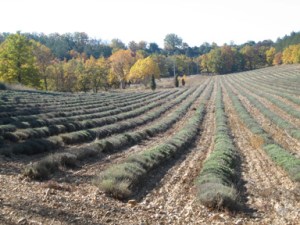
Lavender farm photo.

Lavender farm at
Soeurs Coopératrices Maison St Joseph.

Creek Chincultik

Creek Chincultik
©2010 Carla Woody
First oil painting after a 12-year hiatus.

Honoring the Process

I’m going to come full circle and talk a little about painting. I’m an artist, using mostly oils as my medium. During my lifetime, I periodically took a hiatus from that art form for various reasons. The last rationale was because I moved cross country and no longer had a studio—or so I told myself. I took up black and white photography for several years, but found it not as tactilely satisfying. For a long time, my friend and spiritual mentor Don Américo Yábar had been urging me to paint again and said it would be quite different than what I’d done before. I thought he meant that my subject matter and style would be esoteric based on my experiences in the last number of years. In the fall of 2009, after a 12-year pause, I began to paint again. It just seemed right somehow, without Don Américo ever mentioning it at all when I had been in Peru that summer. And I discovered what he may have meant—however else my canvases may eventually develop. When I was much younger I painted fast and furious, always with a goal in mind, turning out a completed work typically in somewhere between 4-8 hours. Now I’m painting on the same canvas for weeks, sometimes longer. Quite content in the process, I’m allowing the colors to emerge and what expression is more deeply inside me. Perhaps I’m becoming like the older vine Matthieu talked about. Not quite the elder and I’m not yet holding it all inside. Too much to discover still!

But I think what I’ve learned over the years, that is coming out in my painting, and what was echoed through the people we engaged with in Provence, is this. There’s great value to immersion in the integrity of a process. Then the quality of the outcome is naturally delivered. I’ve been taught patience for things to come to fruition. Some things need to happen for others to evolve. When you know this at a visceral level, it brings that joie de vivre written so plainly on the faces of those who live through that understanding like Sister Marie Michelle and Matthieu. It also takes faith—and sometimes more than a little stamina.

*******************

*Édouard Manet turned the French art world upside down with his controversial painting Le Déjeuner sur l’herbe. Pablo Picasso later did his own versions of Luncheon on the Grass.

View information about our October 2013 “La Source de Provence” program here. Limited to 7 travelers.
Categories: Creativity Strategies, Spiritual Evolution, Spiritual Travel, Visual Arts | Tags: , , , , | 2 Comments

Blog at WordPress.com.