Visual Arts

Film Review: Séraphine

SeraphineTreeofLife

Tree of Life ­­- Séraphine Louis, 1928

Séraphine Louis, also known as Séraphine de Senlis, is the subject of this intense biopic—both inspirational and tragic—of a relatively unknown but brilliant artist who teetered between one reality and another. Her paintings were the product of creative and spiritual rapture, induced by spirits, and her love for nature. She was employed as a housekeeper doing the most menial labor and thought by the people around her to be quite odd and slow. But at night she disappeared into another world and turned out extraordinary works using pigments she made herself from unusual sources.

Her break came when Wilhelm Uhde, German art dealer and critic, saw a painting at his neighbor’s home and was astounded to discover that it had been done by his cleaning lady. At a time when avant garde artists such as Picasso and Rousseau were coming on the scene, Uhde became Séraphine’s sponsor encouraging her and finally including her in a show that he organized of the Sacred Heart Painters. Sadly, his patronage would come to an end with the advent of World War II. Séraphine became increasingly isolated and was finally committed to a hospital for the mentally ill. She passed in 1942.

Few of her paintings survive but some may be viewed here. This is the story of a woman who found deep meaning in life and was unusually resourceful, even in the face of periodic ridicule and little support, save one person who proved to be her angel.

This haunting film was a sleeper when it came out in 2009 but later won seven French Academy Awards. Streaming on Amazon. In French with subtitles. Yolande Moreau stars as Séraphine. Film directed by Martin Provost and co-written with Marc Abdelnour.

Categories: cultural interests, Film Review, Visual Arts | Tags: , , , | Leave a comment

Acts of Creation

A few years ago, I was in the Musée d’Orsay in Paris and copied these words from a plaque on the wall in one of the many rooms that contained art works from the mid-1800s through the early 1900s.

A young painter asked Gaugin for advice and he answered, ‘Do not paint too much from nature. Art is an abstraction; extract it from nature while dreaming in front of it and pay more attention to the act of creation than to the result.’ 

Reminders

Cézanne's refuge on Ste. Victoire mountain.

Cézanne’s refuge on Ste. Victoire mountain.

Paul Gaugin’s words punctuated, for me, similar reminders coming over the course of travels in Provence with my group, which then culminated in Paris. As always, those things that stand out to us are what we’re there to encounter. This theme was mine to hear and one that is still prevalent in pockets of France, especially Provence.

Mont Ste. Victoire is a hulking giant of a mountain dominating the Provençal landscape. Post-Impressionist artist Paul Cézanne was fascinated with it. Painting it numerous times, he even had a refuge near the top, to the point we hiked and picnicked having our own luncheon on the grass painters Manet and Picasso might have found acceptable.*

Near Ste. Victoire’s base sits Mas de Cadenet, a winery that has been in the same family since 1813 producing exquisite examples of Côtes de Provence. We stopped by and Matthieu Négrel was waiting for us.

For such a young man, Matthieu was quite the inspiration. Only 25 at that time, he was set to take on a large role when his father retires. Indeed, he had already stepped into sharing many of the important decisions about cultivation of the vineyard and wine-making. We even had a discussion about what it was like to have such a family legacy and the expectations that may come with it, whether it was a harness or a sort of freedom. For Matthieu, it was obvious that he had found his passion early on—and it rested in the land, rhythms of nature, things tended with care, patience. He seemed to contain a distinct knowledge of his place in the world, rare for someone his age. With unabashed charm and a lot of gesturing typical of the region, he exuberantly related fact and philosophy about grapes and wine-making. We were not bored and much of what he relayed was done through metaphor. Matthieu and his family produce wine from vines that range from 35 to 50 years old.

Photo: Making Christmas Wine

Matthieu Négrel making Christmas wine in the old way.

Standing in the vineyard, with Ste. Victoire as the backdrop, he told us about his life. How it was to plant a vine and wait—to harvest only after 5 years. Pointing out a vine planted when his grandfather was a young man and then another planted when he himself was a child, he laughed and said, “Things are very s-l-o-o-o-w here in Provence.”

Then he went on, “In Provence they say, when the vine is young it produces much. But the quality is medium. When older it produces less but the quality is much better. Ahhhh…but when it is the oldest it’s very wise and it holds it all inside and it gives out very little!”

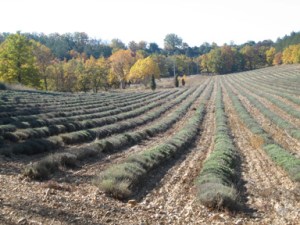
On another day we traveled through the beautiful countryside on winding roads, climbing in elevation and finally came to a Religious House with lavender fields surrounding it. Tucked away in the Alpes de Haute Provence region, discreetly out of sight, three sisters of the Soeurs Coopératrices Maison St Joseph live in an old farmhouse. They are known for cultivating lavandan, a prized type of lavender only grown at this particular altitude, producing the highest medicinal quality essential oil, in the old way, mostly by hand and not technology. Sister Marie Michelle, who greeted us, had a similar glow about her as the one Matthieu had, but many, many more years.

Sister Marie Michelle

Sister Marie Michelle

She showed us their fields and, even though it was late in the season, we could smell lavender faintly in the air. She talked about how they carefully harvested and let the blossoms lay in the sun a certain amount of time so that the oils they made would be at the best strength for all the ways they could be used. She bemoaned the fact that other lavender farmers used machinery that cut the stalks in such a way as to lessen the quality and then didn’t allow them to “strengthen” in the sun after harvest as needed. It was all done quickly, cut and dried—so to speak. And she was quite clear that what sold as lavender essential oils in the world market was lavandin, having much lesser properties, and not lavandan. I was curious how three elderly sisters managed all the fields and harvest until she told us that people from the local community helped. When the sisters are gone, will this art become lost?

Lavender farm photo.

Lavender farm at
Soeurs Coopératrices Maison St Joseph.

Creek Chincultik

Creek Chincultik
©2010 Carla Woody
First oil painting after a 12-year hiatus.

Honoring the Process

I’m going to come full circle and talk a little about painting. I’m an artist, using mostly oils as my medium. During my lifetime, I periodically took a hiatus from that art form for various reasons. The last rationale was because I moved cross country and no longer had a studio—or so I told myself. I took up black and white photography for several years, but found it not as tactilely satisfying. For a long time, my friend and spiritual mentor Don Américo Yábar had been urging me to paint again and said it would be quite different than what I’d done before. I thought he meant that my subject matter and style would be esoteric based on my experiences in the last number of years. In the fall of 2009, after a 12-year pause, I began to paint again. It just seemed right somehow, without Don Américo ever mentioning it at all when I had been in Peru that summer. And I discovered what he may have meant—however else my canvases may eventually develop. When I was much younger I painted fast and furious, always with a goal in mind, turning out a completed work typically in somewhere between 4-8 hours. Now I’m painting on the same canvas for weeks, sometimes longer. Quite content in the process, I’m allowing the colors to emerge and what expression is more deeply inside me. Perhaps I’m becoming like the older vine Matthieu talked about. Not quite the elder and I’m not yet holding it all inside. Too much to discover still!

But I think what I’ve learned over the years, that is coming out in my painting, and what was echoed through the people we engaged with in Provence, is this. There’s great value to immersion in the integrity of a process. Then the quality of the outcome is naturally delivered. I’ve been taught patience for things to come to fruition. Some things need to happen for others to evolve. When you know this at a visceral level, it brings that joie de vivre written so plainly on the faces of those who live through that understanding like Sister Marie Michelle and Matthieu. It also takes faith—and sometimes more than a little stamina.

*******************

*Édouard Manet turned the French art world upside down with his controversial painting Le Déjeuner sur l’herbe. Pablo Picasso later did his own versions of Luncheon on the Grass.

View information about our October 2013 “La Source de Provence” program here. Limited to 7 travelers.

Categories: Creativity Strategies, Spiritual Evolution, Spiritual Travel, Visual Arts | Tags: , , , , | 2 Comments

Book Review: The Painter from Shanghai

painter_from_shanghai

By Jennifer Cody Epstein

I’m always attracted by novels with a backdrop of art, controversial times and exotic locales and quickly became engrossed in The Painter from Shanghai. Only at the end did I realize the central character and many of the supporting ones actually lived. The times were dangerous and the daring commitment of those chronicled in the book’s pages is penetrating.

The author has written a fictional account of Pan Yuliang, a Chinese artist often known in her own country as the “Famous Western-Style Woman Painter”—a title she abhorred because it noted her gender. As a young girl in the early 1900s she was sold to a brothel by her uncle. This is the story of her origins and how she managed to leave that life to enter the world of art, something unheard of in those times, to become a well-known international artist and professor. The reader travels with her from China to Paris to Rome and back to China as she maneuvers between the strong pressures of Chinese tradition, dedication to her art and the political, sometimes deadly upheaval of the 1930s and 1940s. The book provides excellent entertainment as a novel. But it also educates about strict Chinese conventions, some of the heart-breaking practices Chinese women had to endure, and the intersection of Communism and Chiang Kai-shek’s Republicans. Above all it’s about the inner life of an artist and hard choices she makes to adhere to her dream.

Available at Amazon and elsewhere.

Categories: Book Review, Visual Arts | Tags: , , , , | Leave a comment

Spiritual Responsibility? Duty? Cargo?

I’ve been toying with terms to express what I mean and the process I’ve been evolving through in the last year. Responsibility or duty: both have a heavy connotation, not something done freely but something expected.

Within Maya communities there is the “cargo system” still in effect from colonial times. It has to do with civic and religious hierarchical positions, each held for one year. In the Andes, a similar system exists. “Cargo” may be translated as “burden.” Those “carrying cargo” incur expense, the higher the role in the hierarchy, the more monetary investment. In colonial times, the Spanish used the system as a means of control and exploitation. Today, it’s supposed to be a means of mediating wealth and sharing. But in reality, it creates separation. Those who have the most to expend are the ones who rise in community stature. Hence, they have more prestige. This aspect of the construct is quite distasteful to me, not much different than what often exists in western churches.

Going Home ShungopaviOil on canvas depicting Home Dance.©2011 Carla Woody

Going Home Shungopavi
Oil on canvas
depicting Home Dance.
©2011 Carla Woody

Over these last years, I’ve developed friendships with Hopi people who keep the old ways, and learned much about their traditions. Their clan system is complex, each clan and its members carrying separate spiritual responsibilities. Their religious and cultural ceremonies happen monthly according to the cycles of the Hopi calendar. Each ceremony takes up a good portion of each month due to preparation in the kivas and kitchens, aside from the actual dance and closure afterwards. I’ve witnessed the amount of work that goes into them, as well as listened to friends sharing what they can with an outsider. Truly, I marvel how they are able to get anything else done! For those who have chosen to maintain their traditions…it’s a huge investment of time and energy. Many have found it to be too much and put the sacred ways aside to a great degree. Tradition is going to the wayside.

That brings me to my own process. I founded Kenosis Spirit Keepers, as the volunteer-run nonprofit extension of Kenosis, back in 2007. I took that step because I fully believed that the Indigenous wisdom traditions must be valued and supported in a time when powerful influences across the globe sought to devalue and deplete what was life-affirming. Little did I know that my decision would take me on an unexpected, personal odyssey.

Initially, there was abundant support, both financial and sweat equity. We were able to contribute significantly and support community projects in the Peruvian Andes, sponsor intimate meetings between Native spiritual leaders, and eventually began to offer educational outreach in the local community. It was hard work but we could see the positive outcomes that resulted. Those were exciting times. It was exhilarating.

Then the recession hit. Funds dried up and people pulled back and holed up. I found that I was working harder and harder with few outside resources. My commitment to the mission never waivered. But such things eventually take a personal toll on the spirit and physical body.

Finally, a loud internal voice intervened when I was most tired and discouraged, “Why bother? No one out there cares. You’re wasting your time. It’s hopeless.” I’d set the questions aside but they’d return…until the voice became my nearly constant companion. First, you have to understand that it’s normally quite rare for me to have such messages play in my mind. I finally recognized that my internal struggle was a spiritual test.

Maya PrayersOil on canvas depicting the church in San Juan Chamula.©2011 Carla Woody

Maya Prayers
Oil on canvas
depicting the church in San Juan Chamula.
©2011 Carla Woody

Something happened last January during my spiritual travel program in Chiapas, Mexico that shifted my perspective. During “free time” I’d gone to the Maya church in the traditional village of San Juan Chamula, taking those with me who wanted to return. Every year I spend as much time as I can in this powerful place where the very air vibrates with energy. A few days prior we’d been there for the Festival of San Sebastián, during which the statues of the saints, wearing layers of robes, are taken out of their glass cases and carried on the shoulders of cargo holders in a processional in the main square.  When we returned, the saints had not yet been returned to the glass cases that lined the walls. Maya men were removing the outer layers of vestments on the saints and carefully putting them away in special wooden trunks that would later be stored and protected in individual homes.

I stood watching a few feet from a table where Saints Lucia and Martha were resting. Maya women sat on the floor alternately talking with each other and chanting in unison. Candles were everywhere; pine boughs covered the floor; copal smoke was thick in the air. It was magical in the sense that deep reverence can be. I looked at Saint Martha’s painted eyes—and they suddenly seemed to come alive and gaze deeply into mine. I felt penetrated as though some sort of transmission had taken place.

Then one of the men motioned to another who then approached the table. Very carefully, he lifted Saint Martha in his arms and slowly walked over to her case against the wall. But before he placed her inside, he paused.

And then he danced with her, a beatific expression on his face.

My breath caught and my eyes filled with tears. Such a display cannot be from a “burden” one carries, but directly from the heart. Since then I find that each time I share what I witnessed, tears come again. I continue to be moved and the memory has rooted itself within me for purpose, I believe.

A few weekends ago we were privileged to host Hopi Spirit Keepers Harold and Charlene Joseph for our Series here in Prescott. Some aspects they shared had to do with the involved process of Hopi weddings, their ceremonial cycles and community participation. People were touched, to the point that one participant later told me she had no words. Afterwards, a friend and I took Harold and Char to dinner.

We discussed the “Why bother?” questions that had been haunting me, although less frequently in the last months. Surprisingly, those questions were common to all of us sharing that meal. Yet, we all persevere because the core element of spiritual belief and service is implanted somehow in our DNA.

So after all the months of testing—mental angst, physical exhaustion and spiritual inquiry—I’ve returned again to one central theme that I learned years ago in the Andes: ayni, or sacred reciprocity. That’s the term I was looking for; it was under my nose all along. I even wrote about it again in recent blog posts! But I’m revisiting the meaning in a different way.

This is what I’ve re-learned so far:

—    Such ways of being are the invisible strands that hold the world together;

—    It’s possible to operate within a construct that is riddled with shortcomings and still hold pure intent;

—    Intangible things that you value spiritually are worth the hard work, sometimes requiring a lot of faith;

—    Strike a balance in all things;

—    Touch just one person and it touches others;

—    Ask for help; some things take a community.
Categories: Healthy Living, Hopi, Indigenous Wisdom, Maya, Personal Growth, Sacred Reciprocity, Spiritual Evolution, Spiritual Travel, Visual Arts | Tags: , , , , , , , , | 4 Comments

Sculpting a Life

I just completed a three-day workshop at the Mountain Artists Guild with artist Mary Schulte exploring papier mache and concrete sculpture. Sculpture isn’t something I’d done before; I’d never been attracted or even curious. But I met Mary and saw her exquisite papier mache giraffes in June at the “Arte Natura” artists’ reception at the Prescott Center for the Arts Gallery where my own artwork was also exhibited. And something pulled at me; I was intrigued.

Papier Mache Horse

My first attempt at papier mache: a whimsical horse with twigs for legs and straw for mane and tail.

Close-up of horse

Her gentle soul emerged.

That “something” had been running under my skin for a while urging me to move out of the status quo. I long ago learned that when I get a solid internal signal I follow it—even though all the “whys” are unclear. And if the usual excuses of “not enough” time…money…you name it…jump up especially strong then I acknowledge the excuse but set it aside; I’m then certain I’m on the right track. I just follow my initial intuition because…I also learned something else many years ago. The part of me that seeks to maintain the comfort zone gets quite vocal when familiarity is threatened.

In her introduction Mary talked about the types of sculpting. You can carve away like you would with marble or wood. Or you can hand build, adding layer by layer, as in the case of the media we would use. Over the next three days we students—none of us having done anything like it before—engaged in a joint journey of discovery with Mary as our skilled guide.

We students agreed on several things:

  • Undertaking the exploration was exhilarating and fun;
  • There’s focused attention to learning;
  • One medium was easier than the other;
  • Just because one took more learning didn’t mean we’d rule it out;
  • Having a guide who knows the territory saves a ton of angst and wasted time;
  • Even though we did similar things, we each had our own unique signature;
  • By deciding to undertake even this small journey it instilled options and a further sense of freedom.
Concrete Raven

This bird was as feisty as the concrete medium. He became more raven-like as he emerged, grew claws and perched on a wooden branch.

Ultimately, you can look at everything you do for cues as to your own growth. The important thing is to be active. Get out of your comfort zone. Stretch yourself. Otherwise, you relegate yourself to a ho-hum life.

By virtue of its definition, personal growth requires you to carve away what no longer fits or serves you; and to add what does and build upon it.

For me, I learned that my other art capabilities are transferable to an area I hadn’t even considered. And those three days were well spent. Aside from learning a new skill I could add into my body of resources, it did something even more important. It served to open a doorway and leverage evolution—giving a clear announcement to myself that I’m on the move. Permission granted.

***

If you’d like to know more about Mary Schulte’s artwork or when she’ll offer workshops, contact her at vam@cableone.net. I recommend it!

Categories: Arts, Creativity Strategies, Personal Growth, Spiritual Evolution, Visual Arts | Tags: , , , , , , , | Leave a comment

Blog at WordPress.com.