Spiritual Travel

Documentary Review – Peru: A League of Their Own

This inspiring documentary short by Rodrigo Vazquez is a true look at Quechua gender roles and the devastating effect of natural disasters in Peru. It tells the story of a young woman named Juana in the village of Churubamba, located in the Cusco region, who took an unprecedented step outside roles traditional for a Quechua woman. She organized a women’s soccer team, which served as a model that spread across a number of the communities. The teams weren’t only about soccer but also served as a forum for the women to talk about their problems and band together to work for the benefit of all their families.

In the village of Kalla Rayan, a young woman named Felicitas gained entry into meetings reserved for men where she was voted as representative, along with the community president, for a special mission. The two were to find their way to Lima and, with no introduction, seek an audience with the next president to seek aid for the devastation wrought on their village by the floods.

It shows what can happen when any of us take a step off the beaten path. In this film, the starting point was one woman who wanted to play soccer, something taken up by some of the women in other communities and became huge; introduced more equality and potentially has saved one village. It reminds us to follow our dreams and trust the path where it leads – even if we can’t see beyond the next footfall.

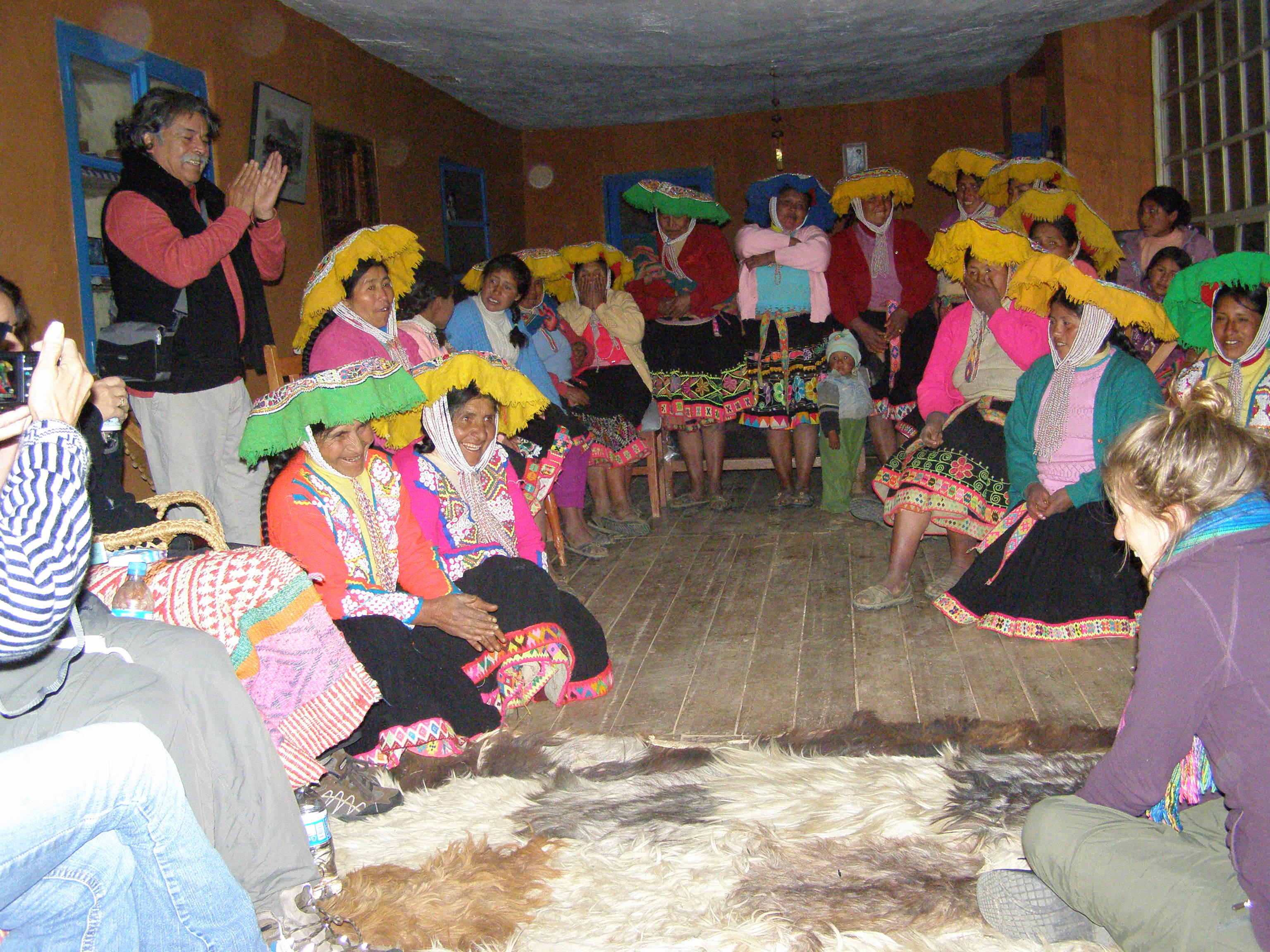
Mollamarka Women Singers

Mollamarka women singers inside Salk’awasi, the ancestral home of Don Americo Yabar.
Photo courtesy of Mark Jericevic.

On another note, the landscape and villages in the film looked so familiar to me that I did a double-take as I watched. I must have traveled through some of the very same areas on my way to Mollamarka for so many years during our Heart of the Andes program.

Film length is 25 minutes. View for free via Karma Tube: Peru: A League of Their Own .

Categories: cultural interests, Film Review, Indigenous Rights, Spiritual Travel | Tags: , , , | Leave a comment

When Hopi Spirits Come to Life: Home Dance at Moenkopi

In July 2009 I was invited by Harold and Char Joseph to Home Dance, the first one in the Hopi village of Moenkopi in 50 years—a very historic event. It’s during this July dance ritual that the Katsina spirits are ushered back to the San Francisco Peaks, the mountain range north of Flagstaff, Arizona, where they live until their return to Hopi in February of each year.*

A friend and I arrived at Moenkopi village outside Tuba City just before dawn. Harold was already leaving home. Moenkopi being Char’s home village, Harold acted as a helper. Normally Harold would have been at Second Mesa’s Shungopavi, already a long time in the kiva, a subterranean chamber reserved for religious rituals, engaged in ceremony in his home village. But this time being quite special he was lending a hand the way relatives do.

The previous night we’d ventured down to the plaza with other family members, carrying chairs, staking out a place in one of several rows already formed. The dirt plaza was long and narrow, enclosed by the original stone homes dating back to the 1870s. I felt like I’d stepped back to another era.

Going Home Shungopavi

Going Home Shungopavi
Oil on canvas
depicting Home Dance.
©2011 Carla Woody

That early morning we sat at the edge of the village with others who had gathered, high on the bluff overlooking the lush cornfields below, a sharp contrast to the red rock cliffs surrounding them. I only discovered later that we actually perched on a kiva. An elder came and asked everyone to move. He slid the wood covering over to reveal its secret and climbed down.

We waited, slightly chilled by the light wind. Glancing around me, some of the people were in special dress, the women in beautiful shawls, and a few young girls wore the traditional hairstyle with fluted buns over each ear. There was a low buzz of conversation and greetings. Everyone waited patiently for the sunlight to hit the cornfields below. A number of pick-up trucks were parked to the side of the fields. In my mind, I converted them to horses. A sound was on the breeze that led me into another time and dimension.

At first it was faint but then it grew, rising up as though from the bowels of the earth. A chant that rose and fell, coming from an area of trees near the field. Those around me went quiet in anticipation, eyes glued, fingers pointing. And finally when the light hit the field just so, Katsinam emerged from the copse forming a single line as they began the slow walk up to the village, carrying cornstalks. It seemed like the line had no end. Finally, all Katsinam came into full view from the woods. They numbered 130, give or take.

As we shifted to our seats at the far end of the plaza, Katsinam poured in one-by-one, forming an ellipsis, continuing the chant, making the small repetitive movements that created the dance, virtually right in front of us. The sound of bells and rattles, strapped to each knee, accompanied each step and joined the drone of their voices. Even though sun now heated the air, I got chicken skin.

They gave cornstalks, a symbol of prosperity, to those watching and gifts of fruit and piki, a paper-thin rolled tortilla made from blue corn. The dancing continued. Then it was time for the first round to end. And the Kachinam left the plaza to be sequestered again. They performed at great sacrifice, foregoing food and water in the blistering sun until much later in the day.

But it was now time for the rest of the village to eat. We returned to the Joseph home and feasted on hominy stew and drank strong coffee. When the phone rang, I’d hear them tell the person on the other end, “Come eat!” One of the family members told me, “This is the Hopi way!” Indeed it was. As people poured through the door, they were directed to grab a plate and ladle a good helping.

The Katsinam were to dance eight times that day. Between dances families and friends gathered at homes, many from out of town it being such a special time. Each time food was shared. We were encouraged to nap in the heat of the day—which I did, in a room full of people that felt like family to me even though it was my first time meeting some of them.

How was it that this was the first Home Dance in Moenkopi in 50 years? Many Hopi people have fallen away from the traditions, and the necessary initiations haven’t occurred to support the ceremonies. Shungopavi is the only village that keeps the complete cycle of religious ceremonies unbroken, the elders staunch.

A strong older woman instigated the 2009 Home Dance. Her son was marrying. She wanted to show off the wedding robes of her son’s bride as part of the ritual. Other brides would be able to do the same. Through her commitment the village re-engaged, others coming from elsewhere to support the ceremony, accounting for the large number of Katsinam, a profound example of what determination can do—and for good cause. Traditions take us back to where we began. For my part, an appreciative outsider greatly stirred by the experience, I hope the Home Dance continues in Moenkopi. At this writing, it’s recurred once. That was in 2011.

***
*A Katsina is a spirit being of the Pueblo Tribes, an invisible natural force that can be called upon to bestow protection and wellbeing for the village. Katsinam is the plural form. In the Hopi tradition there are approximately 400 different Katsinam, each one different and having a separate purpose. For days prior to religious dances, initiated males enter the kiva and undertake long rituals. When they emerge from the kiva to dance, they are no longer who they were when they entered. Instead, they are the embodiment of these powerful spirit beings, dancing in human form, on the earth.
***
I will sponsor Spiritual Travel to Hopi: Sacred Guardians of the World during March 6-9, 2014. This is a rare chance to experience Hopi Spirit Keepers in their homes, hear the ancient stories, visit sacred sites, learn about medicine ways and attend the Night Dances, all that weaves the very identity of the Hopi people as guardians of the world. Only recently is it now possible to be invited to such an experience. It’s only through relationships I’ve developed over a number of years that this program has been born. Join us for this adventure of the spirit! Early registration discount ends November 6. A portion of tuition is tax-deductible to support Kenosis Spirit Keepers’ projects preserving Native traditions.
Categories: cultural interests, Hopi, Indigenous Wisdom, Sacred Reciprocity, Spiritual Travel, Travel Experiences | Tags: , , , , , , , | Leave a comment

Book Review – Fleeting Moments of Fierce Clarity: Journal of a New England Poet

Fleeting Moments

L.M. Browning has written a volume about spiritual travel, not in the sense of exotic adventure, but in leaving the familiar inner dwelling, while staying close to home, to discover what is true. She lets the reader know that difficult circumstances accompanied her through much of her young life, alluding to sacrifices and betrayals. But that’s not where she leaves us. The purpose of disclosure is to let us know where she’s been and where she’s come to this point: unstintingly honest having found strength in vulnerability. Gratitude for the small things. Connection to place.

She frequently mentions the Transcendentalists. In reading the poetry and introductory essays, I can easily imagine the author walking by Thoreau’s side around Walden Pond. I’ve traveled to some of the places named. But even if I hadn’t, her use of language makes them immediate. And there’s a feeling sense that speaks to an inner space common to all of usif we choose to know it.

 As I grasped the old wrought doorknobs, I shook hands with the past.

 Celebrations of nature and history are used as vehicles urging toward spiritual travel, to shed what is meaningless and embrace greater freedom. There are examples on every page. I’ve chosen this one, reprinted with permission, to include here.

The Truce


Pluck a strand of wind

And listen to the trees quiver.


Run until your heart pounds

And watch the stagnant surface

Of the pond ripple.


Throw back

The suffocating blankets of false comfort

And let yourself feel the renewal of the rain.


Only when we overcome

Our fear of being along,

Can we come to know the company

That is always with us.


In surrendering, we are cradled.

In accepting, we are able to impart.

In kneeling, we stand taller.


Gather what is worthy of your devotion

And never betray it.


So that, in the end,

You will know that,

Though you be small,

You poured out all that you are

Into what is greater


And in doing so,

Became part of it.

 In this thin volume much is said. You’ll not want to hurry through it but rather take a page or two and linger, much as you might to inform meditation practice. Fleeting Moments of Fierce Clarity has been given the distinction of Finalist, Next Generation Indie Book Awards in the Non-Fiction Regional Category.

Available in trade paperback, e-book and audio formats via Homebound Publications, Amazon and other online or retail bookstores.

Categories: Book Review, Healing, Solitude, Spiritual Evolution, Spiritual Travel | Tags: , , , , | Leave a comment

Spiritual Travel: Destination or Process?

Some years ago I had an inquiry from someone who was interested in the Entering the Maya Mysteries program I was sponsoring; specifically he was enticed by a destination on the itinerary. He’d done a search and I was the only one offering the opportunity. “But,” he said. “I’m not so sure about this ‘spiritual travel’ stuff.”

Curing ritual image

Curing ritual in San Juan Chamula.
Photo: Carla Woody

How to explain something so intangible? In one respect, it contains elements of tangibility: sites and interactions. Invisible to the naked eye, perhaps unanticipated by the mind, are myriad ways to be drawn into the deeper journey that define these potentially uncharted waters—without conscious realization in the moment that you’ve taken the plunge. Hence, enter aspects that: may have no words or audible sound, cannot be held in your hands, your eye can’t get a bead on, can seem ordinary but aren’t. Yet it produces something akin to a lightning strike that splits the rough outer covering and creates an opening, a probable pathway — and a tangible result. There appears a fork in the road inviting decision. It’s not the territory for a faint-hearted tourist but the traveler of a different sort.

I personally welcome those unending layers and outcomes, only bits and pieces of the larger picture solidifying long after closure of the initiation. I’ve had the great fortune, maybe even destiny, to create such organic spaces, through many years’ relationship-building and travel with special intent: being alert to those people and places who offer themselves as powerful conduits. These elements being necessary to push the energy—our energy—to catapult us beyond places that have grown familiar.

My brand of spiritual travel is physically comprised of sacred sites, ceremonies and those who keep the rituals and stories. The travelers who show up to participate equally act as catalysts. An entrainment occurs and each one gains what they need to further the collective and their own journey. And we find out what it’s like to be at play in a field of mirrors: coming face-to-face with aspects that call out for healing and simultaneously create beauty. I personally celebrate it all.

God pot lighting

Lighting the god pots during a
balché ceremony in Najá.
Photo: Carla Woody

The question arises: do you have to travel to experience such initiation? In some form, you do. We are creatures of habit who tend to cling to a mindset that is familiar, even if not particularly healthy. You must be willing to move outside the container: to be fearless, to be open, to explore. You must embody courage to create a wider life. That’s travel.

The fast track requires putting the daily life on pause and dropping yourself into an unfamiliar environment to rediscover what you forgot. When people gather with this common intent, magic happens. They give themselves permission to explore parts of themselves they’re not so in touch with. Add exposure to Native peoples who inherit a sense of the sacred as an integral aspect of life—and a landscape of possibility appears.

When that happens it leaves an indelible impression and shifts who you are in the world. I frequently face a challenge finding words to express the profound value of the intangible elements running through the lifework I’ve chosen. I currently live in a culture that values the immediate result while ignoring the process that’s all-important in creating something of deep meaning that endures. My sense is that if we’re able to finally find comfort floating in the abyss, it will produce all that’s ever needed–beyond what we could imagine. But it takes travel. I’ll leave you with this quote from A Million Miles in a Thousand Years by Donald Miller:

And once you live a good story, you get a taste for a kind of meaning in life; and you can’t go back to being normal; you can’t go back to the meaningless scenes stitched together by the forgettable thread of wasted time.

*********************
Author’s note: Those years ago I must have found the right words. I’m happy to report that the man concerned about the “spiritual travel” stuff has since traveled with me twice. And even more importantly, in the process, we’ve become friends.

For information on our upcoming “Entering the Maya Mysteries” programs, go here. For other spiritual travel destinations, go here. A portion of tuitions are donated to Kenosis Spirit Keepers for projects that help preserve Indigenous wisdom traditions.

To view other stories on the subject of “Journey” go to the Daily Prompt.

Categories: Energy Healing, Indigenous Wisdom, Lacandón Maya, Maya, Spiritual Evolution, Spiritual Travel | Tags: , , , , , | 5 Comments

Respite


I take daily respite in the morning. It’s my habit to arise quite early, usually before the sun is up, and sit cross-legged facing the east, to the hills just across the way, above the preserved land below my home. Then I go into meditation. I no longer use any technique as I did years ago. Going into meditation became automatic. The energy and stillness just arrive. When the sun comes up over the hills I know it immediately, not only from the strong light that plays against my eyelids, but also because the sun’s vibration is palpable, adding to what I was already experiencing on my own.

For more than thirty years, I’ve started my day this way, in different homes through time but essentially the same process. The fruits of this ritual are potent. It sets the tone for my day; it’s a benefit to my health; insights and guidance are offered: something explained, inspiration given, direction that becomes evident. But most importantly perhaps is the feeling of Presence, a sense of the sacred.

Hoodoos

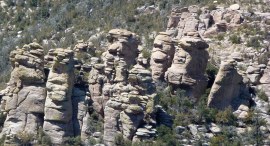
Hoodoos, Mt. Lemmon

I have another respite that I’ve come, over the past few years, to treasure equally, with the same benefits. It’s turned into a habit as well. Every several weeks, five women convene at a home to share a meal and deep communication. I am one of them. We come from different walks of life, life stages and range of experiences and talents. Not all of us even knew the others when we began to gather. Yet we are a homogenous group in that we all seek the same thing: a safe haven where we can let our hair down, talk about tough nuggets we encounter, explore new ideas and celebrate each other. I think I can speak for all of those involved in saying: We’ve become significant to each other, a family of choice.

Santa Catalinas

Santa Catalinas

Salad Nicoise

Salad Nicoise with seared ahi with thanks to our gourmet chef who has mastered champagne camping.

Two years ago, we added an annual camping trip. I have to laugh because we have different ideas of what camping is and the activities involved. But we came to consensus, and this days-long respite has become paramount, too. Last year we camped in the Manti-La Sal National Forest in southeastern Utah. Two weeks ago we were in the Catalinas north of Tucson. We were early this year, and those of us in tents, rather than the camper, froze some nights. Indeed, when I got up at 5 a.m. there was frost blanketing the outside of my tent. But the sun came up. The coffee was hot and the conversation warm. As normal, we undertook our individual pursuits—reading, napping, hiking in quiet places and birdwatching, writing, one-on-one time—and gathering as a group for meals or when we felt like it for deep conversation. It’s fully free and easy.

It was to this group I entrusted the initial reading of my forthcoming novel Portals to the Vision Serpent, to test the flow and story. Any author will understand what it is to let others view their work at that early stage. I knew I could let them hold my fragile newborn, and they would make it dear and be honest. I made changes based on their feedback.

 So, I also knew that I could test an idea I have for the next novel with them. I’ve been mulling it over for the past few years, bits and pieces coming to me over time. It’s fairly complex and pushes the boundaries of a religious doctrine. Right before our camping trip somehow I stumbled upon an actual person who may serve as the inspiration for the main character. It finally seemed time to share, even though the framework wasn’t fully formed. I was grateful I had their full attention.  After listening to my somewhat disjointed dissertation, they agreed the idea had sturdy legs. Now I’m further inspired.

I’ll end here by relating what I’ve learned to be true:

       Daily respite enriches life and is a necessity to mine;

       Gathering regularly with intended community encourages risk-taking, provides comfort and is a sacred respite in itself;

       Even though I live in a wilderness area where silence prevails, leaving home and work for retreat invites further Presence into my life.

This post is dedicated to my Moon Sistars.

Categories: Compassionate Communication, Healthy Living, Meditation, Sacred Reciprocity, Solitude, Spiritual Evolution, Spiritual Travel, The Writing Life | Tags: , , , | 2 Comments

Playing with Uncertainty

Do you remember what it was like to be a young child when everything was new? Being awestruck by all that you saw, heard and felt? Did you pick things up and examine them closely, put them in your mouth? Play—no holds barred? Sing at the top of your lungs just to hear what your voice sounded like?

Mollamarka Girl

Mollamarka Girl
©2003 Carla Woody

As the years unfold, most people become more and more comfortable with certainty—and forget to have the fresh perspective of a child. In fact, the older we are, the more afraid we are likely to be of uncertainty and even become stuck when something unforeseen happens. Paralysis occurs when we are fans of control.

But when spiritual evolution sends a calling card, if we acknowledge the invitation and accept, what we’re asking of ourselves is to let go. At that point, we find ourselves at a threshold, an urging at our back to move through it. Perhaps little may be seen in that beyond place, maybe nothing. Yet embracing the unknown is how we learn and grow.

Metaprograms and Change

 From NLP, metaprograms define how we individually sort information and guide our thought process. Metaprograms predict our behaviors. Note that metaprograms often differ depending on context—relationship, work, etc.—and are a complex mix but easily determined through language patterns. All metaprograms are useful in some context and can be shifted if the orientation is causing an issue.

I’m going to zero in on a couple of metaprograms that I find have a lot to do with how we deal with change—and good to know if we’re contemplating transition. Below is a very brief summary that discusses the outer limits of a range. Most people have some mixture of both.

Toward/Away from: People with a “toward” orientation have their eyes locked on a goal—and go for it. They have blinders on and anticipate the pleasure of having what they want. Those with an “away from” orientation are focused on what they don’t want and avoiding pain. When asked what they want…they often have no idea.

Options/Procedures: People with an “options” mind set are excited by alternatives and possibilities. They love to explore and may do so endlessly. Those with a “procedures” orientation tend to think in black and white terms and love doing things step-by-step to completion. If the procedure is interrupted, they usually grind to a halt.

The Trapeze of Spiritual Travel

It’s natural for all of us to settle into a lifestyle over time and incur aspects of life that become familiar, whether they truly serve us or not. When we choose to “Enter the Forest” beyond the threshold, it involves uncertainty—stepping outside the environment that we’re used to—where we know what to expect, at least most of the time, of ourselves and others. It’s predictable. Those who will have the most emotional difficulty when faced with upheaval will be folks with paired, outer limit “away from” and “procedures” metaprograms.  On the other side, those with paired, radical “toward” and “options” metaprograms may love the journey but have a challenge coming to a place of right fit and new-found foundation.

Danaan Parry’s parable “The Trapeze” really speaks to the balance between control and letting go in order to catch the next swing of the trapeze.

“The Trapeze” video on You Tube.

 There’s also the need to invoke early childhood qualities we may have forgotten: curiosity, appreciation, courage and finally, discernment to determine what truly tastes and feels good. That way we discover what further nurtures us.

The process can be a truly mystical one if we allow it. We will be delivered to the other side, indeed, transformed on the way. And in the midst of letting go we can play with uncertainty—as an ally. We can trust in an age-old process, one learned well by high wire artists and children.

 This is a form of spiritual travel.

***

 Drawn from Navigating Your Lifepath, the six-month mentoring program.

Categories: Healing, Healthy Living, Personal Growth, Spiritual Evolution, Spiritual Travel | Tags: , , , , , , | Leave a comment

Lifepath Dialogues Gathering: The Spiritual Meaning of Lineage (Audio)

Lifepath Dialogue Gathering

The Lifepath Dialogues Gathering is held on the fourth Wednesdays, 6:30-8 PM, at Creekside Center in Prescott, Arizona. The intent is to build like-hearted community and dialogue about what truly matters. I choose monthly topics from my blog and host the evening with special invited guest(s) whose philosophies and work are relevant to the topic. The format involves my presentation of material to create a framework and interview of the special guests. This portion is recorded to share with the world community—wherever you are. Then we turn off the recorder and turn to intimate sharing.

The February 27 Lifepath Dialogues Gathering:

The Spiritual Meaning of Lineage

The complete unedited audio is about 40 minutes long. Click below to listen. Please be patient as it may take a few minutes to download! I hope you enjoy.

 LD02-13

This discussion was based on the post:

Lineage: Calling on the Ancestors
By CARLA WOODY
Author of Calling Our Spirits Home and Standing Stark
Founder, Kenosis and Kenosis Spirit Keepers

SPECIAL FEBRUARY GUEST:

TERRI HANAUER-BRAHM

Terri Hanauer-Brahm wondered why her father refused to discuss his past and why her relatives were the same way. She uncovered a family secret that sent her on an odyssey of discovery. Out of her quest came a book: “The Hanauer Family: Before, During and After the Holocaust.” She will share with us what this journey has meant to her.


Categories: cultural interests, Personal Growth, Spiritual Evolution, Spiritual Travel, Travel Experiences | Tags: , , , , | Leave a comment

Acts of Creation

A few years ago, I was in the Musée d’Orsay in Paris and copied these words from a plaque on the wall in one of the many rooms that contained art works from the mid-1800s through the early 1900s.

A young painter asked Gaugin for advice and he answered, ‘Do not paint too much from nature. Art is an abstraction; extract it from nature while dreaming in front of it and pay more attention to the act of creation than to the result.’ 

Reminders
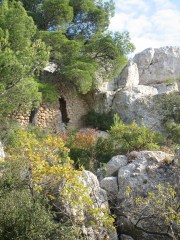
Cézanne's refuge on Ste. Victoire mountain.

Cézanne’s refuge on Ste. Victoire mountain.

Paul Gaugin’s words punctuated, for me, similar reminders coming over the course of travels in Provence with my group, which then culminated in Paris. As always, those things that stand out to us are what we’re there to encounter. This theme was mine to hear and one that is still prevalent in pockets of France, especially Provence.

Mont Ste. Victoire is a hulking giant of a mountain dominating the Provençal landscape. Post-Impressionist artist Paul Cézanne was fascinated with it. Painting it numerous times, he even had a refuge near the top, to the point we hiked and picnicked having our own luncheon on the grass painters Manet and Picasso might have found acceptable.*

Near Ste. Victoire’s base sits Mas de Cadenet, a winery that has been in the same family since 1813 producing exquisite examples of Côtes de Provence. We stopped by and Matthieu Négrel was waiting for us.

For such a young man, Matthieu was quite the inspiration. Only 25 at that time, he was set to take on a large role when his father retires. Indeed, he had already stepped into sharing many of the important decisions about cultivation of the vineyard and wine-making. We even had a discussion about what it was like to have such a family legacy and the expectations that may come with it, whether it was a harness or a sort of freedom. For Matthieu, it was obvious that he had found his passion early on—and it rested in the land, rhythms of nature, things tended with care, patience. He seemed to contain a distinct knowledge of his place in the world, rare for someone his age. With unabashed charm and a lot of gesturing typical of the region, he exuberantly related fact and philosophy about grapes and wine-making. We were not bored and much of what he relayed was done through metaphor. Matthieu and his family produce wine from vines that range from 35 to 50 years old.

Photo: Making Christmas Wine

Matthieu Négrel making Christmas wine in the old way.

Standing in the vineyard, with Ste. Victoire as the backdrop, he told us about his life. How it was to plant a vine and wait—to harvest only after 5 years. Pointing out a vine planted when his grandfather was a young man and then another planted when he himself was a child, he laughed and said, “Things are very s-l-o-o-o-w here in Provence.”

Then he went on, “In Provence they say, when the vine is young it produces much. But the quality is medium. When older it produces less but the quality is much better. Ahhhh…but when it is the oldest it’s very wise and it holds it all inside and it gives out very little!”

On another day we traveled through the beautiful countryside on winding roads, climbing in elevation and finally came to a Religious House with lavender fields surrounding it. Tucked away in the Alpes de Haute Provence region, discreetly out of sight, three sisters of the Soeurs Coopératrices Maison St Joseph live in an old farmhouse. They are known for cultivating lavandan, a prized type of lavender only grown at this particular altitude, producing the highest medicinal quality essential oil, in the old way, mostly by hand and not technology. Sister Marie Michelle, who greeted us, had a similar glow about her as the one Matthieu had, but many, many more years.

Sister Marie Michelle

Sister Marie Michelle

She showed us their fields and, even though it was late in the season, we could smell lavender faintly in the air. She talked about how they carefully harvested and let the blossoms lay in the sun a certain amount of time so that the oils they made would be at the best strength for all the ways they could be used. She bemoaned the fact that other lavender farmers used machinery that cut the stalks in such a way as to lessen the quality and then didn’t allow them to “strengthen” in the sun after harvest as needed. It was all done quickly, cut and dried—so to speak. And she was quite clear that what sold as lavender essential oils in the world market was lavandin, having much lesser properties, and not lavandan. I was curious how three elderly sisters managed all the fields and harvest until she told us that people from the local community helped. When the sisters are gone, will this art become lost?
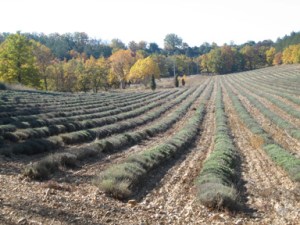
Lavender farm photo.

Lavender farm at
Soeurs Coopératrices Maison St Joseph.

Creek Chincultik

Creek Chincultik
©2010 Carla Woody
First oil painting after a 12-year hiatus.

Honoring the Process

I’m going to come full circle and talk a little about painting. I’m an artist, using mostly oils as my medium. During my lifetime, I periodically took a hiatus from that art form for various reasons. The last rationale was because I moved cross country and no longer had a studio—or so I told myself. I took up black and white photography for several years, but found it not as tactilely satisfying. For a long time, my friend and spiritual mentor Don Américo Yábar had been urging me to paint again and said it would be quite different than what I’d done before. I thought he meant that my subject matter and style would be esoteric based on my experiences in the last number of years. In the fall of 2009, after a 12-year pause, I began to paint again. It just seemed right somehow, without Don Américo ever mentioning it at all when I had been in Peru that summer. And I discovered what he may have meant—however else my canvases may eventually develop. When I was much younger I painted fast and furious, always with a goal in mind, turning out a completed work typically in somewhere between 4-8 hours. Now I’m painting on the same canvas for weeks, sometimes longer. Quite content in the process, I’m allowing the colors to emerge and what expression is more deeply inside me. Perhaps I’m becoming like the older vine Matthieu talked about. Not quite the elder and I’m not yet holding it all inside. Too much to discover still!

But I think what I’ve learned over the years, that is coming out in my painting, and what was echoed through the people we engaged with in Provence, is this. There’s great value to immersion in the integrity of a process. Then the quality of the outcome is naturally delivered. I’ve been taught patience for things to come to fruition. Some things need to happen for others to evolve. When you know this at a visceral level, it brings that joie de vivre written so plainly on the faces of those who live through that understanding like Sister Marie Michelle and Matthieu. It also takes faith—and sometimes more than a little stamina.

*******************

*Édouard Manet turned the French art world upside down with his controversial painting Le Déjeuner sur l’herbe. Pablo Picasso later did his own versions of Luncheon on the Grass.

View information about our October 2013 “La Source de Provence” program here. Limited to 7 travelers.
Categories: Creativity Strategies, Spiritual Evolution, Spiritual Travel, Visual Arts | Tags: , , , , | 2 Comments

Book Review – The Drum Wars: A Modern Maya Story

The Drum Wars: A Modern Maya Story

By Carol Karasik

Drum Wars Cover ImageIn the 1990s, a friend and I were walking on the road to the Palenque ruins. We noticed a narrow dirt road that led into the rainforest. Curious, we followed it and came to an enclave containing ramshackle treehouses—one with a sign that said “Yoga”—and a camping area. We looked at each other and said, “What is this place?” We had stumbled upon El Panchan in its beginnings. Since then it’s grown considerably to a mishmash of cabanas, camping, a couple of competing open-air restaurants with live music, culminating with late-night fire dancers and drumming.

Now all these years later, as part of our annual “Entering Maya Mysteries” pilgrimage, lodging at the Panchan has become a tradition for its close proximity to the ruins—but maybe even more so for its out-of-time, otherworldly value all its own. A year ago, my group sat in Don Mucho’s Restaurant eating tasty cuisine, watching odd characters wander by, listening to live Salsa music, when one of the travelers turned to me and said, “This is like being in a movie!” He had a look of wonder on his face. Just this past January, another traveler looked around and pronounced, “Surreal!” That said even though the day was still quite young.

Carol Karasik has written a historical adventure, an enthralling ride, about a dysfunctional family dynasty, seekers of the unknown and unknowable, and the ancient land and people who issued a calling card to the crossroads called El Panchan. The Drums Wars is an entertaining story that is stranger-than-life, but true. With wry humor, Karasik recounts the origins and intrigues of the residents and transients of this jungle community, grown up near the Maya ruin of Palenque. The gritty, often tedious work, of archeologists, and those of similar eke, are chronicled aptly, adding a bit of mysticism, romance and education along the way.  I was particularly taken with the discovery of the Red Queen’s remains, later to be identified as Lady “Conjurer” who was Pakal the Great’s wife—and the important role played by women at Palenque, the place of transformation.

As I read this crazy backstory it occurred to me that by virtue of its proximity to Palenque that, of course, the Ancient Maya world had to inform it. The planets of the Panchan are in continual alignment, merely a mirror, to create a container. Those drawn there are acting out their fantastic journeys into the Underworld, catapult to the Upperworld, and manifest delivery into the bohemian Middleworld called El Panchan.

Howler Photo

Howler Monkey

Whether you’ve been a traveler in my Maya Mysteries programs, or want to enter this curiosity of human condition—taken to the extreme on your own—reading The Drum Wars may point to some explanation of your own journey…or, at the very least, you’ll find it a fascinating read. Available through Amazon.

Categories: Book Review, Maya, Spiritual Travel | Tags: , | 3 Comments

Speaking Truth

I’ve been reviewing some of my archived newsletter content and came across this paragraph I included in my old “Metaphors for Life” column back in 2009. This one bears repeating. Knowing the truth, or backstory, instead of taking something at face value is always a good idea before opening your mouth to speak, particularly when doing so could inadvertently create damage when none is deserved.

The Media Mantra on Coca

Despacho Photo

Despacho, or prayer offering, containing coca leaves.
Photo credit: Peter Coppola.

Several weeks ago while driving into town I was listening to NPR. A BBC correspondent who had been in Bolivia was being interviewed about the political situation there. During the course of the program, he made a side comment that he’d had a problem with altitude sickness. Then in a sneering tone said something to the effect, “You know what they did for it? Brought me coca tea. You know what they use that for!”

The reporter had absolutely no idea what he was talking about, but merely passed on propaganda. If he had bothered to find out what coca is really about, he’d have discovered it’s largely the spiritual and nutritional mainstay of the Quechua culture. Coca in its natural form is not a drug. Nor do they use it as such, but instead in sacred ceremonies and as a food source. The black market for coca, for purposes of processing into cocaine, is only sustained through demand from the USA and Europe. Take care of the issue at home and the black market trade virtually disappears.

By making the statement he did, especially on NPR, the reporter helped spread an assumption that the Quechua people who chew coca must be addicts. Out of ignorance, people often pick up a carefully manufactured mantra meant to further a misguided cause, parrot the message and create more damage.

Categories: Compassionate Communication, cultural interests, Healthy Living, Indigenous Wisdom, Spiritual Travel | Tags: , , , | 1 Comment

Blog at WordPress.com.