Book Review: Indigenous Message on Water

Indigenous Message on Water

In 2012 a call went out from the coalition of Indigenous leaders of the Indigenous World Forum on Water and Peace (IWFWP) to Native elders, writers, artists, activists—Knowledge Keepers—for poetry, art, chants and prayers on Water, expressions from their own traditions. Over the next several months, submissions poured in, pure harvest from tribes all over the world. The You Tube video below beautifully illustrates the intent to pull together an anthology on this life-giving element that would be called Indigenous Message on Water—and why its needed.

By January last year the editors had begun the process to ready contributions for publication. From June through August 2013 an Indiegogo campaign was opened to pull enough funds together to publish the book, in print and e-book formats, and send copies back to the authors to seed their communities and elsewhere with this important message we all need to hear and hold. They were able to raise $5,000 of their $10,000 goal. I was so glad I was able to support this valuable treatise, even in a small way, having received my copy a few weeks ago.

I am deeply touched by the words and art that leap off the pages from the contributors: Chamoru, Pinay and Maori peoples from the Pacific; Sakhe from Russia; Cree, Tsalagi, Cherokee, Yoeme, Anishinaabe, Lakota, Lipan Apache, Metis, and Gitxan from North America; K’iche’, Kaqchikel, and Q’anjob’al from Guatemala; Maya and Nahuatl from Mexico; Wayuu, Palenque and Kuna from the Caribbean; Uitoto, Okaina and Tikuna from Amazonia; and Kichua, Yanakuna and Mapuche-Huilliche from the Andes.

Spiritual connection and gratitude to Water are ever present in the anthology. It may be used to open community discussions, raise awareness, and as an offering. At the beginning of the book, Juan Sánchez, one of the editors, advises that the passages are meant to be read aloud to the Water; words have the capacity to heal. Grandmother Mona Polacca suggests, “…Once you read them, you may find that you can never escape them, or you may find yourself resisting the narratives in this collection, not wanting to deal with the reality they describe; perhaps it reminds us of our own vulnerability…”

Grief for scarcity, strife and loss of life over water rights is also prevalent in these pages. Forest without Destiny by Judith Santoprieto of Mexico is an example, dedicated to the Indigenous people of Bagua in northern Peru who were senselessly murdered by special forces police during a 2009 protest about natural resources rights.

A crackling is heard in the surroundings

of a forest without destiny,

the first sign of the great uproar;

outside, the bullets:

the rainy season yet to come…

***

We can be reminded to embody the teachings offered.

 Water was our first medicine.

—Gideon MacKay, late Cree Elder, Canada

 ***

We’re called to cup Water

carry it carefully   cradle

within bare hands or ladle

wood to pour resplendence

from ama who makes us

human,  holds us here in

memory brings us back

into ourselves each time

we enter dipping seven

times until we become

who we need to be.

—Allison Hedge Coke, Huron/Cherokee/Cree/Metis, USA

 ***

My oldest brother was 115 years old and died because of his age, not because of illness and this longevity was due to the fact that he used to pray to Water. The Water sang to him. For him, Water was both male and female and, as he practiced meditation, Water rewarded him with a long life.

—Lorenzo Aillapán Cayuleo, (Bird Man), Mapuche Nation, Chile

***

The e-book version is available to treasure and consult. You may go here to download for the minimal cost of $7.00. When you do, you’ll know you are serving Water. The proceeds go to support the gathering of Indigenous leaders, over 60 organizations and other like-intended folks for the Indigenous World Forum on Water and Peace 2014 held September 9-13 in New York that collaboratively seeks to resolve issues for the benefit of all peoples.  Read a 2009 collective statement from the United Nations Permanent Forum on Indigenous Issues about the need for the IWFWP. New information will be posted soon on the IWFWP blog. Go here to subscribe for updates.
Categories: Book Review, Compassionate Communication, Gratitude, Healing, Healthy Living, Indigenous Rights, Indigenous Wisdom | Tags: , , , , , , | Leave a comment

Far Vision and the Long Run

Several years ago I heard a program on NPR’s Morning Edition interviewing a former Israeli Army officer about his interactive computer game called PeaceMaker. The game’s setting is the Israeli-Palestinian Conflict. This is what caught my attention: He said it was about “winning peace.”

There are two roles: the Israeli Prime Minister or the Palestinian President. You can even take both sides and play “against” yourself, entering into different worldviews and available resources. Crisis situations inspired by real events are presented for a decision. There are political advisors who try to persuade to their side—hawk or dove. So it’s about decision-making and strategies. But the most interesting thing is that it shows the effect of the decision—and how the impact of that one critical act may play out in the future! Not unlike a process I often take clients through when they’re at some important juncture in their lives.

They did a short demo during the interview. The host chose to play the Israeli Prime Minister. A skirmish popped up. The advisors hovered. What to do? After a bit of indecision, the host decided he’d send in the army in the name of security—the hawk’s advice. It worked…for a moment. Almost immediately red lights lit up in a number of places on the map. His decision had sparked other crises! Then he was presented with the dire conditions Palestinian civilians were suffering as a result of his decision.

What to do? He took the dove’s advice this time and sent aid. But wait. The Palestinians rejected it. They didn’t trust the move. Look what he did just a short time ago. And so it goes…you don’t win in this game, or any other for that matter, unless the outcome is balanced for both sides. The inventor said losing and frustration are part of the lesson.

We have to learn to do it differently—for all concerned—until competition becomes moot. A one-sided gain never works in the long run. It’s really about acquiring far vision, following a decision out to the horizon line as much as we can.

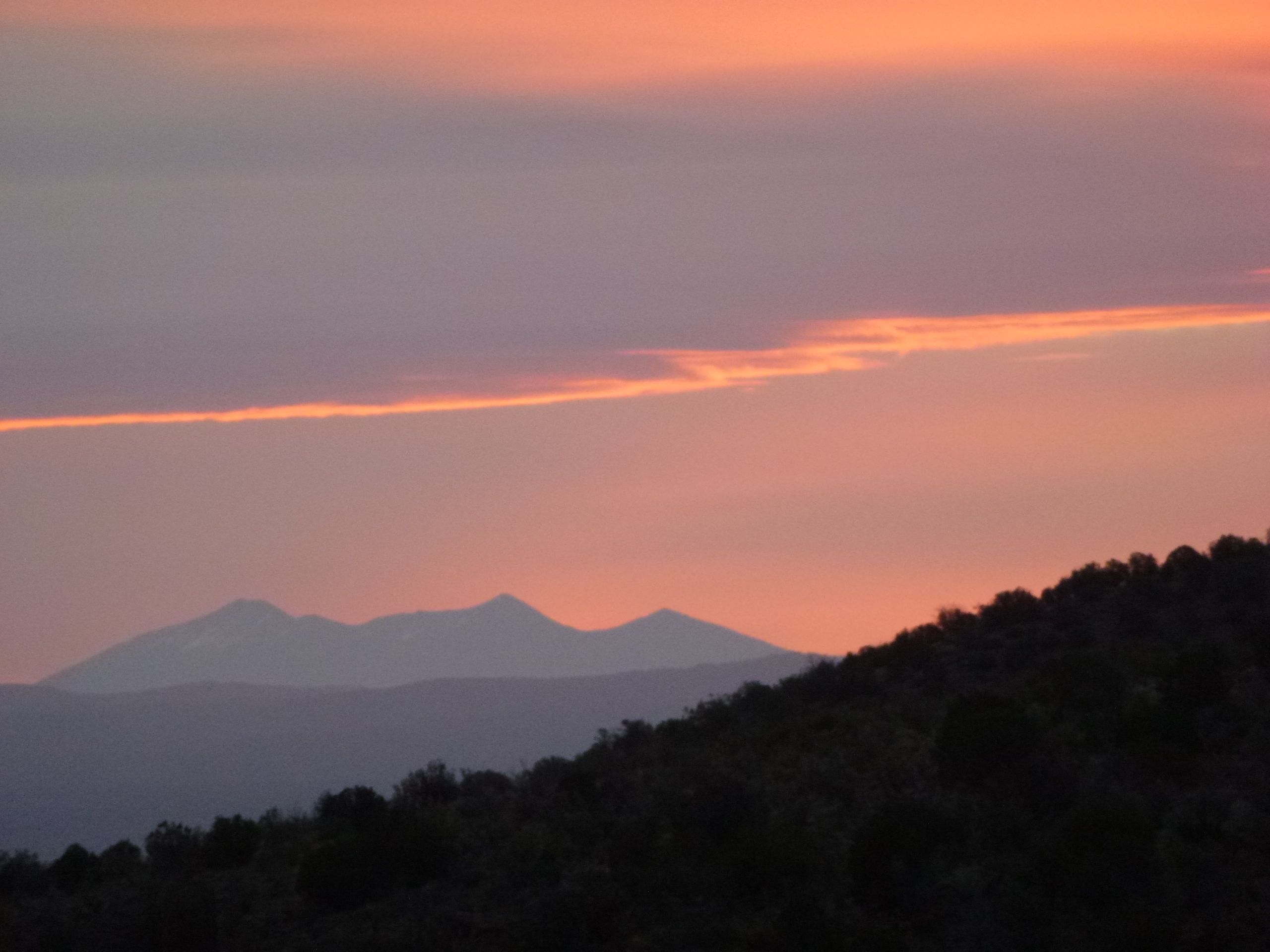
San Francisco Peaks

San Francisco Peaks sacred to the Native people of Arizona. This view from my own sanctuary inspires me to maintain the far vision every day.

In 2009 I was in Santa Fe at a conference put on by the International Funders for Indigenous Peoples Foundation. I heard many stories about outside impacts endangering Native lifeways. A Zuni farmer from Northern Arizona talked about the challenge he was having keeping genetically engineered corn from blowing into his fields and pollinating his Native corn. The result would be stalks that grow higher but are broken by the wind—and the loss of their pure Native strain that had adapted well to the conditions of their land over centuries. For his people it’s not just about loss of crops and food but also loss of heritage, a spiritual connection.

Shortly after returning I saw the documentary The Future of Food, largely about genetically engineered food and its effect, not only on health but heritage, and the absurd greed of large corporations. You see, these corporations have been allowed to patent their seed, a strange practice. There was a story about a farmer in the Midwest who, much like the Zuni farmer, was having trouble with Monsanto Corporation trucks passing on the highway blowing their corn into his fields. His family had developed their heritage corn over a couple of hundred years. He lost the battle. Not only did Monsanto’s corn cross-pollinate, he lost his family heritage in more ways than one. In a bizarre move, Monsanto sued him for patent infringement and won. Had such an outcome crossed the minds of scientists in the Monsanto labs who were developing the product? I’d like to give them the benefit of the doubt but who knows. Since that film came out there have been a number of others with a similar story line.

The examples given here—warring countries, loss of traditions and ways of life—are very big issues. But we can have an impact at the micro level, every day in our own lives, that play into the macro level. Typically we’re untrained. Not many think of wider impact, through time. But if we take the opportunity to project our thoughts and potential actions on down the road and assess the likely outcome, we’d actually find we all have an innate sense of far vision.  We just need to stop, take a breath and then use it.

If you need it, perhaps you can find further inspiration from Neil Young.

***

I’m issuing you an invitation to make a statement for far vision. Participate in our January 31-February 1 Seed Wisdom events in Phoenix. Proceeds benefit the seed saving project founded by Grandmother Flordemayo of the International Council of 13 Indigenous Grandmothers. Make an impact. If you’re unable to attend, please donate to the project. Every bit makes a difference.

Categories: Compassionate Communication, Healthy Living, Indigenous Rights, Sacred Reciprocity, Spiritual Evolution | Tags: , , , | Leave a comment

Documentary Review – Peru: A League of Their Own

This inspiring documentary short by Rodrigo Vazquez is a true look at Quechua gender roles and the devastating effect of natural disasters in Peru. It tells the story of a young woman named Juana in the village of Churubamba, located in the Cusco region, who took an unprecedented step outside roles traditional for a Quechua woman. She organized a women’s soccer team, which served as a model that spread across a number of the communities. The teams weren’t only about soccer but also served as a forum for the women to talk about their problems and band together to work for the benefit of all their families.

In the village of Kalla Rayan, a young woman named Felicitas gained entry into meetings reserved for men where she was voted as representative, along with the community president, for a special mission. The two were to find their way to Lima and, with no introduction, seek an audience with the next president to seek aid for the devastation wrought on their village by the floods.

It shows what can happen when any of us take a step off the beaten path. In this film, the starting point was one woman who wanted to play soccer, something taken up by some of the women in other communities and became huge; introduced more equality and potentially has saved one village. It reminds us to follow our dreams and trust the path where it leads – even if we can’t see beyond the next footfall.

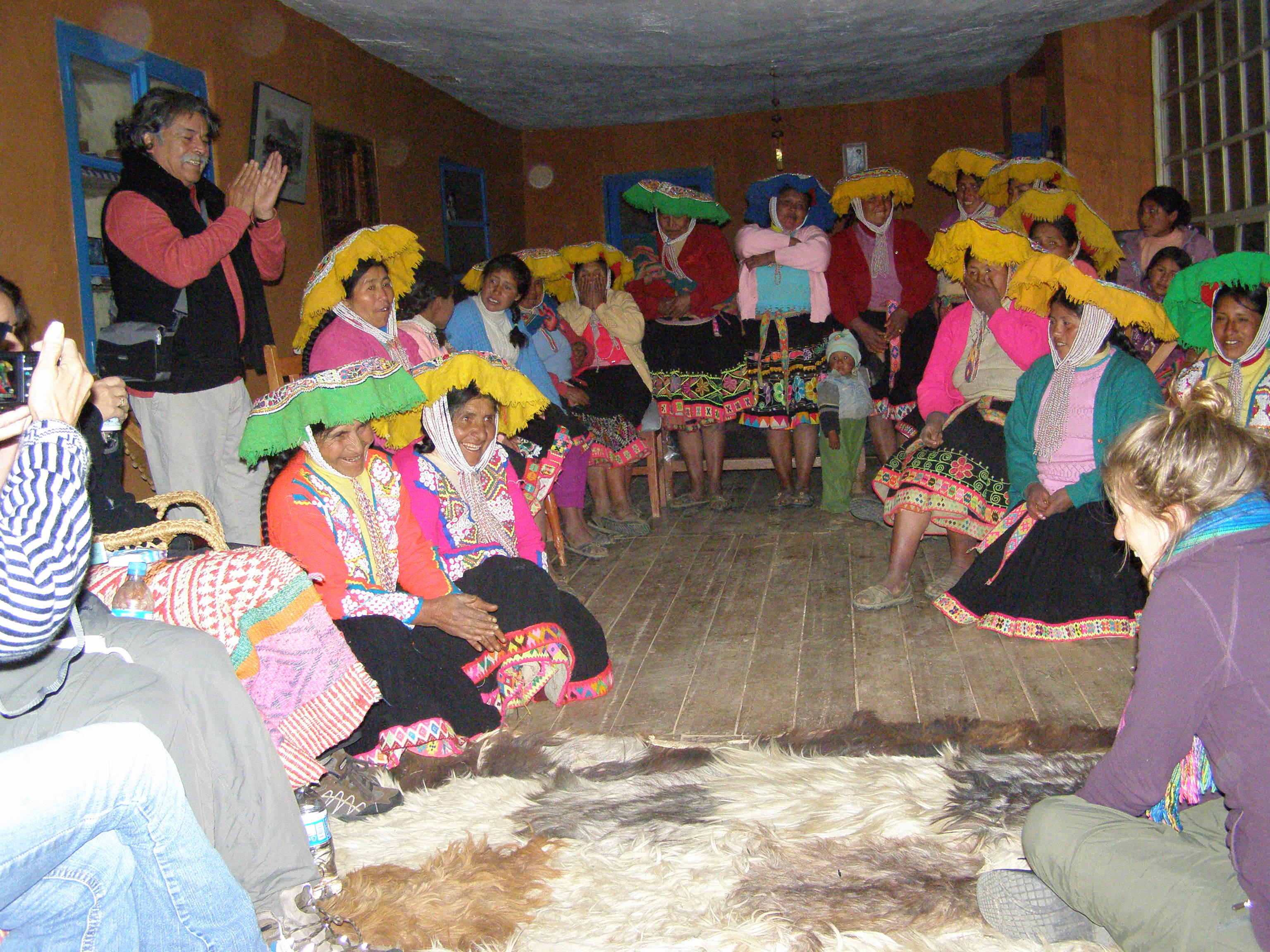
Mollamarka Women Singers

Mollamarka women singers inside Salk’awasi, the ancestral home of Don Americo Yabar.
Photo courtesy of Mark Jericevic.

On another note, the landscape and villages in the film looked so familiar to me that I did a double-take as I watched. I must have traveled through some of the very same areas on my way to Mollamarka for so many years during our Heart of the Andes program.

Film length is 25 minutes. View for free via Karma Tube: Peru: A League of Their Own .

Categories: cultural interests, Film Review, Indigenous Rights, Spiritual Travel | Tags: , , , | Leave a comment

Holy Intent, Invisible Threads

This season is a holy time for many peoples in the world. While multitudes participate fully in—what has become—frenzied materialism, others take a pause or at least strike a balance.

Hopi Ceremonial Calendar by Filmer Kewanyama

Hopi Ceremonial Calendar
by Filmer Kewanyama

Hopi artist friend Filmer Kewanyama says this about December: “The earth’s crust is very fragile. For us, we are supposed to be quiet and reflect on who we are. It is a time for us to be quiet and listen.” This is when storytelling takes place, passing on oral history to the next generation, and the Soyal Ceremony occurs in the kiva, looking to the coming year with great spiritual focus. It’s when the men fashion prayers feathers. Traditionally when Hopi Spirit Keepers have accompanied my groups to Mayalands, they’ve given prayer feathers to those of us holding the center of the journey. The paho, or prayer feather, we each receive is from the roadrunner and meant to protect us as we travel and enter the new year. I wear mine throughout the journey and, upon return home, place each one in a special vessel I keep on my altar.*

This season has become a quiet time for me in the sense that I step back from external activity, a way to remember my own roots, an instilled period of reflection and solitude. And explicitly because there is such space and time for exposure, it’s become heightened with insights, dreams and creative surges for me. Messages come through from the Infinite and that still point inside is given voice.

In that spirit, I’m sharing a dream here that I had early Christmas morning.  I was sponsoring an event, and the person who was to present didn’t show. I knew I needed to step in with an impromptu talk. The audience was getting restless. I thought to speak about the work I believe in: preserving the sanctity of Native traditions to inform the next generations, to bring us back to those core elements that hold the world together. But the words wouldn’t come. How do you express something whose meaning runs so deeply that it can only be felt, that words wouldn’t do justice?

I floundered. Anxiety was showing its face. Just as some of the audience started to collect their coats and leave, Native and non-Native people began to materialize out of the ether to stand on either side of me. Some I knew; others I didn’t. In turn they related the effect, tangible and intangible, that our projects and journeys had on them personally, the importance of continuity toward spiritual grounding, hope, or a wound tended that would otherwise have gone unhealed.

Acknowledge My Relations

Acknowledge My Relations
by Filmer Kewanyama

I came fully awake, feeling resolve to continue holding the vision, even when it seems like few others do, roadblocks appear, or I don’t personally see the ultimate outcome of the intent. For me, these are aspects of true faith realized in this sacred season.

Typically, I don’t remember my dreams. When I do, I know it’s from that invisible realm that retains more wisdom than I do on a daily basis. I would be lying if I said I don’t falter, feel like giving up many times and throwing in the towel. It’s a human condition, especially so when any of us hold a vision that runs counter to the mainstream world, and progress is defying gravity uphill. This is what I sense happens in the kiva: restoring of faith, strengthening of purpose.

True advancements come not from the mainstream but from a collective retaining the holy vision, with understanding how invisible threads may be woven.

That was the prayer feather of my dream Christmas morning that protected me from loss of faith. With renewed intent, I share it here as my own offering—for the circle of life—to guide the next year.

***

Kenosis Spirit Keepers is the nonprofit arm of Kenosis. To learn more about our work, please go here. Your end-of-year donation is tax-deductible and strengthens our mission to preserve Indigenous wisdom for a better world.

The words and artwork of Filmer Kewanyama are used with his full permission. To view a collection of his expressive artwork, go here.

*Most years Entering the Maya Mysteries spiritual travel journeys occur in January.

Categories: cultural interests, Healing, Hopi, Sacred Reciprocity | Tags: , , , , | 5 Comments

Book Review: The Gargoyle

The Gargoyle

An absolutely engrossing and complex novel about a man living a depraved lifestyle until a serious car accident intervenes. Burnt over most of his body and terribly deformed, he undergoes the process of healing forced upon him by medical science. He wants nothing more than to end his life and sets out planning the suicide he would undertake once released from the care unit. In the course of treatments he meets Marianne, a beautiful sculptor who had slipped out of the psychiatric ward and showed up in his room. She claims they were lovers in medieval Germany when she was a nun scribe at the famed Engelthal Abbey and he was a soldier who suffered a similar injury as he had in present times. Through her ministering, not only his body, but also his soul began to heal. The story weaves back and forth between present-day to the Middle Ages, Los Angeles, Germany and elsewhere building a powerful tale of love and intrigue.

Would that the story could end there. But Marianne had word from beyond the veil that her work was nearly done in the present. She was in a frenzied countdown to finish twenty-seven more gargoyles before leaving this plane. Overlay that with the main character’s struggle with the enticements of drug addiction. The reader will vacillate between hope and dread, the outcome being unpredictable. 

For people fascinated with questions relating to the sometime blurred line between mysticism and mental illness, reincarnation, the process of healing and resiliency of the soul, I’m betting you will find The Gargoyle as compelling as I did. Points of medieval life and the mystics of Engelthal Abbey are well researched, an additional plus.  Be forewarned that the description of burn treatment and healing is quite graphic, and unless you’re in the medical profession may be too much for you. If you can get through it, as I did, then you’ll find yourself much more educated on the subject and holding even more compassion for anyone who has to go through such suffering. 

This is Andrew Davidson’s debut novel and he has well proven himself already. I am very much awaiting his next work. Available on Amazon and elsewhere. 

Categories: Book Review, Healing, Spiritual Evolution | Tags: , , , | Leave a comment

How to Lose Your Mind and Regain Your Life

Americo Yabar and Carla

Don Américo Yábar and Carla in 1996 at the Yábar ancestral home outside Cusco.

Nearly 20 years ago, Andean mystic Don Américo Yábar looked me straight in the eyes and advised, “When you lose your mind, you’ll go far.”

I must have given him a blank look at the time, being so in my head as I was. It took me a while, but I finally caught on. It’s been my focus ever since to follow a path of integration. Not losing my mind completely though, I find that it does serve me in certain ways to navigate this culture.

It’s more about losing the smallness the habitual conscious mind often demands. It provides rationalizations that can keep us in our “place” through habit; or the part of us that wants to control—which we all have to some degree—that loves the hard edges of logic and facts. We miss so much if we think things must be seen and known in order to believe they exist.

There’s an aspect within any of us that generates resistance when we consider a larger life than the one we’ve been living, to align fully with the Core Self. That’s because we’d step outside boundaries, ways that are known. That’s a normal response. But it’s only through opening to what is out of habit that we move beyond what has held us back, grow and discover what’s possible.

No invention or transformative process has ever come from thinking inside the box.

Rio Paucartambo Cusco Region, Peru ©1996 Carla Woody

Rio Paucartambo
Cusco Region, Peru
©1996 Carla Woody

My work is with folks who want to live through their deeply held values. A while back I was mentoring someone right upon the threshold, ready to move into transition. She knew the direction she needed to go. Yet, a part of her was petrified; she literally felt frozen in her body, unable to make a decision. We used a process that moved her into the reality she envisioned in order to try it out, well beyond all her worries. As she “looked back in time” she said, “Why was I so scared? Make it all such a big deal? It seems like nothing now.” With the portal established, she took the option her heart told her to take.

If we make decisions through the Core Self, where spiritual values and intent reside, choices are always pure. No subterfuge. No rationalization. Only what speaks of compassion, integrity and unconditional being. Only what’s most beneficial for all concerned and contains clarity.

For me, it’s about following energy. It’s a felt sense. This is the part about losing my mind. I recognize when I’m once again at a crossroads, which can happen in any moment, and the true direction beckons. It’s compelling. I know it holds truth, even if I can’t put it into words. This is so whether it has to do with my work or personal life. The part about using my mind comes in very handy with grounding things into everyday reality, strategies to put something in place. I believe in integration—not either/or.

Interchangeably, I may refer to this portal to Cosmic Consciousness as the Infinite, Core Self, intent or place of the heart. You’ll have your own reference. It’s a felt sense of interconnection with All That Is. You develop the alliance by becoming your own Witness—gently catching yourself, fine-tuning your beliefs and resulting actions—then losing your mind to integration with the heart’s wisdom.  And repeat the process until there’s no need…because we’re human.

***

Note from Carla: If you find yourself consistently bumping up against blocks or clarity has taken a vacation, take a look at Navigating Your Lifepath. For over a decade, folks have made significant positive shifts in their lives using my program—and kept the changes.

Categories: Healthy Living, Personal Growth, Spiritual Evolution | Tags: , , , , , | Leave a comment

Interview with Dianna “Snow Eagle” Henry, Seed Saver

Flordemayo documenting seeds.

Grandmother Flordemayo documenting seeds.
Photo credit: The Path

Grandmother Flordemayo had twice mentioned Dianna “Snow Eagle” Henry to me during my visits to the Seed Temple in Estancia, New Mexico. Each time she lamented, “You just missed her! She was here helping but went back home.”  Home turned out to be Arkansas. When Flordemayo began to establish the Seed Temple, which Kenosis Spirit Keepers helps support, she called Dianna to consult her expertise regarding seed preservation. Dianna has gone back and forth providing service ever since.

The last time I was there, Flordemayo put a book in my hands. Dianna’s coffee table book Whispering Ancestors: The Wisdom of Corn is an illustrated treasure trove of information on Native varieties, some lost to time and then resurrected. In certain ways it takes you back in time by identifying which Native Tribes carried different strains, planting instructions—and hints at the esoteric, ancestral knowledge in the Seed Collective. I was intrigued.

Native Seeds

Native seeds.
Photo Credit: Wisdom of Corn.

Dianna consented to an interview for The Lifepath Dialogues. Below you’ll find the audio recording uploaded to You Tube. She graciously shares how the seed-saving path opened to her, rather unexpectedly as passions sometimes do, and the ways that spiritual knowledge from seeds began to come. One of the many things I appreciate about Dianna is her willingness to follow a path that’s unknown but fueled by intent. She shares it all.

Kenosis Spirit Keepers is pleased to sponsor Grandmother Flordemayo, Dianna Henry and Greg Schoen for events in Phoenix on January 31-February 1, 2014. Greg is also a respected seed saver with many years’ experience and will take us “down the rabbit hole” into the mysticism of seeds. You can read his article about Rainbow Corn in Mother Earth News here.

This Friday night talk and Saturday experiential workshop will directly benefit the Seed Temple’s preservation work. You’re invited to join us and know that—as you are receiving the teachings—you’re also benefiting the wider work of global consciousness.

(Note: The benefit dates mentioned in the recorded interview were changed so that Grandmother Flordemayo could also personally participate, offer her knowledge and prayers.)

Categories: cultural interests, Healthy Living, Indigenous Wisdom, Interview, Sacred Reciprocity, Spiritual Evolution | Tags: , , , , , | Leave a comment

Book Review: Confessions of a Pagan Nun

Confessions of a Pagan Nun

Kate Horsley’s fascinating novel is about an adept caught in the shifting landscape of the Pagan Religion and Christianity in 6th century Ireland.  Not only does it document the times, but also allows us a real taste of the struggle those based in the Earth Religions endured.

Perhaps even importantly, Horsley leads us into the heart and mind of one so troubled, with the internal conflicts she faces between what she knows as her soul’s truth and the instinct for physical survival. This tale is as haunting and bittersweet as it is joyful. Readers may come to find relevance for their own lives in weighing the prices we pay for the choices we make.

Available via Amazon and other bookstores.

Categories: Book Review, Indigenous Rights, Meditation, Spiritual Evolution | Tags: , , , , | Leave a comment

Unexpected Music

Place des Vosges

Place des Vosges

We were exploring Le Marais district when I remembered one of my favorite places. Ah yes, just a short distance away. I succeeded in persuading my friends they really must experience the oldest square in Paris. We turned down a side street that opened into Place des Vosges. Its elegant French classical façade spoke to the aristocracy that once lived above the arcades below. It didn’t take much to imagine Victor Hugo striding along anxious to be home to continue penning his novel of the moment. We noticed a bistro just in time for lunch. Salad, cheese, bread and wine somehow tasting so much better than it ever did at home.

Exiting, we started to round the corner that would take us out of the square when we noticed activity across the way under the arches. Some ten or so people setting up—a musical ensemble! We edged closer to watch. A few others began to gather. The discordant sounds of musicians tuning their violins and cellos ensued. And ensued. And ensued. Until finally my friends were getting impatient, wanting to leave. Oh no! Just a few more minutes, I was saying in my head. Feeling the tug of the group, I started to turn away with them.

And in that moment, the cacophony stopped. A split second of silence brought chaos into perfect order as the haunting strains of Pachelbel’s Canon filled the air. The acoustics amplified the notes to such a degree that we were enveloped, rooted in place. The beauty of the moment was overwhelming. I didn’t want to move from that spot. The energy continued to rise as they went on to play Mozart, Bach and Vivaldi. Thankfully, a violinist broke away and began offering CDs. I gladly purchased one and then discovered their name: Classique Metropolitain. What an unexpected gift, an extraordinary dessert, one we wouldn’t have had if we’d not been willing to pause.

Now when I play their recording, especially when I paint, it takes me right back to that split second of perfect order when my spirits soared—to experience it all again, gaining inspiration. Only much later did I discover that Classique Metropolitain regularly frequented metro stations and Place des Vosges playing to passersby, perhaps to lend pleasure to their day.

◊◊◊

On a nearly annual basis, I sponsor a spiritual travel program called Entering the Maya Mysteries in the Chiapas region of Mexico.  I usually go in January and we spend several days in the highlands participating in ritual and religious festivities for San Sebastián. One particular year music was a thread that ran through our time together—sacred and celebratory, vocal and instrumental—something to be expected considering our itinerary. But it was unexpected music, taking the edge off a situation and lifting our spirits or instilling a hush to any tumbling thoughts, that I most savored and have tucked away in that same place where Classique Metropolitain and Place des Vosges reside.

Lalo Ed Adams lives in New Jersey. Some years ago his search for someone going to Piedras Negras brought him to me. He joined our travels, in the process discovering a new name that he wore proudly. On his second trip with me, Lalo came along again wearing the glow I saw develop on the first one. Early on, he brought out a guitar saying he’d learned to play a couple of years ago and now gathered weekly with guitarists back home. During our days staying at El Panchan outside the Palenque ruins, he inched his way from casually playing at our table at Don Mucho’s Restaurant—until fully on stage with microphone and sound system going! I admired his chutzpah and his playing.

One thing about Lalo was that he understood how music can intervene and shift the energy in a moment. We’d been on our way to the Lacandón Jungle village of Najá anticipating the upcoming ceremony with Don Antonio Martinez when the van began to hesitate and sputter. Our driver was worried. “Bad gas,” he said, finally pulling over. We all bailed out; it appeared there would be a long wait while the situation was remedied. It was hot. We were in the middle of nowhere milling around on the side of the road.

Lalo Ed Adams

Lalo Ed Adams (2nd from right).
Photo credit: Bob Moore

It didn’t take long before Lalo pulled out his guitar. I finally couldn’t resist. I joined in with what he later called my “vocal chops”—that hadn’t been let loose in years. Some of the others chimed in until we had a plein air concert of sorts going. It turned a difficult situation to a light one full of fun. We continued to find moments to sing, all the way up to our closing dinner when we essentially took over a restaurant, and the other patrons joined our musical frivolity that ranged from “I Shall Be Released” to “Nowhere Man.”

But backtracking a bit, the latter half of our journey we stayed in San Cristóbal de las Casas in the Chiapas highlands. While we were visiting Na Bolom I heard faint notes of piano music and wandered into a room. Beautiful, I thought. Taking note of the pianist but not wanting to disturb, I examined the religious icons in the room. At leaving, I saw a poster announcing Richard Pierce Milner as the current artist-in-residence with evening concerts being held regularly. In the next day when we were in the Maya village of Zinacantán witnessing the raucous festivities for San Sebastián, I noticed the pianist there with a friend. This time I made sure we met and, on a whim, invited him to come with us. We were on our way to Don Xun Calixto’s home above San Juan Chamula where a special ritual awaited us. In return, I joked to Richard, I must have a concert.

Indeed. A few nights later, after the group had flown home, I went back to Na Bolom. At one time, before it had been the home of Frans and Trudy Blom, or a museum, the old hacienda had housed a seminary. One long room still bore reminders of that time, an altar at one end, religious paintings on nearly every inch of wall. But a grand piano at the other end dominated the space.  The only light source was candlelight. I took a seat. Richard began to play. And I was transported.

Richard Pierce Milner

Richard Pierce Milner at Na Bolom.
Photo credit: Carla Woody

Truly, Richard’s compositions are hard to categorize, a blend of neo-classical and crossover jazz as descriptor not at all doing them justice. What do you say about pieces that snatch you up to share a deeply personal journey with the artist? That wend their way through memories of a moment by the sea, a difficult healing process, or tribute to a mentor now passed? That touch on something not often touched? I can only say that Richard exposes his innermost feelings through his music and extends an invitation for listeners to join him. As I write these words, piano solos from his CD entitled Other Ways of Knowing are taking me back to that candlelit time at Na Bolom when I first heard him play.

◊◊◊
 In these times when so much of life is artificially structured, perhaps even constricted, that we can no longer breathe, do moments other than that—should we allow them—create openings. Chance encounters, courage mustered, intuition followed, and willingness to engage possibilities provide a distinct loosening that allows us to take flight. For me, unexpected music, especially when I find it within myself, has been a theme that has provided a springboard.
◊◊◊
   To see what other bloggers have posted in response to the Daily Post Writing Challenge: Moved by Music go here.
Categories: Creativity Strategies, Music Review, Travel Experiences | Tags: , , , , | 5 Comments

Interview with Becca Begnaud, Cajun Traiteur

In October 2012, I was visiting friends in Lafayette, Louisiana—Cajun Country—and fell in love with the area. My time there was made that much more interesting by meeting Becca Begnaud who is a traiteur, a Cajun prayer healer. I was invited to interview her for The Lifepath Dialogues during a program of hers. To me, the outcome was fascinating. We cover a lot of ground. Listen to Becca as she talks about what it means to be a traiteur, Cajun culture and challenges on the path as a healer. It’s worth 38 minutes of your time.

Interview on You Tube.

Interview on You Tube.

I will be returning to Lafayette shortly. Becca will be sponsoring my work for her Healing Arts Collective. You can find the details of the November 15 talk Timeless Pathways for Today’s Spirit Keepers and November 16 workshop Asking the Answer in this downloadable flyer. I’ll also be giving a talk in Baton Rouge on November 14 at The Red Shoes, a center for personal and spiritual growth. I’m very much looking forward to returning to this area, rich in so many ways.

Categories: cultural interests, Gratitude, Healing, Interview, Personal Growth, Spiritual Evolution | Tags: , , , , , , | Leave a comment

Blog at WordPress.com.