Posts Tagged With: Indigenous traditions

Interview in 5enses Magazine

5ensesBack in April before I left to walk the Camino de Santiago, Jacques Laliberté made the trek out to my place to interview me for 5enses Magazine, a local publication featuring the arts and science in the Greater Prescott, Arizona area. Jacques is a fellow artist, and over the 20+ years he’s lived in this area has had regular columns on art and related subjects. Even so, we were barely acquaintances; our paths had crossed just a couple of times. I’ve been interviewed several times. But not like this. Before I knew it nearly three hours had passed. And I’d spoken of things I normally keep to myself on the deeper elements of my life and work, not usually the stuff for mainstream consumption. This was more like a chat between friends sharing life experiences and some of those things that are unexplainable in the spiritual realm.

The interview has just been published in print and online. Somehow he was able to condense all the ground we’d covered into a quite readable story…and kept some of the most personal things I’d disclosed to himself. Thank you very much. It’s an apparent talent.

Here is a bit:

 Wisdom through stillness: Carla Woody integrates indigenous ideas in art, life

‘Set your intent and let it go. Your intent is your beginning. Worrying about the details detracts from the intent . . . the attraction will take care of the details.’

Thus — in her ‘The Lifepath Dialogues’ blog — Prescott artist Carla Woody imparts the first of many lessons in a way of living. Artwork and writing are two of the primary ways she’s integrated her far-flung experiences circumscribing a circuitous path around the globe.

‘I was fortunate to spend a significant portion of my 1960s childhood living in a suburb of Paris influenced by French culture where the arts are valued,” Woody writes on her website. “We traveled all over Europe. I remember spending a lot of time in art museums and exploring narrow cobblestone streets with my parents.’

With her childhood mercifully free of the influence of organized religion, Woody was primed to encounter mystic traditions whenever they showed themselves. First, though, came a potential — perhaps vital — obstacle: her service in the military as a consultant in leadership development. Perhaps full immersion in her culture created the momentum to fling her so energetically toward subsequent events…

If you’d like to read the entire article, please go to 5enses.

After many years in Prescott, Jacques moved down the road a bit. He now considers himself a Paulden artist, writer and graphic designer creating book covers for those who self-publish. His first novel The Fictional Autobiography of the 21st Century’s Greatest Artist Andienne Brünsilder was published in February. It’s available locally at the Peregrine Book Company. I haven’t read it yet. But if he writes fiction the way he puts an interview together…it’s got to be good. I noticed the foreword was written by Mick Jagger, which has got my curiosity up.

Autobiography************

Please note a couple of corrections to the 5enses article: Kenosis Spirit Keepers, founded in 2007 to help preserve Indigenous wisdom traditions, is the nonprofit extension of Kenosis, the mother organization I founded in 1999. The mission of Kenosis is to serve human potential—as an assist to live through spiritual values and hold the vision “One tribe, one world.”

For more information on the mission of Kenosis Spirit Keepers, events and what we support, go here. For more on Kenosis spiritual travel and other programs, go here.

Categories: Arts, Interview | Tags: , , , , , | Leave a comment

Allies

In January I took a group to Nahá as usual during my Maya spiritual travel program. Nahá is a tiny Lacandón Maya village deep in the Lacandón Biosphere of Chiapas, Southern Mexico. We go there to be with Don Antonio Martinez for ceremony and show our respect that he’s still holding traditions when there’s so much pressure for him to let them go. We also visit with the widows of the late spiritual leader Chan K’in Viejo, as well as spending time at sacred Lacandón sites.

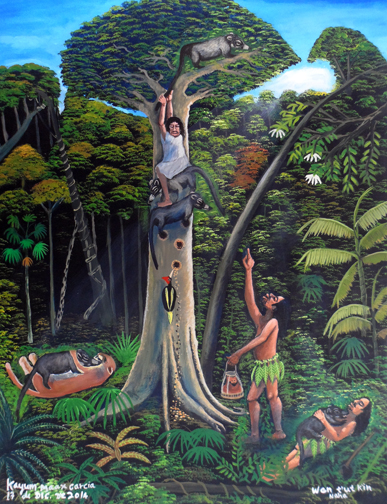
This time we stopped by Kayum’s home. I hadn’t seen him in years. Kayum Ma’ax Garcia is a Lacandón Maya artist of the monkey onen, or clan. He’s also one of Chan K’in Viejo’s sons. He works in acrylics on canvas. In his artwork Kayum conveys actual events, lifeways, creation stories and rituals of a culture nearly gone—as well as his dreams, an important aspect of traditional life. So, in his own way, Kayum is preserving the traditions of his people. I’ve always been fascinated by his art.

Kayum Art

Traveler Frostie Torres purchases a painting from Kayum during our 2007 program. Photo: Alonso Mendez.

But he has little exposure to the world outside his village. I thought to myself, it’s important for his work to get out there, not only to help sustain his family but for others to appreciate Lacandón lifeways and traditions. I suggested to him that he offer his work as archival prints through an online service as I do. But he has no camera, computer or technical knowledge even if he did. Aside from that there’s only Internet at the little lodge where we stay. And the connection is so poor it may as well be non-existent. He had no one to support this possibility, and it was something he really wanted to do after I explained it.

An opportunity landed in my lap, another one that truly matters. The group witnessed the process of this conception. They were excited. I went home and put a vote before the Kenosis Spirit Keepers Board.*

The Allies Gallery is now a program supported by Kenosis Spirit Keepers to sponsor Indigenous artists who have extremely limited capabilities to offer their work. Kayum is our first artist. Proceeds of any of his art sales go directly to him. The same will be true for any other artist we include.

Man of the Wild Acrylic on canvas Kayum Ma'ax Garcia

Man of the Wild
Acrylic on canvas
Kayum Ma’ax Garcia

Our online gallery is now up! You’re invited to check it out and support Kayum through purchase of his work and sharing Allies Gallery with others. We currently have prints available for four of his pieces, in various sizes and formats, and will add more as time goes on.

*******

Kenosis Spirit Keepers is the volunteer-run, grassroots organization I founded in 2007 to help preserve Indigenous traditions, a 501(c)3 nonprofit extension of Kenosis.

Categories: Arts, cultural interests, Lacandón Maya | Tags: , , , , | Leave a comment

Learnings from Hopi: What Is Your Blue Star?

Since 2007 Kenosis Spirit Keepers has been sponsoring Hopi Wisdom Keepers on my spiritual travel programs to reconnect with relations along their migration path from South America.* As much as it’s been spiritually meaningful to them, it’s been an extraordinary privilege for the rest of us on those travels to witness how they find proof in the common symbols, creation stories and even Indigenous language in Peru, Mexico and Guatemala, letting them know—indeed—those were their origins.

One of my favorite memories from Peru is when Harold Joseph met Don Miguelito, an Elder who only spoke Quechua. Yet Harold understood him. Another is when the reed serpent-shaped boats on Lake Titicaca excited Harold. He brought a replica home and showed it to his late father-in-law, the last Hopi oral historian of his clan. Char Joseph told me of her father’s response, “It made him so happy! It proved to him that our stories are real!” All Hopis who have come on the Maya journeys as well have made the connection between the Jaguar Twins in Maya traditional stories and their own, along with many other commonalities.

When such things happen it supports spiritual grounding. Something intangible finds its inherent slot. It’s part of identity and who we are in the world. For so many of us today, ancestry is unclear… lost to time or hidden.

I can easily link my own migrations through this lifetime that have brought me to where I am today. But what about lineage? Mine is a mixed bag. Some can be traced back to the late 1700s through records that tell of my Irish and English ancestors’ wanderings from place to place. However, there’s a good chunk of my heritage only known through veiled family stories or random comments … untraceable. During the first half of the last century, my people were taught to be ashamed of their Native origins and perhaps attempted to pass for something they weren’t. And in earlier years, they were just trying to keep their lives.

What we know of our roots and what we don’t commingles and informs the stories we choose to create through the making of our own lives. And we can pay attention to what runs in our blood that needs no proof.

Pam Hale Trachta, a spiritual mentor and author of Flying Lessons, participated in my Spiritual Travel to Hopi program in March. She’s written a beautifully informative article that encompasses what I’m writing about here: Hopi migrations and our own guiding light.

What Is Your Blue Star?

Blue Star

Blue star petroglyph. Photo: Pam Hale Trachta.

The Hopi people we met in Arizona on a spiritual tour with Carla Woody allowed us to see and photograph a petroglyphic symbol of a blue star that appeared long ago, to signal their way home. The story they told us was that when they emerged through a sipapu or opening in the earth in northern Arizona, they met Masau, the guardian of the earth, who told them they could inhabit this world if they would abide by his instructions…He told them to make migrations into the four directions, and after spreading far and wide he told them they would be signaled back to the place of their emergence… Read more.

Pam also wrote about precious time we spent in the Harold and Char’s home. I wanted to include this, too, as added reading to convey how special it is to be invited.

Hopi Feast

Post-ceremony breakfast feast. Photo: Pam Hale Trachta.

A Hopi Feast

On a literal level, this feast was prepared for us by Charlene Joseph, a Hopi woman from the village of Moenkopi. We were welcomed into her home to learn about the Hopi way of life, which is all about Spirit. Perhaps you can’t see Spirit in the photograph, but it is the major ingredient–the primary flavor in every event, every “dish” that is part of her family’s life…This feast is a tradition the morning after the night Kachina dances, which we were privileged to attendRead more.

******

*I founded Kenosis Spirit Keepers, the nonprofit extension of Kenosis, in 2007 to help preserve Indigenous wisdom ways.

Categories: cultural interests, Hopi, Indigenous Wisdom | Tags: , , , , | 1 Comment

Film Review: The Wellbriety Journey to Forgiveness

I will tell you up front that this is a difficult film to watch and can bring up all kinds of emotion. But if you’re going to watch it, then do so until the end because toward its finish there is much hope conveyed.

During our recent Spirit Keepers Series held in Phoenix on the subject of PTSD and Native healing ways, I had invited Eli PaintedCrow, an Iraq War veteran of the Yaqui Nation and co-founder of Turtle Women Rising, to take part based on her own experiences and to frame further aspects of our Series. She showed a portion of Wellbriety Journey to Forgiveness, a documentary produced by White Bison, Inc. They’re a Native American-operated 501(c)3 nonprofit dedicated to culturally-based healing for Indigenous peoples.

The film starts out with a prophecy given by the Old Ones about the light skins who would arrive, create confusion and great destruction. How everything would be taken from the Native American but their spirituality. There would be tremendous suffering, genocide and a time of testing. But opportunity for healing would present itself. After this time of healing, the buffalo, Native people and all manner of sustenance would return. Harmony would prevail. Native people believe that we entered this time of healing in the early 1990s.

This is the story of that destruction, particularly centered on boarding schools and their effect. If you’re not familiar, in 1879 the first Indian boarding school was opened in New Carlisle, PA. Native children were forcibly taken from their families and shipped off to such schools around the US where they were stripped of their language and anything having to do with their culture. They endured ongoing violence and humiliation in silence—many didn’t survive—and it had horribly detrimental effects reaching all the way to today. This is called intergenerational trauma, certainly a form of PTSD.

As a part of the Wellbriety Movement, Native organizers undertook a 7000-mile journey all over the US to give Elders and their children a chance to tell their stories, perhaps for the first time, and express grief. In this undertaking they hoped to break the cycle of addiction and violence, begin the road to forgiveness and a return to spiritual traditions. The film covers Native values and how to live in harmony as taught by the Old Ones, along with a model called the Four Directions of Forgiveness and a call to Greater Purpose.

This is an extremely powerful film and could be called the Schindler’s List for Native Americans. It was created as an Indian Give-Away by White Bison for purposes of truth-telling and healing.

Whether you have Indigenous members in your family line who suffered the atrocities, have ancestors who perpetrated any part of it, or are born of mixed blood as many of us are…the message presented here is relevant to all. The effects of genocide, abuse and shame are equally carried through the family line. This is a film for anyone whose ancestors have experienced anything of the like. That doesn’t leave out many people on the planet.

This is a move for truth—no more secrets—and healing accomplished when we live in harmony as the Old Ones taught. Seeing the complete film instilled even more significance to me in how I personally live and greater understanding of the important work Kenosis Spirit Keepers does, even if we reach only a few.

This is a film for the Next Seven Generations. Critical mass is important. View the film for free on You Tube and share widely. Length: 1 hour, 13 minutes. Also visit White Bison to learn of their healing institution and classes.

Categories: cultural interests, Film, Healing, Indigenous Rights | Tags: , , , | Leave a comment

Video: Coyote Medicine with Lewis Mehl-Madrona, MD, PhD

In January 2015 Kenosis Spirit Keepers was pleased to collaborate with Johns Hopkins Center for American Indian Health to bring Lewis Mehl-Madrona, MD, PhD, to Baltimore to speak on Coyote Medicine: Lessons in Native American Healing. Dr. Mehl-Madrona, Lakota-Cherokee author of the Coyote Trilogy, shared about historical trauma, lessons about community healing and resilience that come from Native communities.

We were able to video his presentation and offer it to you here. Enjoy…

Categories: cultural interests, Healthy Living, Indigenous Wisdom | Tags: , , | 1 Comment

Pilgrimage

Pilgrimage infers travel, a journey undertaken with intent—not as a lark, although fun can be a part of it. Sometimes the mission is known ahead. Or it’s discovered along the way. Just as true, it may only be in hindsight, a lengthy time passed from the conclusion, that all comes into focus. Ah, there’s the reason I went…

One thing is certain. It’s a passage made with holy purpose, and you must leave the homeland in order for the pilgrimage to occur. I’m using the word ‘holy’ for a reason. It’s a term people usually back away from because of its connotations, often for the same reasons ‘pilgrimage’ is given wide berth. Here I’m using both for common purpose, giving them due because they take us to a place we normally don’t dwell.

To undertake a pilgrimage, your soul must come through, reaching out from that core level. It’s a call to engage, go deeper. It’s a yearning to venture into the unknown. Some conclusion is sought. It’s time to step beyond a threshold, out of the status quo.

Your soul is offering the invitation. But it’s your everyday self that has to accept it at some level because…

 You’re offering yourself up to a foreign land…

Little is likely to be what you’re used to…

There’s certain to be physical, emotional or mental discomfort—maybe all three!

And it’s through such radical departure that you discover what you’re made of—sometimes quite the surprise. As a result, you’re enlivened. Your constructs are stretched. You’re taken beyond your limits. Your new world emerges.

Sometimes folks attempt to fool themselves into it by saying such things as:

 I’m expected to do it.

I’m here to support my spouse…friend…(fill in the blank).

That’s a place I always wanted to visit.

 Whatever it takes to get you there is fine. In the end, there will be certain recognition for most:

 This is spiritual travel. And it’s pure medicine.

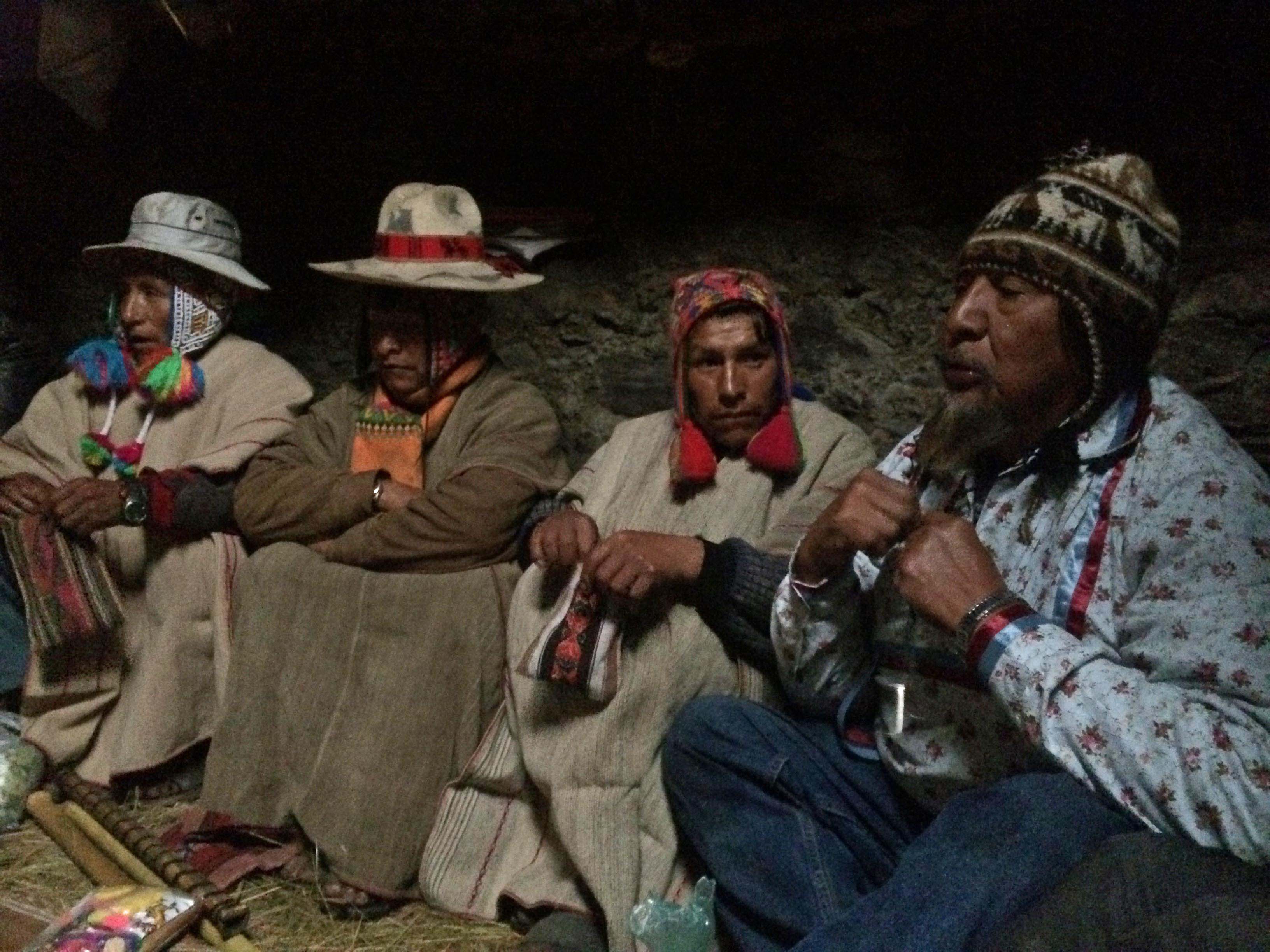
In early November I returned from The Heart of the Andes during which we made a pilgrimage to the Q’ero village of Ccochamocco, perched at 14,300 feet.* Harold Joseph, a Hopi Wisdom Keeper from the village of Shungopavi, Second Mesa, Arizona, was sponsored by Kenosis Spirit Keepers as an emissary for his religious leader Lee Wayne Lomayestewa with a mission to request prayers from the Q’ero community for continuity of threatened Hopi traditions. Harold said, “The Q’ero spiritual leaders make strong prayers!”

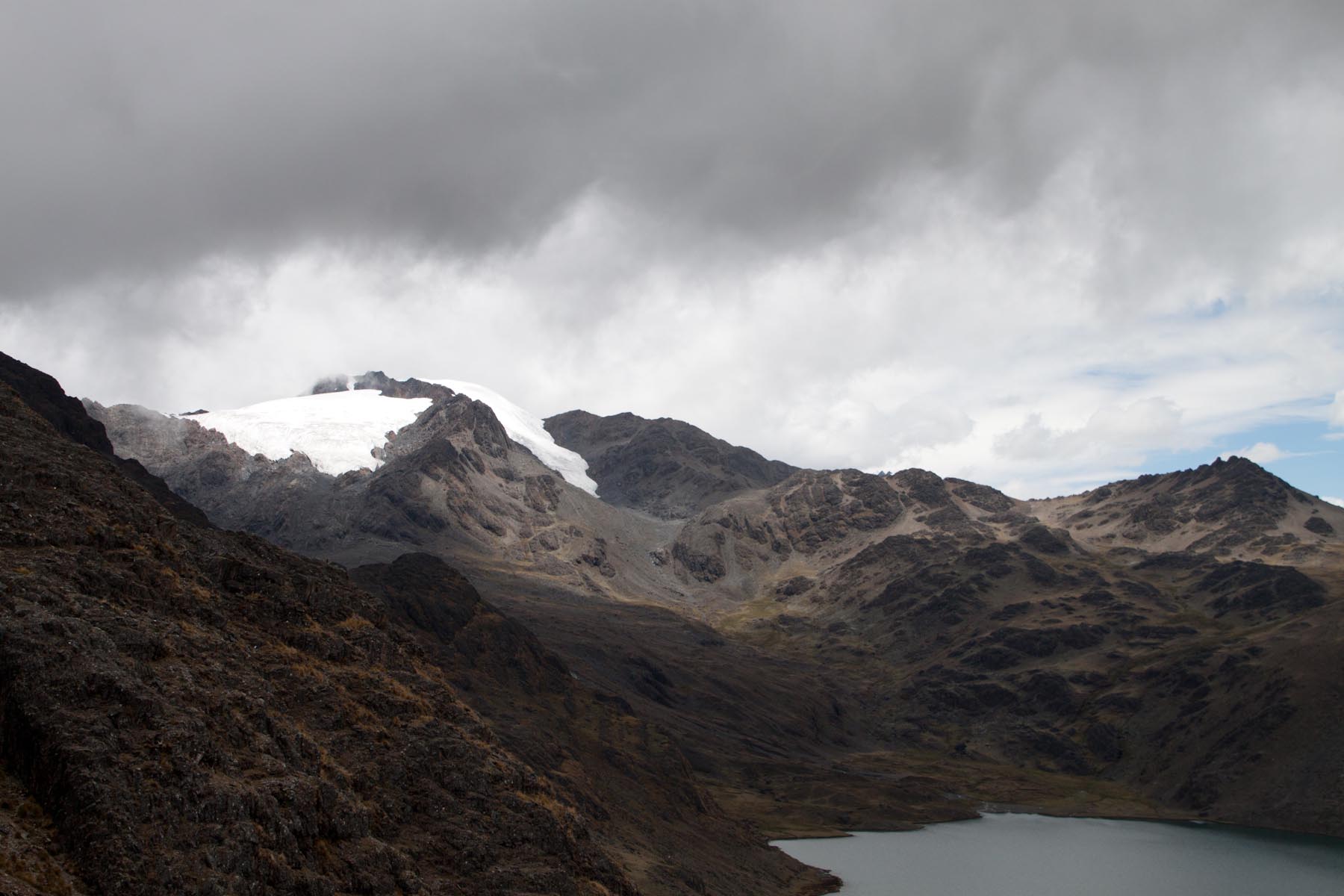
There is no road up to the village. In order to get there we sometimes rode on horseback, much of it walking through some of the most beautiful and steep landscape I’ve experienced. Harold stopped a number of places on our journey to give his own prayers and leaving offerings, as well as during despacho ceremony during our time in the village.* We were truly privileged to be part of all of it.

Hopi Harold Joseph (rt) during despacho ceremony with Q'ero spiritual leaders. Photo credit: Sage Garrett.

Hopi Harold Joseph (rt) during despacho ceremony with Q’ero spiritual leaders. Photo credit: Sage Garrett.

The highest point to and from the village is 16,000 feet before descending. On our return, as some of us were already ascending, I began to hear a voice echoing from the valley below, calling forcefully every few minutes. I couldn’t understand the words or see who it was. Later I learned it was Harold giving us all a message that Hopi Spirit Keepers used with each other during times of challenge in the kiva, after many long hours of prayer or enduring inclement weather during ceremonial dances.

Be strong!

Pilgrimage to Ccochamocco

The highest point at 16,000 ft on the pilgrimage to Ccochamocco. Photo credit: Carla Woody.

Return from Q'eros.

Returning from Q’eros. Photo credit: Carla Woody

He said it’s meant to strengthen spiritual warriors, to remind them they’re doing what they’re doing for more than just themselves. They’re doing it for their community and more…for all humanity. I will never forget Harold’s message bouncing from mountain to mountain.

After we were home for a few weeks, Harold sent me a note about our spiritual travel journey: “The effect on my life has been enormous in terms of the spiritual connections that was made in behalf of the Kikmongi.*** The awareness that we are spiritually connected to creators and keepers of life: Katsi. No changes in my life but emphasis on the importance of carrying on my responsibility as a Hopi and its ceremonial practices that rejuvenates life here on Mother Earth and the Universe for future generations.”

Harold Joseph. Photo credit: Sage Garrett

Harold Joseph. Photo credit: Sage Garrett

In early May I will begin walking the Camino de Santiago, a 500-mile pilgrimage in northern Spain. My old friend Oscar Panizo is going with me. People ask me why I’m doing such a thing. I can’t honestly give a concrete reason. I just know I’m called to undertake it. The whisper had been hovering in the background for a while, and now is the time.

I also know without a doubt: I will repeatedly hear echoes through time—Harold’s voice encouraging me.

*********************

*The next Heart of the Andes will be October 23-November 5, 2015 and include Bolivia and Peru as a special initiation journey mirroring the path designated by Viracocha, the Incan Creator God. Six Q’ero Spirit Keepers have been invited to accompany us in a pilgrimage that will take them back to their origins. A portion of tuition is tax-deductible to support their sponsorship.

**A despacho is a prayer or blessing bundle made in ceremony by Quechua and Q’ero peoples of the Andes.

*** Kikmongi is Hopi for religious leader.


Categories: Hopi, Q'ero, Spiritual Evolution, Spiritual Travel, Travel Experiences | Tags: , , , , , | 5 Comments

Special Notice: Coyote Medicine with Lewis Mehl-Madrona, MD

Kenosis Spirit Keepers logo

SPECIAL NOTICE:

We are pleased to announce our special collaboration with Johns Hopkins Center for American Indian Health bringing Coyote Medicine with Lewis Mehl-Madrona, MD, PhD to Baltimore for a free public talk, January 15, 12 noon-1:15 p.m.

Dr. Mehl-Madrona, Lakota-Cherokee author of the Coyote Trilogy, will share about historical trauma, lessons about community healing and resilience that come from Native communities.

Location: John Hopkins Bloomberg School of Public Health, 615 N. Wolfe Street, Room 1020.

To reserve your space contact Nicole Pare, John Hopkins University, npare1@jhu.edu or phone 410-955-6931.

KSKMehlMadrona2-page-0

***

With special thanks to Mike Weddle, MD, KSK Board Member, and Dr. Allison Barlow, Associate Director, John Hopkins Center for American Indian Health, in their efforts to make this event possible.

Categories: cultural interests, Healthy Living, Indigenous Wisdom | Tags: , , | Leave a comment

Film Review: Q’ero Mystics of Peru

Seti Gershberg has produced an important documentary containing key elements for Westerners to fathom the mysticism of the Peruvian Andes: the descendants of the Inka who embody it, their history and traditions. The film is rich with interviews of Q’ero mystics and breathtaking vistas that perfectly enveloped this viewer, taking me back to all the times I sat in circle with these beautiful people. The energy they carry came through the screen.

We are offered teachings from the Q’ero worldview about interconnection, the inherent birthright of prosperity for all—not just a few—and how ayni, or sacred reciprocity, creates flow and balance. The Q’ero people are living examples, incarnating the natural laws that we all must embrace for global transformation. Segments show despacho ceremonies offering gratitude to the Pachamama (Mother Earth) and Apus (mountain spirits), and blessing prayers. How lightning is a message from the Apus signaling an individual’s role and healing methods are disclosed.

Paq’os (shamans) outline initiations and practices for the life of a healer and mystic—how the process happens over years of commitment, often with strong challenges. One young paq’o describes how, in earlier years, he helped gather materials for the despacho. Then at fourteen he assisted in the making, but it wasn’t until he was eighteen that he was deemed ready to do them on his own. I was personally glad to see this distinction included. Hopefully, it conveys to a Western audience that such a path does not happen in a weekend workshop; nor is it a romantic undertaking but one of humility and sacrifice to community.

Juan Núñez del Prado, Joan Parisi Wilcox, Elizabeth Jenkins, Holly Wissler and J.E. Williams share their understanding from an outside perspective as scholars and authors but also as practitioners of Andean Cosmovision.

The Q’ero are a people of dynastic lineage and strength, who only within the past sixty years have broken out of indentured servitude, having maintained their core identity throughout. These words are spoken during interviews:

 Our work is sacred.

We will not forget or lose this knowledge.

 Q’ero Mystics of Peru came at an opportune time, just as I’m preparing to return to Peru to be with Q’ero friends in the village of Ccochamocco for an unprecedented occurrence during The Heart of the Andes. Hopi Elder Harold Joseph from Shungopavi, Second Mesa, Arizona, is accompanying us, as an emissary of his religious leader, to seek prayers for the preservation of Hopi traditions. He says: The Q’ero spiritual leaders are strong in their prayers. So they are.

I personally thank Seti Gershberg for documenting the wisdom of the Q’ero Nation so effectively.

Categories: cultural interests, Film Review, Indigenous Wisdom, Q'ero | Tags: , , , , , | Leave a comment

Spiritual Integrity and Preservation

In 2009 an important tradition began, first started by Hopi elder Harold Joseph who accepted an invitation to accompany me on my spiritual travel program Entering the Maya Mysteries. As his religious leader’s emissary, the purpose was to reconnect with relations, those from Hopi migration paths. When I make these invitations on behalf of Kenosis Spirit Keepers, it’s without expectation of outcome. I’ve come to know that as long as we within the circle hold the container sacred…what fills it is rich, often with significance I never could have predicted.

The effect Harold had on Don Antonio Martinez, the last Lacandón Maya elder maintaining his timeless traditions, during a very vulnerable time is well documented in my article The Last Spirit Keeper available for download here. Equally significant are the indications Harold saw during our travels through Mayalands that validated his people’s oral history and common thread with these relations of the south. At certain sites he made offerings and prayers. Over these years several other Hopi Spirit Keepers have replicated what Harold started.

Don Antonio Martinez and Harold Joseph

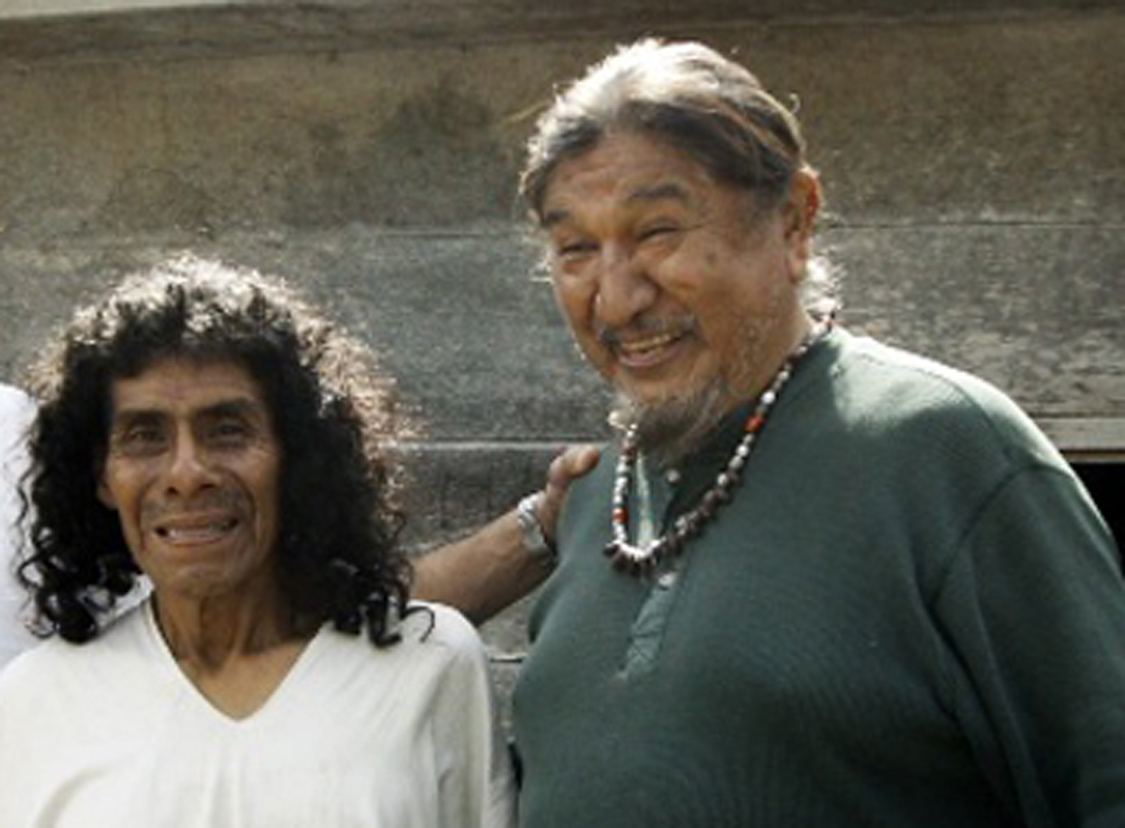
Don Antonio Martinez and Harold Joseph at the Lacandón Maya village of Najá in 2009. Photo credit: Darlene Dunning

This coming January, Merle Namoki, Sun Forehead Clan, from Shungopavi, Second Mesa will continue the tradition, strengthening the bridge of relationship and respect, laying down prayers. A few years ago, Merle said to me, “…We all need to pray to keep our Mother Earth and Father Sky in balance…”

Mike Weddle is a member of the Kenosis Spirit Keepers’ board who, for more than twenty years, has immersed himself in the sacred ways of the Maya of Guatemala. In his essay Are the Maya and the Hopi Two Branches of the Same Ancestral Tree, he compiled examples of common practices linking the two. He also talked about the protectiveness that Hopi people have over their sacred traditions—in order to preserve them.

The intent I hold for spiritual travel has remained the same from the start. It is not to co-opt Indigenous traditions. It is to offer respect through our presence and to hold space that these sacred ways continue. Merle stated the need so well. If in the process we visitors are deeply touched—and we are—we bring this difference home. Who we are in the world is influenced…and felt by our families, friends and communities. Core spiritual elements are strengthened.

The anniversary of an important date is coming up for me. In late Spring 2008 I held my breath as I opened an envelope from the IRS…and exhaled with great relief to see that Kenosis Spirit Keepers was given status as a charitable organization, our nonprofit extension. It was signed and dated October 15, 2007.

Kenosis Spirit Keepers logo

In this post about the continuity of traditions, I also want to express much appreciation to those who have made donations over the years, and certainly to those who have traveled with me…holding reverence, making the circles and sponsorships possible. Through your spiritual integrity, this work continues. Last but certainly not least, the folks who have served on the board since the inception of Kenosis Spirit Keepers, worked hard and assisted with direction and decisions…I have gratitude.

*******************

If you are drawn to support connections between the Hopi and Maya peoples, join us January 18-28, 2015 in Chiapas, Mexico for Entering the Maya Mysteries. A portion of tuition is tax-deductible to support the travel of Hopi Merle Namoki and the humanitarian healing work of Don Sergio Castro in impoverished Maya communities.

To read more about the unusual occurrence that inspired the founding of Kenosis Spirit Keepers see The Ninth Evolution of the Spirit Keepers Journey (with video).

To learn more about the Maya worldview, listen to an excerpt of my interview with Tat Apab’yan Tew, K’iche Maya Daykeeper, who is part of the Maya spiritual travel program.


Categories: Gratitude, Hopi, Indigenous Wisdom, Lacandón Maya, Maya, Sacred Reciprocity, Spiritual Travel | Tags: , , , , , , , | Leave a comment

Book Review – Deep Cinema: Film as Shamanic Initiation

Deep Cinema

Mary Trainor-Brigham’s Deep Cinema deserves your time and attention. I found myself re-reading pages and then sitting, to give the words an opportunity to enter my interior space. Immediately evident, this is a book written to connect with your Indigenous Soul, as the author calls it, the one many of us ignore in this Middle World. She guides us to delve into movies and stories so that they play back to us our own humanity, initiatory passages and further potential.

I’ve studied Joseph Campbell’s work in-depth: his instruction on myth, the Hero’s Journey and places we can readily see examples in film and storytelling. Deep Cinema adds to that work in a way that makes it unique by overlaying shamanic templates from Indigenous cultures. We’re then offered the Soul Compass, a model …designed to transform life from a series of dogmatic dictates or chaotic occurrences…into a rich, sacred Self-defining sojourn which we gladly undertake…the key here is that life becomes meaningful…  The path from Child as Nest Dweller to Elder as Diamond Cutter and Pearl Spinner shows the gateways—mundane to spiritual, balance of Female as Womb Weaver to Male as Navigator—that we all must pass through in order to morph into the next level of growth.

The author brings her background as art therapist, film critic, actor and scriptwriter naturally into play, pointing out the metaphors in a multitude of films, older to more current, that relate to the archetypal templates she offers. With lyrical language, she draws the reader in. On the Voudon shamanic tradition: …According to the Haitians, a person’s small self is like a fish that gets hooked in the heart and reeled in throughout life by the love of and for their Great Self, sitting on a throne beneath the Sea in Lower World…

I was glad to see The Serpent and the Rainbow movie included as a failure at translating anthropologist Wade Davis’ book by the same name. Instead of portraying the rich layers of the Voudon traditions Davis experienced, Hollywood chose to further the cartoon-like, fear-based image of practitioners. Mary recommends Divine Horsemen: The Living Gods of Haiti as a true portrayal.

Once Were Warriors indicates the power of film on a population. In the successful translation of Alan Duff’s novel, Maori director Lee Tamahori graphically depicted real-life struggles with alcoholism and domestic violence the Maori people suffered, bringing it back to loss of spiritual traditions and the turning point of re-engagement. It’s noted that one in every three New Zealanders has seen this film. Most importantly: …after the film hit the theaters, there was an upsurge in the number of men seeking help with domestic violence issues, citing ‘Warrior Troubles’…

I had already viewed a number of the movies covered in the book: Whale Rider, Mindwalk, Capote and others. But I’m going to go back and see some again with new eyes and Deep Cinema beside me. As I was reading, I thought to myself it would be really nice to have an index of all the films and where they’re discussed in the book. I was pleased to find just that at the end. Bottom line: Deep Cinema is not just a reference but also an ally for the spiritual journey.

Available through Amazon.


Categories: Book Review, cultural interests, Film, Indigenous Wisdom, Personal Growth, Spiritual Evolution | Tags: , , , , , , | Leave a comment

Blog at WordPress.com.