Posts Tagged With: Indigenous traditions

Speaking Truth

I’ve been reviewing some of my archived newsletter content and came across this paragraph I included in my old “Metaphors for Life” column back in 2009. This one bears repeating. Knowing the truth, or backstory, instead of taking something at face value is always a good idea before opening your mouth to speak, particularly when doing so could inadvertently create damage when none is deserved.

The Media Mantra on Coca

Despacho Photo

Despacho, or prayer offering, containing coca leaves.
Photo credit: Peter Coppola.

Several weeks ago while driving into town I was listening to NPR. A BBC correspondent who had been in Bolivia was being interviewed about the political situation there. During the course of the program, he made a side comment that he’d had a problem with altitude sickness. Then in a sneering tone said something to the effect, “You know what they did for it? Brought me coca tea. You know what they use that for!”

The reporter had absolutely no idea what he was talking about, but merely passed on propaganda. If he had bothered to find out what coca is really about, he’d have discovered it’s largely the spiritual and nutritional mainstay of the Quechua culture. Coca in its natural form is not a drug. Nor do they use it as such, but instead in sacred ceremonies and as a food source. The black market for coca, for purposes of processing into cocaine, is only sustained through demand from the USA and Europe. Take care of the issue at home and the black market trade virtually disappears.

By making the statement he did, especially on NPR, the reporter helped spread an assumption that the Quechua people who chew coca must be addicts. Out of ignorance, people often pick up a carefully manufactured mantra meant to further a misguided cause, parrot the message and create more damage.

Categories: Compassionate Communication, cultural interests, Healthy Living, Indigenous Wisdom, Spiritual Travel | Tags: , , , | 1 Comment

A Hopi Spirit Keeper’s Travels in Mayalands

Note from Carla Woody: In December 2012, I offered a special Winter Solstice “Entering the Maya Mysteries” program. Kenosis Spirit Keepers sponsored Charlene Joseph, a Hopi Spirit Keeper from Moencopi, on this journey as a part of ongoing efforts to bring together Indigenous Wisdom Holders for mutual spiritual support. Char’s presence, and the heartfelt connections she made with her Maya relations, brought even greater depth to our shared experiences. Truly, it was a gift to have her with us. Below she has generously shared her journey and what it meant to her.

My Mexico/Guatemala  Spiritual Adventure

By Charlene Joseph

What an adventure!  I traveled to Peru in 2009 and had a very rich cultural and spiritual experience.  Knowing the Hopi ancient history and growing up in the traditional Hopi way, I was able to connect to the indigenous people and their way of life.  My travel to Mexico and Guatemala in December 2012 was just as spiritual and the connection to the people culturally and traditionally was immense, just as it was when I went to Peru.

Charlene Joseph and Carla Woody departing for Chiapas, Mexico.

Charlene Joseph and Carla Woody
departing for Chiapas, Mexico.

I spent one week in Tucson with my daughter’s and son’s families the week before my trip. The day before we were to fly out of Phoenix, I left Tucson for Phoenix to meet up with Carla Woody, the organizer of the trip, and spend the night.  Not only did I have trouble finding my way to the hotel, but the next morning as I was reorganizing my luggage, I discovered that I didn’t have my passport! I had left it in Tucson.

It was still early enough to drive back to Tucson and be back before our plane left at 3:00 p.m. so I called my daughter.  Even while studying for her final exams at University of Arizona, it was very thoughtful of her to bring my passport halfway to meet me at Casa Grande. So now, I’m set with my passport and ready to board the plane to Mexico, wondering what laid ahead for me.

San Cristóbal de las Casas


As we were driving to San Cristóbal from Tuxtla after spending the night, I thought about my family back home, the upcoming Hopi New Year and prayers that I will miss for the first time in years, my father who taught me about the Hopi migration from the South. At the same time, I was enjoying the beautiful scenery.

Arriving in the colonial town of San Cristóbal and checking into our hotel felt to me like we were in seclusion.  It was chilly in the hotel lobby and I was wondering why the heater was not on. Once we got checked in and made our way to the room, I found it was just as cold there.  Soon found out that there are no heaters.  We had to dress warm at night or even wear our jackets to bed.  During the day the weather got very warm so we soaked in as much sun and warmth to our liking.

Processional during Festival of Our Lady of Guadalupe.©2012 Carla Woody.

Processional during Festival of Our Lady of Guadalupe.
©2012 Carla Woody.

It was lively day and night in downtown San Cristóbal with fireworks, parades honoring the Lady of Guadalupe, locals selling their art and craft work, food, and even fresh boiled corn, which was my favorite! Also many tourists walked the streets looking, eating, buying from locals, and just enjoying their time.
Family kitchen.©2012 Carla Woody.

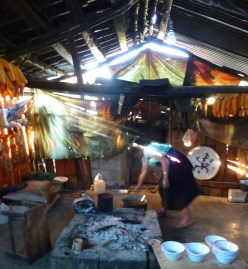
Family kitchen.
©2012 Carla Woody.

One evening we drove about twenty minutes up to the indigenous village of Chamula to participate in ceremony with Don Xun Calixto.  As we were driving through the village, I saw ladies and young girls washing clothes at the water spring, just like we used to when I was growing up.  That scene took me way back to my childhood days. I felt at home seeing the people working in their gardens, fields, drying their harvest, carrying water from the water spring to their homes, and firewood for the evening loaded on the person’s back and everyone working in harmony, it seemed.

We stopped at the bottom of a hill and walked up the steps to Don Xun’s family home, a traditional brick home with an outside shed-like kitchen where they also kept their harvest of corn, beans, squash, variety of melon, and cauliflower stored. On the open fire-pit was a pot of boiling stew being prepared for our meal with the family.  In the yard chickens were being fed, and the group gathered talking and admiring the craft work the family had for sale.
Don Xun Calixto, Spiritual leader of San Juan Chamula, and Charlene Joseph.©2012 Carla Woody.

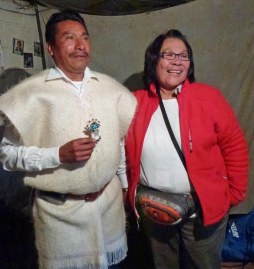
Don Xun Calixto, Spiritual leader of San Juan Chamula, and Charlene Joseph.
©2012 Carla Woody.

Don Xun  started the ceremony in the main house in front of the altar as we sat around him on wooden benches or chairs.  We sat quietly and watched while one group member did the interpretation.  After ceremony was over, I gave a talk and encouraged Don Xun to continue his and his people’s way of life,  that it is good to find that they are still growing their own food and eating off of the land.  I shared with him that my people, the Hopi, live that way also but that we are slowly forgetting.  I told Don Xun that what I shared are my father’s words that he had wanted me to tell our people from the South and that we are connected.  We are brothers and sisters.  Don Xun was happy to hear this.

I presented him with a katsina rain spirit doll (Corn Boy) and asked him to remember my people on Hopi when he is doing his prayers because we need rain for our corn to grow. I asked him to send the rain clouds to Hopi with his prayers because we have been getting little moisture and we need it for our corn to grow.  Don Xun chuckled and said that they did not get enough rain this year either.

Southern Guatemala

Charlene Joseph and Don Nicholas, who attends San Maximón, in Santiago Atitlán.©2012 Carla Woody.

Charlene Joseph and Don Nicholas, who attends San Maximón, in Santiago Atitlán.
©2012 Carla Woody.

A few days later, we left for Guatemala and were on the road all day.  On the way down to Lake Atitlán, Guatemala, there were cornfields everywhere, all the way from San Cristóbal, Mexico to Guatemala.  I was happy because this made the connection for Hopi, and me personally, even more significant.  Corn is very important to Hopi just as it is to the Maya people in the South.

Lake Atitlán is very beautiful, especially at sunset and sunrise.  The weather was much warmer at night which made it very comfy to sleep.  In the morning, after a night’s rest, we got on the boat to take a 40-minute ride across the lake to Santiago Atitlán, below a volcanic mountain.  There we participated in ceremony with Don Nicholas honoring San Maximón.   After ceremony, we headed back to our hotel to board our private bus for Antigua.  It was a 3-hour ride and we got there around 8 p.m.

Ajq'ij Felipe Mejia (Maya Daykeeper) at Iximche.©2012 Carla Woody

Ajq’ij Felipe Mejia (Maya Daykeeper) at Iximche.
©2012 Carla Woody
Ajq'ij Apab'yan Tew (Maya Daykeeper) at Iximche.©2012 Carla Woody

Ajq’ij Apab’yan Tew (Maya Daykeeper) at Iximche.
©2012 Carla Woody

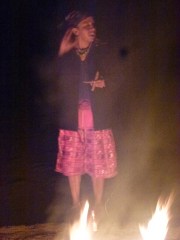
This time we checked into our hotel for three nights.  On December 15, we drove to Iximche for a fire ceremony with Maya Daykeepers Felipe Mejia and Apab’yan Tew at a sacred place where there are pyramids.  It felt very welcoming to see school children playing games and having a cookout.  It was very lively!  The ceremony was interesting and was very colorful.  Again, I felt a strong connection to the Mayas when offerings were made to the fire with food.  I shared with them that Hopi does the same thing.  We also feed the fire and make food offering to the sun.  There were other similarities that I observed that reaffirmed the history of the Hopi to the Mayas of the South.

Palenque

Temple of the Sun at Palenque, Winter Solstice 2012.©2012 Carla Woody.

Temple of the Sun at Palenque,
Winter Solstice 2012.
©2012 Carla Woody.

Nearing the end of our travels and looking forward to Palenque in the jungle.  We left Antigua, went through border checkpoint, and got back into Mexico on December 17th.  Took the whole day to get back to San Cristóbal where we spent two more nights before heading to Palenque where the great pyramids are in the jungle.

It was amazing!  I can’t even begin to express how I felt when we went to the pyramids in Palenque.  Magazines, movies, and pictures are never the same as experiencing the real thing.  Driving to Palenque through the mountains was awesome, too.  All of a sudden a person or people will come out of the forest, people walking along the road with hoes, wood, carrying traditional pottery filled with water.  Wow!

We visited the pyramids on December 20th.  We did a great amount of walking and climbing at the pyramids.  I managed to climb up several with the help of my group members, and especially Ed from Prescott, Arizona who pulled me up and helped me down.  It was interesting to find that the temples are named for the sun, moon, snake, corn, and others I can’t quite remember.  Hopis honor those same things.  There was a ballcourt and a shrine representing the Twin Warriors and the Grandmother which Hopi includes in the Hopi Way of Life ceremonies today.

December 21st was the day of Winter Solstice in Mayaland.   On Hopi, Winter Solstice is also happening at this same time when the men are in the kiva praying and preparing for the New Year.  A time of sacrifice without sleep, praying and working hard so life can continue. They do this for, not only the Hopi, but for all life on earth including animals, plants, sun, moon, water, Mother Earth and all humankind.

On this Winter Solstice Day, the rain was coming down hard and it had started the night before.  Hoping that the rain would subside, we left at seven in the morning for the pyramids to observe Winter Solstice. Sitting on the steps of the Temple of the Sun waiting and getting drenched, after a couple of hours, some of us decided to go back to our cabanas to dry,   We didn’t get to observe the Solstice because the rain took over until five in the afternoon.  As I always say, things happen for a reason!

This journey to Mexico and Guatemala reaffirmed the Hopi migration and some history from the South for me and the Hopis.  My father talked about Palatqwapi , the Snake Serpent, the Twin Warriors and their Grandmother, and more that they brought with them when migrating from the South.  These are all still very much alive today in the Hopi Way of Life.

My father always emphasized that we need to keep faith and continue the Hopi Way to keep the world evolving. I feel very humbled to have participated in this journey and to be able to honor my father and his knowledge and wisdom in this way.
Categories: cultural interests, Hopi, Indigenous Wisdom, Maya, Spiritual Travel | Tags: , , , , , | Leave a comment

Book Review: The Woman at Otowi Crossing

otowicrossing

By Frank Waters

I discovered The Woman at Otowi Crossing in the late 1990s. It spoke to me in such a way that I wrote the executors of Frank Waters’ estate to get permission to use a paragraph in the flyleaf of my own book Calling Our Spirits Home—and they graciously complied. 

So all these scribbled pages, Jack, are to help you understand that an awakening or Emergence, as the Indians call it, is more than a single momentary experience. It requires a slow painful process of realization and orientation… How many thousands of obscure people like me all the world over are having the same experience right now? And for no apparent reason, like me. Keeping quiet about it, too.

                                                       —From Helen Chalmers’ journal in The Woman at Otowi Crossing

The book by Frank Waters is a fictional account of the real-life Edith Warner, there called Helen Chalmers, who ran a tearoom at Otowi Crossing, near both Los Alamos and San Ildefonso Pueblo, for more than twenty years until the Chile train line shut down. Set during the time of the research and development of the atomic bomb, it creates a juxtaposition between the ancient ways and beliefs of pueblo life, modern science and so-called progress. The secrets of those things kept hidden were in the air, the goings-on at Los Alamos as well as influences from her close relationship with the Pueblo people. They permeated Helen’s days in such a way that it created awakenings in her, what she called Emergences. The Woman at Otowi Crossing is replete with such rich aphorisms as the one below, reflecting, too, Waters’ own journey of consciousness.

 … Perhaps none of us really learn anything by degrees. We just keep absorbing things unconsciously without realizing what they mean. Till suddenly, for no apparent reason, it all comes into focus with a blinding flash… 

Historically, Waters’ book would be of interest, too, weaving in the likes of Neils Bohr, Robert Oppenheimer, local Pueblo people and others who frequented Helen’s tearoom. If you’re like me, then, after you read The Woman at Otowi Crossing, you’ll rush out to get The House at Otowi Bridge by Peggy Pond Church. It could almost be considered a companion, one not to be read without the other. Church’s book is a biography of the legendary Edith Warner, a complex woman who lived simply in an out-of-the-way place in a controversial time, and gained wide respect by those who knew her.

Categories: Book Review, cultural interests, Indigenous Wisdom | Tags: , , , , | Leave a comment

February 27 Lifepath Dialogues Gathering: The Spiritual Meaning of Lineage

Lifepath Dialogue Gathering

Exploring the many threads that weave together an expressive, celebrated life.

MARK YOUR CALENDAR AND JOIN US FOR DIALOGUE THAT MATTERS

You are invited! Please pass to friends and family.

FEBRUARY 27, 6:30-8 PM

FREE Monthly Gathering on Fourth Wednesdays

Creekside Center, 337 N. Rush Street, Prescott, Arizona

February’s topic:

“The Spiritual Meaning of Lineage”

Based on the post: “Lineage: Calling on the Ancestors
By CARLA WOODY
Author of Calling Our Spirits Home and Standing Stark
Founder, Kenosis and Kenosis Spirit Keepers

SPECIAL FEBRUARY GUEST:

TERRI HANAUER-BRAHM

Terri Hanauer-Brahm wondered why her father refused to discuss his past and why her relatives were the same way. She uncovered a family secret that sent her on an odyssey of discovery. Out of her quest came a book: “The Hanauer Family: Before, During and After the Holocaust.” She will share with us what this journey has meant to her.

Email: info@kenosis.net or call 928.778.1058

Categories: Healing, Healthy Living, Maya, Personal Growth, Spiritual Evolution, Travel Experiences | Tags: , , , , , , , | Leave a comment

Lineage: Calling on the Ancestors

January 2012

The nondescript address promised little from the street. I opened the old wooden door to slip through the walled entryway and found otherwise. Carol Karasik and I had arranged with the group to meet at Laughlin House, one of the oldest houses in San Cristóbal de Las Casas, then owned by anthropologist Robert Laughlin and his wife Mimi. Carol had been staying at the venerable hacienda—and, with all its rustic charm and lush garden, it seemed the perfect place for our evening gathering.

Dusk was coming quickly. I wandered through the narrow, uneven paths admiring the beauty of the garden, down to the small greenhouse at the far end. As I passed by the main house I noticed a woman kneeling in the grass separating the dwelling from the garden. She was carefully digging a shallow circle, exposing the dirt, already preparing the space. Copal smoke rose from the pedestal burner.

Floridalma (Flori) Pérez González, a traditional  Ajq’ij, a Maya Daykeeper from a Mam village in the mountains of northern Guatemala, was there to offer us a fire ceremony, so sacred to her people. As the rest of the group drifted in, she invited us to join her and sit in circle. We watched in silence as the altar grew on the bare dirt: sugar drawn in a symbol reflecting the day in the Maya calendar, fist-sized balls of resin mixed with shredded wood, candles laid in a circle as offerings to the Nawals, Day-Spirits of the calendar, and Four Directions, sticks of pine pitch, rose petals around the perimeter.

Fire Ceremony Altar

Fire Ceremony Altar

By this time it was dark, just the glow from the incense burner reflecting on our faces; we were cocooned, a timeless place separate from the everyday world. Flori spoke softly and asked me to express the collective intent of the group, then invited each one in the circle to offer their individual words. She lit the fire and invoked the presence of the spirits, praying intermittently in her Maya dialect and Spanish.

Floridalma Pérez González

Floridalma Pérez González

The fire’s flame rose. She called on the Nawals and Ancestors, Grandmothers-Grandfathers, inviting them to accept our petitions and blessings through the smoke. Every now and then she reached her hand into a bag and threw herbs upon the flames. The fire changed shape, moving against the light breeze, not with it. Flori told us the meaning and said it was a good sign. We were drawn into her soft prayers, the flames and, otherwise, the stillness.

After a time, she passed thin, white tallow candles asking us each to take eight, then instructing us to separately approach the fire and, as we settled the candles one by one into the fire, call out the names of those who have gone ahead of us, our Ancestors, to welcome them to our circle, to bless them, as they who are part of who we are, to hear our prayers.

I started. In that moment, I realized that I knew so little about my own family line—but a few names, not nearly enough for the candles I held in my hand. I attempted to sweep the corners of memory to see if anything arose. It didn’t. And when it came my turn to kneel at the fire, beyond three names I could name no more. I placed the remaining tapers, intending they would find their match.

But sadness arose; a hole was uncovered. I didn’t know My People.

I recognized then one of the reasons I’m so drawn to Indigenous traditions. Upon introduction, a number of Wisdom Keepers I’d met would identify their villages and clans going back a few generations. I’d been told that the purpose was to offer any mutual connections. But it’s also a clear statement of identity, place in the world. Those who maintain their traditions are grounded through lineage, lending spiritual strength. Hearing these pronouncements always stirred something poignant in me, as though I was attempting to reach out, to find my own conscious grounding. But I had none in that way, not of the blood that ran in my veins, the places My People had walked, or what aspects of them resonated through time to find residence within me—beyond my own mother and father. I discovered I wasn’t alone. Several of the members of the group struggled in their own way. It was a powerful ceremony.

Fire Photo

It is said that the fire works on you over time.

Its work with me began immediately. I emailed my folks the next morning mentioning the intent of the fire ceremony and my sadness for lack of knowledge of the family line. My mother wrote back saying, “It’s strange you should mention this because yesterday we started cleaning out old boxes…and found papers tracing your father’s family tree!” One of his distant cousin’s had undertaken the search years ago. The papers had been forgotten. We were both astounded at the timing of their urge to clean. I asked my mom if she’d begin looking into her line; she had little knowledge either. She promised she would.

Tracking genealogy is something of an art, sometimes an endless maze with dead-ends, particularly if you have little information at the outset, or experience. My mother got discouraged, having come up with few leads, after much time spent. The project stalled.

December 2012-January 2013

When I visited my folks over Thanksgiving, we talked of family line again. Don Boyd is an old family friend who has become something of an expert in tracing genealogy. I contacted him to see if he would be willing to give my mom some pointers. I then left for my Maya spiritual travel programs over the next two months.

Immediately, there was a flurry of emails between my mom and Don, with copies to me in Mexico and Guatemala. In no time flat, Don was able to produce information that led to a fairly extensive maternal family tree. Although some of the data petered out, thanks to Don and my dad’s distant cousin, I now know most of my lineage.

We still don’t know anything about my dad’s maternal line. But, for the rest, My People were all from the South. My paternal grandfather’s line traces back to 1724 England—and, a curious aside, includes Arthur Woody, the “legendary barefoot forest ranger” one of the first pioneering forest stewards in the US. My maternal grandfather’s people go back to 1766 Ireland. Cherokee lineage exists on both my maternal grandparents’ sides, for sure one documented to 1867 North Carolina. There’s a possible trace of another Cherokee ancestor as far back as 1797 Tennessee, but that one is difficult to prove.

Sunset over San Cristóbal de Las Casas.

Sunset over San Cristóbal de Las Casas.

Less than a week ago we met Flori at dusk. The fiery sunset announced the fire that would be lit in ceremony on the ground, perhaps already mirroring back to us our prayers that would rise. And when it came my time to approach the fire and lay the tapers, I called on my Ancestors, My People, clearly by name. I’ll never know all their stories but I can now intuit their lives—and feel their influence on me, rising up through time, running in my blood, to my place in the world.

I am grateful to the fire.

Fire Ceremony Photo

Categories: cultural interests, Healing, Indigenous Wisdom, Maya, Spiritual Evolution, Spiritual Travel | Tags: , , , , , | 3 Comments

Thought Forms in Black and White

I was in Bali during August 2007, most of it spent in Ubud. In my experience, it’s rare to be in a culture where the spiritual traditions and values are so visible even to a casual observer. There are many things I took away with me, but I’ll offer just a few here.

The first has to do with prayer and ritual integrated into everyday life. There are temples everywhere—public temples, shrines on the streets. And every family compound has an altar even if it’s a small one tucked into a corner, but many are quite elaborate.

Offerings©2007 Carla Woody

Offerings
©2007 Carla Woody

The women seemed to spend a lot of time making small, flat offering baskets from bamboo fronds, measuring about 4 inches square. I’d see them sitting outside storefronts or on the sidewalks talking together while their fingers were busy. For the last week I was there, every morning I watched an elderly woman make her rounds in the bungalow compound where I was staying. She carried a large flat basket in her arms, which contained those smaller ones all holding flower petals, incense, rice, things to attract notice of the gods and signify prosperity. Not only did she place one at the compound shrine and at the base of all the statues, but in front of the bungalow doorways and even on the manager’s desk of the adjacent Internet café; all the important places to create a flow. Later walking through the streets or driving through the countryside, I’d note them in front of businesses and homes, almost everywhere.

The moments for remembrance and gratitude were ongoing. Not a time set aside, but included. One day I had hired a driver to take me to the coast. Along the way, he asked if I minded if he stopped for a few minutes. He pulled over outside a kind of marketplace. While I was fooling around with my camera, he got out. When he returned he had rice pressed into his forehead. During one night’s dinner I was enjoying my food (immensely) and observing my surroundings. One of the servers would stop the others as they passed by. She dipped a flower in a water glass and then anointed them on the head with it. Not playing around, but blessing them.

The understanding of interconnection is also prevalent—family, the banjar, the community. Our style of life in the West is shocking to them. The fact that we seem so disconnected when “I am because you are.”

Bali Translator©2007 Carla Woody

Bali Translator
©2007 Carla Woody

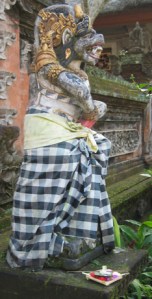
Perhaps more than anything I was taken with the sacred statues that were prevalent at every turn, not just in the temples. They seemed so exotic and expressive to me, not at all benign. I had a very kind driver who was not only quite curious about my culture but also eager to inform me about his.

He said, “Foreigners make a mistake and say we have so many gods. That’s not so. Our gods stay inside the temple and are only brought out for special times.”

I asked him about some of those I saw frequently that look somewhat like serpents or dragons and he disclosed that they were translators, conduits. They took the messages of the gods and translated them so we could understand them. And when I asked him about the black and white checked sarongs on just about all of them, which I was quite fascinated by, this is what he said.

“They remind us that we all have both good and not so good inside of us. This is to remember balance.”

In Bali, those reminders abound. Balance. Work gets done, but the days aren’t overly long. Acceptance of both sides of human nature without going to either extreme, or rejecting part of the self. Connection. And the middle road is valued. No wonder I was so touched—and relaxed.

Categories: cultural interests, Indigenous Wisdom, Sacred Reciprocity, Spiritual Travel, Travel Experiences | Tags: , , , | Leave a comment

Film Review: Genghis Blues


genghisblues

  Documentary Film by Wadi Rum Productions

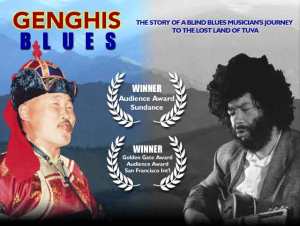
If you’ve ever heard Tuva throat singing and been fascinated by it, this is a film to watch. Aside from that, it tells the poignant and truly inspirational story of blind blues musician Paul Pena. In the mid-80s he first heard throat singing via shortwave radio transmitting from Moscow and was enthralled. It took eight long years, but he tracked down the source, found a recording and proceeded to teach himself the unusual harmonics involved in this technique coming from the tiny Republic of Tuva, between Siberia and Mongolia. He also began to teach himself the spoken language.

In 1993 Tuvan throat singers came to the USA on their first tour and Paul attended a concert. There he met Kongar-ol Ondar, revered in Tuva, and broke out in an extemporaneous demonstration of his self-taught throat singing. Kongar-ol was amazed and invited Paul to Tuva for the international symposium. The film follows Paul and his friends as they traveled across the world and made fast friends of the Tuvan people who fondly called him “Earthquake” after the quality of his voice. This was not an easy journey for Paul who had to deal not only with the limitations of blindness, but also poor health. He set it all aside for this adventure and his love of music.

In his day Paul Pena played with many blues greats and wrote the 1970s hit “Jet Airliner” recorded by the Steve Miller Band. The documentary won the Audience Award at Sundance in 1999 and awards at several other film festivals. A CD is also available called “Genghis Blues” that combines Paul’s roots of American blues, Cape Verdian morna music and Tuva throat singing. Sadly, Paul passed in 2005.

DVD available through Netflix and other sources. View promo video here: a story of courage, intent and passion perfect for our times.

Here’s a bonus. You can watch Paul singing “Jet Airliner”  and throat singing on You Tube.

Categories: Creativity Strategies, Film Review, Indigenous Wisdom | Tags: , , | Leave a comment

Spiritual Responsibility? Duty? Cargo?

I’ve been toying with terms to express what I mean and the process I’ve been evolving through in the last year. Responsibility or duty: both have a heavy connotation, not something done freely but something expected.

Within Maya communities there is the “cargo system” still in effect from colonial times. It has to do with civic and religious hierarchical positions, each held for one year. In the Andes, a similar system exists. “Cargo” may be translated as “burden.” Those “carrying cargo” incur expense, the higher the role in the hierarchy, the more monetary investment. In colonial times, the Spanish used the system as a means of control and exploitation. Today, it’s supposed to be a means of mediating wealth and sharing. But in reality, it creates separation. Those who have the most to expend are the ones who rise in community stature. Hence, they have more prestige. This aspect of the construct is quite distasteful to me, not much different than what often exists in western churches.

Going Home ShungopaviOil on canvas depicting Home Dance.©2011 Carla Woody

Going Home Shungopavi
Oil on canvas
depicting Home Dance.
©2011 Carla Woody

Over these last years, I’ve developed friendships with Hopi people who keep the old ways, and learned much about their traditions. Their clan system is complex, each clan and its members carrying separate spiritual responsibilities. Their religious and cultural ceremonies happen monthly according to the cycles of the Hopi calendar. Each ceremony takes up a good portion of each month due to preparation in the kivas and kitchens, aside from the actual dance and closure afterwards. I’ve witnessed the amount of work that goes into them, as well as listened to friends sharing what they can with an outsider. Truly, I marvel how they are able to get anything else done! For those who have chosen to maintain their traditions…it’s a huge investment of time and energy. Many have found it to be too much and put the sacred ways aside to a great degree. Tradition is going to the wayside.

That brings me to my own process. I founded Kenosis Spirit Keepers, as the volunteer-run nonprofit extension of Kenosis, back in 2007. I took that step because I fully believed that the Indigenous wisdom traditions must be valued and supported in a time when powerful influences across the globe sought to devalue and deplete what was life-affirming. Little did I know that my decision would take me on an unexpected, personal odyssey.

Initially, there was abundant support, both financial and sweat equity. We were able to contribute significantly and support community projects in the Peruvian Andes, sponsor intimate meetings between Native spiritual leaders, and eventually began to offer educational outreach in the local community. It was hard work but we could see the positive outcomes that resulted. Those were exciting times. It was exhilarating.

Then the recession hit. Funds dried up and people pulled back and holed up. I found that I was working harder and harder with few outside resources. My commitment to the mission never waivered. But such things eventually take a personal toll on the spirit and physical body.

Finally, a loud internal voice intervened when I was most tired and discouraged, “Why bother? No one out there cares. You’re wasting your time. It’s hopeless.” I’d set the questions aside but they’d return…until the voice became my nearly constant companion. First, you have to understand that it’s normally quite rare for me to have such messages play in my mind. I finally recognized that my internal struggle was a spiritual test.

Maya PrayersOil on canvas depicting the church in San Juan Chamula.©2011 Carla Woody

Maya Prayers
Oil on canvas
depicting the church in San Juan Chamula.
©2011 Carla Woody

Something happened last January during my spiritual travel program in Chiapas, Mexico that shifted my perspective. During “free time” I’d gone to the Maya church in the traditional village of San Juan Chamula, taking those with me who wanted to return. Every year I spend as much time as I can in this powerful place where the very air vibrates with energy. A few days prior we’d been there for the Festival of San Sebastián, during which the statues of the saints, wearing layers of robes, are taken out of their glass cases and carried on the shoulders of cargo holders in a processional in the main square.  When we returned, the saints had not yet been returned to the glass cases that lined the walls. Maya men were removing the outer layers of vestments on the saints and carefully putting them away in special wooden trunks that would later be stored and protected in individual homes.

I stood watching a few feet from a table where Saints Lucia and Martha were resting. Maya women sat on the floor alternately talking with each other and chanting in unison. Candles were everywhere; pine boughs covered the floor; copal smoke was thick in the air. It was magical in the sense that deep reverence can be. I looked at Saint Martha’s painted eyes—and they suddenly seemed to come alive and gaze deeply into mine. I felt penetrated as though some sort of transmission had taken place.

Then one of the men motioned to another who then approached the table. Very carefully, he lifted Saint Martha in his arms and slowly walked over to her case against the wall. But before he placed her inside, he paused.

And then he danced with her, a beatific expression on his face.

My breath caught and my eyes filled with tears. Such a display cannot be from a “burden” one carries, but directly from the heart. Since then I find that each time I share what I witnessed, tears come again. I continue to be moved and the memory has rooted itself within me for purpose, I believe.

A few weekends ago we were privileged to host Hopi Spirit Keepers Harold and Charlene Joseph for our Series here in Prescott. Some aspects they shared had to do with the involved process of Hopi weddings, their ceremonial cycles and community participation. People were touched, to the point that one participant later told me she had no words. Afterwards, a friend and I took Harold and Char to dinner.

We discussed the “Why bother?” questions that had been haunting me, although less frequently in the last months. Surprisingly, those questions were common to all of us sharing that meal. Yet, we all persevere because the core element of spiritual belief and service is implanted somehow in our DNA.

So after all the months of testing—mental angst, physical exhaustion and spiritual inquiry—I’ve returned again to one central theme that I learned years ago in the Andes: ayni, or sacred reciprocity. That’s the term I was looking for; it was under my nose all along. I even wrote about it again in recent blog posts! But I’m revisiting the meaning in a different way.

This is what I’ve re-learned so far:

—    Such ways of being are the invisible strands that hold the world together;

—    It’s possible to operate within a construct that is riddled with shortcomings and still hold pure intent;

—    Intangible things that you value spiritually are worth the hard work, sometimes requiring a lot of faith;

—    Strike a balance in all things;

—    Touch just one person and it touches others;

—    Ask for help; some things take a community.

Categories: Healthy Living, Hopi, Indigenous Wisdom, Maya, Personal Growth, Sacred Reciprocity, Spiritual Evolution, Spiritual Travel, Visual Arts | Tags: , , , , , , , , | 4 Comments

The Lifepath Dialogues Gathering: Is Genetic Engineering Life-Affirming? (Audio)

The Lifepath Dialogues Gathering is held on the fourth Wednesdays, 6:30-8 PM, at Creekside Center in Prescott, Arizona. The intent is to build like-hearted community and dialogue about what truly matters. I choose monthly topics from my blog and host the evening with special invited guest(s) whose philosophies and work are relevant to the topic. The format involves my presentation of material to create a framework and interview of the special guests. This portion is recorded to share with the world community—wherever you are. Then we turn off the recorder and turn to intimate sharing.

The October 24 Lifepath Dialogues Gathering:

Is Genetic Engineering Life-Affirming?

This discussion was based on the collaborative post: What Legacy GMOs?

I was out of town for the October gathering. I want to thank special guest host Lesley McKeown, Vice Chair, and board member of GMO-Free Prescott, a nonprofit organization seeking to raise awareness of genetically modified organisms (GMO’s) and encourage nourishing food options. October was National Non GMO Month. This topic is so important to health and preservation of tradition. The subject matter is a very tangible aspect of spirituality: what we put into our bodies.

The complete unedited audio is about 40 minutes long. Click on the link below to listen. Please be patient as it may take a few minutes to download! I hope you enjoy.

Is Genetic Engineering Life-Affirming?

Wicked Corn

Our next gathering will be held on Wednesday, November 28, 6:30-8 PM, at Creekside Center as usual.  My special guest will be Yaqin Lance Sandleben, an ordained Sufi minister. 

To remain current on monthly topics subscribe to The Lifepath Dialogues blog or Kenosis Inspirations ezine.

Categories: Healthy Living, Spiritual Evolution | Tags: , , , | 1 Comment

October 24 Lifepath Dialogues Gathering

Lifepath Dialogue Gathering

Exploring the many threads that weave together an expressive, celebrated life.

MARK YOUR CALENDAR AND JOIN US FOR DIALOGUE THAT MATTERS

You are invited! Please pass to friends and family.

OCTOBER 24, 6:30-8 PM

FREE Monthly Gathering on Fourth Wednesdays

Creekside Center, 337 N. Rush Street, Prescott, Arizona

October’s topic:

Is Genetic Engineering Life-Affirming?

Based on the collaborative post: What Legacy GMOs?

By CARLA WOODY
Author of Calling Our Spirits Home and Standing Stark
Founder, Kenosis and Kenosis Spirit Keepers

AND

GMO-FREE PRESCOTT

Guest Host:

Lesley McKeown, Vice Chair, & board member of GMO-Free Prescott,

a 501(c)3 nonprofit organization, seeking to raise awareness of

genetically modified organisms (GMO’S) and encourage nourishing food options.

OCTOBER IS NATIONAL NON GMO MONTH.

Email: info@kenosis.net or call 928.778.1058

OR

Contact GMO-Free Prescott via email.
Carla Woody will return to hosting in November with another special guest.

Categories: Healthy Living, Indigenous Wisdom | Tags: , , | Leave a comment

Blog at WordPress.com.