Posts Tagged With: intent

A Hopi Discovery in Bolivia

It was the first day of The Heart of the Andes. This year’s spiritual travel program included Bolivia as our starting point with culmination in Cusco, closely replicating the initiation journey of the first Inka couple Manco Capac and Mama Ocllo. Directed by their father-god Viracocha, they sought a most holy place to build a city—a place of the sun and navel of the world.*

Prior to setting foot in Tiwanku, said to be the Creation Place where Manco Capac and Mama Ocllo first emerged, we made a stop. On a high windy ridge overlooking the area—a ritual site— Q’ero paq’o friends led a despacho ceremony. Offering sacred cornmeal to each of us, Hopi Suhongva Marvin Lalo made his own prayers to the land as we all released our intent to the winds.**

Marvin had begun to share his feelings and his mission for coming on this journey.

Hopi Elders talk about and remind generations after generations of Hopi oral history, including the migration stories of various clans after the flooding of Palatkwapi, a unknown ancient village located somewhere in the south. Exact routes, established villages, and events have long been forgotten with time. Still, ancient ceremonies remain intact with clans responsible for carrying religious ceremonies through thousands of years of migrations to present-day Hopi villages where the ceremonies are still practiced today.

The Heart of the Andes journey offered an opportunity to connect with ancestral history, to visit the land of the ancients and its descendents, the Q’ero. To what extent my experience would take me, I didn’t know. The first despacho ceremony, I experienced a strong connection as I was presented with a Chakana; a sacred stone necklace and woven cords tied to my wrist. I gave thanks with offerings of my hooma.

At Tiwanku, Marvin already noted the possibility of his own people having set foot on this land. We wandered the ruins, a place of ancient mystery. We were all especially moved in a ritual square, the interior lined with stone faces—a portal perhaps.

Finally pulling ourselves away, in the last half hour before closing we ventured over to an adjacent site. Puma Punku may be the biggest mystery of all. Some conjecture it may have been a docking point, as thousands of years ago Lake Titicaca also covered this area. Now what was left were huge toppled stone slabs and much smaller structures fashioned with extraordinary precision … seemingly impossible for those times. It cannot be explained to this day.

And it was here that Marvin—who had traveled south all the way from Hopi Land on a mission for signs that his people had passed this way—found the Hopi migration petroglyph. The one that was known to point the way to his ancestors. The one that pointed north.

Atypical of other petroglyphs I’ve seen all over the US Southwest or elsewhere, it was large. I’d say three feet, maybe more. Also curious, there was a large serpent petroglyph in front of it, as though verifying the direction.

Even that large, it was easy to miss. The sun was at that point in the day when its rays glare as it’s headed toward the horizon ready for the night. Light bounced off rock surfaces, washing out details. Even with sunglasses my eyes were at its mercy. I missed it.

But not Marvin. He zeroed in on a symbol he knew to be his people’s…and his hair was on fire.

Hopi Migration Symbol

Hopi migration petroglyph at Puma Punka, black and white to better view. Not pictured in its entirety. Nor is the serpent petroglyph pictured. Photo credit: Janet Harvey.

What does this mean exactly? In 2008 Hopi Harold Joseph came on our program that included Puno. On the Peruvian side of Lake Titicaca, we went by boat to the reed islands. There Harold saw the reed boats with serpent heads that he knew from Hopi oral history. He took a replica back to Hopi to show his father-in-law, the last great oral historian of the Tribe…who got tears in his eyes when Harold presented him with an artifact that he already knew.

For Marvin and his Elders, how do you explain the presence of the Hopi migration symbol at Puma Punka if the Hopi had not been there? He talked with excitement of sharing this discovery with the Elders. When our guides spoke of a great city that once existed in this region, now lost, and the great flood that took it, he listened. Geologically, it appears valid. The same story exists in his oral history. The locals even raised the idea that the place we know as Atlantis and the great city they cite are the same.

After we came home, Marvin offered his words, to be included in this documentation, more overview of his time with us in a land he found not to be foreign to him.

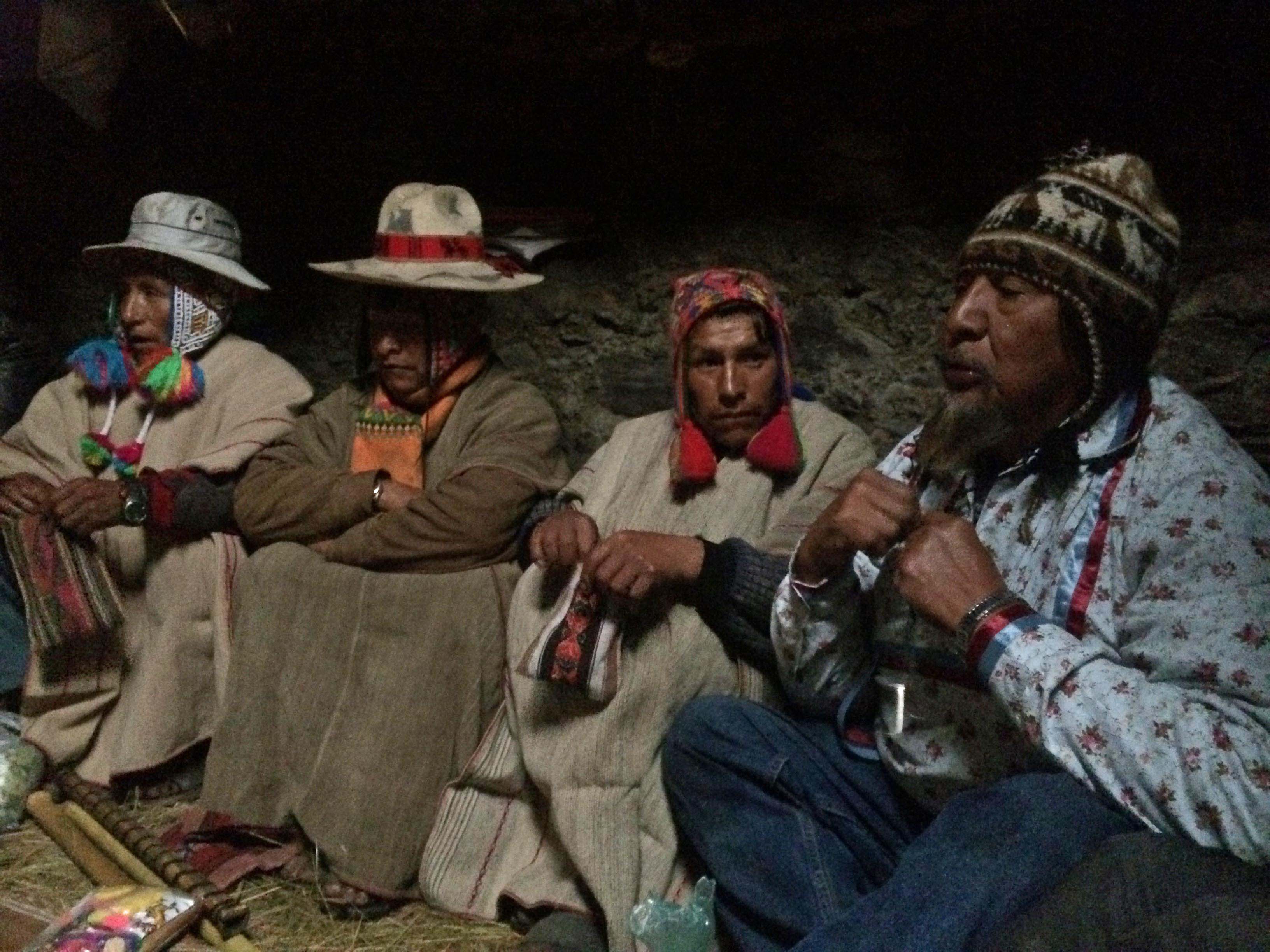
The Q’ero and spiritual guides honored me by inviting me to sit in on the ceremonies and observe. I recognized the po.nga (altar) and offerings to be similar to Hopi. At one point I was asked to pray with my hooma for them: to ask the deities’ especially Hopi to help and assist the people to prosper. I quietly prayed, gave offerings of hooma, drank the cool tasty water and bathed symbolically at the springs.

Each day I visited archeological sites with our group and host. Visiting the great Titicaca Lake, to hear a local legend of a great city, which was flooded thousands of years ago sitting at the bottom of the lake. The more I saw, the more I was reminded of how the structures, stone walls, the land and historical stories are similar in the Hopi Southwest. The migration symbol is common to the Southwest but seeing it in South America helps support our Elders’ stories of Hopi migration from the south: ‘Palatkwapi.’

Suhongva Marvin Lalo

Suhongva Marvin Lalo, Island of the Moon. Photo credit: Carla Woody.

When we know our origins, it grounds spiritual identity. We know our place in the world through all the places our people traveled, the ground their feet have touched. It goes beyond mere belief. I’m not sure the word ‘faith’ is even sufficient.

And when you’ve followed something that you know, even as you don’t know what’s ahead or why…and it comes to some kind of fruition in a way you couldn’t even have imagined…that instills something for which I have no words.

That’s what happened for me on this journey. Next year it will be ten years since an eagle and condor flew together overhead at Huaypo Lake outside Cusco after a despacho ceremony with Q’ero friends. And I had an immediate vision of bringing Hopi people to Peru on my 2007 program…not knowing any Hopi…not knowing it was their migration path…not knowing how it would ever happen…not knowing of the Eagle Condor Prophecy.

I have no words.

********

* Viracocha, Creator-Sun God, is also known as Inti.

** Q’ero paq’os (meaning priests, mystics and/or wisdom keepers) traveled to Bolivia from their home in the high Peruvian Andes as sponsored guests and experience the site of their origin for the first time. At important points in the journey they guided despacho ceremonies, a prayer ritual.

Suhongva Marvin Lalo of Walpi, First Mesa in Northern Arizona was our sponsored Hopi guest for the purpose he mentions in this article. Marvin consults for the Hopi Cultural Center in validating sacred sites and artifacts.

For more on why Kenosis Spirit Keepers has been sponsoring Indigenous guests on our spiritual travel programs, go here.

Categories: Gratitude, Hopi, Indigenous Wisdom, Spiritual Travel | Tags: , , , | 6 Comments

An Integrated Life

Living in a Western culture your life is compartmentalized. Maybe not across the board but largely so unless you’ve made a concerted effort to change what’s handed to us. That means creative expression is separate from work, which in turn is isolated from spirituality. Possibly the closest overlap may be spirituality relating to family or relationship. Or if you’re in a creative field of work where your deeper needs may be unleashed. Such disconnection results in dissatisfaction—an underlying sense of emptiness and lack of freedom that snowballs over time. Containment. I’m quite sure it wasn’t always that way but probably began with the Industrial Revolution and a move away from the land and community. The fact remains: it’s undeniably present. People attempt to fill the hole with ways that don’t work and are often quite harmful.

I had two reminders recently that initiated this post. A young woman from Los Angeles came into The Gallery in Williams, an artist cooperative where I’m a member. I happen to be on duty. When we struck up a conversation, I identified myself as one of the artists.

“I’m an artist,” she said then gestured to her partner. “But he’s a fine artist.”

“What does that mean?” I asked.

“He’s a full-time artist. But I work in a corporation. If I ever have time, then maybe I can do a little something.” Her shoulders slumped, and I could see she rarely had the time or energy left over to devote, given her hours and pressures at work.

Full moon over Bolivia. View from Island of the Sun, Lake Titicaca. ©2015 Carla Woody.

Full moon over Bolivia. View from Island of the Sun, Lake Titicaca. ©2015 Carla Woody.

I told her I used to live the same way. But over time I made conscious decisions to realign my life to what I believe, care about and what gives me energy rather than takes it…that it’s truly possible…that I had to do it for my own wellbeing or suffer the consequences. She asked for my contact information and said, “You’re going to hear from me.” Whether I do or not, I sensed we weren’t just making small talk. In those few moments, possibility created a crack in a previously closed space. And as Leonard Cohen said, “That’s how the light gets in.”

The issue: We don’t have many role models within our culture for those who lead an integrated life. I feel fortunate that I’ve had ongoing influences over twenty years. But it didn’t come from my own culture. I began to understand there was another way to live because I witnessed it within traditional Indigenous communities, especially those where I’ve spent consistent amounts of time. That’s how I know what I’ve seen isn’t isolated. Spiritual beliefs aren’t relegated to one day or a few minutes a week. They permeate everything: the way fields are tilled, the manner food is cooked, how children are raised, the things they create, and how communities interact.*

All is soundly grounded in such a way that gives life meaning and depth throughout. I have so much gratitude for this exposure, which has taught me the “how.” After a time of repetitive experiences, I consciously began to change how I live my own life. In the beginning, it seemed radical and difficult. Now it would be so to live any other way. Any aspect of my life organically dovetails into another.

Modesto

Modesto, long-time Q’ero friend and father to my godson, making prayers to the Pachamama (Mother Earth) and Apus (sacred mountain spirits) during ceremony outside Cusco. ©2015 Carla Woody.

I’ve just returned from this year’s spiritual travel program in Bolivia and Peru. Our Hopi program is coming soon in March, an opportunity for a solid week of witnessing what I discuss here. So my thoughts on integration are very present.

In closing circles I’ve heard concerns from travelers whether they’ll be able to experience the same depth at home. Of course, you can. Any deeply spiritual experience lives inside you always—no matter the form of its delivery. It becomes part of your identity and can be readily called into consciousness if you need a reminder.

I’ve also heard comment about withholding such spiritual consciousness, as though it would become tainted, if carried over to another aspect of life—usually work. Why would you want to keep it in the closet? That would cause internal conflict. (Understand I’m not talking at all about proselytizing, a different matter entirely I find an offensive intrusion.)

When you live through your spiritual values, there’s a trickle down effect shaping who you are in the world, what you believe about yourself and others, how you approach matters, what you create. It doesn’t even involve talking about those values. Yet, all shifts. It’s often visible to others as well. Even if they can’t put their finger on the difference.

I long ago realized folks come to engage in these journeys for reasons they may not be able to articulate but are present throughout all the same. It may play out in different forms but the desire for clarity, resolution and integration are primary and inform re-entry home.

We’re all tested all the time. It comes down to belief about possibility, choice and knowing the “how to.” It means staying strong so you can walk through life with grace. It means knowing the full sense of your birthright and giving yourself a chance to own it.

*********

*That doesn’t mean influences for Indigenous peoples to get off track are nonexistent. There are, mostly coming from Western ways. If they give in to them, the same angst occurs and harms wellbeing…maybe more so because their blood knows another way.

********

Invitation: Join us for our December 4-5 Spirit Keepers Series in Phoenix where Eli PaintedCrow, Yaqui-Mexica Wisdom Keeper, and I offer a primer on ways to walk in two worlds—Indigenous and Western—and live through spiritual values. Donation basis.

Categories: Global Consciousness, Gratitude, Healthy Living, Indigenous Wisdom, Spiritual Travel | Tags: , , , | 2 Comments

How I Released My Monkish Ways

I don’t even remember when I began citing The Monk. It could have been after I had a past life regression back in the early 1980s…and there he was. It had something to do the Inquisition. Even as I witnessed him, I felt all the grief, guilt and overwhelming hopelessness at the state of the world. It was a visceral experience that, over the years, I automatically pulled up whenever I thought about that trance experience. I’m also clear it was hovering, always just beneath the surface. I don’t really know at this point what I believe about past lives: whether they’re real or not. Or if regression is just one tool among many others to uncover what was already there, lodged in the recesses of the mind but unknown. At any rate, I had an over-the-top response that stuck.

For years I’d toss off these words: I’m a monk. I’d usually laugh when I’d say it, as though whatever it was I was talking about was a tendency I just couldn’t help.

Understand this: I know about metaphors, what they presuppose, how they shape what we get or don’t get. My words were totally unconscious…until one day this metaphor—that I’d added to my operational identity—hung in the air before me demanding my attention.

We all use metaphors as a way of speaking about experience. A metaphor is not the experience itself but how we relate to what we’re describing. Language is peppered with them to the point we can mostly agree on their meaning. Advertisers are savvy in using them to attract us to their product. The best writers tuck them with precision into their prose to take us where they intend.

The important thing to know is how the language you use reflects your inner experience and mindset. Once you’re trained in this area, it doesn’t take much listening to someone for a short period of time and have an understanding of their reality: unconscious beliefs and thought processes that predict responses and behaviors that are played out over and over.

The trickier part is to recognize aspects within ourselves as well as what we note in others. We all live behind our own eyes and ears after all. The elements may not be so readily visible. However, you do know if your life is working the way you want or if it isn’t…or needs fine tuning.

If you think about a monk what comes to mind? A bare, solitary cell. An ascetic. Vow of poverty. Others first and foremost. Never self. Communal living. Life of prayer, quiet holy works. There are sides that are useful and those that aren’t depending on your perspective.

Take The Seeker. There’s a desire for something, attributes of curiosity and risk-taking. But The Seeker continually seeks and doesn’t find. And may take a series of missteps, which feed the cycle of seeking. The Seeker hasn’t yet determined internal values to the degree there’s clear discernment regarding choices or the path sought. By maintaining The Seeker, unending options prevail.

The Starving Artist is similar to The Monk except the religion is art. I’m an artist but readily sidestepped that one. It just didn’t stick.

You may now realize it’s useful to learn the language of metaphor, understand the significance and uncover those you live by. If you find any not working for you, then decide where you want to be and an operating metaphor that aligns to it.

I found some very old notes, somewhat incomplete, from a workshop I used to do on this very subject. I’d jotted down a quote I think came from Joseph Campbell.

New life can only be created by metaphoric mutationsynthetic re-creation of the old, and the old must be surrendered for this synthesis to take place. To give up one’s belief concerning some structure of reality, there must be an image that stands for the new goal or framework, even if the specifics or that goal are unclear. You need a strong image for the new goal to break completely with the old systems and risk your life for a new one. It’s the equivalent of asking a passionate question, until all ambiguity is erased and you really believe in your question. It will be answered; the break-point will arrive when you will suddenly be ‘ready.’ Then you must put your hand to the plow and not look back … or walk out onto the water unmindful of the waves.

Not long after The Monk made himself consciously known to me, an opportunity emerged.

Paul and Phoebe Hoogendyk answered a calling—of the kind Joseph Campbell described—received nearly twenty years before. Paul had been gifted with a greenstone, sacred to the Maoris, all those years ago, and then began receiving messages about a sacred journey they were to undertake. The purpose was to connect energy lines of sacred places in the world and leave a portion of the greenstone as an offering in each—holy intent, holy work.

In those earlier journeys they somehow found me and joined my spiritual travel groups in Peru and Mexico. It was a privilege to take part in their ceremonial process for the greenstones that now rest at 18,000 feet in a lagoon on Apu Ausangate, a most sacred mountain in the Cusco Region, and in the middle of Lake Nahá just outside the Lacandón Maya village of Nahá deep in the rainforest of Chiapas. They traveled to other remote areas of the planet to do the same: Tibet, Hawaii, Mongolia, the Arctic Circle and elsewhere.

I could hardly believe all the time had passed. The eleventh greenstone journey was imminent, next to the last. This one to the Orkney Islands in the northernmost part of Scotland. The Monk continued to pace back and forth in the forefront of my awareness. This land of standing stone circles was calling me for purpose, although I didn’t readily know what that entailed. I joined with other friends in late November 2011 meeting in Glasgow, a time when the snow falls and winds cry like banshees in that wintry place.

A thought began to surface about releasing my ‘monkish’ ways. How? It hadn’t yet taken form. I wanted to be respectful. The Monk had served his mission well. But he was ready to move on…and I was ready for him to move on. It was mutual.

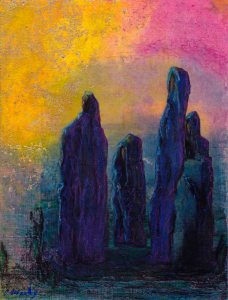
The Visitation

The Visitation
Mixed media on board.
©2011 Carla Woody

As we went to the Isle of Skye and then on to the Isle of Lewis and Callanish Stones … the answer began to come. And I would know the place by the energy that drew me. As we approached the Ring of Brodgar—an ancient sacred site entirely open to the elements where the wind howled and whipped—I felt it. I paused for a while making sure. Then I walked up to the first of the megaliths, placed my back firmly against its support and gave my oath, I release my monkish ways. I went on to do the same at each of the still standing stones, twenty-seven in all of what is believed to be sixty. And each time the wind reached in and snatched the words from my breath, taking with it bits of The Monk. The wind has always been my friend this way. And a presence was dispersed across that land. I think he’s happy.

Following a ritual or other forms of deep work such as this, undertaken with sacred intent, there’s always an integration process. As things settled out and found new meaning, some elements of The Monk remain but have shifted to a real sense of richness I hadn’t previously felt. I still spend a lot of time in solitude. It allows me to immerse in creative pursuits that feed me. I have learned how important it is to give to yourself first…so you can continue serving others well. I do still have to remind myself of that fact. But now it doesn’t take me long to readjust. I can absolutely serve what I believe in without becoming a martyr. That’s a line I now won’t cross. A metaphor in itself that I won’t invite in.

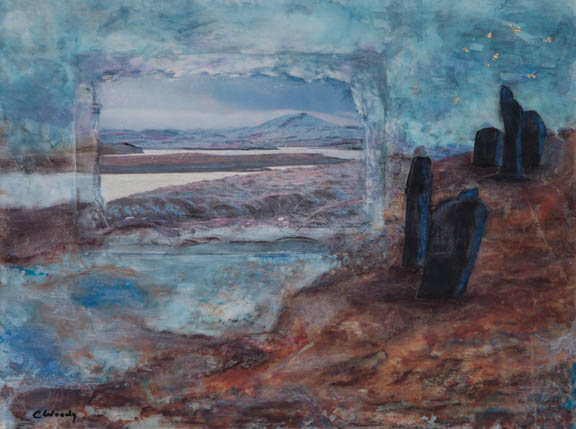
Winter Solstice

Winter Solstice
Mixed media on wood panel.
©2015 Carla Woody

Things evolve over time. This process for me has been no different. I note that Joseph Campbell indicates: You need a strong image for the new goal to break completely with the old systems and risk your life for a new one. The word “goal” doesn’t work for me. I prefer intent as a core element. I don’t yet have an image or an articulation. But I know it’s there. I feel it. It continues to guide me along this deeper path to an as yet unknown dimension holding the intent.

***

The eleventh greenstone rests in the waters near the Stones of Stenness in the Orkneys. To learn more about the greenstone journeys and the work of Paul and Phoebe Hoogendyk, go here. At the bottom of that page you’ll see the symbols of the twelve journeys. Click on each one to read their story and location. The third volume of Set By the Ancients, the story of the greenstone will be available in the first part of 2016.

Categories: Spiritual Evolution, Spiritual Travel | Tags: , , , , , | 2 Comments

Video: Jo Berry on Making Peace with the Enemy

On September 28, Kenosis Spirit Keepers and the Quad-City Interfaith Council co-sponsored a talk in Prescott, Arizona by Jo Berry, global peace activist, following the film screening of Beyond Right and Wrong: Stories of Justice and Forgiveness. She is one of those featured.

This video includes Jo’s moving words on the process she has gone through, her reconciliation with Pat Magee, one of the men who planted the IRA bomb that killed her father, and the reflections of the audience. For more background and a link to view the documentary free online, read my review here.

This is about our collective humanity and global consciousness. How can we pull together in the face of the alarming increase of violence and tragedy? View the video and film. You will witness how some courageous people are doing so.

I want to express appreciation to those in the Prescott, Arizona community who showed up and engaged. Also, many thanks to Prescott College, who provided the space, and their Media Center for filming the talk and discussion so we can share it with others. The graphic nature of the subject matter was very difficult to view but inspiring at the same time—showing how people can reach deep inside themselves to find common ground and heal.

Such venues to address the increasing violence in our world are so important, especially in these times, to explore what we as individuals can do to stop it. It’s always been the grassroots that have made a true difference. Not the politicians.

If you are in the Prescott, Arizona area and would like to participate in a free skill-building study group using materials provided with the documentary, email me with your contact information. I will pass it on to the person forming the group.

If you are interested in having a film screening and talk with Jo Berry in your home community, email your contact info and I will forward. Jo travels globally with this message of peacemaking and hope.

Categories: Compassionate Communication, Global Consciousness, Spiritual Evolution | Tags: , , , , , | Leave a comment

Film Review: Human

Human Documentary

Over the last couple of days I watched Human, a series of three films just released by Yann Arthus-Bertrand, consisting of 2000 interviews over 3 years, covering 60 countries, on aspects of being human. The films moved me at such a level that words haven’t yet surfaced enough to string together a cohesive review.

This is what I can write. You could watch this series solely for the cinematography and soundtrack and it would be transporting. But if you also embraced the words, raw emotion and beauty, the courage and honesty of those interviewed speaking directly from personal experience, it will affect your soul. You see only their faces looking directly into the camera against a black backdrop. You hear only their voices, in their native tongue, distilled in a way you cannot ignore, translated into subtitles. Perhaps the best way to write this review is by directly quoting some of them.

In our language we have no such thing as ‘please’ or ‘thank you’ because what is expected of us is that we share and we give what we have…And not only for Aboriginal people, I expect people from all around the world would do the same before money…

…It’s not the gender of the person I love that defines me. It’s the quality of my loving that defines who I am…

…You must love all human beings for what they are deep down. For only the love of all people can save the world…

…What will I leave behind?…It has to do with the meaning of life…

…I’m very happy when it rains. When I drink milk and I have a good life. When I have a good hut that protects me when it rains…

…I always have amazing things happening to me…but that comes from believing in luck or believing in the power of attraction…Just my experiences of traveling the world in a wheelchair, I’ve seen life from a different angle…That’s taught me on a spiritual level to be happy…

…When we work the land it gives back in silence…

…Why did you, the company, destroy the farmers’ lands?…

…Let’s make a human chain so the monks can get away…

…You shall see who controls the world: you the politicians or we the people…

…There’s a universal dynamic and I want to be a part of it…

As the credits were rolling on the last film one of those interviewed is shown saying: You’ve brought up important things for me today. The films have done the same for me. Having watched the testimonies of people spread around the world, I will be making my own daily choices more thoughtfully.

Watch the trailer on You Tube.

View the series of three films for free streaming online on Films for Action. Each one is a bit less than 1.5 hours but may be viewed separately at your leisure.

***************

Two of the interviewees were also featured in the film Beyond Right and Wrong that I reviewed last month.

Categories: Film Review, Global Consciousness, Spiritual Evolution | Tags: , , , , , | 2 Comments

Through the Dark in Still Point Arts Quarterly

Fire flute

Xavier playing the fire flute, his own translation of a ceremonial experience. Courtesy photo.

I was privileged to interview Xavier Quijas Yxayotl, who grew up on the streets of Guadalajara, Mexico. Until adolescence he was spurned by peers, misunderstood by teachers and family alike, often abused. Then an unlikely benefactor came forward whose support opened possibilities. But it was the boy who stepped up, seized them, grew his talents and embraced the Huichol Indian lineage his family denied. Especially notable, he resurrected ceremonial instruments of his homeland that were lost to time; the way to do so came through dreams. His is an inspirational story of a boy who answered his calling—against all odds—and went on to become internationally known as a composer, ritual musician, artist and spiritual healer.

I’m delighted to announce that my article Through the Dark is being published in the Fall 2015 issue of Still Point Arts Quarterly, a literary arts journal, with much appreciation going to Xavier for indulging me. Here’s the preview of a story of true intent.

The boy fidgeted. He was in foreign territory, held prisoner by his mother’s hand on his arm. They sat side-by-side in matching chairs before the great divide of a massive desk. His mother’s voice rose and fell. Words tumbled over each other as though, if she didn’t get them out fast enough, the man considering them would summarily swat them out the door, no different than pesky insects.

An hour before, his mother pulled him along inner city streets into a massive building. They finally stopped in front of one door among several down the long hall. She smoothed her skirt and combed fingers through his black hair. With a deep breath, she opened the door. The secretary looked up.

“Please, I would like to see the director,” his mother said.

“Do you have an appointment?” The secretary appraised them, noting their dusky skin and worn clothing. When she shook her head, the secretary motioned them to a row of chairs against the wall and picked up the phone. They waited.

The man behind the desk was impeccably dressed in a gray suit matching the color shot through his dark hair and mustache. The lines in his face softened as he listened, shifting attention from the Indian woman before him to the boy, eyes downcast, clutching a notebook in his lap. “Maestro Caracalla, I am Señora Isabel. This is my son Xavier. He’s different, a good artist. In school he always fights because no one understands him, not the teachers, not the other kids. He’s always thinking. Since he was old enough to hold a pencil, he always draws and writes about everything. He’s like an old person in a little boy’s body!”

The woman continued at length relating how, in the last two years, her son kept running away to live on the streets. Xavier slept in parks, skipped school, survived by selling newspapers and shoe shines. Terrified, she would search and drag him home, if she was fortunate to find him. But the next day he’d be gone again. He wouldn’t do what his father wanted: to set aside these silly pastimes, to work making shoes to help support the family.

“We have seven children. Xavier is the youngest boy. We are very poor. But he is so different and I’m afraid what might happen to him. Is there something you can do?” She finished softly.

Maestro Caracalla gestured to the boy’s notebook, “Is this your work?”

Xavier froze in his chair and prayed to disappear. He didn’t think the Maestro would hit him like his father did, but he dreaded the reprimand he knew would come. He whispered, “Yes.”

“Show it to me then.” The room was silent save the sound of Maestro Caracalla slowly turning pages after scrutinizing each one. Finally he closed the book. Looking over wire-rimmed glasses, his eyes seemed to bore into Xavier’s very soul. He gazed at Señora Isabel then back at the boy, whose reddened face was moist with sweat. “Señora, I don’t think you have any idea what a beautiful child you have. What ideas! His writing doesn’t match his age. He’s not a normal child. You have to do something with him. We have to help him!”

Maestro Caracalla told her to bring the boy back the following Monday, handing over a long list of art materials to buy. There’s not enough to eat! How can we buy art supplies? Guilt flooded Xavier’s mind. He was certain of a dead end. But at the appointed time his mother delivered him to the Maestro. She could only muster a clean new drawing tablet and 6B pencil, keeping even that small expenditure hidden from her husband. The secretary ordered a sandwich for Xavier, although he said he didn’t need anything.

“Ah, there you are,” the Maestro swept in from his office. He took Xavier by the hand and led him down the hall. They stopped in all the classrooms where he spoke to the teachers, “I want to introduce Xavier. He’s coming to take classes.”

That is how an eleven-year-old Huichol Indian boy from the streets came to attend Escuela des Artes Plásticas, the art school in Guadalajara, Mexico—the youngest pupil ever to sit alongside regular university students. They became his peers and friends. Maestro Caracalla continued as his benefactor for six years, making sure he had all the classes he needed: writing, painting, art history and more.

Still Point Arts QuarterlyTo obtain the Fall 2015 Still Point Arts Quarterly—a beautifully illustrated journal featuring art portfolios and featured articles—and read the rest of his fascinating story, go here.

Categories: Arts, Creativity Strategies, Indigenous Wisdom, Spiritual Evolution | Tags: , , , , | 2 Comments

Release

Stopped short. Pain out of nowhere…and it recurred over and over with increasing frequency and intensity. It was a mystery. I hadn’t hurt myself in any way that would warrant it. I couldn’t even track what movement caused it. But the laser-like sensations zeroed in on my trunk, and the points shifted inexplicably, as if it wanted to remain elusive. It literally brought me up sharp, halting motion.

I began to have real concern, particularly on how such transient pain, consistent only in its constant appearance, would affect my ability to be fully present. An important journey was coming up—my Heart of the Andes program in late October. Those 2014 travels involved riding a horse and hiking at elevations up to 16,000 feet on our way to the Q’ero village of Ccochamocco.

Arrival in Ccochamocco

Arrival in Ccochamocco in late October 2014.
Photo credit: Sage Garrett.

By that time, I had already attempted to address the issues in ways I thought would work to loosen things up: Swedish massage, deep tissue massage, network chiropractic, regular chiropractic, energy work. All gave temporary relief but not what was needed.

I’ve been a spiritual mentor and practitioner of holistic health for over 20 years. I knew that, more than likely, this physical challenge I was dealing with had a strong, integral mind-body-spirit component.

I remembered back to the mid-90s when a man came to me with severe pain originating in his neck and radiating down one arm. He told me it was so severe he’d gladly cut his arm off to get rid of it. That’s pretty severe. He’d been medically diagnosed with osteoarthritis. The doc told him there was nothing he could do about it.

But I was listening to his language as he spoke about the progression of the pain and asked him: What was going on in your life when you first noticed discomfort? He’d identified a time nine months prior. He thought about it and said with surprise: It was the break-up of my relationship, and I had no control over it! I then guided him through processes to resolve any lingering grief, and then forgiveness. His pain disappeared entirely. It happened in one session.*

During the processes we used, he also realized he’d been conflicted about issues within the old relationship that resolved during our work. I followed him for about a year after that. The only time he’d had any slight recurrence of pain was when he wasn’t being true to himself, which he adjusted. The body has a wonderful way of giving us signals to those things we attempt to push aside or are unaware of in the first place. Hence, we’re supported in our spiritual development this way if we pay attention.

I knew to ask myself these questions and did so. Indeed, I identified an exact point a number of months prior when—out of nowhere—something occurred that went against my values and caused a foundational break for me. Isn’t it interesting how the body can mirror…and what better place to reflect such a thing than the first chakra region, that of foundation?

The truth is: This was an area of my life I’d been uncomfortable with for quite a while. I just didn’t want to look at it. I was forced into it through the circumstances. It had to do with loyalties and impeccability. Qualities I hold highly. But I finally had to answer a question a few folks had directed to me in the last years: Why do you maintain such loyalties when it’s really not beneficial?

I began to do the self-work I knew needed to be done, and over the next couple of months lost the emotional charge to the event that instigated this deep work. In fact, I became grateful for the incident. I experienced relief and so much more alignment. I felt some slight physical discomfort during my Peru program that dissipated entirely over the course of the journey.

But then I returned home.

I address re-entry with the folks on my spiritual travel programs, counseling them how we’ve been in a beautiful, expansive cocoon, an altered state really. It’s necessary to create such a space so that such deep learnings can enter and gain a heart-hold. When we return home though, things at home haven’t changed even though we have. It’s a time of integration and realigning those things hanging out there not fully addressed.

There was that pain again right on cue.

I finally asked my massage therapist, Rhonda Hamilton, if she had any ideas. She’s well plugged into the alternative healing community in our area. She recommended I make an appointment with Ruth Backway, a physical therapist in town who has an excellent reputation. I called for an appointment and was told by the receptionist that she had a long waiting list. But through some miracle, Ruth called me back and got me in within a few days.

I was not in good shape when I showed up at the end of her workday. This woman knows what she’s doing. And my body responded readily as though it had been poised for release. When I left session that day I’d say I was about 80% better. Over the next few weeks I saw her, I vastly improved to the point of complete release.

Release is the operative word and state here. Unbeknownst to me, my entire trunk was twisted to the left. Bizarre. How do such things happen when nothing to cause it occurred? She directed her work on the fascia in that area of my body, the slippery membrane that holds organs and muscles in place. Her approach was painless, a gentle holding until the fascia let go….as though all it wanted was acknowledgement. Isn’t that what we all want?

Ruth had questioned me closely on any accidents I may have had over the years. The only one of any significance I could remember was relatively minor when I was 18. But it was the one I mentioned. In my own practice I always pay attention to what is mentioned, even if it’s not the most obvious. We carry our own wisdom.

Ruth had me recall exactly what happened… and I remembered even the angle of impact…which it turns out was mirrored in my body in the present issue. The question she in turn asked me to consider: Why is this coming up all these years later? We’re talking 40+ years after the fact, especially with such force, when there was no visible injury or emotional trauma at the time. An old pattern stepping forward perhaps?

Why am I telling you all this? Sometimes things hold on…or may have gone underground but affect us in ways we don’t discern…for years. Sometimes there’s a conflict, generating an attempt to go two ways at once. It stops us in our tracks. Sometimes these aspects look for an avenue of recognition, maybe through related issues or correct timing. They become exacerbated.

Any mind-body-spirit residue must be fully identified and released in order to move through the next threshold. When it’s something deep, we can’t address it fully ourselves—even if we have all the tools—and it takes guidance outside ourselves, someone who knows what they’re doing and can see the forest for the trees…and the way out.

With Maya spiritual leaders Don Xun Calixto (l) and Apab'yan Tew (r) in January 2015.

With Maya spiritual leaders Don Xun Calixto (l) and Apab’yan Tew (r) in January 2015.

I am so glad I did. The momentum through the threshold is palpable.

*********

*To read an article originally published in Anchor Point Journal on The Effect of NLP on Physical Pain and Trauma relating the case history in this post, go here.

Categories: Gratitude, Healing, Healthy Living, Spiritual Evolution | Tags: , , , , , | Leave a comment

Pilgrimage

Pilgrimage infers travel, a journey undertaken with intent—not as a lark, although fun can be a part of it. Sometimes the mission is known ahead. Or it’s discovered along the way. Just as true, it may only be in hindsight, a lengthy time passed from the conclusion, that all comes into focus. Ah, there’s the reason I went…

One thing is certain. It’s a passage made with holy purpose, and you must leave the homeland in order for the pilgrimage to occur. I’m using the word ‘holy’ for a reason. It’s a term people usually back away from because of its connotations, often for the same reasons ‘pilgrimage’ is given wide berth. Here I’m using both for common purpose, giving them due because they take us to a place we normally don’t dwell.

To undertake a pilgrimage, your soul must come through, reaching out from that core level. It’s a call to engage, go deeper. It’s a yearning to venture into the unknown. Some conclusion is sought. It’s time to step beyond a threshold, out of the status quo.

Your soul is offering the invitation. But it’s your everyday self that has to accept it at some level because…

 You’re offering yourself up to a foreign land…

Little is likely to be what you’re used to…

There’s certain to be physical, emotional or mental discomfort—maybe all three!

And it’s through such radical departure that you discover what you’re made of—sometimes quite the surprise. As a result, you’re enlivened. Your constructs are stretched. You’re taken beyond your limits. Your new world emerges.

Sometimes folks attempt to fool themselves into it by saying such things as:

 I’m expected to do it.

I’m here to support my spouse…friend…(fill in the blank).

That’s a place I always wanted to visit.

 Whatever it takes to get you there is fine. In the end, there will be certain recognition for most:

 This is spiritual travel. And it’s pure medicine.

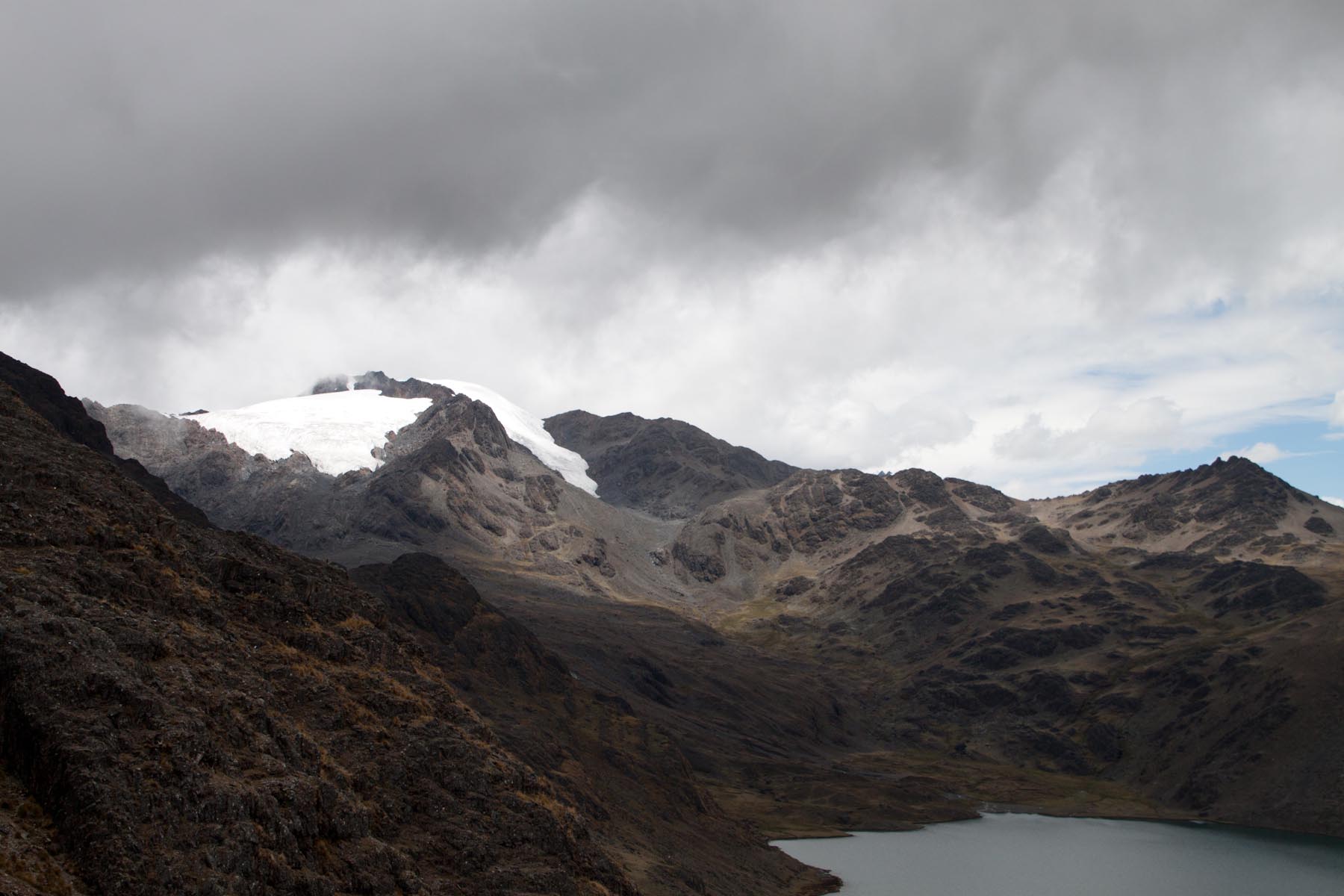
In early November I returned from The Heart of the Andes during which we made a pilgrimage to the Q’ero village of Ccochamocco, perched at 14,300 feet.* Harold Joseph, a Hopi Wisdom Keeper from the village of Shungopavi, Second Mesa, Arizona, was sponsored by Kenosis Spirit Keepers as an emissary for his religious leader Lee Wayne Lomayestewa with a mission to request prayers from the Q’ero community for continuity of threatened Hopi traditions. Harold said, “The Q’ero spiritual leaders make strong prayers!”

There is no road up to the village. In order to get there we sometimes rode on horseback, much of it walking through some of the most beautiful and steep landscape I’ve experienced. Harold stopped a number of places on our journey to give his own prayers and leaving offerings, as well as during despacho ceremony during our time in the village.* We were truly privileged to be part of all of it.

Hopi Harold Joseph (rt) during despacho ceremony with Q'ero spiritual leaders. Photo credit: Sage Garrett.

Hopi Harold Joseph (rt) during despacho ceremony with Q’ero spiritual leaders. Photo credit: Sage Garrett.

The highest point to and from the village is 16,000 feet before descending. On our return, as some of us were already ascending, I began to hear a voice echoing from the valley below, calling forcefully every few minutes. I couldn’t understand the words or see who it was. Later I learned it was Harold giving us all a message that Hopi Spirit Keepers used with each other during times of challenge in the kiva, after many long hours of prayer or enduring inclement weather during ceremonial dances.

Be strong!

Pilgrimage to Ccochamocco

The highest point at 16,000 ft on the pilgrimage to Ccochamocco. Photo credit: Carla Woody.

Return from Q'eros.

Returning from Q’eros. Photo credit: Carla Woody

He said it’s meant to strengthen spiritual warriors, to remind them they’re doing what they’re doing for more than just themselves. They’re doing it for their community and more…for all humanity. I will never forget Harold’s message bouncing from mountain to mountain.

After we were home for a few weeks, Harold sent me a note about our spiritual travel journey: “The effect on my life has been enormous in terms of the spiritual connections that was made in behalf of the Kikmongi.*** The awareness that we are spiritually connected to creators and keepers of life: Katsi. No changes in my life but emphasis on the importance of carrying on my responsibility as a Hopi and its ceremonial practices that rejuvenates life here on Mother Earth and the Universe for future generations.”

Harold Joseph. Photo credit: Sage Garrett

Harold Joseph. Photo credit: Sage Garrett

In early May I will begin walking the Camino de Santiago, a 500-mile pilgrimage in northern Spain. My old friend Oscar Panizo is going with me. People ask me why I’m doing such a thing. I can’t honestly give a concrete reason. I just know I’m called to undertake it. The whisper had been hovering in the background for a while, and now is the time.

I also know without a doubt: I will repeatedly hear echoes through time—Harold’s voice encouraging me.

*********************

*The next Heart of the Andes will be October 23-November 5, 2015 and include Bolivia and Peru as a special initiation journey mirroring the path designated by Viracocha, the Incan Creator God. Six Q’ero Spirit Keepers have been invited to accompany us in a pilgrimage that will take them back to their origins. A portion of tuition is tax-deductible to support their sponsorship.

**A despacho is a prayer or blessing bundle made in ceremony by Quechua and Q’ero peoples of the Andes.

*** Kikmongi is Hopi for religious leader.


Categories: Hopi, Q'ero, Spiritual Evolution, Spiritual Travel, Travel Experiences | Tags: , , , , , | 5 Comments

Series Review: Sacred Journeys with Bruce Feiler

In December, PBS aired a series called Sacred Journeys with Bruce Feiler. Given that I offer spiritual journeys myself, it caught my attention. Bruce Feiler is the bestselling author of several books on religion and contemporary lifestyle, as well as New York Times columnist for This Life in the Sunday newspaper. In the program, he goes along with US travelers to six separate sites around the globe as they participate in sacred gatherings and pilgrimages. As viewers we get hour-long glimpses of:

  • Lourdes, France where the young peasant girl, Bernadette Soubirous, claimed the Virgin Mary appeared to her over a period of time in 1858;
  • A 750-mile pilgrimage route on the Japanese island of Shikoku to 88 temples and shrines honoring the esteemed Buddhist monk Kobo-Daishi, responsible for bringing Buddhism from China in the 9th century;
  • The holy sites in Jerusalem encompassing Judaism, Christianity and Islam;
  • The annual Hajj pilgrimage to Mecca in Saudi Arabia, which mirrors Muhammad’s return to his home as leader of the new Islamic religion;
  • The Kumbh Mela, the largest religious gathering in the world, occurring every 12 years at the intersection of the Ganges and Yamuna Rivers in Allahabad, India;
  • The annual festival of Osun-Osgobo in Osogbo, Nigeria, honoring the goddess of fertility, Osun, of the Yoruba religion.

All features in this series are worth the watch. They’re inspiring and caused me to look at my own reasons for pilgrimages I’ve taken…and the one I’m preparing to take.

The Lourdes segment focused on the annual International Military Pilgrimage that has been ongoing since WWII. This filming showed US veterans of the Iraq and Afghanistan wars, carrying visible and invisible wounds, and was especially poignant.

The Yoruba feature was particularly interesting to me, showing elements of initiation rituals. An explanation offered why there were influences from other religions incorporated into Yoruba: As with many sacred traditions, those who are indigenous to the land incorporate the conqueror’s religion in order to stay alive. They become so intertwined in order that the original form may survive, even if hidden. The statement validated what I’ve seen in some Native traditions I’ve known, and sought to explain myself.

Inasmuch as this series is a visual feast for variety of cultures and spiritual rituals, there’s a thread that remains constant: the sense of seeking and renewal. The pilgrims “move between the questions in their lives” and “step outside themselves to reach for higher meaning.”

I found the pilgrims’ expressions and intent in these segments to be no different than those of the travelers on the spiritual travel journeys I sponsor.

Streaming free at PBS online for a limited time. Also available via DVD or to download.


Categories: cultural interests, Film Review, Healing, Spiritual Evolution, Spiritual Travel | Tags: , , , , , | Leave a comment

We Are All Artists

When I’m especially taken with a book, I greatly anticipate the author’s next one. This was the case with one of my favorite novelists, Jim Fergus. Visits to his website had promised one for several years, even with a specific title and subject matter that is of interest to me. But each time I checked … nothing … and I’d log off disappointed. A few weeks ago I checked, this time discovering he had a new one out. I promptly ordered it. Yet again he’d produced a story that touched me in tender places, as much as it informed. I did something I don’t normally do: I emailed him to express my gratitude that he’s writing again.

He responded. It started a conversation.

Jim told me the book had been published in France and done quite well. But when he went searching for a US publisher, no one was interested. Unbelievable, I thought. This is a writer whose two previous books—One Thousand White Women and The Wild Girl—were bestsellers! But with this new one? He’d stepped out of his genre of The West and Native Americans. He was no longer in the neat slot US publishers had placed him—therefore, a risk.

He went on to say the specific title he’d named on his website, Marie-Blanche, was published in France in 2011, currently in development for a mini-series there. Same problem with US publishers. Jim finally decided to self-publish The Memory of Love, the novel I’d most recently read … just to have a new book in print in my own country.*

This goes to show that even widely celebrated writers—and any such artists really—don’t necessarily have it made, as our fantasies tell us. They’re subject to the same tight restrictions and imperious whims if they depend upon the old-school bureaucracies and structures.

Now he’s writing a sequel to One Thousand White Women, the genre he’s known for, accepted by US publishers. There’s no doubt I’m wildly anticipating its publication. And I’m quite sure it will be a commercial success.

However, the unconventional part of me automatically made an appearance. I shared that I’d written three books and had chosen to self-publish specifically to avoid all the nonsense traditional publishers try to lay on you. I don’t have the time or energy to deal with it. Those who have found my books receive them quite well. **

I also mentioned that it’s the same with most art galleries. To accept an artist’s work, they want to make sure you’re consistent, no matter your talent level. Consistent in this definition means same general subject matter and media, same slotting as above. I’m fortunate to have found two galleries who are happy to show my work, no matter how much I experiment. And I do. I’m not a production line.

All aspects of my work—mentoring, spiritual travel programs, writing or art—appeal to a particular small niche, not the mainstream. And I’ve got much gratitude to those who engage with any of it. It means we’re part of the same tribe.

I often listen to Krista Tippett’s On Being interviews when I’m painting. I find them inspiring, and they sometimes inform the piece I’m working on in the moment. Right on the heels of the conversation I relate above, I listened to her interview with Seth Godin on The Art of Noticing, and Then Creating. No coincidence. Here are some relevant take-aways … ***

  • The assembly line is going away. The things that used to make you feel safe are now risky.
  • Putting something new into the world? The industrial order doesn’t want us to do that.
  • Change comes from the margins.
  • When you do something out of the box, you’re not going to be picked by the old regime.
  • Bottom-up change is the future, not top down.
  • One person can make a difference. You matter.
  • Find people who agree with you and lead them to greater depth.
  • You’re an echo of your art if you’re not making new art.
  • Do it as the gods would do it: with intent, no holding back.
Mystery School in process on the easel.

Mystery School currently in process on the easel.

This is the time of year—as we’re on the threshold of the next one—when I remind myself of these truths by viewing Sean Connery’s rendition of Ithaca by C.P. Cavafy, featured in this blog before.

It reinforces my intent.

 Engage your passion. Fine tune. Put it out there.


 ***

 *My conversation with Jim Fergus was relayed here with his complete permission. This is the review for The Memory of Love I uploaded to Amazon and originally sent to Jim with my first email:

Truly, Jim Fergus is one of my favorite novelists having also read  ONE THOUSAND WHITE WOMEN and THE WILD GIRL. This book is indeed a departure but at least equal to the others. I was personally touched by Chrysis’ striving against convention and evolution as an artist, and Bogey was portrayed as though the writer had lived inside those very emotions. The foreword shared why a man could write this way about love, and only at the end did I realize the characters had actually lived. I’d been waiting a long time since THE WILD GIRL for Jim Fergus’ next novel. I’m very glad he’s writing again. Now I’m looking forward to MARIE-BLANCHE.

 **To view my books and readers’ reviews on Amazon, go here. To view artwork online, go here.

***I recommend listening to the unedited versions of On Being interviews with Krista Tippett. They’re much longer but without the fine polish that editing brings. They’re real.

Categories: Arts, Book Review, Creativity Strategies, Interview, The Writing Life | Tags: , , , , , , , | 1 Comment

Blog at WordPress.com.