Posts Tagged With: intent

What You Can Do in the Face of Devastation and Make a Difference

I received a very disheartening message. I want to share it with youeven though research statistics show that most people would prefer to see uplifting blog content. My feeling is there are just things I can’t ignore. I discount that, due to the immensity of a travesty, I can do nothing about it. That would be the easy way out, to push something aside.

I subscribe to Glenn Shepard’s blog Notes from the Ethnoground. Glenn is an ethnobotanist, medical anthropologist and filmmaker who lives in Brazil and has spent many years doing on-the-ground research in remote rainforest places. Yesterday his latest post ”A letter of protest: In defense of the rights of indigenous peoples and traditional populations in Amazonia” arrived via email. 

The post is about a proposed change to a law currently in the Brazilian House of Representatives “to make changes to Article 231 of the Brazilian Federal Constitution of 1988 defining the public interest in demarcating Indigenous Lands.” It has to do with ancestral land rights of the Indigenous peoples of Amazonia. If passed, it would take away many of their rights in favor of those who have encroached: cattle ranchers, mining operations and more.

Guarani People

Photo credit: Survival International

This is not a new issue. It has been going on for decades with terrible consequences. Not only is the rainforest threatened but Terena, Guarani and other Native peoples have been murdered in defending what is theirs. We rarely hear of these things because they don’t get reported. I did some research of my own and turned up this August 8 news article from the Guardian in the UK. It reports on the killing of a Guarani man believed by Survival International to have been ordered by a landowner, as well as other murders of Native peoples numbering “452 between 2002 and 2010, sharply up on the 167 killed during the previous eight years.” The article accuses the Brazilian government of “pandering to agro-business lobby rather than reallocating areas to indigenous peoples.”

Guarani and Kaiowa Indians are in conflict with ranch owners over the allocation of land in Brazil. Photograph: Celso Junior/AP

Guarani and Kaiowa Indians are in conflict with ranch owners over the allocation of land in Brazil.
Photograph: Celso Junior/AP

 If you’ve read this far, then you likely recognize a familiar story. Although the struggle of the Indigenous people of Brazil is especially heightened, similar things are happening in Native lands the world over. It’s a form of genocide. When the right to live on their own lands, grow their own crops and perform their own religious ceremonies is taken away, it’s devastating.

Have any of you ever lost a home? Been told your religious practices are evil, antiquated or ridiculous? Has your voice not been heard? Probably many of you have had such experiences. For traditional Native people, connection to ancestral lands, community, the foods they grow and ceremonies runs deep. It’s a matter of survival and what keeps them spiritually grounded. Take away these things and a sense of identity vanishes.

What to do about such things? It’s not an easy answer. Personally, I founded Kenosis Spirit Keepers  in 2007, a grassroots volunteer-run nonprofit organization, expressly because I believe so strongly in the contributions that these traditions make to the betterment of the world through continued existence.

Has it been a walk in the park to support projects we’ve committed to fund? No. We’ve had to be very creative to do so. I wish we were able to do so much more.

Does it feel to me as though my efforts and those of my board are like lonely raindrops in the wind? You better believe itespecially when I hear about such things as Glenn reported.

Yet, I can’t turn away. No matter how discouraged and tired I get…I just can’t. That’s because I truly believe the more people who feel the way I doand stay strong in that intentthat the tides will turn. We can make a difference. Looking back in history, I see the shift has happened too many times not to believe in what’s possible. I hold that you do, too.

***

Kenosis Spirit Keepers

To learn more about Kenosis Spirit Keepers and how you can help preserve Indigenous wisdom traditions, go here.

Categories: cultural interests, Indigenous Rights, Indigenous Wisdom, Sacred Reciprocity, Spiritual Evolution | Tags: , , , , | Leave a comment

Worthy of What Really Matters

I particularly wanted to post this note on Independence Day, our national celebration, as a call for remembrance. The Prescott, Arizona area—my home community—has been devastated by loss. A week ago the Granite Mountain Hotshots successfully contained the Doce Fire without loss to human or domestic animal lives or homes. Just a few days later on Sunday, June 30, nineteen firefighters from this elite team lost their own lives fighting the Yarnell Hill Fire. There are no words to express the horror and deep sadness that I feel, and that collectively runs through this spot on the map. No pat sentiments about God’s plan work in these cases where such things happen. And I recognize that they do occur all over the world.

Prescott firefighters

Remembering our fallen Prescott firefighters.
Photo credit: Les Stukenberg/The Daily Courier.

 I am so heartened to see how the community has pulled together to support the evacuees from Yarnell, many whom have lost their homes,  and to raise funds for the families of these courageous firefighters.

candlelight vigil

Candlelight vigil on July 2.
Photo credit: Les Stukenberg/The Daily Courier.

When Andrew Johnson-Schmit, a well-known community arts organizer here, posted this note on his Facebook page, I had to share it  on mine as I believe the same: I am going to remember tonight the next time I despair about this community getting its act together. When I wonder if we really all just can’t get along. When I am tempted to think the trolls in the comment section of Dcourier.com are really indicative of Everybody’s Hometown. Our Hotshots didn’t stop to squabble about whose houses they were going to save, if they’d lived there long enough to qualify as local, if they spoke English well enough, if they voted for the right party’s views, they defended our community and died standing in the way of devastation, between the fire and their neighbors. We can be a community worthy of that kind of sacrifice. I know we can.

 The news today says that the Yarnell Hill Fire is now 45% contained, up from 8%, after covering 8400 acres and loss of 129 homes.

These fires and the resulting tragedy put memories of an anxiety-ridden time fully back in my face, as well as the gratitude that came of it. In 2002 I lived up in Ponderosa Park, a forested community just outside Prescott where the Indian Fire started at a campground on the other end of the road. I’d been staying in the tiny guest cottage of a friend with my three cats while my present home was being built, all things but those I deemed most important in storage.

I was in my Prescott office when I received a call from a long-time participant in my groups telling me about the fire racing toward the cottage. I fairly flew toward home—but the police wouldn’t let me past the roadblock. All I could think about was getting my cats out. We’d been through so much together, I couldn’t stand the thought of losing them that way. Then I remembered that my friend Marilyn Markham Petrich likely knew the back roads through the forest to get me there. She never hesitated. This whole event had a profound effect on me to the point that I wrote about it in my 2004 book Standing Stark.

 …Returning along the same road, we came to a high point. I turned and looked back to see a ridge of flames leaping into the air and billowing smoke filling the sky. Watching the news after getting to her house, we saw that, blessedly for the residents of the little area where I stayed, the strong winds had chanced to shift in the opposite direction. Those homes were saved, but the forest and another housing area closer to town were not so fortunate…Then a miracle happened. The winds that had been wildly spreading the fire died down. In the next days we had some rain. Not a lot, but enough to slow things down. Within a few days the fire was contained, just blocks from the downtown area. 

…That first night as I was settling down to sleep in my new temporary quarters at Marilyn’s home, with the cats plastered to my side, I was extraordinarily grateful that I was not one of those who suffered a personal loss. I also felt soundly blessed that I had such a friend who was willing to rush madly with me into a potentially dangerous situation without any reservations. Everyone should be so fortunate.

But I was also aware that the entire town had shared in a deep soul-searching as to what really matters. Indeed, stories filled the newspaper and conversations for weeks. Handmade signs in shop fronts and driveways were evident proclaiming gratitude to the Hotshots who had risked their lives to help us. That was before people seemed to forget the tragedy and returned to their normal lives.

However, I was left again with a real understanding of how transient everything is, how what we think permanent isn’t…

This time let’s not forget what is truly precious.

To echo what Andrew said: We can keep in our hearts what really matters. We can be worthy of the sacrifices others make for us. We can pass on the same support to others. I know we can.

*****

I’d love to hear your thoughts on what really matters and how you keep it in the forefront. Please comment below.

Categories: Gratitude, Healthy Living, Sacred Reciprocity | Tags: , , , | 4 Comments

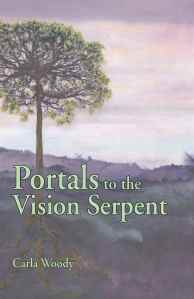
New Book Release: Portals to the Vision Serpent

Portals to the Vision SerpentI am pleased to announce that my latest book has been released and is now available in trade paperback and/or Kindle versions in North America,  Europe and the UK. The Kindle version is also available in Japan, Brazil and India.

As with all my books, I’m donating 10% of profits from book sales to Kenosis Spirit Keepers, the nonprofit I founded to help preserve Indigenous wisdom traditions—like those featured in the novel. Know that if you’re drawn to read the book, you’re also supporting these important projects.

Description

Preston Johns Cadell is tormented. He attempts to outrun discontent and the void in his heart. His mother is hardly around. His father’s origins and disappearance are shrouded by family secrets. His sole remembrance of his father is flying through the stars nestled in his arms.

Any comfort Preston derives is from an unseen advisor who teaches him of the invisible world. Now he is coming of age. Memories arrive from long ago when a brown-skinned woman cared for him. But she, too, vanished. Finding the buried remains of his father’s altar, Preston must answer the draw to his destiny, to discover his lineage—even though he has no idea how or where it will lead him.

Portals to the Vision Serpent is a Hero’s Journey into the realms of shamanism and the Maya world. Interwoven are the struggles of indigenous peoples to preserve their way of life and tragedies that often come from misunderstandings. Through a family saga of dark wounds and mystery, spiritual healing unfolds.

Editorial Reviews

The search to find one’s True Self is a journey that often challenges cultural preconceptions and assumptions. Portals to the Vision Serpent takes this journey deep into the heart of the True People, delivering a story of longing and mystery woven like a story cloth between two worlds.

—Sharon Brown, Publisher, Sacred Fire Magazine

Bloodlines are story lines. In Portals to the Vision Serpent, Carla Woody invites the reader to explore the mysterious, ever-unfolding tale that each one must tell with our lives…one chapter at a time. Step into these pages. Invoke your true name. Re-member who you have always been.

—Jamie K. Reaser, author of Sacred Reciprocity: Courting the Beloved in Everyday Life and Note to Self: Poems for Changing the World from the Inside Out

Portals to the Vision Serpent is a transcendent spiritual adventure of a soul’s inner and outer journey into the rainforests of Guatemala and Mexico and brings awareness to the struggles of native people amidst the onslaught of cultural genocide.

—Matthew Pallamary, author of Land Without Evil

Other Books

Standing Stark Cover Trade paperback currently available in North America. (Watch for wider distribution soon.) Kindle ebook available in North America, Europe, Japan, India and Brazil.

Calling Our Spirits HomeCurrently available in trade paperback in North America. Wider distribution coming soon.

Categories: cultural interests, Healing, Lacandón Maya, Maya, Spiritual Evolution | Tags: , , , , , , , | Leave a comment

A Tribute to Glenn Woody

Glenn Woody at 14 years old.

Glenn Woody
at 14 years old.

My father Glenn Woody was born into the Dust Bowl of Dalhart, Texas, up in what’s called “The Panhandle.” His mother succumbed to complications of childbirth shortly after, and his father was already an elder. Dad was the last of twelve, a good gap in years from the next youngest. His was not an easy childhood and nurturing was absent.

The family was literally dirt poor. I’d seen a few yellowed photos of a broken down, unpainted house set on bare ground with my grandfather, father, and what kids were still left at home, posing out front. But I really had no idea how dire the conditions until I was visiting my folks at their home in Ohio over Thanksgiving last year, and we watched The Dust Bowl, a documentary of those times by Ken Burns. That night my dad began telling about his growing up years, in a way he hasn’t done before. He’s a quiet man who keeps most of his thoughts to himself, the exception was his professional life. I’m glad he decided to open this line of communication.

Before my father’s time my grandfather was well-off, owning a six-hundred acre farm that he intended to divide equally and leave to his children. But the relentless winds and flying dirt endured through several years withering everything in sight, including the old man’s dreams. My grandfather finally picked up the family left at home and moved to Elkhart, in East Texas, where life was marginally better but not much. It sounds like, in the end, he was defeated.

I’m writing of these things because origins are important. The direction of my father’s future and outlook could have been repetitive of the household where he grew up. That’s what usually happens. But it wasn’t that way. I’ve just returned from another visit with my folks. We’ve been discussing family line in much detail. My mother told me that, in those early years of their marriage, my dad would tell her nothing was going to stand in the way of his success. To this day—at the age of eighty-one—tenacity is a major part of his make-up, integrity a partner. Those two qualities served him well and, as far as I can tell, he did indeed achieve those things in life that he deemed important.

Glenn and Sue

Glenn and Sue Woody during
an Air Force promotion ceremony.

He entered the Air Force as an enlisted man, got out, went to college and then law school. One of my earliest memories was of him studying, consistently. Dad returned to the Air Force and retired as a lieutenant colonel, choosing to end that leg of his career rather than accepting orders to Washington DC that would put him on the track to general officer. He went on to serve as a senior trial attorney in civilian service for almost an equal number of years. The accolades given him over the years were many in the places he served in-country and overseas. That’s about career.

Several months ago, Dad was interviewed for the Veterans History Project sponsored by the Library of Congress. Once the video has been edited it will be placed on his page with photos and more. A story he told in that interview really speaks to the kind of person he is. He talked about his time in Vietnam, something he has only started to do recently. He was stationed at Phan Rang, one of the most bombed air bases, and ran the legal office. His predecessor handed down a high rate of court martials related to drug charges, without consideration to severity of usage or situation. Not so with my father. He told the GIs he had no tolerance for hard drugs like heroin. With marijuana he’d give them one chance. He used reason and benefit of the doubt. Court martials were drastically reduced as a result. But I think the next disclosure touched me most. On Sundays, his only day off, he left the base and visited the troops in the outer reaches, physically got down in the trenches with them and asked after their welfare. That’s something that wasn’t in his charter—and put his own life in jeopardy in the course of doing so.

Dad and Carla

Dad and me during our
Summer 2012 vacation in Ireland.

My mother and I have always been of utmost importance to him. He calls us “his ladies.” And he has an affectionate but silly nickname for me that only a few of my closest friends know. We didn’t always get along. Particularly when I was a teenager, we butted heads. I’ve been told that, in some ways, my dad and I are alike. Tenacity is known to turn into stubbornness at times. We could hold our separate positions well if we had different ideas on something I should do. All that has mellowed with age.

Most importantly, my dad taught me about not giving up, to keep on keeping on when it’s something I value deeply, even in the face of great obstacles, and upholding integrity. I couldn’t have asked for a better role model.

On this Father’s Day I want to say…Dad…I’m proud to be your daughter.

Categories: Gratitude, Personal Growth, Sacred Reciprocity, Spiritual Evolution | Tags: , , | Leave a comment

The Juxtaposition

I live in a sparsely populated area, except by rabbits, coyotes, snakes and the occasional hawk or raven. I found it by setting intent and following my sense of direction across preserved land clearly marked with a “no trespassing” sign.

What I discovered was the pristine place that I’ve come to consider my sanctuary. There are a few houses up on hills at a distance behind me. Other than that, there are just lots of good-sized junipers, rocks and some piñons surrounding me. I have a clear view of the San Francisco Peaks and Bill Williams Mountain around ninety miles to the north. The sunrise and sunset on these mountains are the first and last things that bless my day. But the stars have their say, too. Without the interference of electric lights, galaxies seem to display themselves across the night sky and regularly take my breath away.

San Francisco Peaks

San Francisco Peaks

I’ve invested words in these few sentences for you to get a sense of the setting. It’s a place conducive to contemplation, and I’ve sought to include only those things in my living space that will support it. Simple, peaceful living against a beautifully stark backdrop where I face myself every day—and move to go beyond that.

You may think by living in a remote area you can hide out. The truth is that—at least for me—it’s next to impossible to hide. Paradox continually comes to my notice, unbidden.

It was late afternoon. I had been doing “finish” work still left over from building my home. Mindless things. Thoughts drifted in periodically. But I was fairly successful staying present with my paintbrush. Several hours working with my hands brought me a sense of satisfaction at the end of the day and a desire to kick back.

I have a penchant for dramatic films but instead chose a comedy from Netflix. I sat in a particular chair specifically because I could watch the movie but also have a full view of the Peaks heading toward dusk.

I relaxed, feet on the table, sipping a glass of wine. The slapstick humor wasn’t holding my attention. My eyes kept drifting over to the scene outside. The hills were turning the honeyed golden-pink hue they often turned. The ravens were beginning to speak about the coming night.

But the movie seemed to pick up a bit and brought my notice back just as the actors entered a bar scene. The music was raucous. The posturing game was taken to extreme, creating a sense of the plastic that was supposed to be funny. Instead, the filmmakers threw me an unintended question.

My vision suddenly played a trick on me and juxtaposed two separate images, as though I was holding the bar scene in one eye and the landscape in the other…at the same time. That event itself was rather strange and fleeting, but my response to it was more interesting to me and has lasted. It was as though I was hit soundly over the head with intense contrast and told to pay heed.

The rowdy, brittle bar scene next to nature’s beauty was so bizarre that it created a “does not compute” reaction in me. Once that cleared, a question surfaced: What is real?

The bar scene wasn’t real. People weren’t presenting their real faces. There was much standing in the way.

Sage in bloom.

Sage in bloom.

What about the other scene? It’s about as real as it can get, at least for me. I don’t have to see through anything to see the hill over there. I don’t think the tree is concerned about what I think about it. There may be properties of nature I’m not always able to understand and certainly can’t predict, but I find it to be unstintingly honest.

It seems to me that if we want that level of honesty in our own lives we can dare to ask for it. So, what is real?

This moment: That’s real.

The sensation on my palm as I pet my cat’s fur: That’s real.

Little Bit

Little Bit

My breath moving in and out of my body: That’s real.

That thought I had this morning? That comes from some old event in the past and doesn’t exist now. No. That’s not real.

That worry? It hasn’t happened. No. That’s not real.

What about the words I write here? They’re real—in my reality—for what I seek to communicate.

What’s real for you?

**************

Excerpted from Navigating Your Lifepath.

See more musings on the forest for the trees on the Daily Prompt.

Categories: Healthy Living, Meditation, Spiritual Evolution | Tags: , , , | 13 Comments

History, Herstory, Your Story

Periodically I offer retreats, an opportunity to create a parenthesis, a safe haven to cocoon, in order to create clarity of intent and direction without the “busyness” rewarded by our culture that can feed distraction. Sometimes we work in the area of family lineage. I’ll share with you the introductory paragraphs of the process sheet I give participants as one approach in this area.

Collective UnconsciousThere exists a collective unconscious—a field of information—in your family line; what is passed down in underlying knowledge and expression through generations.

History/Herstory.  Her story. His story. Your story.

Now is an opportunity to bring to consciousness what was unconscious. Witness. Inquire. Reflect. To choose what is yours—your own heartbeat and what of your lineage aligns to it.

Marking out space on the floor as a timeline, you have those who came before youyour ancestorsand those who came from youyour descendants. We all leave our fingerprints on others in ways wider than we might imagine, even if we have no biological offspring. Stepping back to witness interwoven connections over time can give a whole new meaning to your own personal choices in the present and what you can and do affect.

***

I have people work as partners, trading off once complete. The partner acts as a witness to the explorer’s process, also to document significant aspects and prompt questions. In this way, the discovery and its effect have depth.

InheritenceFirst, they just observe from a point beside their lineage timeline. Then I invite them to walk beside the timeline and note their own responses and, when their body is drawn, to step onto the timeline and into the body/subtle energy field of that ancestor. I encourage them to do so even when it doesn’t make logical sense; an ancestor generations back isn’t even known to them. After “becoming” the ancestor these are some of the questions answered: What intelligence is communicated through posture, sensation or energy? What is the patterning? Is there a gift?

Usually the draw has to do with a vibratory resonance. Something within them has found a match in some way. The origins of a talent may be suddenly explained through this sort of inquiry. Or maybe the discovery of a detrimental pattern, having skipped a generation or two, but active in the present through the past, is now apparent. What are the stories that have been passed down through the family field of invisible information?

These new awarenesses are but seeds. From this place, answers to follow-on questions can emerge, and means of getting there can present themselves.

What are the gifts you’ve been blessed with that you wish to pass on?

What are any dreams that you’ve taken on that aren’t yours to live?

What are any wounds to be healed that are not yours to be borne?

As the reader, you might wonder how anything could come from this exercise. Here’s what I’ve found to be true through many years of guiding such inquiry and undertaking it myself. There’s something in playduring the parenthesis of a retreatwhen we take off the overcoat of our everyday selves. Then an inner intelligence has a chance to take the lead, delve into areas usually not given notice and integrate the results into day-to-day thoughts and actions.

Energy FieldThis particular line of inquiry is produced from the person’s own energy body, their resident fieldnot through analysis by the mind. In fact, if the everyday mind takes the lead in this process, the explorer will likely be hindered or stalled. Although, insight will be channeled to the mind through energy intelligence.

Whether it turns into conscious awareness or not isn’t really important from my standpoint. For those who are used to intellectual investigation, this pathway can be especially frustrating because they may not know what created the shift. But in the end, is that really important? Or is it more meaningful that lifeafter such a level of work – naturally evolves to include clarity and joy?

*************

Note: This process was inspired from  NLP and the ground-breaking work of Virginia Satir and Bert Hellinger in family systems.  Then it was further produced from inquiry into my own lineage and ongoing exploration into the ways of energy.  If you’d like to know more about retreats go here or get in touch.


Categories: Energy Healing, Healing, NLP, Personal Growth, Spiritual Evolution | Tags: , , , , , , , | Leave a comment

Lifepath Design [Special Offer] – Why take the long way home?

Lifepath Design Special: Your Personal Intensive
Spring Limited Time Offer

I would rather be a superb meteor, ever atom of me in magnificent glow,

than a sleepy and permanent planet.     — Jack London

Fulfillment

Fulfillment
Photo: Carla Woody

 Spring is the perfect time to come to life—completely. There are those of you who have been itching to accelerate a breakthrough, and I want to do my part to support that process. As a gift to subscribers and Facebook friends, I’m offering a private retreat day at a deep discount. (Your intensive may also be divided into two sessions.) I have space in my calendar to engage with seven people over the next couple of months in this way. If you’re interested, get in touch: info@kenosis.net.

Such an intensive won’t be to everyone’s taste.

Cloudburst

Cloudburst
Photo: Carla Woody

But it will be a perfect match if:

✯ You are hovering at a threshold and want to move through it;

✯ You seek to sort through options and dissolve confusion;

✯ You aim to bring a deeply held dream to ground and create clarity;

✯ You desire to engage your spiritual values, your highest priorities and kickstart a fully expressive lifepath;

✯ You are ready to invest in yourself and move beyond stagnation.

It’s my passion to mentor people through a process I went through myself and refined over twenty years to make it readily accessible to others. That’s why I’m making a special discounted offer of $897 ($1497 value) for seven people. Your personal intensive may be taken in person, via phone or Skype. This invitation is good until May 8 and must be taken by July 12.

Here’s an extra bonus: If you decide you need additional guidance, you can apply the retreat cost against Navigating Your Lifepath, my six month mentoring program. You can also read more about my own journey.

Why take the long way home? A well calculated shortcut is ever so much better.

If you fit the criteria above, I’d love to hear from you: info@kenosis.net. Be sure to act now! Lifepath Design Intensives are something I rarely offer due to other commitments. If you’re ready to work, then let’s do it, and it would be my honor.

Categories: Healing, Healthy Living, NLP, Personal Growth, Spiritual Evolution | Tags: , , , , , , | 1 Comment

Origins

 And so we begin, as all human beings do, in space, expressed by a word, permeated by time. Time is a suggestion we swallowed to hold our world together—creating a kind of comfort, but also terror in the false knowing that what passes has a beginning, a middle and an end. We invented words as conductors for experience, but language is meaningless to the intricate nuances of existence. We collectively convinced ourselves that the ground where we stand is solid matter, when the only foundation we truly have we cannot physically touch.

At the soul level, we long to move beyond what is human-made to That which is not. We hope to know the deeper realms of a reality the everyday eye may have experienced solely through fleeting glimpses—of what it cannot determine. We seek to be promised what we may only have scented through the permeable walls from another dimension. We desire to be inspired by what has stirred our bodies in unknown places with hints of rapture. We ask for the sign when the gift has already been given.

Moray Mist Artwork

Moray Mist
©2002 Carla Woody

There is an old Taoist story of parents watching their child as she sleeps next to them. In her sleeping state, the child moans and frets. She twists in discomfort. The parents cannot help their child no matter how much she hurts. If the child would awaken, she would see that the suffering is nothing but a dream.

The mind is the charioteer of experience, while the body is the vehicle that carries out the orders of its driver. The gift we have been given is the one called possibility, whose intent offers to tie all together, creating strands of a whole life rather than a disintegrated one. The gift we have been granted is what throws light into dark places. The gift held out to us has always been present. But accepting the gift has a price—courage. It is an undying courage that allows any of us to whip the dream horse and startle awakening.

*****

Standing Stark Cover

Excerpt from Standing Stark: The Willingness to Engage.

Categories: Healing, Personal Growth, Spiritual Evolution | Tags: , , , , , | Leave a comment

March 27 Lifepath Dialogues Gathering: The Question of Spiritual Responsibilty

Lifepath Dialogue Gathering

Exploring the many threads that weave together an expressive, celebrated life.

MARK YOUR CALENDAR AND JOIN US FOR DIALOGUE THAT MATTERS

You are invited! Please pass to friends and family.

MARCH 27, 6:30-8 PM

FREE Gathering

Creekside Center, 337 N. Rush Street, Prescott, Arizona

March topic:

“The Question of Spiritual Responsibility”

Based on the post: “Spiritual Responsibilty? Duty? Cargo?
By CARLA WOODY
Author of Calling Our Spirits Home and Standing Stark
Founder, Kenosis and Kenosis Spirit Keepers

SPECIAL MARCH GUEST:

Filmer Kewanyama Photo
FILMER KEWANYAMA

Filmer Kewanyama is an award-winning Hopi artist from Shungopavi, Second Mesa, Arizona, whose work depicts the sacred Hopi way of life. He learned the ceremonies that his ancestors passed on to him. Such knowledge comes with its own set of responsibilities, complicated by modern life.

Email: info@kenosis.net or call 928.778.1058

Categories: cultural interests, Hopi, Maya, Sacred Reciprocity, Spiritual Evolution | Tags: , , , , , | 2 Comments

Acts of Creation

A few years ago, I was in the Musée d’Orsay in Paris and copied these words from a plaque on the wall in one of the many rooms that contained art works from the mid-1800s through the early 1900s.

A young painter asked Gaugin for advice and he answered, ‘Do not paint too much from nature. Art is an abstraction; extract it from nature while dreaming in front of it and pay more attention to the act of creation than to the result.’ 

Reminders

Cézanne's refuge on Ste. Victoire mountain.

Cézanne’s refuge on Ste. Victoire mountain.

Paul Gaugin’s words punctuated, for me, similar reminders coming over the course of travels in Provence with my group, which then culminated in Paris. As always, those things that stand out to us are what we’re there to encounter. This theme was mine to hear and one that is still prevalent in pockets of France, especially Provence.

Mont Ste. Victoire is a hulking giant of a mountain dominating the Provençal landscape. Post-Impressionist artist Paul Cézanne was fascinated with it. Painting it numerous times, he even had a refuge near the top, to the point we hiked and picnicked having our own luncheon on the grass painters Manet and Picasso might have found acceptable.*

Near Ste. Victoire’s base sits Mas de Cadenet, a winery that has been in the same family since 1813 producing exquisite examples of Côtes de Provence. We stopped by and Matthieu Négrel was waiting for us.

For such a young man, Matthieu was quite the inspiration. Only 25 at that time, he was set to take on a large role when his father retires. Indeed, he had already stepped into sharing many of the important decisions about cultivation of the vineyard and wine-making. We even had a discussion about what it was like to have such a family legacy and the expectations that may come with it, whether it was a harness or a sort of freedom. For Matthieu, it was obvious that he had found his passion early on—and it rested in the land, rhythms of nature, things tended with care, patience. He seemed to contain a distinct knowledge of his place in the world, rare for someone his age. With unabashed charm and a lot of gesturing typical of the region, he exuberantly related fact and philosophy about grapes and wine-making. We were not bored and much of what he relayed was done through metaphor. Matthieu and his family produce wine from vines that range from 35 to 50 years old.

Photo: Making Christmas Wine

Matthieu Négrel making Christmas wine in the old way.

Standing in the vineyard, with Ste. Victoire as the backdrop, he told us about his life. How it was to plant a vine and wait—to harvest only after 5 years. Pointing out a vine planted when his grandfather was a young man and then another planted when he himself was a child, he laughed and said, “Things are very s-l-o-o-o-w here in Provence.”

Then he went on, “In Provence they say, when the vine is young it produces much. But the quality is medium. When older it produces less but the quality is much better. Ahhhh…but when it is the oldest it’s very wise and it holds it all inside and it gives out very little!”

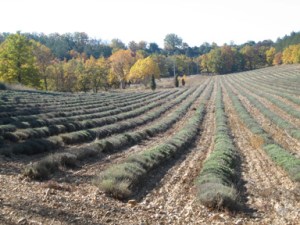
On another day we traveled through the beautiful countryside on winding roads, climbing in elevation and finally came to a Religious House with lavender fields surrounding it. Tucked away in the Alpes de Haute Provence region, discreetly out of sight, three sisters of the Soeurs Coopératrices Maison St Joseph live in an old farmhouse. They are known for cultivating lavandan, a prized type of lavender only grown at this particular altitude, producing the highest medicinal quality essential oil, in the old way, mostly by hand and not technology. Sister Marie Michelle, who greeted us, had a similar glow about her as the one Matthieu had, but many, many more years.

Sister Marie Michelle

Sister Marie Michelle

She showed us their fields and, even though it was late in the season, we could smell lavender faintly in the air. She talked about how they carefully harvested and let the blossoms lay in the sun a certain amount of time so that the oils they made would be at the best strength for all the ways they could be used. She bemoaned the fact that other lavender farmers used machinery that cut the stalks in such a way as to lessen the quality and then didn’t allow them to “strengthen” in the sun after harvest as needed. It was all done quickly, cut and dried—so to speak. And she was quite clear that what sold as lavender essential oils in the world market was lavandin, having much lesser properties, and not lavandan. I was curious how three elderly sisters managed all the fields and harvest until she told us that people from the local community helped. When the sisters are gone, will this art become lost?

Lavender farm photo.

Lavender farm at
Soeurs Coopératrices Maison St Joseph.

Creek Chincultik

Creek Chincultik
©2010 Carla Woody
First oil painting after a 12-year hiatus.

Honoring the Process

I’m going to come full circle and talk a little about painting. I’m an artist, using mostly oils as my medium. During my lifetime, I periodically took a hiatus from that art form for various reasons. The last rationale was because I moved cross country and no longer had a studio—or so I told myself. I took up black and white photography for several years, but found it not as tactilely satisfying. For a long time, my friend and spiritual mentor Don Américo Yábar had been urging me to paint again and said it would be quite different than what I’d done before. I thought he meant that my subject matter and style would be esoteric based on my experiences in the last number of years. In the fall of 2009, after a 12-year pause, I began to paint again. It just seemed right somehow, without Don Américo ever mentioning it at all when I had been in Peru that summer. And I discovered what he may have meant—however else my canvases may eventually develop. When I was much younger I painted fast and furious, always with a goal in mind, turning out a completed work typically in somewhere between 4-8 hours. Now I’m painting on the same canvas for weeks, sometimes longer. Quite content in the process, I’m allowing the colors to emerge and what expression is more deeply inside me. Perhaps I’m becoming like the older vine Matthieu talked about. Not quite the elder and I’m not yet holding it all inside. Too much to discover still!

But I think what I’ve learned over the years, that is coming out in my painting, and what was echoed through the people we engaged with in Provence, is this. There’s great value to immersion in the integrity of a process. Then the quality of the outcome is naturally delivered. I’ve been taught patience for things to come to fruition. Some things need to happen for others to evolve. When you know this at a visceral level, it brings that joie de vivre written so plainly on the faces of those who live through that understanding like Sister Marie Michelle and Matthieu. It also takes faith—and sometimes more than a little stamina.

*******************

*Édouard Manet turned the French art world upside down with his controversial painting Le Déjeuner sur l’herbe. Pablo Picasso later did his own versions of Luncheon on the Grass.

View information about our October 2013 “La Source de Provence” program here. Limited to 7 travelers.

Categories: Creativity Strategies, Spiritual Evolution, Spiritual Travel, Visual Arts | Tags: , , , , | 2 Comments

Blog at WordPress.com.