cultural interests

Film Review: Q’ero Mystics of Peru

Seti Gershberg has produced an important documentary containing key elements for Westerners to fathom the mysticism of the Peruvian Andes: the descendants of the Inka who embody it, their history and traditions. The film is rich with interviews of Q’ero mystics and breathtaking vistas that perfectly enveloped this viewer, taking me back to all the times I sat in circle with these beautiful people. The energy they carry came through the screen.

We are offered teachings from the Q’ero worldview about interconnection, the inherent birthright of prosperity for all—not just a few—and how ayni, or sacred reciprocity, creates flow and balance. The Q’ero people are living examples, incarnating the natural laws that we all must embrace for global transformation. Segments show despacho ceremonies offering gratitude to the Pachamama (Mother Earth) and Apus (mountain spirits), and blessing prayers. How lightning is a message from the Apus signaling an individual’s role and healing methods are disclosed.

Paq’os (shamans) outline initiations and practices for the life of a healer and mystic—how the process happens over years of commitment, often with strong challenges. One young paq’o describes how, in earlier years, he helped gather materials for the despacho. Then at fourteen he assisted in the making, but it wasn’t until he was eighteen that he was deemed ready to do them on his own. I was personally glad to see this distinction included. Hopefully, it conveys to a Western audience that such a path does not happen in a weekend workshop; nor is it a romantic undertaking but one of humility and sacrifice to community.

Juan Núñez del Prado, Joan Parisi Wilcox, Elizabeth Jenkins, Holly Wissler and J.E. Williams share their understanding from an outside perspective as scholars and authors but also as practitioners of Andean Cosmovision.

The Q’ero are a people of dynastic lineage and strength, who only within the past sixty years have broken out of indentured servitude, having maintained their core identity throughout. These words are spoken during interviews:

 Our work is sacred.

We will not forget or lose this knowledge.

 Q’ero Mystics of Peru came at an opportune time, just as I’m preparing to return to Peru to be with Q’ero friends in the village of Ccochamocco for an unprecedented occurrence during The Heart of the Andes. Hopi Elder Harold Joseph from Shungopavi, Second Mesa, Arizona, is accompanying us, as an emissary of his religious leader, to seek prayers for the preservation of Hopi traditions. He says: The Q’ero spiritual leaders are strong in their prayers. So they are.

I personally thank Seti Gershberg for documenting the wisdom of the Q’ero Nation so effectively.

Categories: cultural interests, Film Review, Indigenous Wisdom, Q'ero | Tags: , , , , , | Leave a comment

Book Review – Deep Cinema: Film as Shamanic Initiation

Deep Cinema

Mary Trainor-Brigham’s Deep Cinema deserves your time and attention. I found myself re-reading pages and then sitting, to give the words an opportunity to enter my interior space. Immediately evident, this is a book written to connect with your Indigenous Soul, as the author calls it, the one many of us ignore in this Middle World. She guides us to delve into movies and stories so that they play back to us our own humanity, initiatory passages and further potential.

I’ve studied Joseph Campbell’s work in-depth: his instruction on myth, the Hero’s Journey and places we can readily see examples in film and storytelling. Deep Cinema adds to that work in a way that makes it unique by overlaying shamanic templates from Indigenous cultures. We’re then offered the Soul Compass, a model …designed to transform life from a series of dogmatic dictates or chaotic occurrences…into a rich, sacred Self-defining sojourn which we gladly undertake…the key here is that life becomes meaningful…  The path from Child as Nest Dweller to Elder as Diamond Cutter and Pearl Spinner shows the gateways—mundane to spiritual, balance of Female as Womb Weaver to Male as Navigator—that we all must pass through in order to morph into the next level of growth.

The author brings her background as art therapist, film critic, actor and scriptwriter naturally into play, pointing out the metaphors in a multitude of films, older to more current, that relate to the archetypal templates she offers. With lyrical language, she draws the reader in. On the Voudon shamanic tradition: …According to the Haitians, a person’s small self is like a fish that gets hooked in the heart and reeled in throughout life by the love of and for their Great Self, sitting on a throne beneath the Sea in Lower World…

I was glad to see The Serpent and the Rainbow movie included as a failure at translating anthropologist Wade Davis’ book by the same name. Instead of portraying the rich layers of the Voudon traditions Davis experienced, Hollywood chose to further the cartoon-like, fear-based image of practitioners. Mary recommends Divine Horsemen: The Living Gods of Haiti as a true portrayal.

Once Were Warriors indicates the power of film on a population. In the successful translation of Alan Duff’s novel, Maori director Lee Tamahori graphically depicted real-life struggles with alcoholism and domestic violence the Maori people suffered, bringing it back to loss of spiritual traditions and the turning point of re-engagement. It’s noted that one in every three New Zealanders has seen this film. Most importantly: …after the film hit the theaters, there was an upsurge in the number of men seeking help with domestic violence issues, citing ‘Warrior Troubles’…

I had already viewed a number of the movies covered in the book: Whale Rider, Mindwalk, Capote and others. But I’m going to go back and see some again with new eyes and Deep Cinema beside me. As I was reading, I thought to myself it would be really nice to have an index of all the films and where they’re discussed in the book. I was pleased to find just that at the end. Bottom line: Deep Cinema is not just a reference but also an ally for the spiritual journey.

Available through Amazon.


Categories: Book Review, cultural interests, Film, Indigenous Wisdom, Personal Growth, Spiritual Evolution | Tags: , , , , , , | Leave a comment

Film Review: Séraphine

SeraphineTreeofLife

Tree of Life ­­- Séraphine Louis, 1928

Séraphine Louis, also known as Séraphine de Senlis, is the subject of this intense biopic—both inspirational and tragic—of a relatively unknown but brilliant artist who teetered between one reality and another. Her paintings were the product of creative and spiritual rapture, induced by spirits, and her love for nature. She was employed as a housekeeper doing the most menial labor and thought by the people around her to be quite odd and slow. But at night she disappeared into another world and turned out extraordinary works using pigments she made herself from unusual sources.

Her break came when Wilhelm Uhde, German art dealer and critic, saw a painting at his neighbor’s home and was astounded to discover that it had been done by his cleaning lady. At a time when avant garde artists such as Picasso and Rousseau were coming on the scene, Uhde became Séraphine’s sponsor encouraging her and finally including her in a show that he organized of the Sacred Heart Painters. Sadly, his patronage would come to an end with the advent of World War II. Séraphine became increasingly isolated and was finally committed to a hospital for the mentally ill. She passed in 1942.

Few of her paintings survive but some may be viewed here. This is the story of a woman who found deep meaning in life and was unusually resourceful, even in the face of periodic ridicule and little support, save one person who proved to be her angel.

This haunting film was a sleeper when it came out in 2009 but later won seven French Academy Awards. Streaming on Amazon. In French with subtitles. Yolande Moreau stars as Séraphine. Film directed by Martin Provost and co-written with Marc Abdelnour.

Categories: cultural interests, Film Review, Visual Arts | Tags: , , , | Leave a comment

Lifepath Dialogues Interview with Maya Daykeeper Apab’yan Tew

Apab’yan Tew is an Ajq’ij, a Day Keeper, spiritual guide, dancer and musician, of the K’iche’ Maya tradition from the village of Nawalja’ in Sololá of the Guatemalan highlands. He approaches his sacred calling with humility and passion. I am honored that he’s part of my spiritual travel program in Mayalands during which he shares openly and holds a fire ceremony to send prayers and call upon the ancestors.

In November 2012 I interviewed Tat Apab’yan on the subject of Maya worldview, farming practices and the GMO issue. I included many of his words in Seed Intelligence: Indigenous Perspectives and Our Collective Birthright published in the Anishinaabe (Ojibwe) Farming Curriculum developed by Honor the Earth Foundation for Tribal Community Colleges.

His words are so important for our understanding of the integrative way traditional Maya people live, as well as other Indigenous peoples. I’m sharing an excerpt of our two-hour conversation with you here with his complete permission.

In just this short excerpt Tat Apab’yan covers a lot of ground. He chuckles over the wave of ‘organic’ farming in the West—as though it’s something new—when his people have had such practices for time immemorial. He puzzles over the Western way, now predominant, of dividing land into property when “…the Sky has no conditions…the rains are for everything…” and discusses the sacred sense of reciprocity in everyday Maya lifeways. “…We plant five seeds…only one is for us…”

I hope you enjoy the excerpt and take his words to heart as I did.

To learn more about Spiritual Travel to Chiapas, Mexico: Entering the Maya Mysteries in February 2016, go here. Join us and experience Tat Apab’yan’s teachings in person, along with those of other Maya spiritual leaders and healers who serve their communities. A warning though: It’s life-changing. Tuitions support the continuation of Indigenous traditions and help the spiritual leaders, their families and communities. A portion is tax-deductible through Kenosis Spirit Keepers, the nonprofit extension of Kenosis.

Categories: cultural interests, Gratitude, Indigenous Wisdom, Interview, Maya, Sacred Reciprocity, Spiritual Travel | Tags: , , , , , | 3 Comments

How the Dreams of Chief Hawk Pope Came True

In the late 1980s after my return to Ohio, I took oil painting classes for a couple of years from Chief Hawk Pope of the Shawnee Nation United Remnant Band. I valued his sheer presence and laser-like critiques. He was direct, something I appreciated. I was there to learn, not to have my ego soothed. When something worked, he pointed it out. When it didn’t, he showed how it didn’t and guided correction—explicitly.

I’ve learned that his methods are part of his personality, the make-up of a strong chief, not asking any more of his People than he demands of himself. But that understanding wasn’t even on my horizon when I knew him back then. My interest and passion for preservation of Native ways was yet bubbling beneath the surface, not to fully emerge until the mid-1990s. By that time we had fallen out of touch for some years.

But a strange thing happened.

In the first months of 2014, he began to cross my mind periodically. These occurrences were fleeting; I didn’t hang onto them or wonder why.

In early April I went to Ohio to visit my folks, still living near Dayton. As soon as I arrived I had an overwhelming compulsion to find Chief Hawk—if I could—and reconnect.

I googled his name and discovered his life had taken quite a turn in the 1990s and later. He’d provided vocals for one of the scenes in the movie Dances with Wolves and been extensively involved with the PBS documentary mini-series 500 Nations. In the book Imagining Native America in Music author Michael V Pisani wrote of the musical language he used in the documentary: …the singer Chief Hawk Pope relied on this melodic cadence to underscore moments of great sadness and tragedy such as the Trail of Tears sequence. I also noted he’d been on tour with Spirit the Seventh Fire, a multi-media production conceived by his friend Peter Buffet, with music written by them both. And the Shawnee Nation United Remnant Band now had a home on original Shawnee land, previously lost as a result of genocide advocated through the Indian Removal Act, purchased back by the Tribe.

Shawnee SignI found contact information for the Tribe through their Facebook page and sent a private message explaining who I am and that I’d like to reconnect if Chief Hawk was interested. I got an immediate response from one of the Tribe asking me to come to the Zane Shawnee Caverns, on Shawnee land, a few days later for a meeting. Prior to the appointed day, my mom and I ventured out for a day of sightseeing and got hopelessly lost in an area of Ohio unfamiliar to us both. We ended up in the tiny town of Zanesfield looking for a museum we were told was at least 100 miles north. A few days later on the way to my meeting with Chief Hawk, I was astounded to end up in the very area my mom and I got lost, indeed going right through Zanesfield and drove just a few miles beyond!

I really had no idea why I received inner direction to initiate the request I did. I merely followed that strong, not-to-be-disregarded energy. When I walked into the Zane Shawnee gift shop for our reunion, it was evident that I was supposed to be there. The reconnection was powerful for us both. Beyond that day, I returned to spend another in deep conversation prior to my departure on other travels east. We agreed we’re going to work together—although neither of us know exactly what that means at this point.

Before I left I told Chief Hawk about my unprovoked thoughts of him coming to mind the months prior…then the inner urge to initiate a reunion…even getting lost in the countryside near Shawnee land…when I had no idea they were there.

He looked intently into my eyes and said, “Well, I’ve been throwing out a net these last months.”

I’m glad I paid attention and answered.

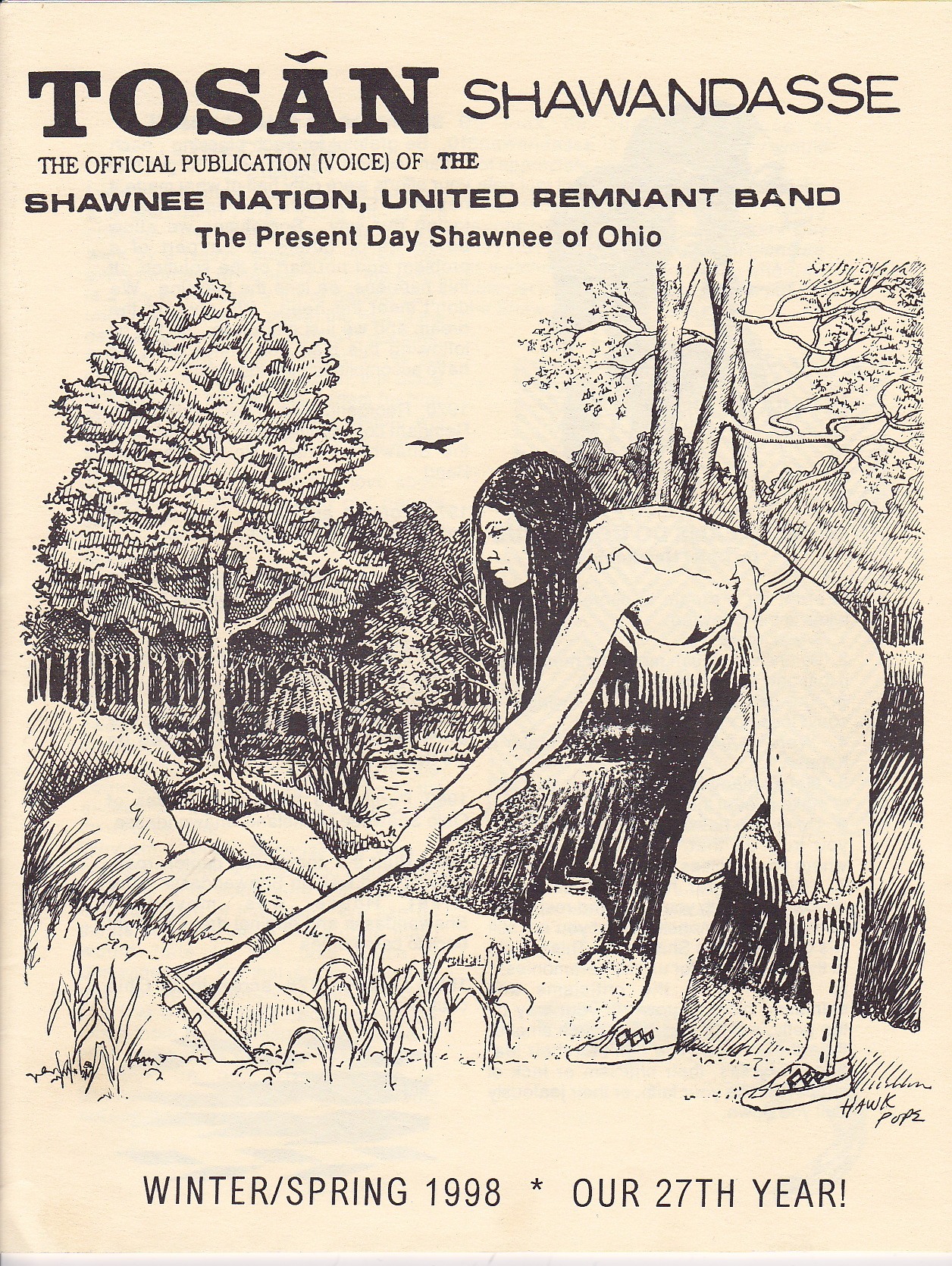
Below is an open article written in 1998 to his People in Tosãn Shawandasse, the official voice of the Shawnee Nation United Remnant Band, beautifully illustrating elements of intent and belief.* What Chief Hawk doesn’t expressly share is the tremendous sacrifice he has borne through his 40+ years as chief since taking on this spiritual responsibility as a young man, given to him by his grandfather.

While directed to the Shawnee People, any of us can take heart and guidance here. His words are truth.

HawkArticle_0001

Some Dreams Do Come True

by Chief Hawk Pope


In order for a dream to come true, all it takes is the following:

– A real need.

– Believing you can meet that need even if that only seems to be a dream.

– The courage to go for it, knowing you could lose.

– Work as hard as it takes to make it happen.

– Get as many of the People as you can to make a team that can do the job.

– Do all you possibly can, knowing that if you truly do that, Creator will take up where your abilities leave off.

– Convey your hopes, dreams, and needs along with your love and respect to Creator and demonstrate that you are still His Children (The Shawnee). This you do in the way He left for us, the ceremonies.

– Rise above the criticisms and stumbling blocks thrown in your way by the petty, evil or just those much smaller than the dream. You can’t let their fear become yours, their criticism or lack of support shake your faith, or their jealousy pull you down.

– Stay the course, no matter what.

– Be grateful for each blessing, each dream come true, and never forget that your efforts were only half of what made it happen. Sometimes we come close to losing our way. Sometimes we allow ourselves or others to be part of a problem and not part of the solution. If this happens, we lose the blessing. We don’t meet the need. We give up the dream and we just plain lose. So far, by following this plan and philosophy, we have accomplished the following:

 — 1970: Reorganization of the people of the Remnant communities and reformation of the Shawnee Nation, United Remnant Band.

— 1974: Formed an interim core Council and moved back to Ohio homeland.

— 1980: Gained State recognition as the descendant Tribe of the historic Shawnee in Ohio.

— 1982: Brought back the ancient ceremonies after 30 years.

— 1985: Constructed our first Great House since historic Lower Shawnee Town on the Scioto.

— 1989: Purchased the first 31 acres of Ohio Shawnee Homeland-Shawandasse.

— 1992: Built the community center, road, electric and well on Shawandasse. The Great House was moved to Shawandasse and original dress brought back to ceremonies.

— 1995: Total of 228 acres in 3 Ohio counties.

******

You are invited by Chief Hawk Pope to visit Shawnee lands located at Zane Shawnee Caverns near Bellefontaine, Ohio. See their website for information on Pow Wows, camping, cave visits and other events and developments on Shawnee lands since 1995.

******

* Reprinting of this open article was used with full permission granted by Chief Hawk Pope.

Categories: cultural interests, Gratitude, Indigenous Rights, Indigenous Wisdom, Sacred Reciprocity | Tags: , , , , , | 7 Comments

Book Review: Spirit Matters by Matthew Pallamary


Spirit Matters

Matthew Pallamary has written an uncensored memoir of his journey through the violent jungle of his origins to the deep interior of his heart and mind—finally delivering him to the Amazon rainforest of Peru and the person he is today. Spirit Matters shows us graphic realities most haven’t seen: dangerous inner city streets, the struggles to leave them behind, and a form of spirituality alternative to mainstream Western culture.

Matt is a respected San Diego writer and workshop leader at writing conferences. Initially known for his horror stories, he became interested in shamanism and Indigenous cultures, producing a book—Land Without Evil—which was recently adapted to stage. Research led him toward experiential understanding of natural substances used for centuries in religious rituals in South America and elsewhere.

Years ago, Matt and I crossed paths in Palenque, Mexico and became friends. I knew he had a rough start; he referred to himself as a Boston street fighter raised in an Irish Catholic ghetto. But I had no idea until I read this memoir; it’s a miracle he made it out alive. Such life experiences instill deep-seated limitations in the mind about what’s acceptable, possible, one’s own worth—or if anything or anyone is safe. The expected path is predictive and short. But Matt had something else operating as well: knowledge that a deeper life was available for him. The honesty in which he describes his internal conflicts, which kept him in a two-steps-forward three-steps-back shuffle for years, is poignant and real.

In this memoir, he also documents academic research on the use of visionary plants in Indigenous cultures, alluding to their use in early Christianity as well but secreted. His experiential research drew him to Mexico and then repeatedly to the Peruvian rainforest where he engaged in intensive ayahuasca ceremonies, over several days at a time, with a shaman initiated to lead them … not a spiritual journey for the faint-hearted. Ayahuasca is known to usher the traveler through a threshold to truth. The truth may be an experience of the Divine, or just as easily a slide into the Dark Night of the Soul. Either way, an instrument of transformation, as he says below.*

 …I saw it in the jungle of the landscapes of my visions, the truth was that the darkness ultimately lived inside me. Ayahuasca had the ability to find and exploit my deepest fears, bringing terror in direct proportion to the depth of the particular fear it tapped into, constituting part of an amazing process of self discovery…

This is a beautiful story of one truly intrepid man, a Warrior of the Spirit if I ever knew one, who found his way out of a dark jungle, when so many of his friends and family did not. Matt Pallamary is someone to be respected for his gritty honesty and intent toward Spirit, aside from his capabilities as a writer. Spirit Matters informs us while providing inspiration.

Available in print, e-book and audiobook through Amazon. Spirit Matters was a Best Books Award Finalist for USA Book News.

****

*Ayahuasca is being used in the treatment of drug addiction—its success rate now documented in a clinical study in Canada. Go to MAPS to learn more and download a copy of the study.


Categories: Book Review, cultural interests, Healing, Indigenous Wisdom, Spiritual Evolution | Tags: , , , , , | 1 Comment

Music Review: Mayan Ancestral Music by Xavier Quijas Yxayotl

xavierqy

Kenosis Spirit Keepers was privileged to sponsor Xavier Quijas Yxayotl in September 2013 for our Spirit Keepers Series held in Phoenix. Xavier is a composer, ritual musician, artist, healer and more. A gentle man of Huichol/Azteca lineage, I’m not sure I’ve met such a multi-talented person who practices his many arts with such humility.

His music carried me beyond this world to another realm entirely. Those nights I slept more soundly than I had in months. Every unique sound—raindrops, wind, birds—are made through instruments he made with his own hands, not environmental recordings. I was able to witness the vast array of clay flutes, whistles and other percussion instruments that comprised his compositions, all adorned with symbolic art.

He first learned to play the flute through his Huichol grandfather as a child, and shortly after began to make his own instruments. But there’s more. In the 1970s, he was called to resurrect ancestral ceremonial instruments destroyed and outlawed during colonial times. Many people are making such instruments now. But back then? No one. How does someone do so when no one else has—and all but a little documentation was obliterated?

I said to Xavier, “Did the calling and ways to make the instruments come to you in dreams and visions?” He confirmed what I sensed. Such things often occur in Indigenous traditions whether to ritual musicians, weavers, midwives, healers, those who hold prayers in varying ways. He also told me, “When I am playing my music, I can often feel my ancestors there standing next to me.”

Xavier has been nominated several times for the Native American Music Award, played at the Nobel Peace Ceremony in Rome, featured on PBS and countless other accolades. For the movie Apocalypto, Mel Gibson contacted him to make the historic instruments used in the movie. Due to union rules, Xavier couldn’t appear in the movie, but he taught the actor-musicians how to play the instruments he made.

We are fortunate that Xavier has a number of CDs available, aside from from Mayan Ancestral Music. You can go to CD Baby to play sample tracks and purchase. Also available on iTunes.

***********

Our next Spirit Keepers Series program will feature Laura Alonzo de Franklin, curandera (healer/spiritual guide) of Mexhica/Aztec lineage. Mark you calendar for September 26-27, 2014 and join us in Phoenix. Check back for more information soon.


Categories: cultural interests, Healing, Indigenous Wisdom, Music Review | Tags: , , , , | 2 Comments

Documentary Review – Peru: A League of Their Own

This inspiring documentary short by Rodrigo Vazquez is a true look at Quechua gender roles and the devastating effect of natural disasters in Peru. It tells the story of a young woman named Juana in the village of Churubamba, located in the Cusco region, who took an unprecedented step outside roles traditional for a Quechua woman. She organized a women’s soccer team, which served as a model that spread across a number of the communities. The teams weren’t only about soccer but also served as a forum for the women to talk about their problems and band together to work for the benefit of all their families.

In the village of Kalla Rayan, a young woman named Felicitas gained entry into meetings reserved for men where she was voted as representative, along with the community president, for a special mission. The two were to find their way to Lima and, with no introduction, seek an audience with the next president to seek aid for the devastation wrought on their village by the floods.

It shows what can happen when any of us take a step off the beaten path. In this film, the starting point was one woman who wanted to play soccer, something taken up by some of the women in other communities and became huge; introduced more equality and potentially has saved one village. It reminds us to follow our dreams and trust the path where it leads – even if we can’t see beyond the next footfall.

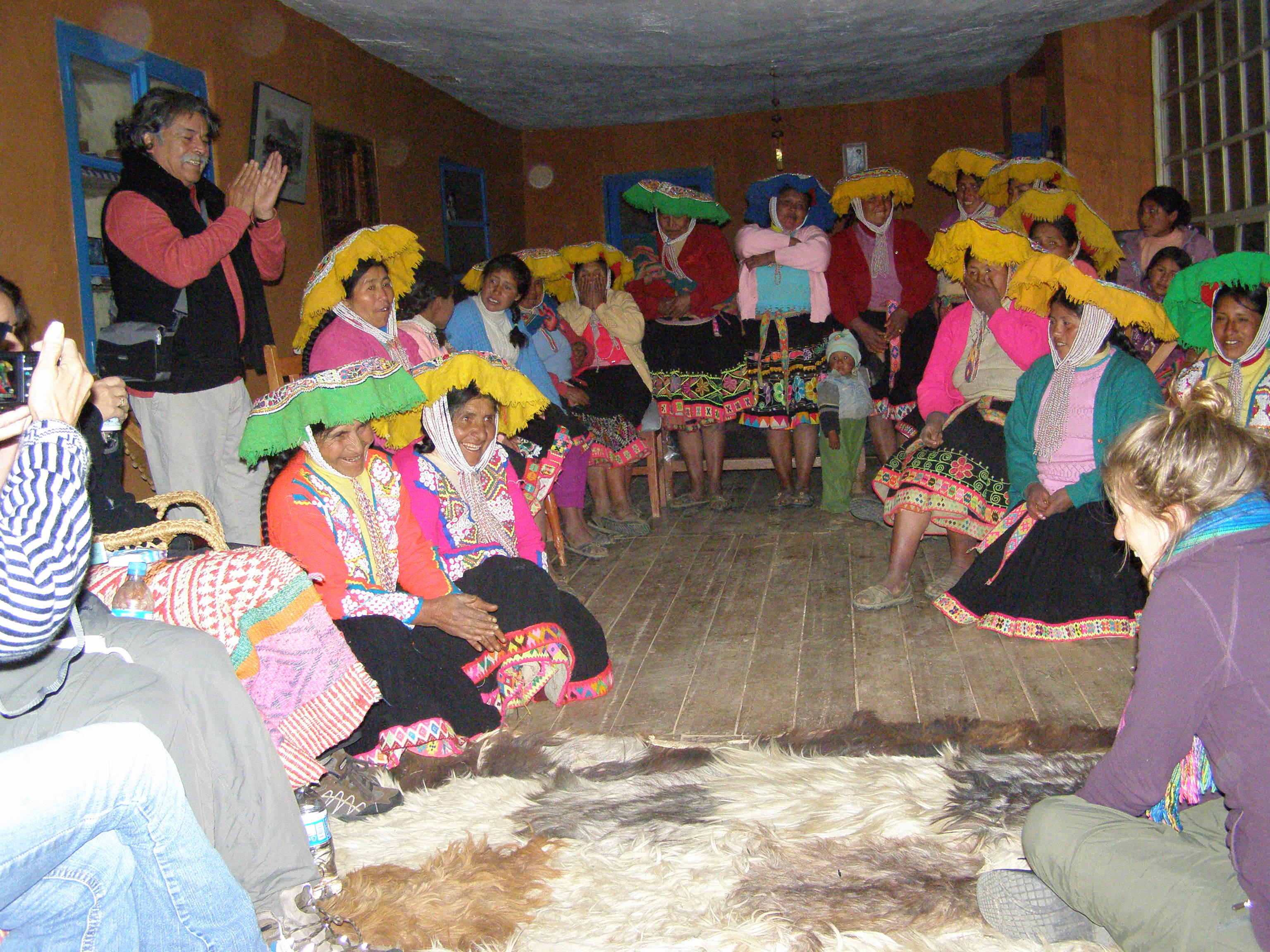
Mollamarka Women Singers

Mollamarka women singers inside Salk’awasi, the ancestral home of Don Americo Yabar.
Photo courtesy of Mark Jericevic.

On another note, the landscape and villages in the film looked so familiar to me that I did a double-take as I watched. I must have traveled through some of the very same areas on my way to Mollamarka for so many years during our Heart of the Andes program.

Film length is 25 minutes. View for free via Karma Tube: Peru: A League of Their Own .

Categories: cultural interests, Film Review, Indigenous Rights, Spiritual Travel | Tags: , , , | Leave a comment

Holy Intent, Invisible Threads

This season is a holy time for many peoples in the world. While multitudes participate fully in—what has become—frenzied materialism, others take a pause or at least strike a balance.

Hopi Ceremonial Calendar by Filmer Kewanyama

Hopi Ceremonial Calendar
by Filmer Kewanyama

Hopi artist friend Filmer Kewanyama says this about December: “The earth’s crust is very fragile. For us, we are supposed to be quiet and reflect on who we are. It is a time for us to be quiet and listen.” This is when storytelling takes place, passing on oral history to the next generation, and the Soyal Ceremony occurs in the kiva, looking to the coming year with great spiritual focus. It’s when the men fashion prayers feathers. Traditionally when Hopi Spirit Keepers have accompanied my groups to Mayalands, they’ve given prayer feathers to those of us holding the center of the journey. The paho, or prayer feather, we each receive is from the roadrunner and meant to protect us as we travel and enter the new year. I wear mine throughout the journey and, upon return home, place each one in a special vessel I keep on my altar.*

This season has become a quiet time for me in the sense that I step back from external activity, a way to remember my own roots, an instilled period of reflection and solitude. And explicitly because there is such space and time for exposure, it’s become heightened with insights, dreams and creative surges for me. Messages come through from the Infinite and that still point inside is given voice.

In that spirit, I’m sharing a dream here that I had early Christmas morning.  I was sponsoring an event, and the person who was to present didn’t show. I knew I needed to step in with an impromptu talk. The audience was getting restless. I thought to speak about the work I believe in: preserving the sanctity of Native traditions to inform the next generations, to bring us back to those core elements that hold the world together. But the words wouldn’t come. How do you express something whose meaning runs so deeply that it can only be felt, that words wouldn’t do justice?

I floundered. Anxiety was showing its face. Just as some of the audience started to collect their coats and leave, Native and non-Native people began to materialize out of the ether to stand on either side of me. Some I knew; others I didn’t. In turn they related the effect, tangible and intangible, that our projects and journeys had on them personally, the importance of continuity toward spiritual grounding, hope, or a wound tended that would otherwise have gone unhealed.

Acknowledge My Relations

Acknowledge My Relations
by Filmer Kewanyama

I came fully awake, feeling resolve to continue holding the vision, even when it seems like few others do, roadblocks appear, or I don’t personally see the ultimate outcome of the intent. For me, these are aspects of true faith realized in this sacred season.

Typically, I don’t remember my dreams. When I do, I know it’s from that invisible realm that retains more wisdom than I do on a daily basis. I would be lying if I said I don’t falter, feel like giving up many times and throwing in the towel. It’s a human condition, especially so when any of us hold a vision that runs counter to the mainstream world, and progress is defying gravity uphill. This is what I sense happens in the kiva: restoring of faith, strengthening of purpose.

True advancements come not from the mainstream but from a collective retaining the holy vision, with understanding how invisible threads may be woven.

That was the prayer feather of my dream Christmas morning that protected me from loss of faith. With renewed intent, I share it here as my own offering—for the circle of life—to guide the next year.

***

Kenosis Spirit Keepers is the nonprofit arm of Kenosis. To learn more about our work, please go here. Your end-of-year donation is tax-deductible and strengthens our mission to preserve Indigenous wisdom for a better world.

The words and artwork of Filmer Kewanyama are used with his full permission. To view a collection of his expressive artwork, go here.

*Most years Entering the Maya Mysteries spiritual travel journeys occur in January.

Categories: cultural interests, Healing, Hopi, Sacred Reciprocity | Tags: , , , , | 5 Comments

Interview with Dianna “Snow Eagle” Henry, Seed Saver

Flordemayo documenting seeds.

Grandmother Flordemayo documenting seeds.
Photo credit: The Path

Grandmother Flordemayo had twice mentioned Dianna “Snow Eagle” Henry to me during my visits to the Seed Temple in Estancia, New Mexico. Each time she lamented, “You just missed her! She was here helping but went back home.”  Home turned out to be Arkansas. When Flordemayo began to establish the Seed Temple, which Kenosis Spirit Keepers helps support, she called Dianna to consult her expertise regarding seed preservation. Dianna has gone back and forth providing service ever since.

The last time I was there, Flordemayo put a book in my hands. Dianna’s coffee table book Whispering Ancestors: The Wisdom of Corn is an illustrated treasure trove of information on Native varieties, some lost to time and then resurrected. In certain ways it takes you back in time by identifying which Native Tribes carried different strains, planting instructions—and hints at the esoteric, ancestral knowledge in the Seed Collective. I was intrigued.

Native Seeds

Native seeds.
Photo Credit: Wisdom of Corn.

Dianna consented to an interview for The Lifepath Dialogues. Below you’ll find the audio recording uploaded to You Tube. She graciously shares how the seed-saving path opened to her, rather unexpectedly as passions sometimes do, and the ways that spiritual knowledge from seeds began to come. One of the many things I appreciate about Dianna is her willingness to follow a path that’s unknown but fueled by intent. She shares it all.

Kenosis Spirit Keepers is pleased to sponsor Grandmother Flordemayo, Dianna Henry and Greg Schoen for events in Phoenix on January 31-February 1, 2014. Greg is also a respected seed saver with many years’ experience and will take us “down the rabbit hole” into the mysticism of seeds. You can read his article about Rainbow Corn in Mother Earth News here.

This Friday night talk and Saturday experiential workshop will directly benefit the Seed Temple’s preservation work. You’re invited to join us and know that—as you are receiving the teachings—you’re also benefiting the wider work of global consciousness.

(Note: The benefit dates mentioned in the recorded interview were changed so that Grandmother Flordemayo could also personally participate, offer her knowledge and prayers.)

Categories: cultural interests, Healthy Living, Indigenous Wisdom, Interview, Sacred Reciprocity, Spiritual Evolution | Tags: , , , , , | Leave a comment

Blog at WordPress.com.