Lineage: Calling on the Ancestors

January 2012

The nondescript address promised little from the street. I opened the old wooden door to slip through the walled entryway and found otherwise. Carol Karasik and I had arranged with the group to meet at Laughlin House, one of the oldest houses in San Cristóbal de Las Casas, then owned by anthropologist Robert Laughlin and his wife Mimi. Carol had been staying at the venerable hacienda—and, with all its rustic charm and lush garden, it seemed the perfect place for our evening gathering.

Dusk was coming quickly. I wandered through the narrow, uneven paths admiring the beauty of the garden, down to the small greenhouse at the far end. As I passed by the main house I noticed a woman kneeling in the grass separating the dwelling from the garden. She was carefully digging a shallow circle, exposing the dirt, already preparing the space. Copal smoke rose from the pedestal burner.

Floridalma (Flori) Pérez González, a traditional  Ajq’ij, a Maya Daykeeper from a Mam village in the mountains of northern Guatemala, was there to offer us a fire ceremony, so sacred to her people. As the rest of the group drifted in, she invited us to join her and sit in circle. We watched in silence as the altar grew on the bare dirt: sugar drawn in a symbol reflecting the day in the Maya calendar, fist-sized balls of resin mixed with shredded wood, candles laid in a circle as offerings to the Nawals, Day-Spirits of the calendar, and Four Directions, sticks of pine pitch, rose petals around the perimeter.

Fire Ceremony Altar

Fire Ceremony Altar

By this time it was dark, just the glow from the incense burner reflecting on our faces; we were cocooned, a timeless place separate from the everyday world. Flori spoke softly and asked me to express the collective intent of the group, then invited each one in the circle to offer their individual words. She lit the fire and invoked the presence of the spirits, praying intermittently in her Maya dialect and Spanish.

Floridalma Pérez González

Floridalma Pérez González

The fire’s flame rose. She called on the Nawals and Ancestors, Grandmothers-Grandfathers, inviting them to accept our petitions and blessings through the smoke. Every now and then she reached her hand into a bag and threw herbs upon the flames. The fire changed shape, moving against the light breeze, not with it. Flori told us the meaning and said it was a good sign. We were drawn into her soft prayers, the flames and, otherwise, the stillness.

After a time, she passed thin, white tallow candles asking us each to take eight, then instructing us to separately approach the fire and, as we settled the candles one by one into the fire, call out the names of those who have gone ahead of us, our Ancestors, to welcome them to our circle, to bless them, as they who are part of who we are, to hear our prayers.

I started. In that moment, I realized that I knew so little about my own family line—but a few names, not nearly enough for the candles I held in my hand. I attempted to sweep the corners of memory to see if anything arose. It didn’t. And when it came my turn to kneel at the fire, beyond three names I could name no more. I placed the remaining tapers, intending they would find their match.

But sadness arose; a hole was uncovered. I didn’t know My People.

I recognized then one of the reasons I’m so drawn to Indigenous traditions. Upon introduction, a number of Wisdom Keepers I’d met would identify their villages and clans going back a few generations. I’d been told that the purpose was to offer any mutual connections. But it’s also a clear statement of identity, place in the world. Those who maintain their traditions are grounded through lineage, lending spiritual strength. Hearing these pronouncements always stirred something poignant in me, as though I was attempting to reach out, to find my own conscious grounding. But I had none in that way, not of the blood that ran in my veins, the places My People had walked, or what aspects of them resonated through time to find residence within me—beyond my own mother and father. I discovered I wasn’t alone. Several of the members of the group struggled in their own way. It was a powerful ceremony.

Fire Photo

It is said that the fire works on you over time.

Its work with me began immediately. I emailed my folks the next morning mentioning the intent of the fire ceremony and my sadness for lack of knowledge of the family line. My mother wrote back saying, “It’s strange you should mention this because yesterday we started cleaning out old boxes…and found papers tracing your father’s family tree!” One of his distant cousin’s had undertaken the search years ago. The papers had been forgotten. We were both astounded at the timing of their urge to clean. I asked my mom if she’d begin looking into her line; she had little knowledge either. She promised she would.

Tracking genealogy is something of an art, sometimes an endless maze with dead-ends, particularly if you have little information at the outset, or experience. My mother got discouraged, having come up with few leads, after much time spent. The project stalled.

December 2012-January 2013

When I visited my folks over Thanksgiving, we talked of family line again. Don Boyd is an old family friend who has become something of an expert in tracing genealogy. I contacted him to see if he would be willing to give my mom some pointers. I then left for my Maya spiritual travel programs over the next two months.

Immediately, there was a flurry of emails between my mom and Don, with copies to me in Mexico and Guatemala. In no time flat, Don was able to produce information that led to a fairly extensive maternal family tree. Although some of the data petered out, thanks to Don and my dad’s distant cousin, I now know most of my lineage.

We still don’t know anything about my dad’s maternal line. But, for the rest, My People were all from the South. My paternal grandfather’s line traces back to 1724 England—and, a curious aside, includes Arthur Woody, the “legendary barefoot forest ranger” one of the first pioneering forest stewards in the US. My maternal grandfather’s people go back to 1766 Ireland. Cherokee lineage exists on both my maternal grandparents’ sides, for sure one documented to 1867 North Carolina. There’s a possible trace of another Cherokee ancestor as far back as 1797 Tennessee, but that one is difficult to prove.

Sunset over San Cristóbal de Las Casas.

Sunset over San Cristóbal de Las Casas.

Less than a week ago we met Flori at dusk. The fiery sunset announced the fire that would be lit in ceremony on the ground, perhaps already mirroring back to us our prayers that would rise. And when it came my time to approach the fire and lay the tapers, I called on my Ancestors, My People, clearly by name. I’ll never know all their stories but I can now intuit their lives—and feel their influence on me, rising up through time, running in my blood, to my place in the world.

I am grateful to the fire.

Fire Ceremony Photo

Categories: cultural interests, Healing, Indigenous Wisdom, Maya, Spiritual Evolution, Spiritual Travel | Tags: , , , , , | 3 Comments

Film Review: Water

water

Film by Deepa Mehta

This film is set in Varanasi, India during the time of Gandhi’s rise in the 1930s. It is, at once, much like India herself. The cinematography is incredibly beautiful recording the most holy temples, landscape, people and colors while forcing us to acknowledge devastating conditions in which so many of the people live, particularly women. A paradox placed upon the people through their most sacred beliefs. But it does not leave us with such discomfort alone. It also presents hope.

This is the story of eight year-old Chuyia, left suddenly a widow at the death of her many years older husband. As the sacred texts direct, she is sent to live in a house of widows, an ascetic, hair shorn, eating one meal a day, even though she never lived as a wife with her husband. A heart-breaking account of a practice that continues to this day in some areas. Doctrine states that while her husband is alive a woman is half his body, and when he dies she is half his corpse, held in highest esteem and yet treated badly, then living in the most extreme poverty. The hope offered in the film comes through the bond that develops between young Chuyia and some of the widows, the intervention of a stranger and the new teachings of Ghandhi making headway during those times.

The film was so controversial that, during its initial making in 2000, filmmaker Deepa Mehta, cast and crew were driven from Veranasi, their safety threatened by mobs and the set torn down, causing the project to be abandoned for a few years. Four years later, Mehta was able to complete the film in Sri Lanka. It was nominated for an Oscar in 2005.

Rather than be put off by the subject matter, I invite readers to view the film. It has a beautifully haunting quality that will stay with you for a long time. Available in DVD or watch online free. The soundtrack is equally mesmerizing.

Categories: cultural interests, Film Review | Tags: , , , | 1 Comment

Book Review: The Painter from Shanghai

painter_from_shanghai

By Jennifer Cody Epstein

I’m always attracted by novels with a backdrop of art, controversial times and exotic locales and quickly became engrossed in The Painter from Shanghai. Only at the end did I realize the central character and many of the supporting ones actually lived. The times were dangerous and the daring commitment of those chronicled in the book’s pages is penetrating.

The author has written a fictional account of Pan Yuliang, a Chinese artist often known in her own country as the “Famous Western-Style Woman Painter”—a title she abhorred because it noted her gender. As a young girl in the early 1900s she was sold to a brothel by her uncle. This is the story of her origins and how she managed to leave that life to enter the world of art, something unheard of in those times, to become a well-known international artist and professor. The reader travels with her from China to Paris to Rome and back to China as she maneuvers between the strong pressures of Chinese tradition, dedication to her art and the political, sometimes deadly upheaval of the 1930s and 1940s. The book provides excellent entertainment as a novel. But it also educates about strict Chinese conventions, some of the heart-breaking practices Chinese women had to endure, and the intersection of Communism and Chiang Kai-shek’s Republicans. Above all it’s about the inner life of an artist and hard choices she makes to adhere to her dream.

Available at Amazon and elsewhere.

Categories: Book Review, Visual Arts | Tags: , , , , | Leave a comment

Thought Forms in Black and White

I was in Bali during August 2007, most of it spent in Ubud. In my experience, it’s rare to be in a culture where the spiritual traditions and values are so visible even to a casual observer. There are many things I took away with me, but I’ll offer just a few here.

The first has to do with prayer and ritual integrated into everyday life. There are temples everywhere—public temples, shrines on the streets. And every family compound has an altar even if it’s a small one tucked into a corner, but many are quite elaborate.

Offerings©2007 Carla Woody

Offerings
©2007 Carla Woody

The women seemed to spend a lot of time making small, flat offering baskets from bamboo fronds, measuring about 4 inches square. I’d see them sitting outside storefronts or on the sidewalks talking together while their fingers were busy. For the last week I was there, every morning I watched an elderly woman make her rounds in the bungalow compound where I was staying. She carried a large flat basket in her arms, which contained those smaller ones all holding flower petals, incense, rice, things to attract notice of the gods and signify prosperity. Not only did she place one at the compound shrine and at the base of all the statues, but in front of the bungalow doorways and even on the manager’s desk of the adjacent Internet café; all the important places to create a flow. Later walking through the streets or driving through the countryside, I’d note them in front of businesses and homes, almost everywhere.

The moments for remembrance and gratitude were ongoing. Not a time set aside, but included. One day I had hired a driver to take me to the coast. Along the way, he asked if I minded if he stopped for a few minutes. He pulled over outside a kind of marketplace. While I was fooling around with my camera, he got out. When he returned he had rice pressed into his forehead. During one night’s dinner I was enjoying my food (immensely) and observing my surroundings. One of the servers would stop the others as they passed by. She dipped a flower in a water glass and then anointed them on the head with it. Not playing around, but blessing them.

The understanding of interconnection is also prevalent—family, the banjar, the community. Our style of life in the West is shocking to them. The fact that we seem so disconnected when “I am because you are.”

Bali Translator©2007 Carla Woody

Bali Translator
©2007 Carla Woody

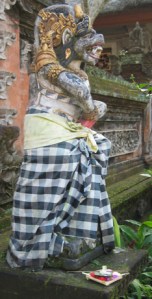
Perhaps more than anything I was taken with the sacred statues that were prevalent at every turn, not just in the temples. They seemed so exotic and expressive to me, not at all benign. I had a very kind driver who was not only quite curious about my culture but also eager to inform me about his.

He said, “Foreigners make a mistake and say we have so many gods. That’s not so. Our gods stay inside the temple and are only brought out for special times.”

I asked him about some of those I saw frequently that look somewhat like serpents or dragons and he disclosed that they were translators, conduits. They took the messages of the gods and translated them so we could understand them. And when I asked him about the black and white checked sarongs on just about all of them, which I was quite fascinated by, this is what he said.

“They remind us that we all have both good and not so good inside of us. This is to remember balance.”

In Bali, those reminders abound. Balance. Work gets done, but the days aren’t overly long. Acceptance of both sides of human nature without going to either extreme, or rejecting part of the self. Connection. And the middle road is valued. No wonder I was so touched—and relaxed.

Categories: cultural interests, Indigenous Wisdom, Sacred Reciprocity, Spiritual Travel, Travel Experiences | Tags: , , , | Leave a comment

Voice and Expression

Co-authored by Yaqin Lance Sandleben and Carla Woody

Carla speaking here: When I was a young girl I had a vivid inner world but reticent to share it with others, being painfully shy. Strangely, one thing I wasn’t shy about was my singing voice. I sang all the time. The summer I turned fourteen my family moved to a different state, the latest in several moves during childhood. A neighborhood girl and I spent hours recording ourselves singing Mamas and Papas songs just for fun, when we weren’t getting in trouble for one thing or another. That was the late Sixties…and you were expected to push the edges.

But something happened in September. My newfound friend and ally went to a different school. What bit of security and grounding I felt in the new environment was no longer present. Over the next months I made my way tentatively, finally settling in with a handful of girls, cliches being a matter of survival in junior high and high school beyond. But when I’d join in with songs on the radio…or hum under my breath you’d have thought I’d grown two heads, the responses I received from my friends.

Everyone feels out of place and wants to fit in during teenaged years…and at the same time want to be different. A terrible conflict. So, most of us shut down aspects of ourselves. In my case, it was my public voice. My singing voice was silent for decades and so was my ability to express in the most basic ways outside my family.

It was only years later that outer expression began to come again, part of an evolutionary process. By that time though, being so unused, my throat would hurt and my voice was so weak, it refused to emerge fully when I’d attempt it. I even went to India for a short time to study raga, Indian classical vocal music, with Sufi leader Shabda Kahn, in hopes of overcoming the block. I succinctly remember the day in practice when Shabda looked at me in what could only be described as loving irritation and bellowed, “Get your voice out!” Yet, still, I physically couldn’t.

***

Yaqin speaking here: In the path of development, of spiritual and material development, one of our most important tools is the human voice. One can easily see this in how the voice of another affects one. Likewise, as the Sufi Inayat Khan said, the voice is the expression of a person’s spirit. Knowing this one may direct attention and practice towards developing and opening the voice. Further, there is an ancient and sacred teaching on the mysticism of sound, and how it how it can be used. As the Sufis say, through recitation and concentration: “…travelers on the spiritual path can overcome narcissism, resolve their issues of separation from God and from humanity, and awaken to God’s presence…”

***

Carla again: In 1998 I moved to Prescott, Arizona. Strangely enough, I found a small Sufi community there. I’ve always been drawn to the Sufis for their inclusiveness. Yaqin Lance Sandleben held monthly zikr, a Sufi chanting devotional practice. I attended religiously for years until travel and my own work made it difficult to be there. I am indebted to Yaqin for the space he continued to hold those years. My voice had varied little…until one night. We were well into our zikr when suddenly a voice burst forth with a sweetness and power I hadn’t heard before. Surely, it had come from someone else. But I had to acknowledge it as my own…and acknowledge it still.

Giving voice comes in many forms. It’s our birthright to express and sometimes a journey to come back to the place where we began, without fear, to offer to ourselves and the world our own special expression.

Categories: Creativity Strategies, Healing, Healthy Living, Personal Growth, Sacred Reciprocity, Spiritual Evolution | Tags: , , , , | 4 Comments

A Tribute to Ted Andrews

Lakota and Ted  photo

Photo credit: Dragonhawk Publishing

Probably all of us can point to some people who have passed through our lives and made a difference somehow, even if they themselves never knew it. A stray word may have been said. A direction offered. And through that interaction, we took a step; or were alerted to something otherwise unknown.

Ted Andrews served as one of those people for me. It was 1987 and I had just returned to Dayton, Ohio after living in Germany for several years. While there I had been introduced to metaphysics, my appetite whetted. But the opportunities to learn more, to participate in some circle in Dayton, were almost non-existent, or at least quite hidden. Through some diligence I found the Mountaintop Bookstore, a small enclave not too far from my home. And there I stumbled upon Ted Andrews, spiritual teacher, metaphysical author and kindly, gentle man. Back then, he offered classes in a small room of the bookstore. I took all of them and experienced something awakening beyond mere intellectual curiosity.

And I discovered that he still gave readings. When I went to his modest home it turned out that he lived only a few blocks away from me. He brought me into the front room and we sat across a small table from each other.

Intuitives often use accoutrements such as Tarot or other types of cards, palm reading, any number of things depending on culture. But for true intuitives these things are really extraneous because they themselves are the channel. Ted Andrews was one of the true ones. That day he did use an intermediary—the Tarot. But finally he looked earnestly into my eyes and took my hands into his.

“Are you a healer?” he said.

“No!” I was bewildered by the question and wasn’t even sure what he meant. With what little I did understand about that realm at the time, even the idea of his inquiry seemed preposterous—and downright scary. After all, the flavor of my life back then far from supported such an activity.

“Well, you have fire around your hands.”

“Oh, okay. I understand that. I’m an artist and I work with my hands. I paint.” I was relieved.

“No, this is something else. You also have fire energy very much attempting to enter your crown chakra. Allow it.” He said gently and then nothing more, knowing that any more at that time would have been too much.

Through 1988, a short year, long before I met Don Américo Yábar in 1994, Ted Andrew was my first spiritual teacher, someone who opened a doorway. Recently I was telling a friend the story I have recounted here and we became curious about what he is doing now. Doing a search brought me the very sad news that he passed in October 2009, still a young man.

Ted gave much to the world as a teacher, animal advocate, writer, a compassionate soul and clairvoyant. A great intellect who was able to translate complex metaphysical philosophies into everyday language. Many of you probably know his books, especially Animal Speak and Simplified Qabala Magic.

For me, he pointed the way, to something inherent but unacknowledged, a choice point awaiting. I vividly remember the moment he did it that day in his small front room. I have been able to draw on his soft encouragement over the years—and it’s given me courage. I only regret that I didn’t return soon enough to tell him so.

Categories: Healing, Personal Growth, Spiritual Evolution | Tags: , , , | 4 Comments

Book Review: Acedia and Me – A Marriage, Monks, and A Writer’s Life

acedia

If you are one of those people who is unrelentingly committed to a path, particularly one that the world may little understand, and yet you have periodically fallen into doubt, there is actually a name for this affliction – much to my relief. Doubt is not really a good word for a state that can reach a level of deep despair and sense of futility. And yet it’s not depression in the clinical sense.

Acedia was included in the “eight bad thoughts” of the desert monks but was later inexplicably dropped when translated into the Catholic Church’s “seven deadly sins.” If only over the years I would have had a word for it, not as a sin but as a thought that can assail a person who has monkish tendencies or artists, advocates and others who probe the edges of convention. Then there could have been a level of comfort and normalcy in the experiences. But instead, the term and understanding of it was dropped into time, to be hidden in little known annals or diaries of people who had the courage to express it.

Kathleen Norris has done many of us a favor by writing a book about acedia, giving many personal examples and historical references. Taken from the book, “… the monk struggling with acedia is dealing with more than bad moods, psychic fluctuations, or moral defeats. It is a question of resolve that arises in the wake of a decisive choice for which the monk has risked his life’a danger to anyone whose work requires great concentration and discipline yet is considered by many to be of little practical value…”

Along with the author’s own writings, a real plus is in the last chapter, a collection forty-odd pages long of quotes, personal experiences from such luminaries as John of the Cross, Emily Dickinson, Petrarch, Dante, Evelyn Waugh and many others. Sometimes it helps to name something and I can sense a future essay of my own percolating. Read a Q&A with the author, plus an excerpt.

You may recognize the author’s name from her other books such as The Cloister Walk and Dakota: A Spiritual Geography. Read this latest book if your path has ever taken you into an unnamed state that may be acedia—or if you anticipate it could.

Available on Amazon and elsewhere.

Categories: Book Review, Personal Growth, Spiritual Evolution | Tags: , , , , , | Leave a comment

January 23 Lifepath Dialogues Gathering: Voice and Expression

Lifepath Dialogue GatheringExploring the many threads that weave together an expressive, celebrated life.
MARK YOUR CALENDAR AND JOIN US FOR DIALOGUE THAT MATTERS

You are invited! Please pass to friends and family.

JANUARY 23, 6:30-8 PM

FREE Monthly Gathering on Fourth Wednesdays

Creekside Center, 337 N. Rush Street, Prescott, Arizona

January’s topic:

“Voice and Expression”

Based on the post: “Voice and Expression”
By CARLA WOODY
Author of Calling Our Spirits Home and Standing Stark
Founder, Kenosis and Kenosis Spirit Keepers

SPECIAL JANUARY GUEST HOST:

YAQIN LANCE SANDLEBEN

Yaqin Lance Sandleben Photo

Yaqin Lance Sandleben is a Cherag, an ordained minister of American Sufism following the Chisti Sufi lineage of India. He leads the Dances of Universal Peace, Universal Worship Service and offers guidance on the path of spiritual awakening. Yaqin lives in Prescott, Arizona, where he has practiced pharmacy for 35 years, raised a family, and served the community in different ways—mostly through volunteering.  His interests in religion, spiritual development, and the awakening process began at the age of 12 in the Christian Church.   For many years he studied well known and obscure paths of awakening.  He began meditating 40 years ago and embraced American Sufism 33 years ago.   He has also studied and practiced Buddhism with many teachers, including HH the Dalai Lama and other Tibetan teachers.  His Sufi connection has led him to India, to the shrines of saints, and to the study of Raga, Indian Classical music.

Email: info@kenosis.net or call 928.778.1058

Categories: Healing, Healthy Living, Meditation, Spiritual Evolution, Uncategorized | Tags: , , , , , | Leave a comment

Film Review: Genghis Blues


genghisblues

  Documentary Film by Wadi Rum Productions

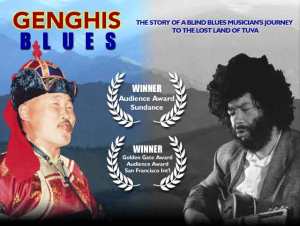
If you’ve ever heard Tuva throat singing and been fascinated by it, this is a film to watch. Aside from that, it tells the poignant and truly inspirational story of blind blues musician Paul Pena. In the mid-80s he first heard throat singing via shortwave radio transmitting from Moscow and was enthralled. It took eight long years, but he tracked down the source, found a recording and proceeded to teach himself the unusual harmonics involved in this technique coming from the tiny Republic of Tuva, between Siberia and Mongolia. He also began to teach himself the spoken language.

In 1993 Tuvan throat singers came to the USA on their first tour and Paul attended a concert. There he met Kongar-ol Ondar, revered in Tuva, and broke out in an extemporaneous demonstration of his self-taught throat singing. Kongar-ol was amazed and invited Paul to Tuva for the international symposium. The film follows Paul and his friends as they traveled across the world and made fast friends of the Tuvan people who fondly called him “Earthquake” after the quality of his voice. This was not an easy journey for Paul who had to deal not only with the limitations of blindness, but also poor health. He set it all aside for this adventure and his love of music.

In his day Paul Pena played with many blues greats and wrote the 1970s hit “Jet Airliner” recorded by the Steve Miller Band. The documentary won the Audience Award at Sundance in 1999 and awards at several other film festivals. A CD is also available called “Genghis Blues” that combines Paul’s roots of American blues, Cape Verdian morna music and Tuva throat singing. Sadly, Paul passed in 2005.

DVD available through Netflix and other sources. View promo video here: a story of courage, intent and passion perfect for our times.

Here’s a bonus. You can watch Paul singing “Jet Airliner”  and throat singing on You Tube.

Categories: Creativity Strategies, Film Review, Indigenous Wisdom | Tags: , , | Leave a comment

Lifepath Dialogues Gathering: The Ways of Inclusion (Audio)

The Lifepath Dialogues Gathering is held on the fourth Wednesdays, 6:30-8 PM, at Creekside Center in Prescott, Arizona. The intent is to build like-hearted community and dialogue about what truly matters. I choose monthly topics from my blog and host the evening with special invited guest(s) whose philosophies and work are relevant to the topic. The format involves my presentation of material to create a framework and interview of the special guests. This portion is recorded to share with the world community—wherever you are. Then we turn off the recorder and turn to intimate sharing.

The November 28 Lifepath Dialogues Gathering:

The Ways of Inclusion

The complete unedited audio is about 40 minutes long. Click below to listen. Please be patient as it may take a few minutes to download! I hope you enjoy.

This discussion was based on the post: The Gift of Mother India

By CARLA WOODY
Author of Calling Our Spirits Home and Standing Stark
Founder, Kenosis and Kenosis Spirit Keepers

Yaqin Lance Sandleben PhotoNovember’s special guest was Yaqin Lance Sandleben. Yaqin is a Cherag, an ordained minister of American Sufism following the Chisti Sufi lineage of India. He leads the Dances of Universal Peace, Universal Worship Service and offers guidance on the path of spiritual awakening. Yaqin lives in Prescott, Arizona, where he has practiced pharmacy for 35 years, raised a family, and served the community in different ways—mostly through volunteering.  His interests in religion, spiritual development, and the awakening process began at the age of 12 in the Christian Church.   For many years he studied well known and obscure paths of awakening.  He began meditating 40 years ago and embraced American Sufism 33 years ago.   He has also studied and practiced Buddhism with many teachers, including HH the Dalai Lama and other Tibetan teachers.  His Sufi connection has led him to India, to the shrines of saints, and to the study of Raga, Indian Classical music.

Categories: Compassionate Communication, Healing, Healthy Living, Meditation, Personal Growth, Spiritual Evolution | Tags: , , , , , | 2 Comments

Blog at WordPress.com.