Posts Tagged With: Core Self

The Dialogue of Creative Intelligence

Ann Hamilton describes herself as a “maker” rather than artist, and characterizes the start of her projects this way: I just try to listen for what something needs to become. Michelangelo relayed a similar process so long ago: I saw the angel in the marble and carved until I set him free.

Delivery doesn’t come in an instant but evolves in a process ⏤ bit by bit. It’s about being patient with the unfolding. It takes a dialogue with what wants to emerge, creating space for the communication. Sitting with it.

If what emerges has depth then it isn’t formulaic. For me, it’s about synthesis. In what form does this communication want to be held? Two-dimensional? Three-dimensional? Oil? Mixed media? Or written form? I introduce options to the conversation and question the best fit ⏤ and am open to changing directions in mid-stream because it’s suddenly called for.

I’m not a person who has one way of doing things. That would bore me to tears, limit flexibility and impede problem-solving. I enjoy stockpiling choices at my fingertips. It fuels my creative energy. Ongoing learning, adding this and that to my repertoire, inspires me. I believe this strategy sparks a type of creative intelligence. I wouldn’t fit on an assembly line and abhor restrictions. It sucks the life right out of me.

I’ve written before about the expectations establishment galleries and publishers hold. Recording companies, too. They want what they call ‘consistency’ which translates to limitation of subject matter and form. Of course, they’re invested in bottom line dollars. But what they’re doing in the process is obstructing artistic growth. The artists I revere most are those who deviate.

Shawn Phillips is a case in point:

…The mere fact that he was a musician as much as a singer and songwriter made him stand out, and helped him attract a dedicated following. His refusal to shape his music — which crosses between folk-rock, jazz, progressive, pop, and classical — to anyone else’s expectations allows him to hold onto a large and dedicated cult following, without ever achieving the stardom that his talent seemed to merit…He never courted an obvious commercial sound, preferring to write songs that, as he put it, “make you feel different from the way you felt before you started listening”…

My respect for Picasso grew exponentially when I was in Paris last year and went to the Picasso Museum, which houses representations of all the journeys he’d taken. I’d known him mostly as a Cubist, and for his Rose and Blue Periods. I discovered he was not only a painter of many diverging techniques, but also a sculptor, printmaker, ceramicist, stage designer, poet and playwright.


PicassoGoat

She-Goat. Picasso, 1950. Constructed of found objects then bronze cast.

Picasso’s ability to produce works in an astonishing range of styles made him well respected during his own lifetime. After his death in 1973 his value as an artist and inspiration to other artists has only grown. He is without a doubt destined to permanently etch himself into the fabric of humanity as one of the greatest artists of all time.

There’s something to be said for being unorthodox. Especially if you don’t care about mainstream success. Although it may come unexpectedly…precisely because you deviate.

In this round-about way I’m now introducing my latest venture. For a while I’d felt the pull to move into more three-dimensional artwork and had been casting about to see what drew me. Then I discovered the separate works of Jan Huling and Nancy Josephson…unlike anything I’d seen before…which spoke to my unconventional soul. They’ve both had their artwork featured in a multitude of galleries, museums, newspapers and magazines. I decided to go study with them for a week in April in Puerto Vallarta at Hacienda Mosaico and came away with a treasure trove of new knowledge from their generous teachings. And they’re good people.  No affected airs there despite all their accomplishments.

Das Bug

Das Bug. 8′ long. Jan Huling. Currently showing at the Duane Reed Gallery in St. Louis and slated for the Art Market + Design Fair in Bridgehampton, July 7-10. Photo used with permission.

In her artist statement Jan says:

In a recent review, the New York Times dubbed my work “oddball assemblages,” and aptly so. My three-dimensional collages combine found objects with surface design, sometimes touching on narrative themes. I’m also drawn to religious and political icons, inspired by a continuing fascination with indigenous or popular culture and world religions…Czech seed beads adorn objects in colorful patterns, camouflaging their original circumstance, allowing us to see them as pure form without their usual connotations. The process is slow and meticulous, Zen-like, with the choice of forms motivating color schemes and iconography.

Bird Goddess

Erzulie Kouvez, Bird Goddess. 10′ tall x 6′ diameter. Nancy Josephson. Exhibiting at the Visionary Art Museum in Baltimore until September 4. Photo used with permission.

Erzulie Kouvez

Erzulie Kouvez, detail. Photo used with permission.

Musician, artist, Vodou priestess…Nancy shares this:

I started in music. I only wanted to do ‘real’ music…rootsy, soulful and elemental. I wanted to get to the core of what music is in the way it lifts the spirit from the inside…Then I started using my hands instead of my voice. Visual art gave me a more solitary way to explore how to surround myself in physical beauty and meaning. Trial and Error was my alma mater…Then I went to Haiti…My first trip opened up questions about physical home, one’s spiritual ‘home’, how one ‘gets by’, what one must risk during the creative process, what IS the creative process. With every trip I found more questions as well as a few answers.

Here’s the piece I’ve thus far created since returning home. A plethora of ideas hover in the ether nagging at me. I believe most of them will get their turn over time. I’ll integrate what I’ve learned into both two and three-dimensional pieces, an extension of my meditation practice. Indeed, I’d been describing the process as Zen-like before I read the same in Jan’s artist statement. But then there’s a bit of obsessive quality to it, too…
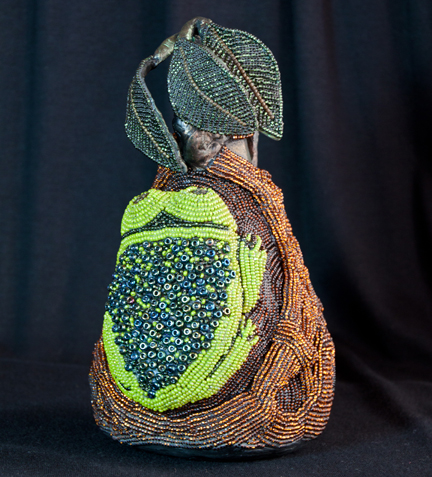
Rain God Front

The Rain God. Carla Woody. Mixed media: Czech glass beads, resin clay, found object, acrylics. 7.5″ tall x 14″ diameter.*

The Rain God

The Rain God, side view.

On another note, I’ve been asked about my artwork: How can you let them go?

When there’s a dialogue of great depth I find that I do need to keep them on the easel or table for a while, maybe even a few months, to see what else we may have to say to each other ⏤ to make sure the conversation has come to a close. When there’s a sense of finality then I can release it with the intent the piece itself will take the dialogue to others.

Sometimes that happens in surprising ways. A few years ago I painted an oil I called My Magdalen Heart which was displayed at The Gallery in Williams. On a day I was there, a French Canadian man approached me with an incredulous look saying the piece had spoken to him. It’s a blessing for me when I hear how the dialogue continues. A few days later the Magdalen went to live in New Mexico with a woman who’d had a relationship with her since childhood.

It’s important to put our expressions out into the world, in whatever way we do, without conforming to others’ rules, and then sending them on their way…so they can take on a life of their own. There may be someone just waiting to engage in the dialogue ⏤ with an anticipation they didn’t know they had.

♦︎♦︎♦︎

*The Rain God is currently available through The Gallery in Williams or inquire by email through this blog.

Categories: Arts, Creativity Strategies, Visual Arts | Tags: , , , | 4 Comments

Book Review: The Andean Cosmovision

AndeanCosmovision

This is a precious book on a number of levels. First, it is written by a Western man, a dedicated seeker on the Andean path through the teachings of Don Américo Yábar, who has consistently held intent to integrate his learnings back into life at home…and share what he’s discovered over more than twenty years. He touches on some of his struggles to do so coming from a Western intellectual perspective.  This honesty is important. It shows possibility toward core understanding beyond the mind and a way of incorporating it into daily living, an evolutionary process.

I can state these things with confidence having known Oakley Gordon over a very long time, witnessing his process as much as being a fellow traveler on the path. I know his heart. We were introduced to the Andean way through the same spiritual teacher, literally at the same time and place. He has also served on the board of Kenosis Spirit Keepers as Vice-President since our inception.

The book is a primer on Andean worldview. If you want more beyond the introduction, Oakley provides endnotes and anthropological resources. In this book though he writes to you as a friend would, not as an academic. It’s easy to take in and comprehend.

But ultimately it’s a guidebook, a how-to. It’s a compilation of meditations gleaned directly from Don Américo and exposure to other paq’os⎯a general Quechua term for healer, shaman or mystic⎯or created by the author from what he’s learned while in Peru. I don’t think another such book exists. This is important. From my own spiritual travel programs, people periodically express the fear of not being able to recreate the same state of being upon their return home. I share and show them how to do so. But The Andean Cosmovision provides it in print with many different examples to explore with step-by-step instruction.

Oakley states that, although much of the book is taken from the teachings of one specific teacher, he believes any paq’o would validate them. I’ll take it one step further. The tenets covered in this book are found at the core of all Indigenous traditions I’ve worked within: Maya, Hopi and Andean, as well as others where I’ve had exposure.

Highly recommend. Available in print and e-book through Amazon and on Oakley’s website.

♦︎♦︎♦︎

 Oakley will be covering the material in his book during a weekend workshop June 3-5, 2016 in Rockville, Utah to benefit the Heart Walk Foundation who work within the Japu Q’ero villages in the areas of education and agriculture. For more information, click this link to a pdf flyer: Andean Cosmovision Workshop

Categories: Book Review, Indigenous Wisdom, Meditation, Q'ero, Spiritual Evolution | Tags: , , , , | 1 Comment

The Fierce Quiet Place

We give a gift to ourselves when we allow connection with our innermost being. This is the one untouched by circumstances but fierce in its inviolate sanctity. The silence in this place is so loud you can hear it, so palpable you can feel it. And yet there’s no adequate way to express the comfort and inspiration it brings. Comfort here meant as nurturing. Coupled with inspiration, it urges us on…through…and beyond…to what we can’t yet know. And the circumstances of our lives⏤the challenges⏤fall away. It doesn’t mean they’re not there but are approached differently. A state of grace through the chaos and surrounding confusion.

And that Fierce Quiet Place wants expression in any way we can. It creates a portal and finds its way into the material world through narrative art, music, poetry and prose, ceremony and ritual…a touch…complete presence we give to others. It’s funneled from non-ordinary reality that exists out-of-time to land here.

This is what I’ve recognized more and more. And knowing that when I give myself over to that Fierce Quiet Place the most beautiful things happen. I live from a deeper place. I meet people who hold similar expression. I want to introduce you to one of them through the way it happened.

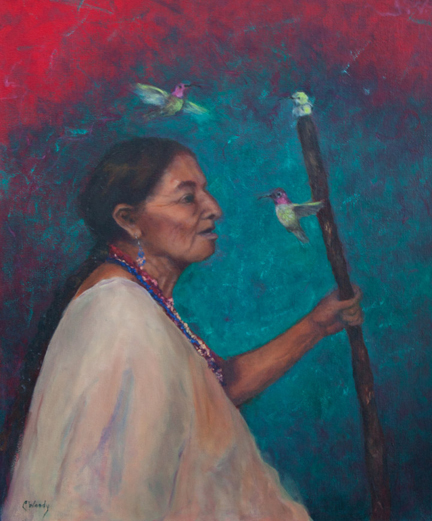
In February I completed This Is My Walk in Life, an oil painting. Over the course of its creation, it came to life. The portal opened. A silent dialogue ensued and conveyed itself as best I could onto canvas. It was not a casual process.

This is my walk in life

Title: This Is My Walk in Life Oil on canvas, 20×24. ©2016 Carla Woody. All rights reserved.

This is the description I gave it.

We all have a walk in life, perhaps chosen before we set our feet on Mother Earth. And amidst hardships there’s unexpected joy. If we open our eyes to it, there’s magic in fleeting moments when we truly experience what life is. This painting is inspired by the Lacandón Maya women of the rainforest village of Nahá in Chiapas, Mexico.

Then at the end of March I met Laura Weaver. She came from Colorado to take part in the fire ceremony guided by Tat Apab’yan Tew during our Spirit Keepers Series. I didn’t know she’s an accomplished poet. I’m quite sure she didn’t know I’m an artist and writer.

Then a few weeks ago I saw a poem she wrote in March.

 A Way of Walking

There is a way of walking

from point A to point B

as if there is nothing

of significance in between.


We have been taught to move

in straight lines, to lay life out

along a grid of efficiencies.

But there is another way to navigate.


This way carves a serpentine road

full of mysterious meetings.

Along this path, the directives come

from the world itself speaking


through all of its voices. And because

something else is guiding us—because

we are listening—at the next crossroads

we turn left instead of right—


and find a never before seen village

where an old man harvests golden apples

he offers to those who pass by. And over

the silken hills, cowbells sound out


like ancient monk song, and the last

of the sunlight breaks through the rainclouds

so that everything is shimmering and awake.

And the oak tree that cracked in last


night’s storm is dripping with honeycomb

and bee hum. And as this moment swells

and blooms open with its own fullness,

suddenly the idea of Point A & Point B


makes no sense at all. For now

you have no idea who you are

or if you have arrived. You only know

that you are everywhere.

I couldn’t help but note the strong similarities in the titles of our respective works and common message. Then yesterday I read her poem Making Passage which reaches an even deeper platform. I urge you to read it. It will speak to your soul.

I don’t think I’m presuming. When the Fierce Quiet Place is fully expressed we all say the same thing. Only the variation in our medium is different.

Earlier I described Laura as an accomplished poet but that’s not quite sufficient. Her words have a way of gently, persistently making their way inside us on a path all their own and touches the universal. And—in my experience—I feel heard. Even held.

 ♦♦♦

♦︎ The reprint of A Way of Walking is used with permission. Subscribe to Soul Passages and receive Laura Weaver’s poetry as she publishes.

♦︎ My original oil This Is My Walk in Life is currently available. Inquire for more information. Archival prints are available here.


Categories: Arts, Creativity Strategies, Spiritual Evolution, The Writing Life, Visual Arts | Tags: , , , | Leave a comment

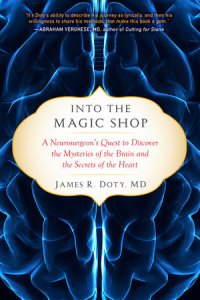
Book Review: Into the Magic Shop

IntoTheMagicShop

My attraction to read Into the Magic Shop was generated through Krista Tippett’s On Being interview called The Magic Shop of the Brain with neurosurgeon and author James Doty, MD. I had no idea who he was. But sincerity flooded his voice as he spoke about the need and effects of compassion. To have a medical doctor speak in this way is so unusual⏤given the hurried, sterile treatment patients in this country normally receive. When Krista asked him to speak of the ritual he underwent prior to neurosurgery, he had me. Rather than having a nurse prep the patient in the operating room he does so himself. After the patient is anesthetized, he shaves the surgery site himself, saying it connects him to the patient as a human being and grounds him in the procedure he is about to take.

From the book:

It is a ritual I do. And as I slowly shave the head, I think of this precious little boy and go over every detail of the surgery in my mind. I cut off the first bit of hair and hand it to the circulator to put in a small bag for the boy’s mother. This is his first haircut, and while it’s the last thing on his mom’s mind now, I know it will matter to her later. It’s a milestone you want to remember. First haircut. First tooth lost. First day of school. First time riding a bike. First brain surgery is never on this list.

What were the influences that made James Doty who he is today with an outlook and behaviors so unusual in his field? He was born into a troubled family where he received no support. He felt alone. He had low self-esteem. But one day he wandered into a magic shop and found his saving grace in an elder named Ruth who was visiting her son, the owner of the store. She saw something in this boy and invited him to return the next day and every day for the next six weeks. She promised to teach him.

…I know how to turn a flicker into a flame. Someone taught me and now I think it’s time that I teach you…It’s going to take a lot of work and you’re going to have to practice the tricks I teach you even more than you did your thumb trick. But I promise you, what I’m going to teach you will change your life…

This is James Doty’s memoir and includes a long learning curve as many spiritual journeys do…because he neglected to include one of the most important teachings Ruth gave him. Ultimately he remembers but not without many trials. And when all her teachings finally took hold, the most powerful magic happened.

Today Dr. Doty is the Founder-Director of the Center for Compassion and Altruism Research and Education⏤of which the Dalai Lama was an original funder⏤and clinical professor at Stanford University School of Medicine.

In many ways Into the Magic Shop reminded me of an all-time favorite book: Illusions by Richard Bach. I always held that the story must be true; Donald Shimoda must have been a real person. I longed for it to be so. But Into the Magic Shop is…without a doubt.

I highly recommend this book. Available on Amazon and elsewhere in print and e-book.


Categories: Book Review, Compassionate Communication, Global Consciousness, Healing | Tags: , , , | 2 Comments

The Float: Losing Your Skin to Deep Relaxation

In the 1983 my life began to change drastically. I was living in Germany and suddenly exposed to many influences unavailable⎯or at least drastically hidden⎯in Ohio where I’d lived for the previous seventeen years. I regularly attended weekend seminars in Wiesbaden through the international branch of the Association for Humanistic Psychology featuring researcher Dr. Stanley Krippner’s work on dreams and shamanism, scientist Dr. Valerie Hunt’s research on the human energy system and others. And I was immersed in a progressive, experiential master’s degree program on human relations through the University of Oklahoma’s satellite program that exposed students to such areas as Virginia Satir’s family systems work, sacred Native American rituals and even Robert Monroe’s studies in out-of-body experiences.

It was somewhere in here that I heard about neuroscientist Dr. John Lilly’s sensory deprivation tanks, initially emerging from his interest in trance states and what happened⎯physically and mentally⎯to astronauts when freed from gravity. The late Edgar Mitchell, who went on to found the Institute of Noetic Sciences, is a good example, seen here in this beautiful tribute video We Are One.

I remember thinking: I wonder what it would be like if I no longer identified with my body or mind? I’d already been meditating for about five years, a practice begun as recovery from a serious health issue. After the first few years I’d begun to experience⎯what seemed like at the time⎯strange sensations in my body. Having no one to talk to about these experiences, it was a relief when I went to Dr. Hunt’s seminar to learn that energy was something present for everyone. We just need to open our awareness to it.

But there was no floatation tank available, and my desire to experience it went underground. Years later through meditation, ceremony and being in an altered state of consciousness for days through spiritual travel I would sporadically lose any sense of boundaries. The only way I could refer to it was “losing my skin.” These rare occurrences were spontaneous, nothing I could call on myself. But the sense it brought was merging with the Universe⎯not unlike what Edgar Mitchell described.

Then about a year ago I came across some information online indicating there’s been an upsurge in interest in floatation tanks, state-of-the art versions, and more prevalent opportunities to dip a toe in. In fact, there are several sites in Arizona alone. Indeed, it seems to be going as mainstream as massage therapy.

So a couple of weekends ago when I was in Sedona with close women friends, I suggested we make appointments at True Rest. We all held anticipation for the hour-long session. I’m sure with different thoughts going through our heads as with any unknown experience. There were three uppermost in my mind. I’ve never had claustrophobia but wondered if I’d have any anxiety being completely contained in a small pod. That was a needless concern. The young man on staff was very careful to introduce every aspect of the experience, through video and demonstrating each feature on the pod, including how to alleviate any sign of claustrophobia. The second thought in my mind was whether it would be like “losing my skin.” It was and more. The third had to do with sleep patterns and whether it would help. For years, I’d been experiencing cyclical issues with sleep. I was in the middle of one and sleep deprived.

The young guy on staff had offered his own story having to do with a broken back, intense chronic pain and no sleep, which had resolved through regular float sessions. So I was hopeful.

The float rooms and tanks are private with shower. The water in the pods is body temp and they’re filled with a huge amount of Epsom salts, causing the body to automatically float. There’s an option to have light or complete darkness, as well as soothing music or none. My initial experience was floating on a warm sea that graduated to being in the womb. And before long I did “lose my skin” and had the sense of being elevated somewhere in the clouds or beyond. Periodically, I would feel gently thrust through the earth’s core. A purely kinesthetic experience of nothingness, with movement, quite hard to describe. At one point I had a fleeting thought to breathe in and out of my third eye and was presented with extraordinary visuals and energy. As I breathed in, I was looking from above into billowing light and energy emerging through the third eye portal. As I breathed out I was in an underground cavern standing at the edge of a lake leading to light in the distance. I was in two places at once and witnessing from a distance, the image begging to be documented on canvas.

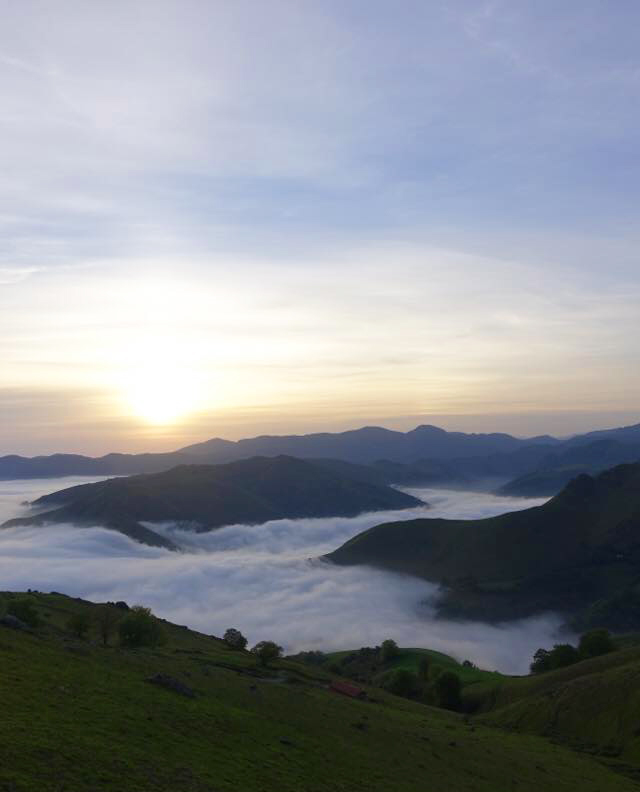
Pyrenees

Pyrenees, Camino Frances, 2015.

There was a sense of timelessness. After “no time” the filter began swirling and drew me back, letting me know the hour had somehow ended. I showered off and went to the other dressing room. My body was more relaxed than I could remember, even after a very good massage. I looked in the mirror and swear I appeared ten years younger.

But the best news is the longer effect it’s had on me. Since this initial float I’ve slept quite well at night. Only once did I resort to the herbal sleep aid I keep on hand. I feel rested upon awakening. The visuals are still vivid, waiting to be transferred to canvas.

After the float when my friends and I returned to our lodging I was drawn to sit outside where it opened to a creek and wilderness area beyond. I felt absolutely present with nature, a comforting stillness inside. I sat there for quite some time until I got up to leisurely shoot images of the ducks and light on the red rocks. Only in retrospect did I realize the float had provided this segue to absolute Presence.

Each friend’s experience was different; the common denominator was deep relaxation. When I spoke to the young man about the depth of my own initial experience, he said I was probably predisposed due to all my years of daily meditation practice. I intuitively knew how to put my mind and body in a state; the float took me the rest of the way. In all the literature I’ve read, including the classic book by Michael Hutchinson The Book of Floating: Exploring the Private Sea, experiences similar to mine do begin to occur after a series of floats, number depending on the individual. Long-term effects being: stress management, healing, pain management, enhanced creativity and sleep, increased problem solving capabilities, and spiritual consciousness. It’s even said to have effect on addiction and weight loss, which makes sense if the aforementioned attributes are in place.

Of course, the ultimate intent is to have such a Zen state integrated through daily life. It seems to me that, in addition to my daily meditation practice, a monthly float will help create such a passage. There’s no need to have the background knowledge that ushered me into my first session, just a desire to glean the benefits.

To find a floatation location in your area, go here. I do recommend True Rest in Sedona, with other locations in Arizona and elsewhere. The premises were quite lovely and spotlessly clean, and staff was welcoming and informative. Groupon coupon discounts are sometimes available.

Categories: Creativity Strategies, Energy Healing, Meditation, Spiritual Evolution | Tags: , , , , | 6 Comments

An Inspired Life: Xavier Quijas Yxayotl

In late 2013 Xavier Quijas Yxayotl—Huichol composer, musician and artist—shared his life story with me. It was a real privilege to hear of his origins, struggles and inspirations. The thing about Xavier is that you’d normally never know the details of his backstory. But maybe you would pick up there’s something deeper. He carries a sense of humility that typically only comes by having gone through hard times…survived…and having instilled great meaning in his life, touching others through his craft and presence.

Xavier Quijas Yxayotl

Portrait of Xavier Quijas Yxayotl with one of his handmade ancestral flutes. ©2015 Barry Wolf. All rights reserved. Used with permission.

With permission I turned his disclosures into a narrative that was picked up in 2014 by Still Point Arts Quarterly for their Fall 2015 issue. I thank editor Christine Cote for giving this important story space. I can now share the story in its entirety here as Xavier told it to me. I hope you are as inspired as I was.

 ***

 Through the Dark

 The boy fidgeted. He was in foreign territory, held prisoner by his mother’s hand on his arm. They sat side-by-side in matching chairs before the great divide of a massive desk. His mother’s voice rose and fell. Words tumbled over each other as though, if she didn’t get them out fast enough, the man considering them would summarily swat them out the door, no different than pesky insects.

An hour before, his mother pulled him along inner city streets into a massive building. They finally stopped in front of one door among several down the long hall. She smoothed her skirt and combed fingers through his black hair. With a deep breath, she opened the door. The secretary looked up.

“Please, I would like to see the director,” his mother said.

“Do you have an appointment?” The secretary appraised them, noting their dusky skin and worn clothing. When she shook her head, the secretary motioned them to a row of chairs against the wall and picked up the phone. They waited.

The man behind the desk was impeccably dressed in a gray suit matching the color shot through his dark hair and mustache. The lines in his face softened as he listened, shifting attention from the Indian woman before him to the boy, eyes downcast, clutching a notebook in his lap.

“Maestro Caracalla, I am Señora Isabel. This is my son Xavier. He’s different, a good artist. In school he always fights because no one understands him, not the teachers, not the other kids. He’s always thinking. Since he was old enough to hold a pencil, he always draws and writes about everything. He’s like an old person in a little boy’s body!”

The woman continued at length relating how, in the last two years, her son kept running away to live on the streets. Xavier slept in parks, skipped school, survived by selling newspapers and shoe shines. Terrified, she would search and drag him home, if she was fortunate to find him. But the next day he’d be gone again. He wouldn’t do what his father wanted: to set aside these silly pastimes, to work making shoes to help support the family.

“We have seven children. Xavier is the youngest boy. We are very poor. But he is so different and I’m afraid what might happen to him. Is there something you can do?” She finished softly.

Maestro Caracalla gestured to the boy’s notebook, “Is this your work?”

Xavier froze in his chair and prayed to disappear. He didn’t think the Maestro would hit him like his father did, but he dreaded the reprimand he knew would come. He whispered, “Yes.”

“Show it to me then.” The room was silent save the sound of Maestro Caracalla slowly turning pages after scrutinizing each one. Finally he closed the book. Looking over wire-rimmed glasses, his eyes seemed to bore into Xavier’s very soul. He gazed at Señora Isabel then back at the boy, whose reddened face was moist with sweat. “Señora, I don’t think you have any idea what a beautiful child you have. What ideas! His writing doesn’t match his age. He’s not a normal child. You have to do something with him. We have to help him!”

Maestro Caracalla told her to bring the boy back the following Monday, handing over a long list of art materials to buy. There’s not enough to eat! How can we buy art supplies? Guilt flooded Xavier’s mind. He was certain of a dead end. But at the appointed time his mother delivered him to the Maestro. She could only muster a clean new drawing tablet and 6B pencil, keeping even that small expenditure hidden from her husband. The secretary ordered a sandwich for Xavier, although he said he didn’t need anything.

“Ah, there you are,” the Maestro swept in from his office. He took Xavier by the hand and led him down the hall. They stopped in all the classrooms where he spoke to the teachers, “I want to introduce Xavier. He’s coming to take classes.”

That is how an eleven-year-old Huichol Indian boy from the streets came to attend Escuela des Artes Plásticas, the art school in Guadalajara, Mexico—the youngest pupil ever to sit alongside regular university students. They became his peers and friends. Maestro Caracalla continued as his benefactor for six years, making sure he had all the classes he needed: writing, painting, art history and more…

Xavier Painting 1

Painting by Xavier at the age of 18. Photo courtesy of Xavier Quijas Yxayotl. All rights reserved.

Xavier painting-2

Xavier with one of his painted pow wow drums. Photo courtesy of Xavier Quijas Yxayotl. All rights reserved.

Continue reading Xavier’s story here and find out how he returned to the Huichol roots denied him as a child, and went on to resurrect ancient instruments lost to time through visitations from his ancestors.

Categories: Indigenous Wisdom, Interview, Music Review, The Writing Life, Visual Arts | Tags: , , , , | 4 Comments

Book Review: Traveling with Pomegranates

Traveling with PomegranatesI had just finished reading The Invention of Wings and was so taken with its sensitivity and historical significance that I went online to see what else Sue Monk Kidd had written. That’s when I discovered Traveling with Pomegranates, a memoir written by mother and daughter. What initially attracted me was its framework: spiritually oriented travel to sacred sites. Since I sponsor spiritual journey programs myself, it was a natural draw. I found so much richness in this container.

The content is drawn from the personal journals of Sue Monk Kidd and daughter Ann Kidd Taylor as they journey to sites in Greece, Turkey and France, touching down in-between at home in South Carolina, over a few year period. Mother is poised on the cusp of her fifties. Daughter is barely twenty. Both face age-related life events, desires and the all-too-often wrestling…internal questioning… that comes as a result. I suspect they would have engaged with these universal aspects anyway. But the process was marked out in two ways that probably intensified it and kept it rolling. First, it was the awareness they gave to each other during their travels, based on their relationship, even as they were going through their own worry and self-discovery. The perspective and emotional content based on age was prominent.

The other significance had to do with the way each of them engaged the iconic historical and mythological feminine figures based on their travel to particular sacred sites. And how the unfolding carries forward over time, strengthening itself through further focused intent and journeying. I know this through my own experiences and witnessing others in my travels who do the same.

The special treat for me was Sue Monk Kidd’s disclosure of her own process as a writer—inspirations and tribulations. At that point, she was known for nonfiction, kicking up a bit of a fuss in theological circles with The Dance of the Dissident Daughter. Yet her heart called out to write novels. She’s frank about the self-doubt but finally plowing forward anyway. We don’t often think about bestselling authors or others of acclaim in that light. It makes her human in our eyes, encourages us to stay the course.

This is a book that caused me to reflect on my own stage of life: where I’ve been, the Great Unknown yet to unfold, and opportunities to embrace living even more fully.

Available in print and ebook on Amazon and elsewhere.


Categories: Book Review, Spiritual Evolution, Spiritual Travel, The Writing Life | Tags: , , , | Leave a comment

A Word

This is the time when many of us look back over the last year to note how things have evolved…and to the future for what we want to come into our lives next. Goal-setting is just too dry and linear for me. There’s no juice to it. Besides, it reminds me of all those many strategic planning retreats I facilitated with executives and their managers when I was an organizational development consultant so many years ago. I think they despised the sanctioned process as much as I did. Then after all that drudgery the plans always ended up in a drawer somewhere, merely lip service paid. By the way, that’s one of the major reasons I stepped out of that line of work. It was like banging my head against the wall—and I’d much rather put my attention where it can make some kind of difference.

I prefer the organic, a framework that gives rise to things I couldn’t predict but end up having so much more effect on evolution, maybe revolution—my own and others’—than I ever could have dreamed up. There’s a core element to it, a sort of intent. A few years ago, I shared an excerpt from my book Standing Stark in a post called The Tasking relating to this subject. The first few lines are below.

Set your intent and let it go. Your intent is your beginning. Worrying about the details detracts from the intent. In your strong intent, the attraction will take care of the details.

I want to offer you a ritual that leads in this direction. I am part of a small women’s circle. We gather in a member’s home once a month, have deeply personal conversations and share a meal. I have much gratitude for these women. There’s trust that goes beyond mere friendship. We hold space for each other in a way I’ve not ever been held except by my folks. For the last few years in December we’ve come together for special purpose. I don’t think they’ll mind if I tell you. Good things need to be shared. And the process is also similar to what I’ve suggested to students over the years.

We each choose a word for the next year. Not just any word. Not one taken lightly—because we’ve seen well enough through experience how the word will make appearances in our lives in ways that shape us. It will bring experiences in the mundane, the beautiful, the difficult. It acts as a teacher, and through this learning we are consciously involved in our own process and communion with the Infinite. It’s for those who want to delve deeply.

I can liken it to the wazifas of the Sufi tradition. Through wazifa practice, chanting one or more of the Ninety-Nine Beautiful Names of Allah, you’re essentially calling in an attribute, one you ask to open within yourself.

The difference here is that you don’t have to chant the word, although you could use it in meditation or some other way to remind yourself. The beauty is, that once you’ve chosen your word, you’ve made a declaration. The word has been released to the ether and will come back to you as most beneficial. Note beneficial doesn’t necessarily mean easy.

Apparitions

Apparitions. Mixed media on panel. ©2014 Carla Woody

A personal example from December 2014: I knew I’d been hovering at a threshold for quite some time. I’d been patient for a few years. But I was also quite ready to step through and get on with it…whatever it was. For 2015 I chose: Momentum. In my personal translation I view momentum as something that builds upon itself, a movement that keeps on delivering. It did and will likely continue since I’ve embraced it.

When I look back on my last year I’m astounded at the turn my life began to take almost immediately. It started with the depth and breadth of the container we engaged with during the January Maya program. Within a few months I walked the Camino de Santiago, one of the most difficult yet beautiful things I’ve done for myself. I knew this going in.

Through the summer I recovered and integrated but was aware the pilgrimage wasn’t yet complete. There was another part that was to come. It would determine my level of integration to date and carry its own outcome, which it did and laid the groundwork for something else. If you haven’t already read about the happenings during the October-November initiation journey in Bolivia and Peru, take a look at A Hopi Discovery in Bolivia and A Vision Comes. In this entire year-long process my creativity and relationships have deepened; I’ve gained an added state of presence that I’m shown in so many ways large and small. I feel different. I’ve been graced. And it looked many different ways over the course of the year.

So it may come as no surprise that in December during our special purpose gathering…after sitting with my choice for 2016, considering carefully, I chose: Grace. With all its many nuances—potential ways it may visit—to polish any rough edges, this is my choice.

Choosing a word to inform your year isn’t necessarily for the faint of heart but does come with untold benefits in the long-run. If you’re tempted to invoke yours, I encourage it. Such an act enlivens you.

 *****

If you want to choose a word but just the right one remains elusive, take a look at the Positive Qualities Chart. It shows root and related qualities. This is a tool I offer students during my Navigating Your Lifepath program. I notice the chart’s author now has one for Divine Attributes as well.


Categories: Creativity Strategies, Spiritual Evolution | Tags: , , | 2 Comments

A Vision Comes

On the second day of our time on the Island of the Sun in Bolivia an opportunity presented itself. Local Aymara spiritual leader Mallku Roger Choque offered to take us to a closely held sacred place, one little known to outsiders where even few locals venture. The ancient ceremonial purpose of the site off the Island of the Sun was verified some decades ago when archaeologists found ritual artifacts on the lake bed at its base.

Clearly, this was another gift being handed to us. The first gift occurred the day before when sponsored Hopi guest Suhongva Marvin Lalo had discovered the Hopi migration petroglyph on a huge stone slab at the ruins of Puma Punku, outside La Paz—significant validation of the Hopi migration path. My spiritual travel group also included five sponsored Q’ero Wisdom Keepers making this journey to return to their Inka origins, as well as participants from across the US and Canada.

Given the cue by Mallku Roger we descended from the high point where we were lodging to the boat below. Not long after we headed out, waves washing behind us, this Aymara paq’o, or medicine person, laid a large weaving out on the floor of the boat’s front interior. Crouching down, he removed items from his bag. Soon it became apparent he would be leading a despacho ceremony, a prayer offering. Others squeezed around the altar, getting as close as we could in that cramped space.

12011211_913458098707716_6145306239569370714_n

Mallku Roger Choque. Photo credit: Carla Woody.

And a memory surfaced, one of being on a boat and, so much the same, engaged in despacho ceremony the previous year on a private journey with a few friends. But that time we had been leaving the Island of the Moon, ancient site of the Mystery School for Inka priestesses. And after our prayers were all placed in the despacho, and it was tightly wrapped, I was beckoned outside to the boat’s back deck. The package was placed in my hands. I remember standing, watching the waves recede as we plowed through the waters. Raising my hands I released the bundle to send it arcing over the waters. Time slowed down. It seemed to hover for a few moments before slipping into the lake…and some kind of energy was emitted. We all felt it. I tried not to engage my mind then about what it might mean, if anything.

I came back to the present as one of my Q’ero friends stood before me offering me a kintu for the Pachamama—Mother Earth—coca leaves in proper placement. Taking them into my own hands, I began breathing my prayers into the coca. Another kintu was given for the Apus, the mountain spirits. My friend came back to receive the kintus that would be placed in an earthen vessel, along with the others. I gazed out at Lake Titicaca, so incredibly vast, then turned my attention back to the ceremony.

12190847_913458045374388_7982839939952919371_n

Despacho ceremony on Lake Titicaca. Photo credit: Carla Woody.

And in that split second, a vision distilled. I say vision but can I say a precise image appeared? No. It was more a sense that something was being woven together. Can I say that I was given a commandment? No. But I was receiving a precise direction. It produced the feeling of something inside settling and becoming solid. A calling I didn’t question. But it still involved asking permission. I sat there with the knowledge.

By then the boat had approached our destination. But first the vessel that held all our prayers and blessings was lowered carefully into the shallow water and came to rest.

That night after dinner I asked Hopi, Q’ero and Aymara spiritual leaders if they would gather in circle with me. I told them of the vision I’d received during ceremony: to invite Hopi, Q’ero, Aymara and Maya Wisdom Keepers on a pilgrimage in 2016 nearly replicating the one we were making this year from Bolivia to Peru with one difference. The culmination would be on Q’ero. While others have brought different traditions together in various locations on a much grander scale, the direction I’d received involved a journey of an intimate, humble nature. I felt that others across the lands who would assist in holding such a space for this pilgrimage would emerge to support it. I asked the Wisdom Keepers if they would tell me what thoughts they had. One by one they spoke agreeing wholeheartedly with this vision.

Only Mallku Roger was silent. When all had finished speaking their piece, he turned to Marvin, our Hopi guest, and said in a strong voice, “I see your pain. And I have the same pain. Your pain is all our pain.” He gestured around this circle of his Indigenous brothers. “We are to help each other. I will never abandon you. We will never abandon each other.”

He spoke at length on the Eagle Condor Prophecy, then turned to me. I swear his eyes bored into my very soul and wouldn’t let me go. “This is like a weaving. We cannot do this alone. There are those who are connectors, people who help. Your vision is correct.”

In that moment, the last vestiges of doubt that periodically played inside my head over the years about the work I’ve dedicated myself to…when I’d get tired…when my faith got called into question…when it seemed like I was swimming against a tidal wave with little forward motion…dissipated.

Later I wondered if last year—when I slipped the despacho into Lake Titicaca—something had been set into motion. One more evolution. Each time it’s never about predicting what is to come as a result. One can’t. But it is about engagement…full engagement to the calling.

********

To read about the discovery of the Hopi migration petroglyph at Puma Punku and more background, go here.

To learn more about the 2016 Heart of the Andes spiritual travel program in Bolivia and Peru, the intimate pilgrimage honoring the Eagle Condor Prophecy as noted in this writing, go here.


Categories: Global Consciousness, Hopi, Indigenous Wisdom, Maya, Q'ero, Sacred Reciprocity, Spiritual Travel | Tags: , , , , | 2 Comments

A Hopi Discovery in Bolivia

It was the first day of The Heart of the Andes. This year’s spiritual travel program included Bolivia as our starting point with culmination in Cusco, closely replicating the initiation journey of the first Inka couple Manco Capac and Mama Ocllo. Directed by their father-god Viracocha, they sought a most holy place to build a city—a place of the sun and navel of the world.*

Prior to setting foot in Tiwanku, said to be the Creation Place where Manco Capac and Mama Ocllo first emerged, we made a stop. On a high windy ridge overlooking the area—a ritual site— Q’ero paq’o friends led a despacho ceremony. Offering sacred cornmeal to each of us, Hopi Suhongva Marvin Lalo made his own prayers to the land as we all released our intent to the winds.**

Marvin had begun to share his feelings and his mission for coming on this journey.

Hopi Elders talk about and remind generations after generations of Hopi oral history, including the migration stories of various clans after the flooding of Palatkwapi, a unknown ancient village located somewhere in the south. Exact routes, established villages, and events have long been forgotten with time. Still, ancient ceremonies remain intact with clans responsible for carrying religious ceremonies through thousands of years of migrations to present-day Hopi villages where the ceremonies are still practiced today.

The Heart of the Andes journey offered an opportunity to connect with ancestral history, to visit the land of the ancients and its descendents, the Q’ero. To what extent my experience would take me, I didn’t know. The first despacho ceremony, I experienced a strong connection as I was presented with a Chakana; a sacred stone necklace and woven cords tied to my wrist. I gave thanks with offerings of my hooma.

At Tiwanku, Marvin already noted the possibility of his own people having set foot on this land. We wandered the ruins, a place of ancient mystery. We were all especially moved in a ritual square, the interior lined with stone faces—a portal perhaps.

Finally pulling ourselves away, in the last half hour before closing we ventured over to an adjacent site. Puma Punku may be the biggest mystery of all. Some conjecture it may have been a docking point, as thousands of years ago Lake Titicaca also covered this area. Now what was left were huge toppled stone slabs and much smaller structures fashioned with extraordinary precision … seemingly impossible for those times. It cannot be explained to this day.

And it was here that Marvin—who had traveled south all the way from Hopi Land on a mission for signs that his people had passed this way—found the Hopi migration petroglyph. The one that was known to point the way to his ancestors. The one that pointed north.

Atypical of other petroglyphs I’ve seen all over the US Southwest or elsewhere, it was large. I’d say three feet, maybe more. Also curious, there was a large serpent petroglyph in front of it, as though verifying the direction.

Even that large, it was easy to miss. The sun was at that point in the day when its rays glare as it’s headed toward the horizon ready for the night. Light bounced off rock surfaces, washing out details. Even with sunglasses my eyes were at its mercy. I missed it.

But not Marvin. He zeroed in on a symbol he knew to be his people’s…and his hair was on fire.

Hopi Migration Symbol

Hopi migration petroglyph at Puma Punka, black and white to better view. Not pictured in its entirety. Nor is the serpent petroglyph pictured. Photo credit: Janet Harvey.

What does this mean exactly? In 2008 Hopi Harold Joseph came on our program that included Puno. On the Peruvian side of Lake Titicaca, we went by boat to the reed islands. There Harold saw the reed boats with serpent heads that he knew from Hopi oral history. He took a replica back to Hopi to show his father-in-law, the last great oral historian of the Tribe…who got tears in his eyes when Harold presented him with an artifact that he already knew.

For Marvin and his Elders, how do you explain the presence of the Hopi migration symbol at Puma Punka if the Hopi had not been there? He talked with excitement of sharing this discovery with the Elders. When our guides spoke of a great city that once existed in this region, now lost, and the great flood that took it, he listened. Geologically, it appears valid. The same story exists in his oral history. The locals even raised the idea that the place we know as Atlantis and the great city they cite are the same.

After we came home, Marvin offered his words, to be included in this documentation, more overview of his time with us in a land he found not to be foreign to him.

The Q’ero and spiritual guides honored me by inviting me to sit in on the ceremonies and observe. I recognized the po.nga (altar) and offerings to be similar to Hopi. At one point I was asked to pray with my hooma for them: to ask the deities’ especially Hopi to help and assist the people to prosper. I quietly prayed, gave offerings of hooma, drank the cool tasty water and bathed symbolically at the springs.

Each day I visited archeological sites with our group and host. Visiting the great Titicaca Lake, to hear a local legend of a great city, which was flooded thousands of years ago sitting at the bottom of the lake. The more I saw, the more I was reminded of how the structures, stone walls, the land and historical stories are similar in the Hopi Southwest. The migration symbol is common to the Southwest but seeing it in South America helps support our Elders’ stories of Hopi migration from the south: ‘Palatkwapi.’

Suhongva Marvin Lalo

Suhongva Marvin Lalo, Island of the Moon. Photo credit: Carla Woody.

When we know our origins, it grounds spiritual identity. We know our place in the world through all the places our people traveled, the ground their feet have touched. It goes beyond mere belief. I’m not sure the word ‘faith’ is even sufficient.

And when you’ve followed something that you know, even as you don’t know what’s ahead or why…and it comes to some kind of fruition in a way you couldn’t even have imagined…that instills something for which I have no words.

That’s what happened for me on this journey. Next year it will be ten years since an eagle and condor flew together overhead at Huaypo Lake outside Cusco after a despacho ceremony with Q’ero friends. And I had an immediate vision of bringing Hopi people to Peru on my 2007 program…not knowing any Hopi…not knowing it was their migration path…not knowing how it would ever happen…not knowing of the Eagle Condor Prophecy.

I have no words.

********

* Viracocha, Creator-Sun God, is also known as Inti.

** Q’ero paq’os (meaning priests, mystics and/or wisdom keepers) traveled to Bolivia from their home in the high Peruvian Andes as sponsored guests and experience the site of their origin for the first time. At important points in the journey they guided despacho ceremonies, a prayer ritual.

Suhongva Marvin Lalo of Walpi, First Mesa in Northern Arizona was our sponsored Hopi guest for the purpose he mentions in this article. Marvin consults for the Hopi Cultural Center in validating sacred sites and artifacts.

For more on why Kenosis Spirit Keepers has been sponsoring Indigenous guests on our spiritual travel programs, go here.

Categories: Gratitude, Hopi, Indigenous Wisdom, Spiritual Travel | Tags: , , , | 6 Comments

Blog at WordPress.com.