Posts Tagged With: Indigenous traditions

The Unborn, the Ancestors

Little girl…little boy. You, the leaf! You, the new branch! Listen to me. Listen to this song I have. A word I have…a speech. You must be dreaming. You must be sleeping. Are you tired? Can I speak to you? Are you tired? Are you dreaming?

I want to talk to you. I have a word from my heart to you. Would you want to talk to me? Would you want to move?

You are the reason my heart is alive! You are the reason my life is complete!

In a lilting voice he gently coaxed then paused, just as his lineage had for centuries. He sought a cue, maybe movement, to let him know he’d made a connection.

From the beginning of March, I’d traveled with Maya Daykeeper Apab’yan Tew to Kansas, Hopi and elsewhere around Arizona. Between journeys I was privileged to host him in my home. Now we were in the last days of the month, he stood—delicately poised in traditional dress, eyes half closed, an arm lifted, hand upturned—at the front of the room. The rest of us seated, in a meditative state.

Huichol composer-musician Xavier Quijas Yxayotl played his flute softly in the background, his music framing Apab’yan’s words. Monita Lynn Baker joined in with just the appropriate bit of percussion. I’d invited Xavier to our Spirit Keepers Series gathering at North Mountain Visitors Center in Phoenix to reconnect with Apab’yan. They hadn’t seen each other in 25 years. Their ritual music-dance teachers were friends but both had long passed.

Apab’yan had spoken at length on K’iche’ Maya worldview—originating from the Guatemalan highlands—and his responsibilities as a Daykeeper working with the Cholq’ij calendar. During the course of the evening he revealed that he’d acted as a traditional midwife for the last 16 years. He had a patient with a difficult pregnancy, the baby in a questionable position, awaiting his return home. This mention naturally led into the singing speech we experienced, the intervention meant to guide the baby to reposition on its own in utero, to align correctly with the birth canal.*

The song ended. The room was silent, the energy palpable. I think we must all have been touched in ways indefinable. Perhaps there was something enlivened that had been asleep. Or a dream grounded into this reality. Perhaps there were aspects we each may have carried into this life from our mothers and fathers—inner vulnerabilities—that were soothed, shed. This was a perfect portal to usher us into the fire ceremony the next day.

North Mountain Visitors Center abuts the Phoenix Mountain Preserve. The beautiful grounds are pristine, belying its poignant past. It was here, from the 1890s until 1930s, that many Native families camped, attempting to see the children taken from their homes and subjected to forced assimilation at the Phoenix Indian School. Interspersed were the tuberculosis camps in the early 1900s for those seeking the curative properties of dry desert air.

We gathered, in the shadows of the small ampitheatre, and Apab’yan consecrated an altar space where he would guide the fire ceremony. And it was here that he would call upon the ancestors. In his own words

Everything is alive. Everything has a form of communication. Everything has meaning and belongs to a natural system.

The Maya ceremony consists of preparing a ceremonial pyre. It is called a gift but also a payment in the sense of reciprocity. The K’iche’ ceremonial pyre is not a bonfire; it does not burn a long time. It does not need to last. The importance has to do with what happens while the fire is active: There must be a dialogue.

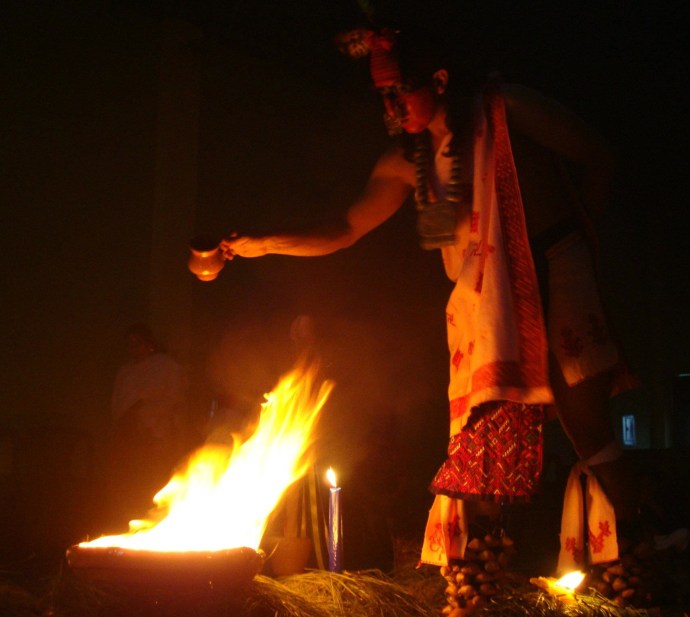
As normal, those assembled took part in the building of the altar, some given special roles. One held the fire stick. Some were called upon to make the first lighting. Two others to pass out candles. And the fire began to burn. Puffing on the ceremonial cigar, Apab’yan called for the Grandmothers-Grandfathers to be present. He made the prayers. Placing candles, we made our own prayers. At long last, the fire started to die down, the conversation coming to completion.

But not yet.

Apab’yan went over to Xavier and Monita, whispering to them. After asking me to lead the circle in holding space, those three walked into the desert. And then…on the air…from the distance…we heard flute and voice rising and falling…singing to the land…to any lingering ghosts of sadness…offering up prayers. And some strange force blew through. It overtook my body. Ever so slowly, involuntarily, my body began to arch backwards until it was in an impossible position. Held. For what seemed like forever. Until it let me go. When I opened my eyes, I saw the Diné woman across the circle crying.

When they re-entered the circle, Apab’yan knelt before her and asked her to ritually bless him with burning sage. That image and the power of it sticks in my mind: Diné woman, Maya man.

The ceremony now closed, the sense of what occurred remained. A communal undertaking. Correctly done. Even as I’m writing this now, I’m feeling into the sacred space…all over again…we all created. I imagine it still hangs in the air in the ampitheatre, the people who pass through wondering what has touched them.

I’ve been in powerful ceremonies before. Fire ceremonies, too. But none ever as compelling as this one. Perhaps it was the culmination of all the energy accumulated from all the ceremonies over a month’s time, carried with us…from Hopi…to private land outside Wichita…to private and public sites in Tucson and finally in Phoenix. And some particularly precious energy remains within my own sanctuary.**

With much respect and gratitude to Apab’yan  and those who showed up in these ritual circles. The journey continues in January in Maya Land with the strength we gathered in March. Anyone drawn is welcome.

Below I’m adding a piece written by Pam Hale Trachta with her own reflections.

 The Power of Ritual and Ceremony

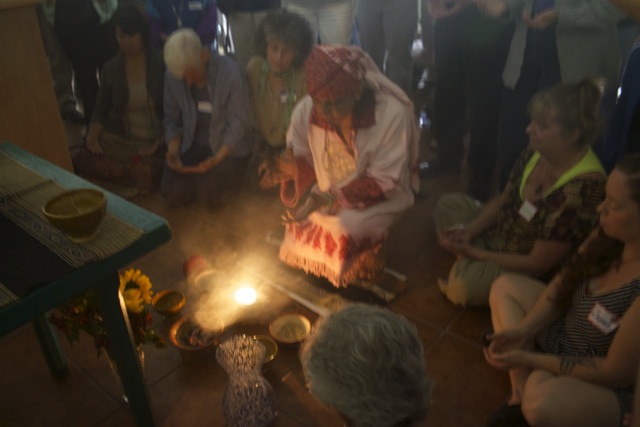
The smoke from the copal grew thicker in the room, as Apab’yan fed the small container fire with the granules of incense, and his prayers. People seated around him and behind him prayed too, mesmerized now by the hypnotic chanting in the Mayan language, punctuated by English phrases so we could all track where the prayers were being directed.

The room was darkened in order to suggest the atmosphere of the caves where this water ceremony is usually performed. A bowl of water resting on the table received the blessing, and participants would eventually be offered sips of it, as in communion. Finally, roses were dipped into the water and used to shake drops of water on all those gathered.

It was a potent blessing, because the intimacy and power of ritual transcends cultures, language differences and even philosophical details. Spirit is Spirit in any language. And the language of Spirit is ceremony.

Water Ceremony

Water Ceremony at Tacheria Interfaith School of Spiritual Direction in Tucson. Photo: Pam Hale Trachta.
Read more

♦♦♦

 * Apab’yan Tew is likely the only male Maya midwife that exists. He knows of no other. Indeed, it’s not traditional. It occurred because, when he was a lost young man wandering in the Guatemala highlands, a Maya midwife took him in. And before long he assisted her in the process. He became her apprentice until he began to birth babies on his own. He remains readily sought after as a midwife. When in the highlands he does everything from the beginning: talks, sings, moves and delivers the baby. In the city, he prepares everything until the point of delivery then sends the mother to the hospital for final delivery by a doctor. This was the case recently in Mexico City. Apab’yan and the mother were able to bypass the difficulties of the pregnancy. She successfully delivered a baby girl.

**With many thanks to the following people and organizations for hosting us and making the March beauty possible:

  • On Hopi: Charlene and Harold Joseph;
  • In Kansas: Lonetta Lollar and John Brack, and Belle Dessa and the Great Plains Earth Institute;
  • Elsewhere in Arizona: Pam Hale Trachta, Frank Williams and Tacheria Interfaith School of Spiritual Direction, Leslie Spencer-Snider and North Mountain Visitors Center, and Cindy Heath.
Categories: cultural interests, Gratitude, Indigenous Wisdom, Maya, Sacred Reciprocity | Tags: , , , , , | 2 Comments

A Havasupai Elder Speaks

We drove along the South Rim tourist area of the Grand Canyon and wound our way to the west on a dirt road through tall pines. Leaving the throngs of people behind, with much anticipation, we entered a different world. During opening circle for our spiritual travel program to Hopi just the night before, I’d let the folks know an opportunity had presented itself.

The Grand Canyon is sacred to the Hopi. They emerged into this middle world in ancient times from a point deep in its interior, and the Havasupai people have called it home for at least a thousand years. A relationship exists between these peoples. So when my Hopi partner Char Joseph contacted the Havasupai Tribe inquiring if there was someone who would speak to us about their ways, they were happy to oblige saying…all too often they were forgotten.

We pulled into Supai Camp, once the tribal winter home on the rim where just a few remain. The traditional dwellings are long gone. In 1934 the National Park Service (NPS) tore down or burned the homes without notice to the residents who were away at the time. I Am the Grand Canyon documents more than a century’s devastation of the Havasupai at the hands of the US federal government, NPS, Grand Canyon Association and Sierra Club. In the book, Havasupai Mack Putesoy testified how their homes were burned to the ground with all their belongings inside. Effie Hanna said she lost things she’d been saving all her life. In place of traditional homes on their aboriginal lands, the NPS built cabins and forced the residents to pay rent.

However, I knew none of this at the time we approached the home where we’d been invited.

Havasupai Girl

Havasupai girl, circa 1900. Photo credit unknown.

We were greeted at the door by Colleen Kaska, daughter of Daniel Kaska who was chairman of the Havasupai Tribe in the 1970s. Elder Daniel is now quite frail but welcomed us. He wanted to tell us the story of the Havasupai, People of the Blue-Green Waters named after the beautiful canyon waters running through the area they now mostly live. Colleen shared in the storytelling.

Their aboriginal lands once encompassed areas from the Grand Canyon to the Colorado River and the San Francisco Peaks west to Ashfork and Seligman. In the warm months they lived in what is now known as Cataract Canyon in the interior of the Grand Canyon and grew crops. In winter months they dwelt on the rim in order to hunt.

Once the Santa Fe railroad came along and interest in the Grand Canyon grew as a tourist and recreational site the Havasupai were squeezed and began to suffer. In 1882 President Arthur declared the majority of their aboriginal land belonged to the American public. The People of the Blue-Green Waters lost their plateau hunting-herding lands and many thousands of acres. They were barred from rim watering holes by cattlemen and the NPS…and relegated to Cataract Canyon. This narrow 518-acre tract doesn’t see sun during winter months, and historically endured flash floods that sometimes took out homes and people.

Colleen had been relating this history in a matter-of-fact way. The more she spoke, the sadder I felt. I had no idea what we would learn when we came through this family’s door. But I didn’t anticipate such a story. I’d thought of the NPS and Sierra Club as entities that conserved beauty…not those who wrought devastation upon peoples of the land (I thought) they were to protect. I said, “This all must be heartbreaking.”

Colleen paused, became still. She had a faraway look in her eyes. “Yes. But when I walk our aboriginal lands⎯the ones taken from us⎯I know it is of my people. My ancestors are there.” The tone of her voice made clear that knowledge gave her strength.

Elder Daniel spoke haltingly of the century-long struggles to be recognized by the federal government, to regain any of the land taken from them, including his own personal involvement as chairman in this quest. Finally, in 1976 they succeeded to a small degree: 185 acres returned to the Havasupai with 95,300 acres named “Havasupai Use Lands” but controlled by the NPS.

Daniel Kaska and Apabyan Tew

Havasupai Elder Daniel Kaska & Maya Daykeeper Apab’yan Tew. Photo: Colleen Kaska.

K’iche’ Maya Daykeeper Apab’yan Tew was present as a sponsored guest on our spiritual travel program. He wanted to know about Havasupai ceremonies. He asked Daniel, “Do you have a story about some time of a spiritual nature you remember?” Daniel shook his head. It seemed the focus for so long had been a fight for acknowledgment, some recognition of their worth, that there was no energy left for anything else.

Mike Weddle⎯Kenosis Spirit Keepers board member, Daykeeper and musician⎯visiting from Maryland was able to join our group for just two days. He brought his flute. I invited Mike to offer Daniel and Colleen a prayer song. The music was sweet. When it came to an end, there was silence. Then Daniel began to sing in words and tones that entered every one of us. The energy seemed to shift.

When we all expressed how it touched us, he uttered softly, “It’s a funeral song.” And then, “We are a lost tribe.” It was painful to hear of such loss.

Our visit was over. We formed a circle outside under the pines and invited Colleen to join us. Elder Daniel was unable to do so. Apab’yan offered a Maya prayer for the People of the Blue-Green Waters and the land.

A few days later I received a note from Mike who had to leave for other business.

I think we all felt the same as elder Daniel Kaska told his story of loss and betrayal, going to Washington where no one would listen, voting against the government deal when his own people would not listen, and his final ‘I don’t know what will become of us’. When he sang his beautiful song, and then said it was a funeral song, I almost wept.

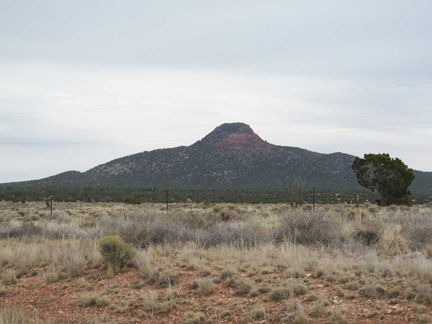
We were invited by Colleen to join a singing ceremony 8 am Saturday at Red Butte. I did go to represent us but there was no one there. There are two forest roads on each side of the Butte, but no people, no cars, and no singing.

So I climbed the switchbacks to the very top of the butte, the summit. At the very top there is a crossing with 4 paths going in the 4 cardinal directions. I’m sending a photo. Colleen called this the Supai place of origin.

I felt that in just 2 days I had been witness to the place where the Supai began and perhaps the place where they end. As there was no one else there to sing, I did the singing, and I sang the Maltyoxb’al, the [Maya] great gratitude song, for the arc of the Supai nation.

Red Butte

Red Butte where the Havasupai were born to this world. Photo: Mike Weddle.

redbutte3

Four Directions at the summit of Red Butte. Photo: Mike Weddle.

When we held our closing circle at the end of our week with the Hopi and Havasupai people, I spoke to the group.

I never know in advance how things will unfold when we hold a sacred container of pure intent. Things I can never predict come in ways that affect us all. I believe the most important thing we did during this journey was sit in respect, listen deeply to this Elder’s words and witness the grief he carries.

Sometimes that’s all we can do even in the face of our own helplessness at such recognition. And that acknowledgment matters.

***********

Note: Elder Daniel Kaska singing recorded by Apab’yan Tew.

Go here to learn more about Spiritual Travel to Hopi: Sacred Guardians of the World,  and check back for next year’s March travels.

Categories: cultural interests, Healing, Indigenous Rights, Spiritual Travel | Tags: , , | 4 Comments

Film Review – The Red Queen: A Mayan Mystery

In 1994 a tomb was excavated in Temple XIII in the main plaza of Palenque, the large Maya ruin complex in Chiapas, Mexico. It was the finest thus far uncovered, even more so than the great ruler Pakal II’s in the Temple of the Inscriptions just a couple of doors down. The quantity of jadeite, sacred objects and two skeletons on either side of the sarcophagus indicated someone of the highest standing. And a very curious thing: The remains were completely covered in a powdery red substance that turned out to be cinnabar.

A physical anthropologist determined the remains to be female. The temple richness  pointed to the final resting place of an esteemed ruler. But for women to attain such a capacity was unusual. Thus began The Red Queen. And then it immediately garnered my attention when archaeologist David Friedal took the screen saying, “The history of the past is not the history of men but men and women together. And at times women change the course of history. Not men.”

The Red Queen is not a boring historical documentary. Rather it entertains the question: Who was the Red Queen? She was nicknamed so because of the cinnabar. Attendants carefully covered her in the toxic powder at burial. It made its way into her very bones. We’re on board as the film tracks the mysteries, technical methods and data that lead to a conclusion from the three likeliest candidates.

  • Was it Yohl Ik’nal, the grandmother of Pakal? As far as we know she was the first Maya female to rule on her own…for 21 years.
  • Was it Sak K’uk, who took over the throne when her brother was killed? She held rule until she was able to put her son Pakal on the throne when he turned twelve. Likely she guided him from behind for some time after that.
  • Or was it Tz’akbu Ajaw, the wife of Pakal? And sometimes called Lady Conjurer as noted in Carol Karasik’s book The Drum Wars where she devoted a chapter to the Red Queen.

Those who know me are well acquainted with my love for Palenque, having been drawn back regularly since 1995 when I first had the pleasure. So the story of the Red Queen was an interest on that level. But more so, I found it heartening to have women recognized for who they are, their accomplishments and learn something of their story—not quietly influencing behind the scenes but front stage center.

Produced by the Discovery Channel, 2005. Watch it free on You Tube.

The Red Queen 1

Part One: View it here. 1 hour, 9 minutes.

Red Queen-2

Part Two: View it here. 24 minutes.

*****

For more information on our next scheduled Maya Mysteries spiritual travel program in Chiapas…where we visit Palenque and pay respects to the Red Queen, go here.


Categories: cultural interests, Film, Maya | Tags: , , | 1 Comment

An Inspired Life: Xavier Quijas Yxayotl

In late 2013 Xavier Quijas Yxayotl—Huichol composer, musician and artist—shared his life story with me. It was a real privilege to hear of his origins, struggles and inspirations. The thing about Xavier is that you’d normally never know the details of his backstory. But maybe you would pick up there’s something deeper. He carries a sense of humility that typically only comes by having gone through hard times…survived…and having instilled great meaning in his life, touching others through his craft and presence.

Xavier Quijas Yxayotl

Portrait of Xavier Quijas Yxayotl with one of his handmade ancestral flutes. ©2015 Barry Wolf. All rights reserved. Used with permission.

With permission I turned his disclosures into a narrative that was picked up in 2014 by Still Point Arts Quarterly for their Fall 2015 issue. I thank editor Christine Cote for giving this important story space. I can now share the story in its entirety here as Xavier told it to me. I hope you are as inspired as I was.

 ***

 Through the Dark

 The boy fidgeted. He was in foreign territory, held prisoner by his mother’s hand on his arm. They sat side-by-side in matching chairs before the great divide of a massive desk. His mother’s voice rose and fell. Words tumbled over each other as though, if she didn’t get them out fast enough, the man considering them would summarily swat them out the door, no different than pesky insects.

An hour before, his mother pulled him along inner city streets into a massive building. They finally stopped in front of one door among several down the long hall. She smoothed her skirt and combed fingers through his black hair. With a deep breath, she opened the door. The secretary looked up.

“Please, I would like to see the director,” his mother said.

“Do you have an appointment?” The secretary appraised them, noting their dusky skin and worn clothing. When she shook her head, the secretary motioned them to a row of chairs against the wall and picked up the phone. They waited.

The man behind the desk was impeccably dressed in a gray suit matching the color shot through his dark hair and mustache. The lines in his face softened as he listened, shifting attention from the Indian woman before him to the boy, eyes downcast, clutching a notebook in his lap.

“Maestro Caracalla, I am Señora Isabel. This is my son Xavier. He’s different, a good artist. In school he always fights because no one understands him, not the teachers, not the other kids. He’s always thinking. Since he was old enough to hold a pencil, he always draws and writes about everything. He’s like an old person in a little boy’s body!”

The woman continued at length relating how, in the last two years, her son kept running away to live on the streets. Xavier slept in parks, skipped school, survived by selling newspapers and shoe shines. Terrified, she would search and drag him home, if she was fortunate to find him. But the next day he’d be gone again. He wouldn’t do what his father wanted: to set aside these silly pastimes, to work making shoes to help support the family.

“We have seven children. Xavier is the youngest boy. We are very poor. But he is so different and I’m afraid what might happen to him. Is there something you can do?” She finished softly.

Maestro Caracalla gestured to the boy’s notebook, “Is this your work?”

Xavier froze in his chair and prayed to disappear. He didn’t think the Maestro would hit him like his father did, but he dreaded the reprimand he knew would come. He whispered, “Yes.”

“Show it to me then.” The room was silent save the sound of Maestro Caracalla slowly turning pages after scrutinizing each one. Finally he closed the book. Looking over wire-rimmed glasses, his eyes seemed to bore into Xavier’s very soul. He gazed at Señora Isabel then back at the boy, whose reddened face was moist with sweat. “Señora, I don’t think you have any idea what a beautiful child you have. What ideas! His writing doesn’t match his age. He’s not a normal child. You have to do something with him. We have to help him!”

Maestro Caracalla told her to bring the boy back the following Monday, handing over a long list of art materials to buy. There’s not enough to eat! How can we buy art supplies? Guilt flooded Xavier’s mind. He was certain of a dead end. But at the appointed time his mother delivered him to the Maestro. She could only muster a clean new drawing tablet and 6B pencil, keeping even that small expenditure hidden from her husband. The secretary ordered a sandwich for Xavier, although he said he didn’t need anything.

“Ah, there you are,” the Maestro swept in from his office. He took Xavier by the hand and led him down the hall. They stopped in all the classrooms where he spoke to the teachers, “I want to introduce Xavier. He’s coming to take classes.”

That is how an eleven-year-old Huichol Indian boy from the streets came to attend Escuela des Artes Plásticas, the art school in Guadalajara, Mexico—the youngest pupil ever to sit alongside regular university students. They became his peers and friends. Maestro Caracalla continued as his benefactor for six years, making sure he had all the classes he needed: writing, painting, art history and more…

Xavier Painting 1

Painting by Xavier at the age of 18. Photo courtesy of Xavier Quijas Yxayotl. All rights reserved.

Xavier painting-2

Xavier with one of his painted pow wow drums. Photo courtesy of Xavier Quijas Yxayotl. All rights reserved.

Continue reading Xavier’s story here and find out how he returned to the Huichol roots denied him as a child, and went on to resurrect ancient instruments lost to time through visitations from his ancestors.

Categories: Indigenous Wisdom, Interview, Music Review, The Writing Life, Visual Arts | Tags: , , , , | 4 Comments

A Vision Comes

On the second day of our time on the Island of the Sun in Bolivia an opportunity presented itself. Local Aymara spiritual leader Mallku Roger Choque offered to take us to a closely held sacred place, one little known to outsiders where even few locals venture. The ancient ceremonial purpose of the site off the Island of the Sun was verified some decades ago when archaeologists found ritual artifacts on the lake bed at its base.

Clearly, this was another gift being handed to us. The first gift occurred the day before when sponsored Hopi guest Suhongva Marvin Lalo had discovered the Hopi migration petroglyph on a huge stone slab at the ruins of Puma Punku, outside La Paz—significant validation of the Hopi migration path. My spiritual travel group also included five sponsored Q’ero Wisdom Keepers making this journey to return to their Inka origins, as well as participants from across the US and Canada.

Given the cue by Mallku Roger we descended from the high point where we were lodging to the boat below. Not long after we headed out, waves washing behind us, this Aymara paq’o, or medicine person, laid a large weaving out on the floor of the boat’s front interior. Crouching down, he removed items from his bag. Soon it became apparent he would be leading a despacho ceremony, a prayer offering. Others squeezed around the altar, getting as close as we could in that cramped space.

12011211_913458098707716_6145306239569370714_n

Mallku Roger Choque. Photo credit: Carla Woody.

And a memory surfaced, one of being on a boat and, so much the same, engaged in despacho ceremony the previous year on a private journey with a few friends. But that time we had been leaving the Island of the Moon, ancient site of the Mystery School for Inka priestesses. And after our prayers were all placed in the despacho, and it was tightly wrapped, I was beckoned outside to the boat’s back deck. The package was placed in my hands. I remember standing, watching the waves recede as we plowed through the waters. Raising my hands I released the bundle to send it arcing over the waters. Time slowed down. It seemed to hover for a few moments before slipping into the lake…and some kind of energy was emitted. We all felt it. I tried not to engage my mind then about what it might mean, if anything.

I came back to the present as one of my Q’ero friends stood before me offering me a kintu for the Pachamama—Mother Earth—coca leaves in proper placement. Taking them into my own hands, I began breathing my prayers into the coca. Another kintu was given for the Apus, the mountain spirits. My friend came back to receive the kintus that would be placed in an earthen vessel, along with the others. I gazed out at Lake Titicaca, so incredibly vast, then turned my attention back to the ceremony.

12190847_913458045374388_7982839939952919371_n

Despacho ceremony on Lake Titicaca. Photo credit: Carla Woody.

And in that split second, a vision distilled. I say vision but can I say a precise image appeared? No. It was more a sense that something was being woven together. Can I say that I was given a commandment? No. But I was receiving a precise direction. It produced the feeling of something inside settling and becoming solid. A calling I didn’t question. But it still involved asking permission. I sat there with the knowledge.

By then the boat had approached our destination. But first the vessel that held all our prayers and blessings was lowered carefully into the shallow water and came to rest.

That night after dinner I asked Hopi, Q’ero and Aymara spiritual leaders if they would gather in circle with me. I told them of the vision I’d received during ceremony: to invite Hopi, Q’ero, Aymara and Maya Wisdom Keepers on a pilgrimage in 2016 nearly replicating the one we were making this year from Bolivia to Peru with one difference. The culmination would be on Q’ero. While others have brought different traditions together in various locations on a much grander scale, the direction I’d received involved a journey of an intimate, humble nature. I felt that others across the lands who would assist in holding such a space for this pilgrimage would emerge to support it. I asked the Wisdom Keepers if they would tell me what thoughts they had. One by one they spoke agreeing wholeheartedly with this vision.

Only Mallku Roger was silent. When all had finished speaking their piece, he turned to Marvin, our Hopi guest, and said in a strong voice, “I see your pain. And I have the same pain. Your pain is all our pain.” He gestured around this circle of his Indigenous brothers. “We are to help each other. I will never abandon you. We will never abandon each other.”

He spoke at length on the Eagle Condor Prophecy, then turned to me. I swear his eyes bored into my very soul and wouldn’t let me go. “This is like a weaving. We cannot do this alone. There are those who are connectors, people who help. Your vision is correct.”

In that moment, the last vestiges of doubt that periodically played inside my head over the years about the work I’ve dedicated myself to…when I’d get tired…when my faith got called into question…when it seemed like I was swimming against a tidal wave with little forward motion…dissipated.

Later I wondered if last year—when I slipped the despacho into Lake Titicaca—something had been set into motion. One more evolution. Each time it’s never about predicting what is to come as a result. One can’t. But it is about engagement…full engagement to the calling.

********

To read about the discovery of the Hopi migration petroglyph at Puma Punku and more background, go here.

To learn more about the 2016 Heart of the Andes spiritual travel program in Bolivia and Peru, the intimate pilgrimage honoring the Eagle Condor Prophecy as noted in this writing, go here.


Categories: Global Consciousness, Hopi, Indigenous Wisdom, Maya, Q'ero, Sacred Reciprocity, Spiritual Travel | Tags: , , , , | 2 Comments

A Hopi Discovery in Bolivia

It was the first day of The Heart of the Andes. This year’s spiritual travel program included Bolivia as our starting point with culmination in Cusco, closely replicating the initiation journey of the first Inka couple Manco Capac and Mama Ocllo. Directed by their father-god Viracocha, they sought a most holy place to build a city—a place of the sun and navel of the world.*

Prior to setting foot in Tiwanku, said to be the Creation Place where Manco Capac and Mama Ocllo first emerged, we made a stop. On a high windy ridge overlooking the area—a ritual site— Q’ero paq’o friends led a despacho ceremony. Offering sacred cornmeal to each of us, Hopi Suhongva Marvin Lalo made his own prayers to the land as we all released our intent to the winds.**

Marvin had begun to share his feelings and his mission for coming on this journey.

Hopi Elders talk about and remind generations after generations of Hopi oral history, including the migration stories of various clans after the flooding of Palatkwapi, a unknown ancient village located somewhere in the south. Exact routes, established villages, and events have long been forgotten with time. Still, ancient ceremonies remain intact with clans responsible for carrying religious ceremonies through thousands of years of migrations to present-day Hopi villages where the ceremonies are still practiced today.

The Heart of the Andes journey offered an opportunity to connect with ancestral history, to visit the land of the ancients and its descendents, the Q’ero. To what extent my experience would take me, I didn’t know. The first despacho ceremony, I experienced a strong connection as I was presented with a Chakana; a sacred stone necklace and woven cords tied to my wrist. I gave thanks with offerings of my hooma.

At Tiwanku, Marvin already noted the possibility of his own people having set foot on this land. We wandered the ruins, a place of ancient mystery. We were all especially moved in a ritual square, the interior lined with stone faces—a portal perhaps.

Finally pulling ourselves away, in the last half hour before closing we ventured over to an adjacent site. Puma Punku may be the biggest mystery of all. Some conjecture it may have been a docking point, as thousands of years ago Lake Titicaca also covered this area. Now what was left were huge toppled stone slabs and much smaller structures fashioned with extraordinary precision … seemingly impossible for those times. It cannot be explained to this day.

And it was here that Marvin—who had traveled south all the way from Hopi Land on a mission for signs that his people had passed this way—found the Hopi migration petroglyph. The one that was known to point the way to his ancestors. The one that pointed north.

Atypical of other petroglyphs I’ve seen all over the US Southwest or elsewhere, it was large. I’d say three feet, maybe more. Also curious, there was a large serpent petroglyph in front of it, as though verifying the direction.

Even that large, it was easy to miss. The sun was at that point in the day when its rays glare as it’s headed toward the horizon ready for the night. Light bounced off rock surfaces, washing out details. Even with sunglasses my eyes were at its mercy. I missed it.

But not Marvin. He zeroed in on a symbol he knew to be his people’s…and his hair was on fire.

Hopi Migration Symbol

Hopi migration petroglyph at Puma Punka, black and white to better view. Not pictured in its entirety. Nor is the serpent petroglyph pictured. Photo credit: Janet Harvey.

What does this mean exactly? In 2008 Hopi Harold Joseph came on our program that included Puno. On the Peruvian side of Lake Titicaca, we went by boat to the reed islands. There Harold saw the reed boats with serpent heads that he knew from Hopi oral history. He took a replica back to Hopi to show his father-in-law, the last great oral historian of the Tribe…who got tears in his eyes when Harold presented him with an artifact that he already knew.

For Marvin and his Elders, how do you explain the presence of the Hopi migration symbol at Puma Punka if the Hopi had not been there? He talked with excitement of sharing this discovery with the Elders. When our guides spoke of a great city that once existed in this region, now lost, and the great flood that took it, he listened. Geologically, it appears valid. The same story exists in his oral history. The locals even raised the idea that the place we know as Atlantis and the great city they cite are the same.

After we came home, Marvin offered his words, to be included in this documentation, more overview of his time with us in a land he found not to be foreign to him.

The Q’ero and spiritual guides honored me by inviting me to sit in on the ceremonies and observe. I recognized the po.nga (altar) and offerings to be similar to Hopi. At one point I was asked to pray with my hooma for them: to ask the deities’ especially Hopi to help and assist the people to prosper. I quietly prayed, gave offerings of hooma, drank the cool tasty water and bathed symbolically at the springs.

Each day I visited archeological sites with our group and host. Visiting the great Titicaca Lake, to hear a local legend of a great city, which was flooded thousands of years ago sitting at the bottom of the lake. The more I saw, the more I was reminded of how the structures, stone walls, the land and historical stories are similar in the Hopi Southwest. The migration symbol is common to the Southwest but seeing it in South America helps support our Elders’ stories of Hopi migration from the south: ‘Palatkwapi.’

Suhongva Marvin Lalo

Suhongva Marvin Lalo, Island of the Moon. Photo credit: Carla Woody.

When we know our origins, it grounds spiritual identity. We know our place in the world through all the places our people traveled, the ground their feet have touched. It goes beyond mere belief. I’m not sure the word ‘faith’ is even sufficient.

And when you’ve followed something that you know, even as you don’t know what’s ahead or why…and it comes to some kind of fruition in a way you couldn’t even have imagined…that instills something for which I have no words.

That’s what happened for me on this journey. Next year it will be ten years since an eagle and condor flew together overhead at Huaypo Lake outside Cusco after a despacho ceremony with Q’ero friends. And I had an immediate vision of bringing Hopi people to Peru on my 2007 program…not knowing any Hopi…not knowing it was their migration path…not knowing how it would ever happen…not knowing of the Eagle Condor Prophecy.

I have no words.

********

* Viracocha, Creator-Sun God, is also known as Inti.

** Q’ero paq’os (meaning priests, mystics and/or wisdom keepers) traveled to Bolivia from their home in the high Peruvian Andes as sponsored guests and experience the site of their origin for the first time. At important points in the journey they guided despacho ceremonies, a prayer ritual.

Suhongva Marvin Lalo of Walpi, First Mesa in Northern Arizona was our sponsored Hopi guest for the purpose he mentions in this article. Marvin consults for the Hopi Cultural Center in validating sacred sites and artifacts.

For more on why Kenosis Spirit Keepers has been sponsoring Indigenous guests on our spiritual travel programs, go here.

Categories: Gratitude, Hopi, Indigenous Wisdom, Spiritual Travel | Tags: , , , | 6 Comments

Spiritual Travel to Hopi, March 2-8

If you’re subscribed to The Lifepath Dialogues, then I’m guessing you’d be someone who would engage in our upcoming program on Hopi in Northern Arizona—such an experience unlikely available to you on your own. Only in the last two years has it been possible to hold this in-depth program…in all respect…sanctioned by the Hopi religious leader.

Hopi TEW KSK Final-low

Since 2007 the nonprofit I founded, Kenosis Spirit Keepers, has been sponsoring Hopi Wisdom Keepers on spiritual travel programs to Bolivia, Peru, Guatemala and Mexico to reconnect with their relations from their migration path up from South America.

Now for the first time, we are sponsoring an Indigenous relation of the Hopi from outside the US. We are honored to bring Apab’yan Tew, Maya Daykeeper, spiritual leader, dancer and musician, to Hopi to share traditions and witness similarities to his Maya traditions as the Hopi have in his own homeland.

Apab'yan-15-1

These are spiritually-oriented programs, also supporting preservation of Native traditions in danger of decimation. In fact, a tuition portion of all spiritual travel programs are tax-deductible for that purpose. The elements are carefully put together to give you an experience that builds upon itself…and continues to evolve long after you’ve returned home.

For more information or to register, go here. Any questions or comments are always welcome. Feel free to contact me directly. Registration deadline is January 29.

Categories: Hopi, Indigenous Wisdom, Maya, Spiritual Evolution, Spiritual Travel | Tags: , , | Leave a comment

An Integrated Life

Living in a Western culture your life is compartmentalized. Maybe not across the board but largely so unless you’ve made a concerted effort to change what’s handed to us. That means creative expression is separate from work, which in turn is isolated from spirituality. Possibly the closest overlap may be spirituality relating to family or relationship. Or if you’re in a creative field of work where your deeper needs may be unleashed. Such disconnection results in dissatisfaction—an underlying sense of emptiness and lack of freedom that snowballs over time. Containment. I’m quite sure it wasn’t always that way but probably began with the Industrial Revolution and a move away from the land and community. The fact remains: it’s undeniably present. People attempt to fill the hole with ways that don’t work and are often quite harmful.

I had two reminders recently that initiated this post. A young woman from Los Angeles came into The Gallery in Williams, an artist cooperative where I’m a member. I happen to be on duty. When we struck up a conversation, I identified myself as one of the artists.

“I’m an artist,” she said then gestured to her partner. “But he’s a fine artist.”

“What does that mean?” I asked.

“He’s a full-time artist. But I work in a corporation. If I ever have time, then maybe I can do a little something.” Her shoulders slumped, and I could see she rarely had the time or energy left over to devote, given her hours and pressures at work.

Full moon over Bolivia. View from Island of the Sun, Lake Titicaca. ©2015 Carla Woody.

Full moon over Bolivia. View from Island of the Sun, Lake Titicaca. ©2015 Carla Woody.

I told her I used to live the same way. But over time I made conscious decisions to realign my life to what I believe, care about and what gives me energy rather than takes it…that it’s truly possible…that I had to do it for my own wellbeing or suffer the consequences. She asked for my contact information and said, “You’re going to hear from me.” Whether I do or not, I sensed we weren’t just making small talk. In those few moments, possibility created a crack in a previously closed space. And as Leonard Cohen said, “That’s how the light gets in.”

The issue: We don’t have many role models within our culture for those who lead an integrated life. I feel fortunate that I’ve had ongoing influences over twenty years. But it didn’t come from my own culture. I began to understand there was another way to live because I witnessed it within traditional Indigenous communities, especially those where I’ve spent consistent amounts of time. That’s how I know what I’ve seen isn’t isolated. Spiritual beliefs aren’t relegated to one day or a few minutes a week. They permeate everything: the way fields are tilled, the manner food is cooked, how children are raised, the things they create, and how communities interact.*

All is soundly grounded in such a way that gives life meaning and depth throughout. I have so much gratitude for this exposure, which has taught me the “how.” After a time of repetitive experiences, I consciously began to change how I live my own life. In the beginning, it seemed radical and difficult. Now it would be so to live any other way. Any aspect of my life organically dovetails into another.

Modesto

Modesto, long-time Q’ero friend and father to my godson, making prayers to the Pachamama (Mother Earth) and Apus (sacred mountain spirits) during ceremony outside Cusco. ©2015 Carla Woody.

I’ve just returned from this year’s spiritual travel program in Bolivia and Peru. Our Hopi program is coming soon in March, an opportunity for a solid week of witnessing what I discuss here. So my thoughts on integration are very present.

In closing circles I’ve heard concerns from travelers whether they’ll be able to experience the same depth at home. Of course, you can. Any deeply spiritual experience lives inside you always—no matter the form of its delivery. It becomes part of your identity and can be readily called into consciousness if you need a reminder.

I’ve also heard comment about withholding such spiritual consciousness, as though it would become tainted, if carried over to another aspect of life—usually work. Why would you want to keep it in the closet? That would cause internal conflict. (Understand I’m not talking at all about proselytizing, a different matter entirely I find an offensive intrusion.)

When you live through your spiritual values, there’s a trickle down effect shaping who you are in the world, what you believe about yourself and others, how you approach matters, what you create. It doesn’t even involve talking about those values. Yet, all shifts. It’s often visible to others as well. Even if they can’t put their finger on the difference.

I long ago realized folks come to engage in these journeys for reasons they may not be able to articulate but are present throughout all the same. It may play out in different forms but the desire for clarity, resolution and integration are primary and inform re-entry home.

We’re all tested all the time. It comes down to belief about possibility, choice and knowing the “how to.” It means staying strong so you can walk through life with grace. It means knowing the full sense of your birthright and giving yourself a chance to own it.

*********

*That doesn’t mean influences for Indigenous peoples to get off track are nonexistent. There are, mostly coming from Western ways. If they give in to them, the same angst occurs and harms wellbeing…maybe more so because their blood knows another way.

********

Invitation: Join us for our December 4-5 Spirit Keepers Series in Phoenix where Eli PaintedCrow, Yaqui-Mexica Wisdom Keeper, and I offer a primer on ways to walk in two worlds—Indigenous and Western—and live through spiritual values. Donation basis.

Categories: Global Consciousness, Gratitude, Healthy Living, Indigenous Wisdom, Spiritual Travel | Tags: , , , | 2 Comments

Spiritual Travel to Hopi: Sacred Guardians of the World

Going Home Shungopavi

Special Announcement

Spiritual Travel to Hopi: Sacred Guardians of the World

March 2-8, 2016

Immersion Experience in the Hopi Way of Life.

Early registration discount until November 6.

We are pleased to announce our Spiritual Travel Program to Hopi: Sacred Guardians of the World. This is a rare opportunity to experience Hopi Spirit Keepers in their homes, hear the ancient stories, visit hidden sacred sites, learn about medicine ways and attend the Night Dances, all that weaves the very identity of the Hopi people as guardians of the world. Only recently has it become possible to be invited to an immersion experience unlikely to have on your own.


Aoab'yan TewSponsored Maya Guest

Apab’yan Tew is an Ajq’ij, a Day Keeper, spiritual guide, dancer and musician, of the sacred K’iche’ Maya tradition from the village of Nawalja’ in Sololá of the Guatemalan highlands. Sought after as a speak and consultant, we are fortunate to have Tat Apab’yan traveling with us as translator of Maya traditions as they may relate to Hopi ways.


Response to our previous programs has been overwhelming. The group size is limited to maintain respect and the intimate nature. A portion of tuition is tax-deductible to help preserve continuity of Native wisdom traditions through the initiatives of Kenosis Spirit Keepers, the nonprofit extension of Kenosis. More information, including detailed itinerary, tuition and bios, is on the website.

Registration deadline January 29. Early registration discount until November 6. Register now to hold your space! For questions call 928-778-1058 or email.

Blessings of the Four Directions.

Categories: Hopi, Indigenous Wisdom, Maya, Spiritual Evolution, Spiritual Travel | Tags: , , , | Leave a comment

Through the Dark in Still Point Arts Quarterly

Fire flute

Xavier playing the fire flute, his own translation of a ceremonial experience. Courtesy photo.

I was privileged to interview Xavier Quijas Yxayotl, who grew up on the streets of Guadalajara, Mexico. Until adolescence he was spurned by peers, misunderstood by teachers and family alike, often abused. Then an unlikely benefactor came forward whose support opened possibilities. But it was the boy who stepped up, seized them, grew his talents and embraced the Huichol Indian lineage his family denied. Especially notable, he resurrected ceremonial instruments of his homeland that were lost to time; the way to do so came through dreams. His is an inspirational story of a boy who answered his calling—against all odds—and went on to become internationally known as a composer, ritual musician, artist and spiritual healer.

I’m delighted to announce that my article Through the Dark is being published in the Fall 2015 issue of Still Point Arts Quarterly, a literary arts journal, with much appreciation going to Xavier for indulging me. Here’s the preview of a story of true intent.

The boy fidgeted. He was in foreign territory, held prisoner by his mother’s hand on his arm. They sat side-by-side in matching chairs before the great divide of a massive desk. His mother’s voice rose and fell. Words tumbled over each other as though, if she didn’t get them out fast enough, the man considering them would summarily swat them out the door, no different than pesky insects.

An hour before, his mother pulled him along inner city streets into a massive building. They finally stopped in front of one door among several down the long hall. She smoothed her skirt and combed fingers through his black hair. With a deep breath, she opened the door. The secretary looked up.

“Please, I would like to see the director,” his mother said.

“Do you have an appointment?” The secretary appraised them, noting their dusky skin and worn clothing. When she shook her head, the secretary motioned them to a row of chairs against the wall and picked up the phone. They waited.

The man behind the desk was impeccably dressed in a gray suit matching the color shot through his dark hair and mustache. The lines in his face softened as he listened, shifting attention from the Indian woman before him to the boy, eyes downcast, clutching a notebook in his lap. “Maestro Caracalla, I am Señora Isabel. This is my son Xavier. He’s different, a good artist. In school he always fights because no one understands him, not the teachers, not the other kids. He’s always thinking. Since he was old enough to hold a pencil, he always draws and writes about everything. He’s like an old person in a little boy’s body!”

The woman continued at length relating how, in the last two years, her son kept running away to live on the streets. Xavier slept in parks, skipped school, survived by selling newspapers and shoe shines. Terrified, she would search and drag him home, if she was fortunate to find him. But the next day he’d be gone again. He wouldn’t do what his father wanted: to set aside these silly pastimes, to work making shoes to help support the family.

“We have seven children. Xavier is the youngest boy. We are very poor. But he is so different and I’m afraid what might happen to him. Is there something you can do?” She finished softly.

Maestro Caracalla gestured to the boy’s notebook, “Is this your work?”

Xavier froze in his chair and prayed to disappear. He didn’t think the Maestro would hit him like his father did, but he dreaded the reprimand he knew would come. He whispered, “Yes.”

“Show it to me then.” The room was silent save the sound of Maestro Caracalla slowly turning pages after scrutinizing each one. Finally he closed the book. Looking over wire-rimmed glasses, his eyes seemed to bore into Xavier’s very soul. He gazed at Señora Isabel then back at the boy, whose reddened face was moist with sweat. “Señora, I don’t think you have any idea what a beautiful child you have. What ideas! His writing doesn’t match his age. He’s not a normal child. You have to do something with him. We have to help him!”

Maestro Caracalla told her to bring the boy back the following Monday, handing over a long list of art materials to buy. There’s not enough to eat! How can we buy art supplies? Guilt flooded Xavier’s mind. He was certain of a dead end. But at the appointed time his mother delivered him to the Maestro. She could only muster a clean new drawing tablet and 6B pencil, keeping even that small expenditure hidden from her husband. The secretary ordered a sandwich for Xavier, although he said he didn’t need anything.

“Ah, there you are,” the Maestro swept in from his office. He took Xavier by the hand and led him down the hall. They stopped in all the classrooms where he spoke to the teachers, “I want to introduce Xavier. He’s coming to take classes.”

That is how an eleven-year-old Huichol Indian boy from the streets came to attend Escuela des Artes Plásticas, the art school in Guadalajara, Mexico—the youngest pupil ever to sit alongside regular university students. They became his peers and friends. Maestro Caracalla continued as his benefactor for six years, making sure he had all the classes he needed: writing, painting, art history and more.

Still Point Arts QuarterlyTo obtain the Fall 2015 Still Point Arts Quarterly—a beautifully illustrated journal featuring art portfolios and featured articles—and read the rest of his fascinating story, go here.

Categories: Arts, Creativity Strategies, Indigenous Wisdom, Spiritual Evolution | Tags: , , , , | 2 Comments

Blog at WordPress.com.