The Grace of Ayni: How a Young Q’ero Man Journeys to Maya Land

There’s a point in spiritual development that—if we’re going any further—we recognize something so important that it will guide us the rest of our lives: It’s not all about us. It becomes a natural act to give back in whatever ways we can, large or small. Every time we do it’s an act of gratitude done—not with thoughts of getting something in return—but purely because it’s ours to do, representative of a deeper calling. I’ve written about ayni before, a practice embedded in the way of life in the Andes and other Indigenous cultures. Ayni is a Quechua word loosely translated as sacred reciprocity, a way of living within the universal law of balance and flow.

Ayni travels anywhere in your life: family, friends, those you know little or not at all. Acknowledgement to the Creator, Mother Earth, the ancestors and guides—those seen and unseen—comprising all the threads of this tapestry we call existence. It’s the validation of your presence in its make-up, a particular insight to global consciousness.

The practice has long been a focus in my personal life through what I’ve learned by consistent contact with Indigenous ways. I’m especially invested in exposing participants of my spiritual travel programs as I can—by writing about it, speaking of it and embedding automatic ayni within tuitions that goes to help support the spiritual leaders and their families who have offered their hearts to us. And it goes into the communities to benefit people the travelers have never met.

I make this point because it’s not a natural part of Western culture, which is particularly evident lately. We must be taught that ayni is ours to embrace so the world becomes a better place. In the last few years, I’ve become much more vocal about all this. I talk to people about standing beside me in this work. It does take a global village. Through Kenosis Spirit Keepers, we’ve created Kinship Ambassadors recognizing individuals who are supporting our initiatives in various ways. Our Kinship Circle acknowledges collaborative organizations we’ve worked with to jointly further our common missions.

A wonderful thing has unfolded over the last few years, something that makes my heart sing. Folks are stepping forward to support or completely sponsor areas of the work. They understand the value through their own experiences. I cannot begin to tell you how much it means that they are joining with the vision. This is ayni in action.

With this preface, I want to share a story leading to the most recent occurrence. During the 2014 Heart of the Andes program, we visited with Q’ero friends in Ccochamocco. We spent our days in ceremony, surrounded by the children, awestruck by the power of the land. Ccochamocco is a small, isolated village high in the Andes at 14,500 feet. Residents live in stone huts, with none of the most basic services we have, their alpaca close by. Life is hard there. Yet in its simplicity, in ayni with each other and Pachamama (Mother Earth), the Apus (sacred mountain spirits), Mama Killa (Mother Moon) and Inti (the Sun), these are some of the most peaceful, connected people I’ve experienced. Power is delivered through their natural reverence for all things. We can learn a lot from them.

Our first day in Ccochomocco, a young man made the point of introducing himself to me. He was 17 years old at the time. His name was Santos, son of my old friend Don Domingo, a respected paq’o (shaman or traditional Wisdom Keeper) that I’d first met 20 years before. A few years ago he passed suddenly under unexplained circumstances, a tragedy his family still struggles to endure. It was evident this young man was suffering his father’s absence. He stayed close while we were there, and proclaimed he would follow in his father’s footsteps to undertake the path of the paq’o himself. He meant it. It’s not a light commitment. It’s one of endurance and duty to community, in service to the Cosmos. He set aside his given name Santos and took on a new one: Salqa. In Quechua, Salqa (or Salka, another spelling) means ‘undomesticated energy’⏤the word given to the chaotic energy of The Great Mystery that distills into pure intent.

The next year I arranged a pilgrimage starting outside La Paz, Bolivia and ending in Cusco, closely replicating the initiation journey of the first Inka couple Manco Capac and Mama Ocllo. Directed by their father-god Viracocha, they sought a most holy place to build a city—a place of the sun and navel of the world. As part of this program we sponsored five Qeros and one Hopi along the path of their origins. I made sure that Salqa was invited. I felt it important that, if Salqa was going to commit himself in this way, then it was key for him to know, at this young age, the place of his spiritual origins.

He was thrilled to be part of this journey. Innocence and humility are part of his make-up. He was so eager to learn. Janet Harvey, a return traveler from North Carolina, remembers him this way:

Salqa and I stood listening to our guide describe the significant areas at Raqch’i, the temple of Wiracocha. The guide mentioned one place as the ‘ushnu.’  “Isn’t that a word for ‘navel’?”  I asked. Both of us checked the guidebook he had purchased to find this place on the map. Instead, we became transfixed on the photo of a sculpted image of Viracocha. One of many moments shared with this young/old, playful, wise, curious, creative, helpful, encouraging (for those of us hiking UP the steep path), smiling, thoughtful young man.

During this 2015 pilgrimage I experienced a vision during despacho ceremony that will shortly come to pass in 2016: Qero, Maya, Hopi and Aymara journeying together all the way from Bolivia culminating in Ccochamocco in the high Andes of Peru. But secretly I also held another vision: to bring a Qero paq’o to Maya Land in 2017 to meet those relations in their home environment. A Hopi Wisdom Keeper is already slated to join us there as normal. I had no idea how this would come to pass but have learned to trust and set it aside. The details were not mine to arrange.

This May, out of the blue, I was contacted by another return traveler inquiring about the possibility of sponsoring Salqa on the Maya program in January. Terry Waters of Colorado told me she’d intended to set her reasons for making the suggestion down in just a few paragraphs…and wrote a few pages instead. They were heartfelt. In part, she wrote:

…During our ceremony in Raqch’i Salqa so powerfully expressed himself, clearly from his heart, in the English he’d just learned. His words will remain in my memory. It was like music to my soul…Our Q’ero friends planted blessings in my heart that just keep growing, and I experience this young man as a fine representative of his people, someone who will do great things and impact many souls.

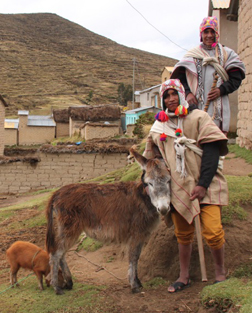
Salqa Apaza

Salqa (left) breathing prayers into a kintu during 2015 despacho ceremony outside Cusco. Photo courtesy of Diane Grupe Marshall.

As ayni took the lead, things were on the wind and developed quickly. In just a few days it was settled. A group of women who traveled with Salqa in Bolivia and Peru bonded together to sponsor him to Maya Land this coming January.
Salqa Bolivia

Salqa Apaza (foreground) on the Island of the Sun, Bolivia, during the 2015 Bolivia-Peru pilgrimage. Photo courtesy of Diane Grupe Marshall.

Diane Grupe Marshall of Montana shared with me:

Salqa is so kind, compassionate and mindful of his traditions. But he’s also becoming aware of today’s challenges and need to preserve those Q’ero traditions.

Maya Daykeeper Apab’yan Tew has agreed to act as his “spiritual father” during the entire January journey. Indeed, he’s delighted to take him under his wing with great anticipation. Since Tat Apab’yan will be on the Bolivia-Peru journey in September-October, they will have opportunity to make a connection in advance. Such mentoring will be a blessing to witness, and I know will add so much for all of us as we hold the space.

As for Salqa, he accepted our invitation and wrote:

 It is a magnificent idea! I will be preparing for such a trip from this early time. I would like to share our customs and traditions…Andean spirituality of the Nation of Q’eros. I am happy to read this message! Thank you for giving me the opportunity to travel and get to know other countries and get to know the Maya brothers. Greetings from the distance and many hugs for you.
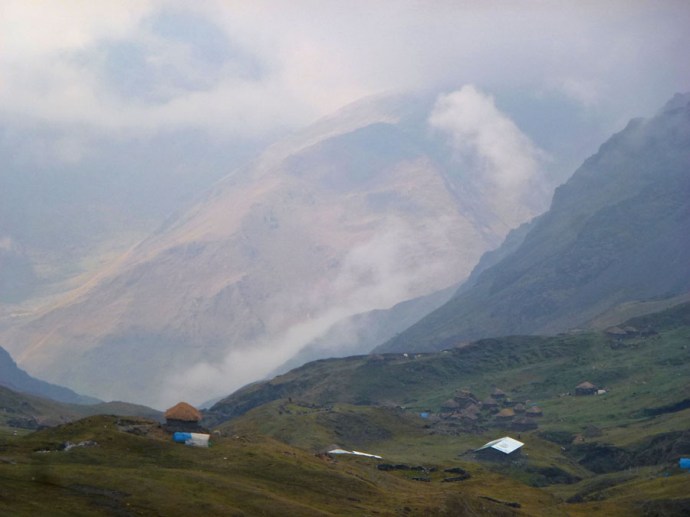
Ccochamocco

Q’ero village of Ccochamocco in the Cusco Region of Peru. Photo courtesy of Carla Woody.

And so…this is the story…how the young paq’o Salqa Apaza will make history by being the first of his people to share traditions with Maya leaders in their home communities in Chiapas, Mexico.

And how the grace of ayni has a life of its own and travels on.

***********

You are invited to join us on this important, history-making journey, January 18-28, in Maya Land, and support the tutelage of this young Qero Wisdom Keeper. Be part of the global village.


Categories: Global Consciousness, Gratitude, Hopi, Indigenous Wisdom, Maya, Q'ero, Spiritual Evolution | Tags: , , | 2 Comments

Film Review: The Grounded

It’s apropos that I’m reviewing The Grounded documentary at this point. I’ve just returned from a weekend in Utah where I attended a workshop by my old friend Oakley Gordon introducing the material and practices from his book Andean Cosmovision, which I reviewed last month. The two are connected.

Steve Kroschel is an independent filmmaker and naturalist. His work has been featured on the National Geographic Channel, BBC, PBS and feature films. In 2012 he stumbled upon the power of connecting to the Earth⎯sometimes called “Earthing” or “Grounding”⎯because of his own physical pain issues. He discovered that, if he would lie directly on the ground, or even bury himself in soil, his pain lessened and overnight…dissipated. He slept better, too. Curious, he undertook research to determine how Grounding affects life force. He came up with a way to conduct Earth frequencies through a cable and attached it to cut flowers in a container of water on a table inside his home. Sitting immediately beside those flowers were others that were not connected. Those receiving the energy lived significantly longer.

Not everyone can or wants to walk barefoot outside frequently or bury themselves in earth. Steve invented devices that people could use on an everyday basis and began distributing them for free to the population of Haines, Alaska near where he lives. Soon he had a pool of local folks using them on a regular basis, participating in his research. Results were largely consistent with his own experience, some quite remarkable. One man was in a wheelchair, his legs paralyzed for 25 years. First, he was able to move his legs and feet slightly. Ultimately he was able to walk haltingly with a walker.

Steve knew that if he could get some well-known figures on board with his discovery, to show them proof, then this message of healing would likely reach a wider audience. That was his goal: a drug-free, natural approach to health and wellbeing available to everyone. He was able to gain the interest and endorsement of the late Apollo 14 astronaut Edgar Mitchell, environmental scientist Dr. David Suzuki and others. Today he collaborates with Dr. Laura Koniver in this work documenting changes in pain levels, macula health, osteoporosis and more.

Of course, Indigenous peoples have known since time immemorial that Mother Earth is alive, as is the entire Cosmos.  These energy properties are available through intent and connection. Merely sit on the earth, or raise your hands to the sun or moon and experience an elevated sense of being. That’s what Oakley’s book is about: his learnings over 22 years from the teachings of the Andes. I validate what he is now teaching through my own experience over time with Andean and other Indigenous traditions.

Here’s what’s particularly important about Steve Kroschel’s documentary. There are a lot of naysayers out there, those only too ready to dismiss the effects discussed here as “New Age” or devalued out of hand, particularly by those with interests in Big Pharma. With the clinical proof and testimonies offered in the film, there’s no denying the powerful regenerative effects all around us…for free.

The Grounded is well worth your health to watch: 1.25 hours. Available streaming on You Tube.

Or, at least view Prescription Is Earth, the shorter version that contains most of the salient points in 18 minutes. Also streaming for free on You Tube.

For more information on Grounding, see Steve Kroschel’s website.

****

With thanks to friend Betina Lindsey for pointing me to this film.


Categories: Energy Healing, Film Review, Healthy Living, Indigenous Wisdom | Tags: , , , , , | Leave a comment

The Unborn, the Ancestors

Little girl…little boy. You, the leaf! You, the new branch! Listen to me. Listen to this song I have. A word I have…a speech. You must be dreaming. You must be sleeping. Are you tired? Can I speak to you? Are you tired? Are you dreaming?

I want to talk to you. I have a word from my heart to you. Would you want to talk to me? Would you want to move?

You are the reason my heart is alive! You are the reason my life is complete!

In a lilting voice he gently coaxed then paused, just as his lineage had for centuries. He sought a cue, maybe movement, to let him know he’d made a connection.

From the beginning of March, I’d traveled with Maya Daykeeper Apab’yan Tew to Kansas, Hopi and elsewhere around Arizona. Between journeys I was privileged to host him in my home. Now we were in the last days of the month, he stood—delicately poised in traditional dress, eyes half closed, an arm lifted, hand upturned—at the front of the room. The rest of us seated, in a meditative state.

Huichol composer-musician Xavier Quijas Yxayotl played his flute softly in the background, his music framing Apab’yan’s words. Monita Lynn Baker joined in with just the appropriate bit of percussion. I’d invited Xavier to our Spirit Keepers Series gathering at North Mountain Visitors Center in Phoenix to reconnect with Apab’yan. They hadn’t seen each other in 25 years. Their ritual music-dance teachers were friends but both had long passed.

Apab’yan had spoken at length on K’iche’ Maya worldview—originating from the Guatemalan highlands—and his responsibilities as a Daykeeper working with the Cholq’ij calendar. During the course of the evening he revealed that he’d acted as a traditional midwife for the last 16 years. He had a patient with a difficult pregnancy, the baby in a questionable position, awaiting his return home. This mention naturally led into the singing speech we experienced, the intervention meant to guide the baby to reposition on its own in utero, to align correctly with the birth canal.*

The song ended. The room was silent, the energy palpable. I think we must all have been touched in ways indefinable. Perhaps there was something enlivened that had been asleep. Or a dream grounded into this reality. Perhaps there were aspects we each may have carried into this life from our mothers and fathers—inner vulnerabilities—that were soothed, shed. This was a perfect portal to usher us into the fire ceremony the next day.

North Mountain Visitors Center abuts the Phoenix Mountain Preserve. The beautiful grounds are pristine, belying its poignant past. It was here, from the 1890s until 1930s, that many Native families camped, attempting to see the children taken from their homes and subjected to forced assimilation at the Phoenix Indian School. Interspersed were the tuberculosis camps in the early 1900s for those seeking the curative properties of dry desert air.

We gathered, in the shadows of the small ampitheatre, and Apab’yan consecrated an altar space where he would guide the fire ceremony. And it was here that he would call upon the ancestors. In his own words

Everything is alive. Everything has a form of communication. Everything has meaning and belongs to a natural system.

The Maya ceremony consists of preparing a ceremonial pyre. It is called a gift but also a payment in the sense of reciprocity. The K’iche’ ceremonial pyre is not a bonfire; it does not burn a long time. It does not need to last. The importance has to do with what happens while the fire is active: There must be a dialogue.

As normal, those assembled took part in the building of the altar, some given special roles. One held the fire stick. Some were called upon to make the first lighting. Two others to pass out candles. And the fire began to burn. Puffing on the ceremonial cigar, Apab’yan called for the Grandmothers-Grandfathers to be present. He made the prayers. Placing candles, we made our own prayers. At long last, the fire started to die down, the conversation coming to completion.

But not yet.

Apab’yan went over to Xavier and Monita, whispering to them. After asking me to lead the circle in holding space, those three walked into the desert. And then…on the air…from the distance…we heard flute and voice rising and falling…singing to the land…to any lingering ghosts of sadness…offering up prayers. And some strange force blew through. It overtook my body. Ever so slowly, involuntarily, my body began to arch backwards until it was in an impossible position. Held. For what seemed like forever. Until it let me go. When I opened my eyes, I saw the Diné woman across the circle crying.

When they re-entered the circle, Apab’yan knelt before her and asked her to ritually bless him with burning sage. That image and the power of it sticks in my mind: Diné woman, Maya man.

The ceremony now closed, the sense of what occurred remained. A communal undertaking. Correctly done. Even as I’m writing this now, I’m feeling into the sacred space…all over again…we all created. I imagine it still hangs in the air in the ampitheatre, the people who pass through wondering what has touched them.

I’ve been in powerful ceremonies before. Fire ceremonies, too. But none ever as compelling as this one. Perhaps it was the culmination of all the energy accumulated from all the ceremonies over a month’s time, carried with us…from Hopi…to private land outside Wichita…to private and public sites in Tucson and finally in Phoenix. And some particularly precious energy remains within my own sanctuary.**

With much respect and gratitude to Apab’yan  and those who showed up in these ritual circles. The journey continues in January in Maya Land with the strength we gathered in March. Anyone drawn is welcome.

Below I’m adding a piece written by Pam Hale Trachta with her own reflections.

 The Power of Ritual and Ceremony

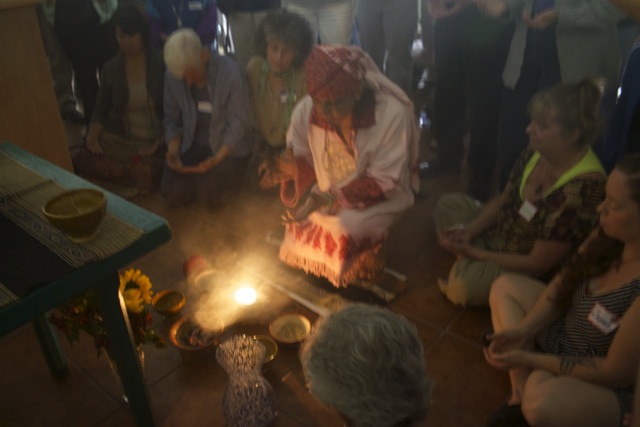
The smoke from the copal grew thicker in the room, as Apab’yan fed the small container fire with the granules of incense, and his prayers. People seated around him and behind him prayed too, mesmerized now by the hypnotic chanting in the Mayan language, punctuated by English phrases so we could all track where the prayers were being directed.

The room was darkened in order to suggest the atmosphere of the caves where this water ceremony is usually performed. A bowl of water resting on the table received the blessing, and participants would eventually be offered sips of it, as in communion. Finally, roses were dipped into the water and used to shake drops of water on all those gathered.

It was a potent blessing, because the intimacy and power of ritual transcends cultures, language differences and even philosophical details. Spirit is Spirit in any language. And the language of Spirit is ceremony.

Water Ceremony

Water Ceremony at Tacheria Interfaith School of Spiritual Direction in Tucson. Photo: Pam Hale Trachta.

Read more

♦♦♦

 * Apab’yan Tew is likely the only male Maya midwife that exists. He knows of no other. Indeed, it’s not traditional. It occurred because, when he was a lost young man wandering in the Guatemala highlands, a Maya midwife took him in. And before long he assisted her in the process. He became her apprentice until he began to birth babies on his own. He remains readily sought after as a midwife. When in the highlands he does everything from the beginning: talks, sings, moves and delivers the baby. In the city, he prepares everything until the point of delivery then sends the mother to the hospital for final delivery by a doctor. This was the case recently in Mexico City. Apab’yan and the mother were able to bypass the difficulties of the pregnancy. She successfully delivered a baby girl.

**With many thanks to the following people and organizations for hosting us and making the March beauty possible:

  • On Hopi: Charlene and Harold Joseph;
  • In Kansas: Lonetta Lollar and John Brack, and Belle Dessa and the Great Plains Earth Institute;
  • Elsewhere in Arizona: Pam Hale Trachta, Frank Williams and Tacheria Interfaith School of Spiritual Direction, Leslie Spencer-Snider and North Mountain Visitors Center, and Cindy Heath.
Categories: cultural interests, Gratitude, Indigenous Wisdom, Maya, Sacred Reciprocity | Tags: , , , , , | 2 Comments

The Dialogue of Creative Intelligence

Ann Hamilton describes herself as a “maker” rather than artist, and characterizes the start of her projects this way: I just try to listen for what something needs to become. Michelangelo relayed a similar process so long ago: I saw the angel in the marble and carved until I set him free.

Delivery doesn’t come in an instant but evolves in a process ⏤ bit by bit. It’s about being patient with the unfolding. It takes a dialogue with what wants to emerge, creating space for the communication. Sitting with it.

If what emerges has depth then it isn’t formulaic. For me, it’s about synthesis. In what form does this communication want to be held? Two-dimensional? Three-dimensional? Oil? Mixed media? Or written form? I introduce options to the conversation and question the best fit ⏤ and am open to changing directions in mid-stream because it’s suddenly called for.

I’m not a person who has one way of doing things. That would bore me to tears, limit flexibility and impede problem-solving. I enjoy stockpiling choices at my fingertips. It fuels my creative energy. Ongoing learning, adding this and that to my repertoire, inspires me. I believe this strategy sparks a type of creative intelligence. I wouldn’t fit on an assembly line and abhor restrictions. It sucks the life right out of me.

I’ve written before about the expectations establishment galleries and publishers hold. Recording companies, too. They want what they call ‘consistency’ which translates to limitation of subject matter and form. Of course, they’re invested in bottom line dollars. But what they’re doing in the process is obstructing artistic growth. The artists I revere most are those who deviate.

Shawn Phillips is a case in point:

…The mere fact that he was a musician as much as a singer and songwriter made him stand out, and helped him attract a dedicated following. His refusal to shape his music — which crosses between folk-rock, jazz, progressive, pop, and classical — to anyone else’s expectations allows him to hold onto a large and dedicated cult following, without ever achieving the stardom that his talent seemed to merit…He never courted an obvious commercial sound, preferring to write songs that, as he put it, “make you feel different from the way you felt before you started listening”…

My respect for Picasso grew exponentially when I was in Paris last year and went to the Picasso Museum, which houses representations of all the journeys he’d taken. I’d known him mostly as a Cubist, and for his Rose and Blue Periods. I discovered he was not only a painter of many diverging techniques, but also a sculptor, printmaker, ceramicist, stage designer, poet and playwright.


PicassoGoat

She-Goat. Picasso, 1950. Constructed of found objects then bronze cast.

Picasso’s ability to produce works in an astonishing range of styles made him well respected during his own lifetime. After his death in 1973 his value as an artist and inspiration to other artists has only grown. He is without a doubt destined to permanently etch himself into the fabric of humanity as one of the greatest artists of all time.

There’s something to be said for being unorthodox. Especially if you don’t care about mainstream success. Although it may come unexpectedly…precisely because you deviate.

In this round-about way I’m now introducing my latest venture. For a while I’d felt the pull to move into more three-dimensional artwork and had been casting about to see what drew me. Then I discovered the separate works of Jan Huling and Nancy Josephson…unlike anything I’d seen before…which spoke to my unconventional soul. They’ve both had their artwork featured in a multitude of galleries, museums, newspapers and magazines. I decided to go study with them for a week in April in Puerto Vallarta at Hacienda Mosaico and came away with a treasure trove of new knowledge from their generous teachings. And they’re good people.  No affected airs there despite all their accomplishments.

Das Bug

Das Bug. 8′ long. Jan Huling. Currently showing at the Duane Reed Gallery in St. Louis and slated for the Art Market + Design Fair in Bridgehampton, July 7-10. Photo used with permission.

In her artist statement Jan says:

In a recent review, the New York Times dubbed my work “oddball assemblages,” and aptly so. My three-dimensional collages combine found objects with surface design, sometimes touching on narrative themes. I’m also drawn to religious and political icons, inspired by a continuing fascination with indigenous or popular culture and world religions…Czech seed beads adorn objects in colorful patterns, camouflaging their original circumstance, allowing us to see them as pure form without their usual connotations. The process is slow and meticulous, Zen-like, with the choice of forms motivating color schemes and iconography.

Bird Goddess

Erzulie Kouvez, Bird Goddess. 10′ tall x 6′ diameter. Nancy Josephson. Exhibiting at the Visionary Art Museum in Baltimore until September 4. Photo used with permission.

Erzulie Kouvez

Erzulie Kouvez, detail. Photo used with permission.

Musician, artist, Vodou priestess…Nancy shares this:

I started in music. I only wanted to do ‘real’ music…rootsy, soulful and elemental. I wanted to get to the core of what music is in the way it lifts the spirit from the inside…Then I started using my hands instead of my voice. Visual art gave me a more solitary way to explore how to surround myself in physical beauty and meaning. Trial and Error was my alma mater…Then I went to Haiti…My first trip opened up questions about physical home, one’s spiritual ‘home’, how one ‘gets by’, what one must risk during the creative process, what IS the creative process. With every trip I found more questions as well as a few answers.

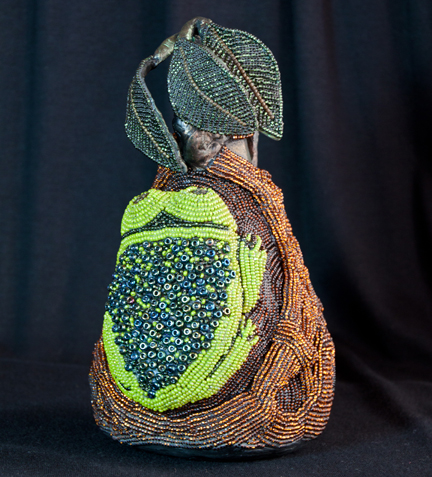
Here’s the piece I’ve thus far created since returning home. A plethora of ideas hover in the ether nagging at me. I believe most of them will get their turn over time. I’ll integrate what I’ve learned into both two and three-dimensional pieces, an extension of my meditation practice. Indeed, I’d been describing the process as Zen-like before I read the same in Jan’s artist statement. But then there’s a bit of obsessive quality to it, too…

Rain God Front

The Rain God. Carla Woody. Mixed media: Czech glass beads, resin clay, found object, acrylics. 7.5″ tall x 14″ diameter.*

The Rain God

The Rain God, side view.

On another note, I’ve been asked about my artwork: How can you let them go?

When there’s a dialogue of great depth I find that I do need to keep them on the easel or table for a while, maybe even a few months, to see what else we may have to say to each other ⏤ to make sure the conversation has come to a close. When there’s a sense of finality then I can release it with the intent the piece itself will take the dialogue to others.

Sometimes that happens in surprising ways. A few years ago I painted an oil I called My Magdalen Heart which was displayed at The Gallery in Williams. On a day I was there, a French Canadian man approached me with an incredulous look saying the piece had spoken to him. It’s a blessing for me when I hear how the dialogue continues. A few days later the Magdalen went to live in New Mexico with a woman who’d had a relationship with her since childhood.

It’s important to put our expressions out into the world, in whatever way we do, without conforming to others’ rules, and then sending them on their way…so they can take on a life of their own. There may be someone just waiting to engage in the dialogue ⏤ with an anticipation they didn’t know they had.

♦︎♦︎♦︎

*The Rain God is currently available through The Gallery in Williams or inquire by email through this blog.

Categories: Arts, Creativity Strategies, Visual Arts | Tags: , , , | 4 Comments

Book Review: The Andean Cosmovision

AndeanCosmovision

This is a precious book on a number of levels. First, it is written by a Western man, a dedicated seeker on the Andean path through the teachings of Don Américo Yábar, who has consistently held intent to integrate his learnings back into life at home…and share what he’s discovered over more than twenty years. He touches on some of his struggles to do so coming from a Western intellectual perspective.  This honesty is important. It shows possibility toward core understanding beyond the mind and a way of incorporating it into daily living, an evolutionary process.

I can state these things with confidence having known Oakley Gordon over a very long time, witnessing his process as much as being a fellow traveler on the path. I know his heart. We were introduced to the Andean way through the same spiritual teacher, literally at the same time and place. He has also served on the board of Kenosis Spirit Keepers as Vice-President since our inception.

The book is a primer on Andean worldview. If you want more beyond the introduction, Oakley provides endnotes and anthropological resources. In this book though he writes to you as a friend would, not as an academic. It’s easy to take in and comprehend.

But ultimately it’s a guidebook, a how-to. It’s a compilation of meditations gleaned directly from Don Américo and exposure to other paq’os⎯a general Quechua term for healer, shaman or mystic⎯or created by the author from what he’s learned while in Peru. I don’t think another such book exists. This is important. From my own spiritual travel programs, people periodically express the fear of not being able to recreate the same state of being upon their return home. I share and show them how to do so. But The Andean Cosmovision provides it in print with many different examples to explore with step-by-step instruction.

Oakley states that, although much of the book is taken from the teachings of one specific teacher, he believes any paq’o would validate them. I’ll take it one step further. The tenets covered in this book are found at the core of all Indigenous traditions I’ve worked within: Maya, Hopi and Andean, as well as others where I’ve had exposure.

Highly recommend. Available in print and e-book through Amazon and on Oakley’s website.

♦︎♦︎♦︎

 Oakley will be covering the material in his book during a weekend workshop June 3-5, 2016 in Rockville, Utah to benefit the Heart Walk Foundation who work within the Japu Q’ero villages in the areas of education and agriculture. For more information, click this link to a pdf flyer: Andean Cosmovision Workshop

Categories: Book Review, Indigenous Wisdom, Meditation, Q'ero, Spiritual Evolution | Tags: , , , , | 1 Comment

The Fierce Quiet Place

We give a gift to ourselves when we allow connection with our innermost being. This is the one untouched by circumstances but fierce in its inviolate sanctity. The silence in this place is so loud you can hear it, so palpable you can feel it. And yet there’s no adequate way to express the comfort and inspiration it brings. Comfort here meant as nurturing. Coupled with inspiration, it urges us on…through…and beyond…to what we can’t yet know. And the circumstances of our lives⏤the challenges⏤fall away. It doesn’t mean they’re not there but are approached differently. A state of grace through the chaos and surrounding confusion.

And that Fierce Quiet Place wants expression in any way we can. It creates a portal and finds its way into the material world through narrative art, music, poetry and prose, ceremony and ritual…a touch…complete presence we give to others. It’s funneled from non-ordinary reality that exists out-of-time to land here.

This is what I’ve recognized more and more. And knowing that when I give myself over to that Fierce Quiet Place the most beautiful things happen. I live from a deeper place. I meet people who hold similar expression. I want to introduce you to one of them through the way it happened.

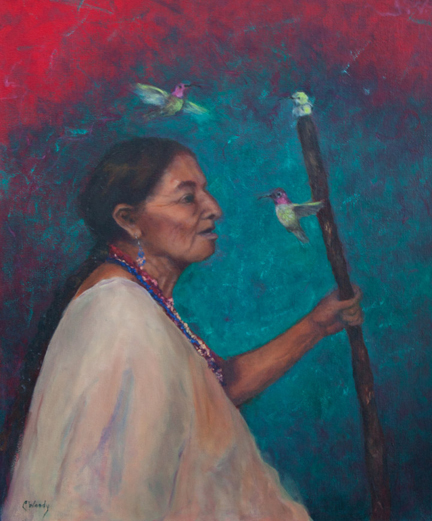
In February I completed This Is My Walk in Life, an oil painting. Over the course of its creation, it came to life. The portal opened. A silent dialogue ensued and conveyed itself as best I could onto canvas. It was not a casual process.

This is my walk in life

Title: This Is My Walk in Life Oil on canvas, 20×24. ©2016 Carla Woody. All rights reserved.

This is the description I gave it.

We all have a walk in life, perhaps chosen before we set our feet on Mother Earth. And amidst hardships there’s unexpected joy. If we open our eyes to it, there’s magic in fleeting moments when we truly experience what life is. This painting is inspired by the Lacandón Maya women of the rainforest village of Nahá in Chiapas, Mexico.

Then at the end of March I met Laura Weaver. She came from Colorado to take part in the fire ceremony guided by Tat Apab’yan Tew during our Spirit Keepers Series. I didn’t know she’s an accomplished poet. I’m quite sure she didn’t know I’m an artist and writer.

Then a few weeks ago I saw a poem she wrote in March.

 A Way of Walking

There is a way of walking

from point A to point B

as if there is nothing

of significance in between.


We have been taught to move

in straight lines, to lay life out

along a grid of efficiencies.

But there is another way to navigate.


This way carves a serpentine road

full of mysterious meetings.

Along this path, the directives come

from the world itself speaking


through all of its voices. And because

something else is guiding us—because

we are listening—at the next crossroads

we turn left instead of right—


and find a never before seen village

where an old man harvests golden apples

he offers to those who pass by. And over

the silken hills, cowbells sound out


like ancient monk song, and the last

of the sunlight breaks through the rainclouds

so that everything is shimmering and awake.

And the oak tree that cracked in last


night’s storm is dripping with honeycomb

and bee hum. And as this moment swells

and blooms open with its own fullness,

suddenly the idea of Point A & Point B


makes no sense at all. For now

you have no idea who you are

or if you have arrived. You only know

that you are everywhere.

I couldn’t help but note the strong similarities in the titles of our respective works and common message. Then yesterday I read her poem Making Passage which reaches an even deeper platform. I urge you to read it. It will speak to your soul.

I don’t think I’m presuming. When the Fierce Quiet Place is fully expressed we all say the same thing. Only the variation in our medium is different.

Earlier I described Laura as an accomplished poet but that’s not quite sufficient. Her words have a way of gently, persistently making their way inside us on a path all their own and touches the universal. And—in my experience—I feel heard. Even held.

 ♦♦♦

♦︎ The reprint of A Way of Walking is used with permission. Subscribe to Soul Passages and receive Laura Weaver’s poetry as she publishes.

♦︎ My original oil This Is My Walk in Life is currently available. Inquire for more information. Archival prints are available here.


Categories: Arts, Creativity Strategies, Spiritual Evolution, The Writing Life, Visual Arts | Tags: , , , | Leave a comment

Book Review: Into the Magic Shop

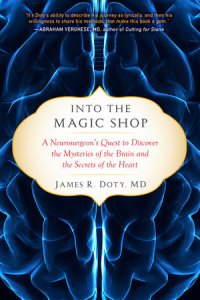
IntoTheMagicShop

My attraction to read Into the Magic Shop was generated through Krista Tippett’s On Being interview called The Magic Shop of the Brain with neurosurgeon and author James Doty, MD. I had no idea who he was. But sincerity flooded his voice as he spoke about the need and effects of compassion. To have a medical doctor speak in this way is so unusual⏤given the hurried, sterile treatment patients in this country normally receive. When Krista asked him to speak of the ritual he underwent prior to neurosurgery, he had me. Rather than having a nurse prep the patient in the operating room he does so himself. After the patient is anesthetized, he shaves the surgery site himself, saying it connects him to the patient as a human being and grounds him in the procedure he is about to take.

From the book:

It is a ritual I do. And as I slowly shave the head, I think of this precious little boy and go over every detail of the surgery in my mind. I cut off the first bit of hair and hand it to the circulator to put in a small bag for the boy’s mother. This is his first haircut, and while it’s the last thing on his mom’s mind now, I know it will matter to her later. It’s a milestone you want to remember. First haircut. First tooth lost. First day of school. First time riding a bike. First brain surgery is never on this list.

What were the influences that made James Doty who he is today with an outlook and behaviors so unusual in his field? He was born into a troubled family where he received no support. He felt alone. He had low self-esteem. But one day he wandered into a magic shop and found his saving grace in an elder named Ruth who was visiting her son, the owner of the store. She saw something in this boy and invited him to return the next day and every day for the next six weeks. She promised to teach him.

…I know how to turn a flicker into a flame. Someone taught me and now I think it’s time that I teach you…It’s going to take a lot of work and you’re going to have to practice the tricks I teach you even more than you did your thumb trick. But I promise you, what I’m going to teach you will change your life…

This is James Doty’s memoir and includes a long learning curve as many spiritual journeys do…because he neglected to include one of the most important teachings Ruth gave him. Ultimately he remembers but not without many trials. And when all her teachings finally took hold, the most powerful magic happened.

Today Dr. Doty is the Founder-Director of the Center for Compassion and Altruism Research and Education⏤of which the Dalai Lama was an original funder⏤and clinical professor at Stanford University School of Medicine.

In many ways Into the Magic Shop reminded me of an all-time favorite book: Illusions by Richard Bach. I always held that the story must be true; Donald Shimoda must have been a real person. I longed for it to be so. But Into the Magic Shop is…without a doubt.

I highly recommend this book. Available on Amazon and elsewhere in print and e-book.


Categories: Book Review, Compassionate Communication, Global Consciousness, Healing | Tags: , , , | 2 Comments

A Havasupai Elder Speaks

We drove along the South Rim tourist area of the Grand Canyon and wound our way to the west on a dirt road through tall pines. Leaving the throngs of people behind, with much anticipation, we entered a different world. During opening circle for our spiritual travel program to Hopi just the night before, I’d let the folks know an opportunity had presented itself.

The Grand Canyon is sacred to the Hopi. They emerged into this middle world in ancient times from a point deep in its interior, and the Havasupai people have called it home for at least a thousand years. A relationship exists between these peoples. So when my Hopi partner Char Joseph contacted the Havasupai Tribe inquiring if there was someone who would speak to us about their ways, they were happy to oblige saying…all too often they were forgotten.

We pulled into Supai Camp, once the tribal winter home on the rim where just a few remain. The traditional dwellings are long gone. In 1934 the National Park Service (NPS) tore down or burned the homes without notice to the residents who were away at the time. I Am the Grand Canyon documents more than a century’s devastation of the Havasupai at the hands of the US federal government, NPS, Grand Canyon Association and Sierra Club. In the book, Havasupai Mack Putesoy testified how their homes were burned to the ground with all their belongings inside. Effie Hanna said she lost things she’d been saving all her life. In place of traditional homes on their aboriginal lands, the NPS built cabins and forced the residents to pay rent.

However, I knew none of this at the time we approached the home where we’d been invited.

Havasupai Girl

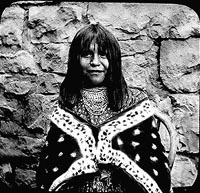
Havasupai girl, circa 1900. Photo credit unknown.

We were greeted at the door by Colleen Kaska, daughter of Daniel Kaska who was chairman of the Havasupai Tribe in the 1970s. Elder Daniel is now quite frail but welcomed us. He wanted to tell us the story of the Havasupai, People of the Blue-Green Waters named after the beautiful canyon waters running through the area they now mostly live. Colleen shared in the storytelling.

Their aboriginal lands once encompassed areas from the Grand Canyon to the Colorado River and the San Francisco Peaks west to Ashfork and Seligman. In the warm months they lived in what is now known as Cataract Canyon in the interior of the Grand Canyon and grew crops. In winter months they dwelt on the rim in order to hunt.

Once the Santa Fe railroad came along and interest in the Grand Canyon grew as a tourist and recreational site the Havasupai were squeezed and began to suffer. In 1882 President Arthur declared the majority of their aboriginal land belonged to the American public. The People of the Blue-Green Waters lost their plateau hunting-herding lands and many thousands of acres. They were barred from rim watering holes by cattlemen and the NPS…and relegated to Cataract Canyon. This narrow 518-acre tract doesn’t see sun during winter months, and historically endured flash floods that sometimes took out homes and people.

Colleen had been relating this history in a matter-of-fact way. The more she spoke, the sadder I felt. I had no idea what we would learn when we came through this family’s door. But I didn’t anticipate such a story. I’d thought of the NPS and Sierra Club as entities that conserved beauty…not those who wrought devastation upon peoples of the land (I thought) they were to protect. I said, “This all must be heartbreaking.”

Colleen paused, became still. She had a faraway look in her eyes. “Yes. But when I walk our aboriginal lands⎯the ones taken from us⎯I know it is of my people. My ancestors are there.” The tone of her voice made clear that knowledge gave her strength.

Elder Daniel spoke haltingly of the century-long struggles to be recognized by the federal government, to regain any of the land taken from them, including his own personal involvement as chairman in this quest. Finally, in 1976 they succeeded to a small degree: 185 acres returned to the Havasupai with 95,300 acres named “Havasupai Use Lands” but controlled by the NPS.

Daniel Kaska and Apabyan Tew

Havasupai Elder Daniel Kaska & Maya Daykeeper Apab’yan Tew. Photo: Colleen Kaska.

K’iche’ Maya Daykeeper Apab’yan Tew was present as a sponsored guest on our spiritual travel program. He wanted to know about Havasupai ceremonies. He asked Daniel, “Do you have a story about some time of a spiritual nature you remember?” Daniel shook his head. It seemed the focus for so long had been a fight for acknowledgment, some recognition of their worth, that there was no energy left for anything else.

Mike Weddle⎯Kenosis Spirit Keepers board member, Daykeeper and musician⎯visiting from Maryland was able to join our group for just two days. He brought his flute. I invited Mike to offer Daniel and Colleen a prayer song. The music was sweet. When it came to an end, there was silence. Then Daniel began to sing in words and tones that entered every one of us. The energy seemed to shift.

When we all expressed how it touched us, he uttered softly, “It’s a funeral song.” And then, “We are a lost tribe.” It was painful to hear of such loss.

Our visit was over. We formed a circle outside under the pines and invited Colleen to join us. Elder Daniel was unable to do so. Apab’yan offered a Maya prayer for the People of the Blue-Green Waters and the land.

A few days later I received a note from Mike who had to leave for other business.

I think we all felt the same as elder Daniel Kaska told his story of loss and betrayal, going to Washington where no one would listen, voting against the government deal when his own people would not listen, and his final ‘I don’t know what will become of us’. When he sang his beautiful song, and then said it was a funeral song, I almost wept.

We were invited by Colleen to join a singing ceremony 8 am Saturday at Red Butte. I did go to represent us but there was no one there. There are two forest roads on each side of the Butte, but no people, no cars, and no singing.

So I climbed the switchbacks to the very top of the butte, the summit. At the very top there is a crossing with 4 paths going in the 4 cardinal directions. I’m sending a photo. Colleen called this the Supai place of origin.

I felt that in just 2 days I had been witness to the place where the Supai began and perhaps the place where they end. As there was no one else there to sing, I did the singing, and I sang the Maltyoxb’al, the [Maya] great gratitude song, for the arc of the Supai nation.

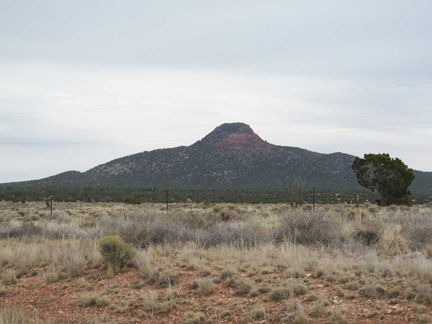
Red Butte

Red Butte where the Havasupai were born to this world. Photo: Mike Weddle.

redbutte3

Four Directions at the summit of Red Butte. Photo: Mike Weddle.

When we held our closing circle at the end of our week with the Hopi and Havasupai people, I spoke to the group.

I never know in advance how things will unfold when we hold a sacred container of pure intent. Things I can never predict come in ways that affect us all. I believe the most important thing we did during this journey was sit in respect, listen deeply to this Elder’s words and witness the grief he carries.

Sometimes that’s all we can do even in the face of our own helplessness at such recognition. And that acknowledgment matters.

***********

Note: Elder Daniel Kaska singing recorded by Apab’yan Tew.

Go here to learn more about Spiritual Travel to Hopi: Sacred Guardians of the World,  and check back for next year’s March travels.

Categories: cultural interests, Healing, Indigenous Rights, Spiritual Travel | Tags: , , | 4 Comments

The Float: Losing Your Skin to Deep Relaxation

In the 1983 my life began to change drastically. I was living in Germany and suddenly exposed to many influences unavailable⎯or at least drastically hidden⎯in Ohio where I’d lived for the previous seventeen years. I regularly attended weekend seminars in Wiesbaden through the international branch of the Association for Humanistic Psychology featuring researcher Dr. Stanley Krippner’s work on dreams and shamanism, scientist Dr. Valerie Hunt’s research on the human energy system and others. And I was immersed in a progressive, experiential master’s degree program on human relations through the University of Oklahoma’s satellite program that exposed students to such areas as Virginia Satir’s family systems work, sacred Native American rituals and even Robert Monroe’s studies in out-of-body experiences.

It was somewhere in here that I heard about neuroscientist Dr. John Lilly’s sensory deprivation tanks, initially emerging from his interest in trance states and what happened⎯physically and mentally⎯to astronauts when freed from gravity. The late Edgar Mitchell, who went on to found the Institute of Noetic Sciences, is a good example, seen here in this beautiful tribute video We Are One.

I remember thinking: I wonder what it would be like if I no longer identified with my body or mind? I’d already been meditating for about five years, a practice begun as recovery from a serious health issue. After the first few years I’d begun to experience⎯what seemed like at the time⎯strange sensations in my body. Having no one to talk to about these experiences, it was a relief when I went to Dr. Hunt’s seminar to learn that energy was something present for everyone. We just need to open our awareness to it.

But there was no floatation tank available, and my desire to experience it went underground. Years later through meditation, ceremony and being in an altered state of consciousness for days through spiritual travel I would sporadically lose any sense of boundaries. The only way I could refer to it was “losing my skin.” These rare occurrences were spontaneous, nothing I could call on myself. But the sense it brought was merging with the Universe⎯not unlike what Edgar Mitchell described.

Then about a year ago I came across some information online indicating there’s been an upsurge in interest in floatation tanks, state-of-the art versions, and more prevalent opportunities to dip a toe in. In fact, there are several sites in Arizona alone. Indeed, it seems to be going as mainstream as massage therapy.

So a couple of weekends ago when I was in Sedona with close women friends, I suggested we make appointments at True Rest. We all held anticipation for the hour-long session. I’m sure with different thoughts going through our heads as with any unknown experience. There were three uppermost in my mind. I’ve never had claustrophobia but wondered if I’d have any anxiety being completely contained in a small pod. That was a needless concern. The young man on staff was very careful to introduce every aspect of the experience, through video and demonstrating each feature on the pod, including how to alleviate any sign of claustrophobia. The second thought in my mind was whether it would be like “losing my skin.” It was and more. The third had to do with sleep patterns and whether it would help. For years, I’d been experiencing cyclical issues with sleep. I was in the middle of one and sleep deprived.

The young guy on staff had offered his own story having to do with a broken back, intense chronic pain and no sleep, which had resolved through regular float sessions. So I was hopeful.

The float rooms and tanks are private with shower. The water in the pods is body temp and they’re filled with a huge amount of Epsom salts, causing the body to automatically float. There’s an option to have light or complete darkness, as well as soothing music or none. My initial experience was floating on a warm sea that graduated to being in the womb. And before long I did “lose my skin” and had the sense of being elevated somewhere in the clouds or beyond. Periodically, I would feel gently thrust through the earth’s core. A purely kinesthetic experience of nothingness, with movement, quite hard to describe. At one point I had a fleeting thought to breathe in and out of my third eye and was presented with extraordinary visuals and energy. As I breathed in, I was looking from above into billowing light and energy emerging through the third eye portal. As I breathed out I was in an underground cavern standing at the edge of a lake leading to light in the distance. I was in two places at once and witnessing from a distance, the image begging to be documented on canvas.

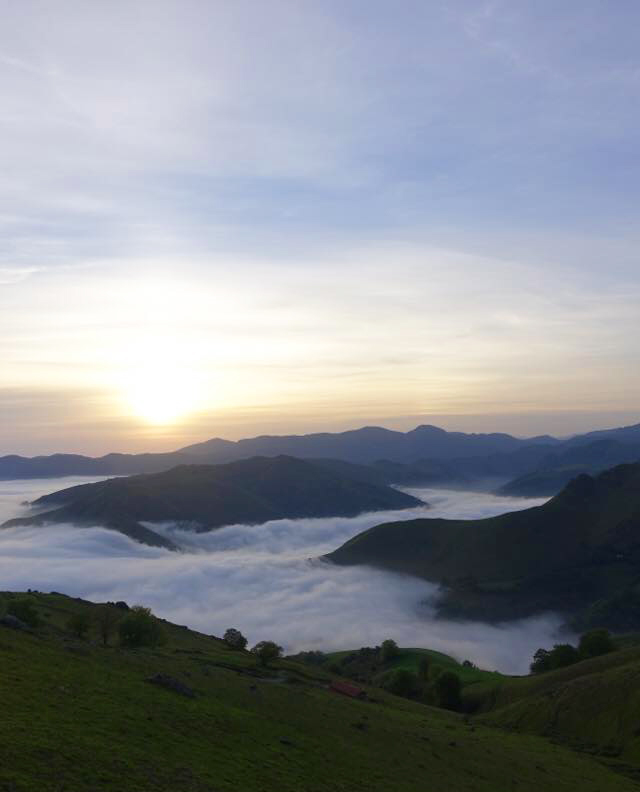
Pyrenees

Pyrenees, Camino Frances, 2015.

There was a sense of timelessness. After “no time” the filter began swirling and drew me back, letting me know the hour had somehow ended. I showered off and went to the other dressing room. My body was more relaxed than I could remember, even after a very good massage. I looked in the mirror and swear I appeared ten years younger.

But the best news is the longer effect it’s had on me. Since this initial float I’ve slept quite well at night. Only once did I resort to the herbal sleep aid I keep on hand. I feel rested upon awakening. The visuals are still vivid, waiting to be transferred to canvas.

After the float when my friends and I returned to our lodging I was drawn to sit outside where it opened to a creek and wilderness area beyond. I felt absolutely present with nature, a comforting stillness inside. I sat there for quite some time until I got up to leisurely shoot images of the ducks and light on the red rocks. Only in retrospect did I realize the float had provided this segue to absolute Presence.

Each friend’s experience was different; the common denominator was deep relaxation. When I spoke to the young man about the depth of my own initial experience, he said I was probably predisposed due to all my years of daily meditation practice. I intuitively knew how to put my mind and body in a state; the float took me the rest of the way. In all the literature I’ve read, including the classic book by Michael Hutchinson The Book of Floating: Exploring the Private Sea, experiences similar to mine do begin to occur after a series of floats, number depending on the individual. Long-term effects being: stress management, healing, pain management, enhanced creativity and sleep, increased problem solving capabilities, and spiritual consciousness. It’s even said to have effect on addiction and weight loss, which makes sense if the aforementioned attributes are in place.

Of course, the ultimate intent is to have such a Zen state integrated through daily life. It seems to me that, in addition to my daily meditation practice, a monthly float will help create such a passage. There’s no need to have the background knowledge that ushered me into my first session, just a desire to glean the benefits.

To find a floatation location in your area, go here. I do recommend True Rest in Sedona, with other locations in Arizona and elsewhere. The premises were quite lovely and spotlessly clean, and staff was welcoming and informative. Groupon coupon discounts are sometimes available.

Categories: Creativity Strategies, Energy Healing, Meditation, Spiritual Evolution | Tags: , , , , | 6 Comments

Film Review – The Red Queen: A Mayan Mystery

In 1994 a tomb was excavated in Temple XIII in the main plaza of Palenque, the large Maya ruin complex in Chiapas, Mexico. It was the finest thus far uncovered, even more so than the great ruler Pakal II’s in the Temple of the Inscriptions just a couple of doors down. The quantity of jadeite, sacred objects and two skeletons on either side of the sarcophagus indicated someone of the highest standing. And a very curious thing: The remains were completely covered in a powdery red substance that turned out to be cinnabar.

A physical anthropologist determined the remains to be female. The temple richness  pointed to the final resting place of an esteemed ruler. But for women to attain such a capacity was unusual. Thus began The Red Queen. And then it immediately garnered my attention when archaeologist David Friedal took the screen saying, “The history of the past is not the history of men but men and women together. And at times women change the course of history. Not men.”

The Red Queen is not a boring historical documentary. Rather it entertains the question: Who was the Red Queen? She was nicknamed so because of the cinnabar. Attendants carefully covered her in the toxic powder at burial. It made its way into her very bones. We’re on board as the film tracks the mysteries, technical methods and data that lead to a conclusion from the three likeliest candidates.

  • Was it Yohl Ik’nal, the grandmother of Pakal? As far as we know she was the first Maya female to rule on her own…for 21 years.
  • Was it Sak K’uk, who took over the throne when her brother was killed? She held rule until she was able to put her son Pakal on the throne when he turned twelve. Likely she guided him from behind for some time after that.
  • Or was it Tz’akbu Ajaw, the wife of Pakal? And sometimes called Lady Conjurer as noted in Carol Karasik’s book The Drum Wars where she devoted a chapter to the Red Queen.

Those who know me are well acquainted with my love for Palenque, having been drawn back regularly since 1995 when I first had the pleasure. So the story of the Red Queen was an interest on that level. But more so, I found it heartening to have women recognized for who they are, their accomplishments and learn something of their story—not quietly influencing behind the scenes but front stage center.

Produced by the Discovery Channel, 2005. Watch it free on You Tube.

The Red Queen 1

Part One: View it here. 1 hour, 9 minutes.

Red Queen-2

Part Two: View it here. 24 minutes.

*****

For more information on our next scheduled Maya Mysteries spiritual travel program in Chiapas…where we visit Palenque and pay respects to the Red Queen, go here.


Categories: cultural interests, Film, Maya | Tags: , , | 1 Comment

Blog at WordPress.com.