Posts Tagged With: Spiritual Evolution

Origins

 And so we begin, as all human beings do, in space, expressed by a word, permeated by time. Time is a suggestion we swallowed to hold our world together—creating a kind of comfort, but also terror in the false knowing that what passes has a beginning, a middle and an end. We invented words as conductors for experience, but language is meaningless to the intricate nuances of existence. We collectively convinced ourselves that the ground where we stand is solid matter, when the only foundation we truly have we cannot physically touch.

At the soul level, we long to move beyond what is human-made to That which is not. We hope to know the deeper realms of a reality the everyday eye may have experienced solely through fleeting glimpses—of what it cannot determine. We seek to be promised what we may only have scented through the permeable walls from another dimension. We desire to be inspired by what has stirred our bodies in unknown places with hints of rapture. We ask for the sign when the gift has already been given.

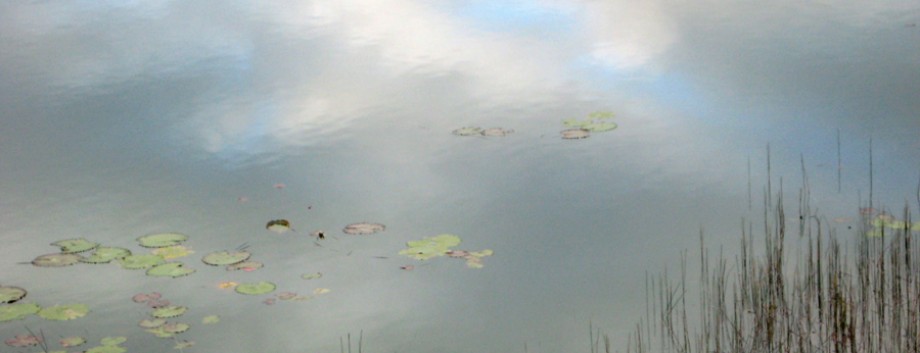
Moray Mist Artwork

Moray Mist
©2002 Carla Woody

There is an old Taoist story of parents watching their child as she sleeps next to them. In her sleeping state, the child moans and frets. She twists in discomfort. The parents cannot help their child no matter how much she hurts. If the child would awaken, she would see that the suffering is nothing but a dream.

The mind is the charioteer of experience, while the body is the vehicle that carries out the orders of its driver. The gift we have been given is the one called possibility, whose intent offers to tie all together, creating strands of a whole life rather than a disintegrated one. The gift we have been granted is what throws light into dark places. The gift held out to us has always been present. But accepting the gift has a price—courage. It is an undying courage that allows any of us to whip the dream horse and startle awakening.

*****

Standing Stark Cover

Excerpt from Standing Stark: The Willingness to Engage.

Categories: Healing, Personal Growth, Spiritual Evolution | Tags: , , , , , | Leave a comment

Lifepath Dialogues Gathering: The Spiritual Meaning of Lineage (Audio)

Lifepath Dialogue Gathering

The Lifepath Dialogues Gathering is held on the fourth Wednesdays, 6:30-8 PM, at Creekside Center in Prescott, Arizona. The intent is to build like-hearted community and dialogue about what truly matters. I choose monthly topics from my blog and host the evening with special invited guest(s) whose philosophies and work are relevant to the topic. The format involves my presentation of material to create a framework and interview of the special guests. This portion is recorded to share with the world community—wherever you are. Then we turn off the recorder and turn to intimate sharing.

The February 27 Lifepath Dialogues Gathering:

The Spiritual Meaning of Lineage

The complete unedited audio is about 40 minutes long. Click below to listen. Please be patient as it may take a few minutes to download! I hope you enjoy.

 LD02-13

This discussion was based on the post:

Lineage: Calling on the Ancestors
By CARLA WOODY
Author of Calling Our Spirits Home and Standing Stark
Founder, Kenosis and Kenosis Spirit Keepers

SPECIAL FEBRUARY GUEST:

TERRI HANAUER-BRAHM

Terri Hanauer-Brahm wondered why her father refused to discuss his past and why her relatives were the same way. She uncovered a family secret that sent her on an odyssey of discovery. Out of her quest came a book: “The Hanauer Family: Before, During and After the Holocaust.” She will share with us what this journey has meant to her.


Categories: cultural interests, Personal Growth, Spiritual Evolution, Spiritual Travel, Travel Experiences | Tags: , , , , | Leave a comment

March 27 Lifepath Dialogues Gathering: The Question of Spiritual Responsibilty

Lifepath Dialogue Gathering

Exploring the many threads that weave together an expressive, celebrated life.

MARK YOUR CALENDAR AND JOIN US FOR DIALOGUE THAT MATTERS

You are invited! Please pass to friends and family.

MARCH 27, 6:30-8 PM

FREE Gathering

Creekside Center, 337 N. Rush Street, Prescott, Arizona

March topic:

“The Question of Spiritual Responsibility”

Based on the post: “Spiritual Responsibilty? Duty? Cargo?
By CARLA WOODY
Author of Calling Our Spirits Home and Standing Stark
Founder, Kenosis and Kenosis Spirit Keepers

SPECIAL MARCH GUEST:

Filmer Kewanyama Photo
FILMER KEWANYAMA

Filmer Kewanyama is an award-winning Hopi artist from Shungopavi, Second Mesa, Arizona, whose work depicts the sacred Hopi way of life. He learned the ceremonies that his ancestors passed on to him. Such knowledge comes with its own set of responsibilities, complicated by modern life.

Email: info@kenosis.net or call 928.778.1058

Categories: cultural interests, Hopi, Maya, Sacred Reciprocity, Spiritual Evolution | Tags: , , , , , | 2 Comments

Acts of Creation

A few years ago, I was in the Musée d’Orsay in Paris and copied these words from a plaque on the wall in one of the many rooms that contained art works from the mid-1800s through the early 1900s.

A young painter asked Gaugin for advice and he answered, ‘Do not paint too much from nature. Art is an abstraction; extract it from nature while dreaming in front of it and pay more attention to the act of creation than to the result.’ 

Reminders

Cézanne's refuge on Ste. Victoire mountain.

Cézanne’s refuge on Ste. Victoire mountain.

Paul Gaugin’s words punctuated, for me, similar reminders coming over the course of travels in Provence with my group, which then culminated in Paris. As always, those things that stand out to us are what we’re there to encounter. This theme was mine to hear and one that is still prevalent in pockets of France, especially Provence.

Mont Ste. Victoire is a hulking giant of a mountain dominating the Provençal landscape. Post-Impressionist artist Paul Cézanne was fascinated with it. Painting it numerous times, he even had a refuge near the top, to the point we hiked and picnicked having our own luncheon on the grass painters Manet and Picasso might have found acceptable.*

Near Ste. Victoire’s base sits Mas de Cadenet, a winery that has been in the same family since 1813 producing exquisite examples of Côtes de Provence. We stopped by and Matthieu Négrel was waiting for us.

For such a young man, Matthieu was quite the inspiration. Only 25 at that time, he was set to take on a large role when his father retires. Indeed, he had already stepped into sharing many of the important decisions about cultivation of the vineyard and wine-making. We even had a discussion about what it was like to have such a family legacy and the expectations that may come with it, whether it was a harness or a sort of freedom. For Matthieu, it was obvious that he had found his passion early on—and it rested in the land, rhythms of nature, things tended with care, patience. He seemed to contain a distinct knowledge of his place in the world, rare for someone his age. With unabashed charm and a lot of gesturing typical of the region, he exuberantly related fact and philosophy about grapes and wine-making. We were not bored and much of what he relayed was done through metaphor. Matthieu and his family produce wine from vines that range from 35 to 50 years old.

Photo: Making Christmas Wine

Matthieu Négrel making Christmas wine in the old way.

Standing in the vineyard, with Ste. Victoire as the backdrop, he told us about his life. How it was to plant a vine and wait—to harvest only after 5 years. Pointing out a vine planted when his grandfather was a young man and then another planted when he himself was a child, he laughed and said, “Things are very s-l-o-o-o-w here in Provence.”

Then he went on, “In Provence they say, when the vine is young it produces much. But the quality is medium. When older it produces less but the quality is much better. Ahhhh…but when it is the oldest it’s very wise and it holds it all inside and it gives out very little!”

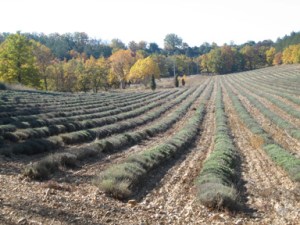
On another day we traveled through the beautiful countryside on winding roads, climbing in elevation and finally came to a Religious House with lavender fields surrounding it. Tucked away in the Alpes de Haute Provence region, discreetly out of sight, three sisters of the Soeurs Coopératrices Maison St Joseph live in an old farmhouse. They are known for cultivating lavandan, a prized type of lavender only grown at this particular altitude, producing the highest medicinal quality essential oil, in the old way, mostly by hand and not technology. Sister Marie Michelle, who greeted us, had a similar glow about her as the one Matthieu had, but many, many more years.

Sister Marie Michelle

Sister Marie Michelle

She showed us their fields and, even though it was late in the season, we could smell lavender faintly in the air. She talked about how they carefully harvested and let the blossoms lay in the sun a certain amount of time so that the oils they made would be at the best strength for all the ways they could be used. She bemoaned the fact that other lavender farmers used machinery that cut the stalks in such a way as to lessen the quality and then didn’t allow them to “strengthen” in the sun after harvest as needed. It was all done quickly, cut and dried—so to speak. And she was quite clear that what sold as lavender essential oils in the world market was lavandin, having much lesser properties, and not lavandan. I was curious how three elderly sisters managed all the fields and harvest until she told us that people from the local community helped. When the sisters are gone, will this art become lost?

Lavender farm photo.

Lavender farm at
Soeurs Coopératrices Maison St Joseph.

Creek Chincultik

Creek Chincultik
©2010 Carla Woody
First oil painting after a 12-year hiatus.

Honoring the Process

I’m going to come full circle and talk a little about painting. I’m an artist, using mostly oils as my medium. During my lifetime, I periodically took a hiatus from that art form for various reasons. The last rationale was because I moved cross country and no longer had a studio—or so I told myself. I took up black and white photography for several years, but found it not as tactilely satisfying. For a long time, my friend and spiritual mentor Don Américo Yábar had been urging me to paint again and said it would be quite different than what I’d done before. I thought he meant that my subject matter and style would be esoteric based on my experiences in the last number of years. In the fall of 2009, after a 12-year pause, I began to paint again. It just seemed right somehow, without Don Américo ever mentioning it at all when I had been in Peru that summer. And I discovered what he may have meant—however else my canvases may eventually develop. When I was much younger I painted fast and furious, always with a goal in mind, turning out a completed work typically in somewhere between 4-8 hours. Now I’m painting on the same canvas for weeks, sometimes longer. Quite content in the process, I’m allowing the colors to emerge and what expression is more deeply inside me. Perhaps I’m becoming like the older vine Matthieu talked about. Not quite the elder and I’m not yet holding it all inside. Too much to discover still!

But I think what I’ve learned over the years, that is coming out in my painting, and what was echoed through the people we engaged with in Provence, is this. There’s great value to immersion in the integrity of a process. Then the quality of the outcome is naturally delivered. I’ve been taught patience for things to come to fruition. Some things need to happen for others to evolve. When you know this at a visceral level, it brings that joie de vivre written so plainly on the faces of those who live through that understanding like Sister Marie Michelle and Matthieu. It also takes faith—and sometimes more than a little stamina.

*******************

*Édouard Manet turned the French art world upside down with his controversial painting Le Déjeuner sur l’herbe. Pablo Picasso later did his own versions of Luncheon on the Grass.

View information about our October 2013 “La Source de Provence” program here. Limited to 7 travelers.

Categories: Creativity Strategies, Spiritual Evolution, Spiritual Travel, Visual Arts | Tags: , , , , | 2 Comments

February 27 Lifepath Dialogues Gathering: The Spiritual Meaning of Lineage

Lifepath Dialogue Gathering

Exploring the many threads that weave together an expressive, celebrated life.

MARK YOUR CALENDAR AND JOIN US FOR DIALOGUE THAT MATTERS

You are invited! Please pass to friends and family.

FEBRUARY 27, 6:30-8 PM

FREE Monthly Gathering on Fourth Wednesdays

Creekside Center, 337 N. Rush Street, Prescott, Arizona

February’s topic:

“The Spiritual Meaning of Lineage”

Based on the post: “Lineage: Calling on the Ancestors
By CARLA WOODY
Author of Calling Our Spirits Home and Standing Stark
Founder, Kenosis and Kenosis Spirit Keepers

SPECIAL FEBRUARY GUEST:

TERRI HANAUER-BRAHM

Terri Hanauer-Brahm wondered why her father refused to discuss his past and why her relatives were the same way. She uncovered a family secret that sent her on an odyssey of discovery. Out of her quest came a book: “The Hanauer Family: Before, During and After the Holocaust.” She will share with us what this journey has meant to her.

Email: info@kenosis.net or call 928.778.1058

Categories: Healing, Healthy Living, Maya, Personal Growth, Spiritual Evolution, Travel Experiences | Tags: , , , , , , , | Leave a comment

What 12-21-12 Meant to Me by Lori Clarke, Guest Blogger

Note from Carla Woody: Lori Clarke is a Canadian who traveled with us on the Winter Solstice 2012 program. She has generously offered impressions of her travels and a day she’d been anticipating for many years.

***

The anticipated climax of my trip was to be the day of the end of the Mayan calendar, December 21, 2012.  I have been following this day since my mid 20’s, copying the date into each new years calendar.   In my 20’s, the date seemed a life time away but now in my mid 50’s, the date is actually here… right now…

I decided several years ago that when this date arrived, I didn’t want to be home.  I wanted to be able to say where I was on that date, when whatever happened…or didn’t happen…on the Winter Solstice of 2012.  The end of the Mayan calendar and by some peoples’ interpretation, an accurate prediction of ‘the end of the world.’

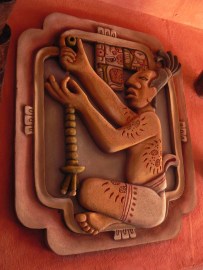
Maya Relief

Maya Relief
©2012 Lori Clarke

I left Canada on Dec 8. Our ambitious itinerary kept us busy traveling and participating in healing and fire ceremonies, dinners with traditional families, textile and art gallery tours with our guides, visiting churches, museums and sacred sites.  Meeting our guides, hearing their stories and feeling their passion was inspiring, lifting.  It is very encouraging to learn that there is quite a collective movement cultivating the Mayan culture–the archaeological and historical richness, and striving to find the balance between maintaining tradition and economic growth in an increasingly modern world.  Pride in their ancestral lineage, increased understanding between the many language dialects and unity are essential components for their future.  The Maya were not defeated but very much alive.  Coming together.

Our group of 12 arrive in Palenque on Dec 19.  We spent the day touring the ruins and hear about Maya cosmology.  Upon returning to our lodging after a long, hot and humid day, I laid down before having dinner.  I increasingly didn‘t feel well and ended up vomiting.  After all these years of anticipating this date, how could I be sick and miss Dec 21, 2012.  I didn’t eat dinner that night.    Then, as night fell upon us, it began to rain.  We have not seen any rain on our trip and now, on the eve of Dec 21, it is not only raining but we are having a torrential downpour.   I began to worry if we were even going to the site in the morning if this rain continues.

Temple of the Foliated Cross

Scene from the Temple of the Sun toward the Temple of the Foliated Cross.
©2012 Lori Clarke.

To my astonishment, I woke up in the morning feeling fine.  It was a one-time appellation, no diarrhea, no headache.  Very strange.  But it does continue to rain.  We gather, eat breakfast and catch a cab to the Palenque ruins.    Along the road we pass a large group of walkers.  Maybe a 100 people, all soaking wet, singing and dancing on their way to the site.  Mostly young people, long hair, oddly dressed and obviously free-spirited.  At the gate, we are the first people in line and wait to get our tickets.  While we are waiting, we notice that the rain has stopped.  How timely.  The large group of walkers then arrive and fill up the entrance area.  Moments later, our group was allowed in 15 minutes before the park was officially open.  We quickly walk to the selected area and climb the steps up to the temple (The Temple of the Sun).  To our amazement, we have the place to ourselves, only one security person and us.  The rain has stopped but the grounds are wet and slippery making the climb rather tricky.   We look out over the jungle canopy and observe the low level of clouds, hanging heavy and providing a misty, mysterious mood to the morning.   We had a beautiful period alone on top of the temple looking down at the altar and up over the treetops.  It was a sacred moment.  The rain began again and groups of people started to arrive on site.  How truly special it was to experience this quiet and private time alone in the heart of Palenque.  No distractions from completely being present and absorbing all of its splendour.

However breathtaking this moment was in space and time, it wasn’t what we were expecting.  It had been our plan to see the sun rise above the jungle canopy at 8:36am.  The anticipation of being there to see the first peak of the rising sun on Dec 21, 2012 was exhilarating.  As much as it was disappointing that it didn‘t happen that way, it had to be realized that, unseen to us, the sun certainly did rise that morning.  A very powerful acknowledgement.

It continued to pour.  We all were varying degrees of wet and a little annoyed with all this rain.  But then I had another realization.  Water is life.  The rain is cleansing and water inspires growth, like the planted seed.

My eyes were then attracted to the altar in the centre of this area.  It was great to see it this morning without people sitting on or hanging around it, as was the case yesterday.  The altar is stone in the shape of a cross.  The centre of the cross is also marked, marked with another raised stone.  To me, this represents the heart.  From the heart, energy flows out in all four directions.  Each direction having it’s own strength and character.  Standing at the top, I could see it clearly.

I decided to go down to the altar and stopped for a moment at each of the four directions.  I then noticed that the rain falling on the temple steps was pooling and then cascaded over and down the stairs creating the flow of a waterfall.  I had glad I decided to wear my sandals this morning so I didn’t have to worry about my shoes getting wet.  I chose to be childlike and walked through the puddles.  I intentionally walked up the steps of the highest temple, following the cascading waterfall.  I imagined, feeling like a spawning salmon climbing upwards against the flow.   Reaching the top, I noticed my heavy breath.  After a few moments, I made my decent following the same path down.

As I left this area, and walked between the two sets of major ruins, I felt a strong wind.  As I learned in Peru, I stopped, opened my arms and greeted the energy.  I stood still for a moment breathing in the breath.

Dec 21, 2012  is the beginning of a new era.  What was profound to me on this date is what I already know to be true.  Believe in the unseen.   I saw very clearly, that when we are aligned with a higher power, and are connected at the heart, we will be nurtured and guided so our energy will flow outward in love and be of service to the universe.   Through our own free will, each one of us as individuals will live our life and learn the lessons through our authentic souls.

©2012 Lori Clarke. All rights reserved. Reprinted with permission.

Rain at Palenque

Rain cascading over the steps leading to the ball court,
Dec. 21, 2012.
©2012 Carla Woody.

Categories: cultural interests, Healing, Indigenous Wisdom, Maya, Spiritual Evolution, Spiritual Travel | Tags: , , , , | 1 Comment

Lineage: Calling on the Ancestors

January 2012

The nondescript address promised little from the street. I opened the old wooden door to slip through the walled entryway and found otherwise. Carol Karasik and I had arranged with the group to meet at Laughlin House, one of the oldest houses in San Cristóbal de Las Casas, then owned by anthropologist Robert Laughlin and his wife Mimi. Carol had been staying at the venerable hacienda—and, with all its rustic charm and lush garden, it seemed the perfect place for our evening gathering.

Dusk was coming quickly. I wandered through the narrow, uneven paths admiring the beauty of the garden, down to the small greenhouse at the far end. As I passed by the main house I noticed a woman kneeling in the grass separating the dwelling from the garden. She was carefully digging a shallow circle, exposing the dirt, already preparing the space. Copal smoke rose from the pedestal burner.

Floridalma (Flori) Pérez González, a traditional  Ajq’ij, a Maya Daykeeper from a Mam village in the mountains of northern Guatemala, was there to offer us a fire ceremony, so sacred to her people. As the rest of the group drifted in, she invited us to join her and sit in circle. We watched in silence as the altar grew on the bare dirt: sugar drawn in a symbol reflecting the day in the Maya calendar, fist-sized balls of resin mixed with shredded wood, candles laid in a circle as offerings to the Nawals, Day-Spirits of the calendar, and Four Directions, sticks of pine pitch, rose petals around the perimeter.

Fire Ceremony Altar

Fire Ceremony Altar

By this time it was dark, just the glow from the incense burner reflecting on our faces; we were cocooned, a timeless place separate from the everyday world. Flori spoke softly and asked me to express the collective intent of the group, then invited each one in the circle to offer their individual words. She lit the fire and invoked the presence of the spirits, praying intermittently in her Maya dialect and Spanish.

Floridalma Pérez González

Floridalma Pérez González

The fire’s flame rose. She called on the Nawals and Ancestors, Grandmothers-Grandfathers, inviting them to accept our petitions and blessings through the smoke. Every now and then she reached her hand into a bag and threw herbs upon the flames. The fire changed shape, moving against the light breeze, not with it. Flori told us the meaning and said it was a good sign. We were drawn into her soft prayers, the flames and, otherwise, the stillness.

After a time, she passed thin, white tallow candles asking us each to take eight, then instructing us to separately approach the fire and, as we settled the candles one by one into the fire, call out the names of those who have gone ahead of us, our Ancestors, to welcome them to our circle, to bless them, as they who are part of who we are, to hear our prayers.

I started. In that moment, I realized that I knew so little about my own family line—but a few names, not nearly enough for the candles I held in my hand. I attempted to sweep the corners of memory to see if anything arose. It didn’t. And when it came my turn to kneel at the fire, beyond three names I could name no more. I placed the remaining tapers, intending they would find their match.

But sadness arose; a hole was uncovered. I didn’t know My People.

I recognized then one of the reasons I’m so drawn to Indigenous traditions. Upon introduction, a number of Wisdom Keepers I’d met would identify their villages and clans going back a few generations. I’d been told that the purpose was to offer any mutual connections. But it’s also a clear statement of identity, place in the world. Those who maintain their traditions are grounded through lineage, lending spiritual strength. Hearing these pronouncements always stirred something poignant in me, as though I was attempting to reach out, to find my own conscious grounding. But I had none in that way, not of the blood that ran in my veins, the places My People had walked, or what aspects of them resonated through time to find residence within me—beyond my own mother and father. I discovered I wasn’t alone. Several of the members of the group struggled in their own way. It was a powerful ceremony.

Fire Photo

It is said that the fire works on you over time.

Its work with me began immediately. I emailed my folks the next morning mentioning the intent of the fire ceremony and my sadness for lack of knowledge of the family line. My mother wrote back saying, “It’s strange you should mention this because yesterday we started cleaning out old boxes…and found papers tracing your father’s family tree!” One of his distant cousin’s had undertaken the search years ago. The papers had been forgotten. We were both astounded at the timing of their urge to clean. I asked my mom if she’d begin looking into her line; she had little knowledge either. She promised she would.

Tracking genealogy is something of an art, sometimes an endless maze with dead-ends, particularly if you have little information at the outset, or experience. My mother got discouraged, having come up with few leads, after much time spent. The project stalled.

December 2012-January 2013

When I visited my folks over Thanksgiving, we talked of family line again. Don Boyd is an old family friend who has become something of an expert in tracing genealogy. I contacted him to see if he would be willing to give my mom some pointers. I then left for my Maya spiritual travel programs over the next two months.

Immediately, there was a flurry of emails between my mom and Don, with copies to me in Mexico and Guatemala. In no time flat, Don was able to produce information that led to a fairly extensive maternal family tree. Although some of the data petered out, thanks to Don and my dad’s distant cousin, I now know most of my lineage.

We still don’t know anything about my dad’s maternal line. But, for the rest, My People were all from the South. My paternal grandfather’s line traces back to 1724 England—and, a curious aside, includes Arthur Woody, the “legendary barefoot forest ranger” one of the first pioneering forest stewards in the US. My maternal grandfather’s people go back to 1766 Ireland. Cherokee lineage exists on both my maternal grandparents’ sides, for sure one documented to 1867 North Carolina. There’s a possible trace of another Cherokee ancestor as far back as 1797 Tennessee, but that one is difficult to prove.

Sunset over San Cristóbal de Las Casas.

Sunset over San Cristóbal de Las Casas.

Less than a week ago we met Flori at dusk. The fiery sunset announced the fire that would be lit in ceremony on the ground, perhaps already mirroring back to us our prayers that would rise. And when it came my time to approach the fire and lay the tapers, I called on my Ancestors, My People, clearly by name. I’ll never know all their stories but I can now intuit their lives—and feel their influence on me, rising up through time, running in my blood, to my place in the world.

I am grateful to the fire.

Fire Ceremony Photo

Categories: cultural interests, Healing, Indigenous Wisdom, Maya, Spiritual Evolution, Spiritual Travel | Tags: , , , , , | 3 Comments

Voice and Expression

Co-authored by Yaqin Lance Sandleben and Carla Woody

Carla speaking here: When I was a young girl I had a vivid inner world but reticent to share it with others, being painfully shy. Strangely, one thing I wasn’t shy about was my singing voice. I sang all the time. The summer I turned fourteen my family moved to a different state, the latest in several moves during childhood. A neighborhood girl and I spent hours recording ourselves singing Mamas and Papas songs just for fun, when we weren’t getting in trouble for one thing or another. That was the late Sixties…and you were expected to push the edges.

But something happened in September. My newfound friend and ally went to a different school. What bit of security and grounding I felt in the new environment was no longer present. Over the next months I made my way tentatively, finally settling in with a handful of girls, cliches being a matter of survival in junior high and high school beyond. But when I’d join in with songs on the radio…or hum under my breath you’d have thought I’d grown two heads, the responses I received from my friends.

Everyone feels out of place and wants to fit in during teenaged years…and at the same time want to be different. A terrible conflict. So, most of us shut down aspects of ourselves. In my case, it was my public voice. My singing voice was silent for decades and so was my ability to express in the most basic ways outside my family.

It was only years later that outer expression began to come again, part of an evolutionary process. By that time though, being so unused, my throat would hurt and my voice was so weak, it refused to emerge fully when I’d attempt it. I even went to India for a short time to study raga, Indian classical vocal music, with Sufi leader Shabda Kahn, in hopes of overcoming the block. I succinctly remember the day in practice when Shabda looked at me in what could only be described as loving irritation and bellowed, “Get your voice out!” Yet, still, I physically couldn’t.

***

Yaqin speaking here: In the path of development, of spiritual and material development, one of our most important tools is the human voice. One can easily see this in how the voice of another affects one. Likewise, as the Sufi Inayat Khan said, the voice is the expression of a person’s spirit. Knowing this one may direct attention and practice towards developing and opening the voice. Further, there is an ancient and sacred teaching on the mysticism of sound, and how it how it can be used. As the Sufis say, through recitation and concentration: “…travelers on the spiritual path can overcome narcissism, resolve their issues of separation from God and from humanity, and awaken to God’s presence…”

***

Carla again: In 1998 I moved to Prescott, Arizona. Strangely enough, I found a small Sufi community there. I’ve always been drawn to the Sufis for their inclusiveness. Yaqin Lance Sandleben held monthly zikr, a Sufi chanting devotional practice. I attended religiously for years until travel and my own work made it difficult to be there. I am indebted to Yaqin for the space he continued to hold those years. My voice had varied little…until one night. We were well into our zikr when suddenly a voice burst forth with a sweetness and power I hadn’t heard before. Surely, it had come from someone else. But I had to acknowledge it as my own…and acknowledge it still.

Giving voice comes in many forms. It’s our birthright to express and sometimes a journey to come back to the place where we began, without fear, to offer to ourselves and the world our own special expression.

Categories: Creativity Strategies, Healing, Healthy Living, Personal Growth, Sacred Reciprocity, Spiritual Evolution | Tags: , , , , | 4 Comments

A Tribute to Ted Andrews

Lakota and Ted  photo

Photo credit: Dragonhawk Publishing

Probably all of us can point to some people who have passed through our lives and made a difference somehow, even if they themselves never knew it. A stray word may have been said. A direction offered. And through that interaction, we took a step; or were alerted to something otherwise unknown.

Ted Andrews served as one of those people for me. It was 1987 and I had just returned to Dayton, Ohio after living in Germany for several years. While there I had been introduced to metaphysics, my appetite whetted. But the opportunities to learn more, to participate in some circle in Dayton, were almost non-existent, or at least quite hidden. Through some diligence I found the Mountaintop Bookstore, a small enclave not too far from my home. And there I stumbled upon Ted Andrews, spiritual teacher, metaphysical author and kindly, gentle man. Back then, he offered classes in a small room of the bookstore. I took all of them and experienced something awakening beyond mere intellectual curiosity.

And I discovered that he still gave readings. When I went to his modest home it turned out that he lived only a few blocks away from me. He brought me into the front room and we sat across a small table from each other.

Intuitives often use accoutrements such as Tarot or other types of cards, palm reading, any number of things depending on culture. But for true intuitives these things are really extraneous because they themselves are the channel. Ted Andrews was one of the true ones. That day he did use an intermediary—the Tarot. But finally he looked earnestly into my eyes and took my hands into his.

“Are you a healer?” he said.

“No!” I was bewildered by the question and wasn’t even sure what he meant. With what little I did understand about that realm at the time, even the idea of his inquiry seemed preposterous—and downright scary. After all, the flavor of my life back then far from supported such an activity.

“Well, you have fire around your hands.”

“Oh, okay. I understand that. I’m an artist and I work with my hands. I paint.” I was relieved.

“No, this is something else. You also have fire energy very much attempting to enter your crown chakra. Allow it.” He said gently and then nothing more, knowing that any more at that time would have been too much.

Through 1988, a short year, long before I met Don Américo Yábar in 1994, Ted Andrew was my first spiritual teacher, someone who opened a doorway. Recently I was telling a friend the story I have recounted here and we became curious about what he is doing now. Doing a search brought me the very sad news that he passed in October 2009, still a young man.

Ted gave much to the world as a teacher, animal advocate, writer, a compassionate soul and clairvoyant. A great intellect who was able to translate complex metaphysical philosophies into everyday language. Many of you probably know his books, especially Animal Speak and Simplified Qabala Magic.

For me, he pointed the way, to something inherent but unacknowledged, a choice point awaiting. I vividly remember the moment he did it that day in his small front room. I have been able to draw on his soft encouragement over the years—and it’s given me courage. I only regret that I didn’t return soon enough to tell him so.

Categories: Healing, Personal Growth, Spiritual Evolution | Tags: , , , | 4 Comments

Book Review: Acedia and Me – A Marriage, Monks, and A Writer’s Life

acedia

If you are one of those people who is unrelentingly committed to a path, particularly one that the world may little understand, and yet you have periodically fallen into doubt, there is actually a name for this affliction – much to my relief. Doubt is not really a good word for a state that can reach a level of deep despair and sense of futility. And yet it’s not depression in the clinical sense.

Acedia was included in the “eight bad thoughts” of the desert monks but was later inexplicably dropped when translated into the Catholic Church’s “seven deadly sins.” If only over the years I would have had a word for it, not as a sin but as a thought that can assail a person who has monkish tendencies or artists, advocates and others who probe the edges of convention. Then there could have been a level of comfort and normalcy in the experiences. But instead, the term and understanding of it was dropped into time, to be hidden in little known annals or diaries of people who had the courage to express it.

Kathleen Norris has done many of us a favor by writing a book about acedia, giving many personal examples and historical references. Taken from the book, “… the monk struggling with acedia is dealing with more than bad moods, psychic fluctuations, or moral defeats. It is a question of resolve that arises in the wake of a decisive choice for which the monk has risked his life’a danger to anyone whose work requires great concentration and discipline yet is considered by many to be of little practical value…”

Along with the author’s own writings, a real plus is in the last chapter, a collection forty-odd pages long of quotes, personal experiences from such luminaries as John of the Cross, Emily Dickinson, Petrarch, Dante, Evelyn Waugh and many others. Sometimes it helps to name something and I can sense a future essay of my own percolating. Read a Q&A with the author, plus an excerpt.

You may recognize the author’s name from her other books such as The Cloister Walk and Dakota: A Spiritual Geography. Read this latest book if your path has ever taken you into an unnamed state that may be acedia—or if you anticipate it could.

Available on Amazon and elsewhere.

Categories: Book Review, Personal Growth, Spiritual Evolution | Tags: , , , , , | Leave a comment

Blog at WordPress.com.